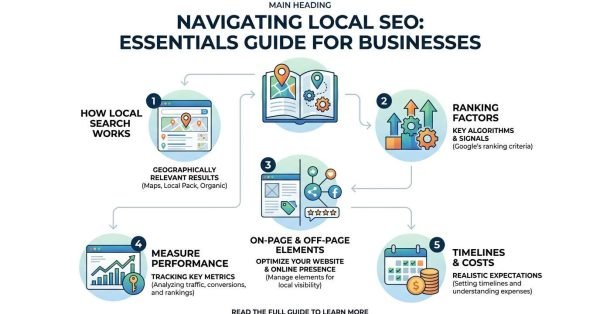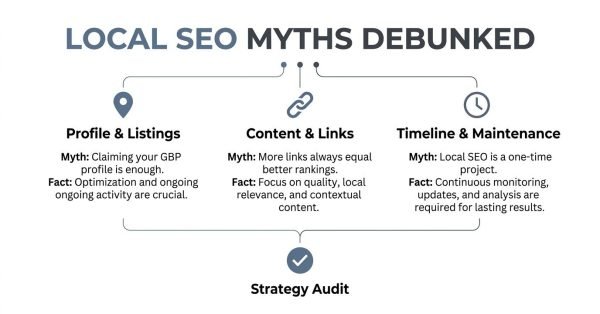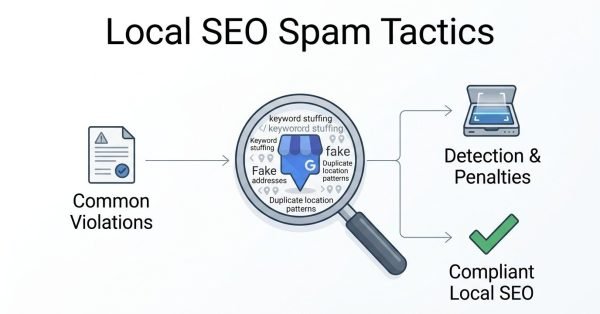
Local SEO is the practice of optimizing a business’s online presence to attract more customers from relevant local searches, and it relies on a specific vocabulary that trips up even experienced marketers. I built this glossary because I kept fielding the same confused questions from clients about what terms like “citation” or “proximity signal” actually mean in practice.
Getting this vocabulary wrong costs real money and real rankings. Misunderstanding NAP consistency alone can quietly tank an otherwise solid local strategy.
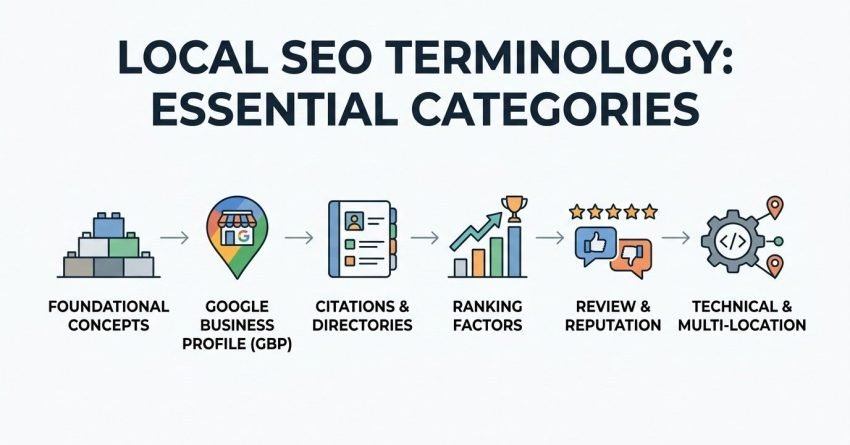
This guide groups more than 120 terms into clear categories: the foundational concepts everyone needs first, Google Business Profile terminology, citations and directory language, ranking factor vocabulary, review and reputation terms, and the more technical structured data and multi-location language used by larger operations.
Foundational Local SEO Terms Every Business Owner Should Know
Local SEO is the process of improving a business’s visibility in location-based search results, including Google’s Local Pack, local organic listings, and map-based search queries. I treat this as the umbrella term that every other definition in this guide sits underneath.
Google Business Profile is the free listing Google provides to businesses so they can control how they appear in local search and Maps results. I still hear people call it “Google My Business,” which was the old name before Google rebranded it in 2021.
NAP stands for Name, Address, and Phone Number, and it refers to the exact business identity details that must match across every platform where the business appears online. NAP consistency describes how closely those details align across directories, citations, and the website itself, and inconsistent NAP data is one of the more common reasons a business plateaus in local rankings.
The Local Pack, sometimes called the Map Pack or 3-Pack, is the block of three business listings Google displays with a map above the organic results for location-based queries. This differs from standard organic search results, which are the traditional blue-link listings ranked by relevance and authority rather than physical proximity.
Geo-targeting refers to tailoring content, ads, or search visibility toward users in a specific geographic area. I use this term constantly when discussing location page strategy with multi-location clients.
Google Business Profile & Local Listing Terms
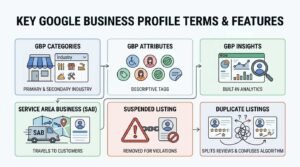
Google Business Profile terminology covers the specific features and settings inside the platform that directly influence how a listing performs in local search. GBP categories are the primary and secondary classifications a business selects to tell Google what industry it operates in, and choosing the wrong primary category is a mistake I see constantly.
GBP attributes are the specific descriptive tags a business can enable on its profile, such as “wheelchair accessible” or “women-led,” that help match the listing to filtered searches. GBP Insights is the built-in analytics dashboard showing how customers find and interact with a profile, including search queries and call tracking data.
The business description is the short summary field on a Google Business Profile where an owner explains what the business does, and Google restricts this to 750 characters. A service area business, often abbreviated SAB, is a business that travels to customers rather than serving them at a fixed storefront address, and it hides its physical address on the public profile.
A suspended listing is a Google Business Profile that has been temporarily or permanently removed from search results for violating Google’s guidelines. Duplicate listings occur when a single business ends up with more than one profile for the same location, which splits reviews and confuses the algorithm about which listing to rank.
Google Posts are short, timely updates a business can publish directly to its profile, similar in format to a social media post, and they appear in the knowledge panel for a limited window before expiring.
Local Citations & Directory Terms
A citation is any online mention of a business’s name, address, and phone number, whether or not it includes a link back to the business’s website. Citations come in two forms: structured citations, which appear in a standardized format on business directories like Yelp or Yellow Pages, and unstructured citations, which are informal mentions found in blog posts, news articles, or social media.
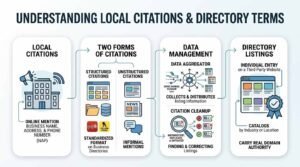
A data aggregator is a company that collects and distributes business listing information to multiple directories and platforms at once, and getting the data right at the aggregator level saves a lot of manual cleanup later. Citation cleanup is the process of finding and correcting inconsistent, duplicate, or outdated business listings across the web.
A directory listing is a business’s individual entry on a third-party website that catalogs companies by industry or location, and the strongest ones carry real domain authority in their niche.
Local Ranking Factors & Algorithm Terms
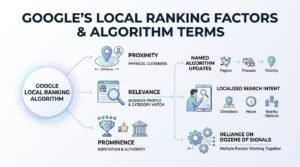
Google’s local ranking algorithm weighs three primary signal categories: proximity, relevance, and prominence. Proximity measures how physically close a searcher or their specified location is to a business, and it carries more weight in local rankings than in standard organic search.
Relevance describes how well a business profile matches what a searcher is looking for, based on category selection, business description, and on-page content. Prominence reflects how well-known and reputable a business is, drawing on factors like review volume, citation count, and overall web authority.
Google has released several named local algorithm updates over the years, including Pigeon, Possum, and Vicinity, each of which reshaped how proximity and business categorization affect rankings. Localized search intent refers to a searcher’s underlying goal when their query includes or implies a location, such as wanting directions, hours, or nearby options rather than general information.
A ranking signal is any measurable factor a search engine uses to determine where a page or listing appears in results, and local SEO relies on dozens of these signals working together rather than any single one.
Reviews & Reputation Management Terms
Review velocity refers to the rate at which a business accumulates new reviews over time, and Google treats a steady, ongoing pace as a stronger signal than a single burst of reviews followed by silence. Review gating is the prohibited practice of filtering customers based on their likely rating before directing only happy customers to leave a public review.
A review response is a business’s public reply to a customer review, and responding to both positive and negative reviews signals active management to both customers and the algorithm. Star rating is the average numerical score, typically out of five, that aggregates all of a business’s customer reviews into a single visible figure.
Sentiment analysis is the process of evaluating the tone and emotional content of review text to determine whether feedback is generally positive, negative, or neutral. Reputation management is the broader practice of monitoring, responding to, and improving how a business is perceived across reviews and public online mentions.
On-Page Local SEO Terms
![Infographic titled ON-PAGE LOCAL SEO TERMS illustrating how Local Keywords & Geo-Modifiers (SERVICE TERM + [CITY NAME]) branch into three core on-page elements: Optimized Title Tags (PRIMARY KEYWORD | [GEOGRAPHIC AREA]), Dedicated Location Pages targeting a specific area map, and Local Landing Pages featuring conversion funnels.](https://whitelabelseoservice.com/wp-content/uploads/2026/09/On-Page-Local-SEO-Terms-300x167.jpg)
A location page is a dedicated page on a business’s website built around a specific geographic area it serves, distinct from the homepage or general service pages. Local keywords are search terms that include or imply a geographic modifier, such as a city, neighborhood, or “near me” phrasing.
A geo-modifier is the specific location-based word or phrase added to a keyword to target searchers in that area, like adding a city name to a service term. Title tags written with local context include the target geographic area alongside the primary keyword to reinforce relevance for that market.
A local landing page is a page designed specifically to convert visitors from a particular geographic market, often built around a single city or service area combination.
Local Link Building & Off-Page Terms
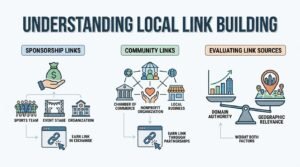
Local link building is the process of earning backlinks from websites relevant to a business’s specific geographic market or industry niche. A local backlink is a link from a website based in or closely tied to the same city, region, or community as the business it points to.
A sponsorship link is a backlink earned by financially supporting a local event, team, or organization in exchange for a link on their website. A community link comes from local organizations, chambers of commerce, or nonprofit partnerships rather than paid placements.
Domain authority, in a local context, still measures overall site strength on a logarithmic scale, but local link builders weight geographic relevance alongside raw authority scores when evaluating a prospective link source.
Structured Data & Technical Local SEO Terms
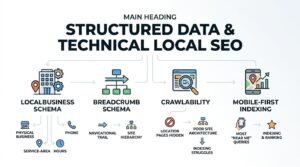
Schema markup is a standardized code vocabulary added to a website’s HTML that helps search engines understand the content and context of a page. LocalBusiness schema is a specific schema type that tells search engines a website represents a physical or service-area business, including structured fields for address, hours, and phone number.
Breadcrumb schema marks up the navigational trail shown near a page title, helping search engines understand a site’s hierarchy and often displaying that trail directly in search results. Crawlability refers to how easily search engine bots can access and navigate a website’s pages, and location pages hidden behind poor site architecture often struggle to get indexed at all.
Mobile-first indexing is Google’s practice of primarily using the mobile version of a website’s content for indexing and ranking, which matters heavily for local search since most “near me” queries happen on phones.
Multi-Location & Enterprise Local SEO Terms
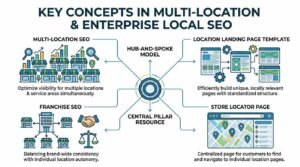
Multi-location SEO is the practice of optimizing search visibility for a business operating in more than one physical location or service area simultaneously. A location landing page template is a standardized page structure used to efficiently build unique, locally relevant pages across dozens or hundreds of markets.
Franchise SEO addresses the specific challenge of balancing brand-wide consistency with individual location autonomy across a franchised business network. A store locator page is a centralized page that helps customers find and navigate to a business’s individual location pages, typically through a searchable map or list interface.
The hub-and-spoke model, applied to local SEO, organizes a central pillar resource that links out to individual location or service pages that go deeper into location-specific detail.
Local SEO Metrics & Tracking Terms
Local Pack ranking measures a business’s specific position within the three-listing Local Pack for a given search query and location. Share of Local Voice, often abbreviated SoLV, is a metric that tracks how often a business appears in local search results compared to its direct competitors across a defined set of target keywords.
Impressions, within GBP Insights, count how many times a business profile appeared in search or Maps results, regardless of whether a user clicked through. Click-through rate, in a local context, measures the percentage of people who viewed a listing and then clicked to visit the website, call, or request directions.
Conversion tracking, applied to local search, measures specific actions like phone calls, direction requests, or form submissions that result directly from a local search interaction.
Voice Search & Emerging Local SEO Terms
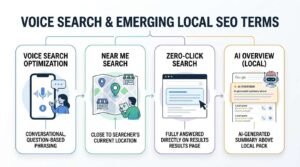
Voice search optimization is the practice of structuring content to match the conversational, question-based phrasing people use with voice assistants like Siri or Google Assistant. Near me search refers to queries that explicitly or implicitly ask for businesses close to the searcher’s current location, and this query type has grown enormously since smartphone adoption became universal.
A zero-click search is a search query that gets fully answered directly on the results page, without the user ever clicking through to a website. AI Overview, in a local context, is Google’s AI-generated summary that can now surface directly above local pack results for certain informational local queries.
Common Local SEO Penalties & Compliance Terms
Keyword stuffing, within a GBP context, refers to the prohibited practice of cramming extra keywords into a business name field to manipulate rankings. A guideline violation is any action that breaks Google’s published rules for Business Profile listings, reviews, or content.
A manual action is a penalty applied directly by a Google reviewer after identifying a guideline violation, as opposed to an automatic algorithmic filter. A spam listing is a fake, duplicate, or intentionally misleading Google Business Profile created to manipulate local search results.
Conclusion
This glossary connects the vocabulary behind Google Business Profile management, citation building, ranking signals, and reputation into one coherent picture. Local SEO keeps evolving, and new terms will keep emerging as Google’s algorithms and AI-driven features change.
We built White Label SEO Service to translate this vocabulary into results, and we’re ready to help you put these concepts to work.
Frequently Asked Questions
What is the difference between local SEO and organic SEO?
Local SEO targets location-based search results like the Local Pack and Maps, while organic SEO focuses on general, non-geographic search rankings. Local SEO weighs proximity and GBP signals more heavily than traditional organic ranking factors.
How many citations does a business need for local SEO?
There’s no fixed number, but consistency matters more than volume across the citations a business does have. Most healthy profiles maintain accurate listings across 30 to 50 core directories relevant to their industry.
What is NAP consistency and why does it matter?
NAP consistency means a business’s name, address, and phone number match exactly across every online listing and directory. Inconsistent NAP data confuses search engines about which business details are accurate, weakening local ranking signals.
How long does local SEO take to show results?
Most businesses see measurable local ranking improvements within three to six months of consistent optimization work. Competitive markets and poor starting citation profiles can extend that timeline further.
What is the Google Local Pack?
The Local Pack is the three-listing block with a map that Google displays above organic results for location-based search queries. It draws on proximity, relevance, and prominence signals to determine which three businesses appear.
Do online reviews really affect local rankings?
Yes, reviews directly influence prominence, one of the three core local ranking factors Google uses. Review volume, star rating, recency, and response activity all contribute to that prominence signal.
What is a service area business in local SEO?
A service area business is a company that travels to customers rather than operating from a public-facing storefront address. These businesses can hide their address on Google Business Profile while still appearing in relevant local searches.