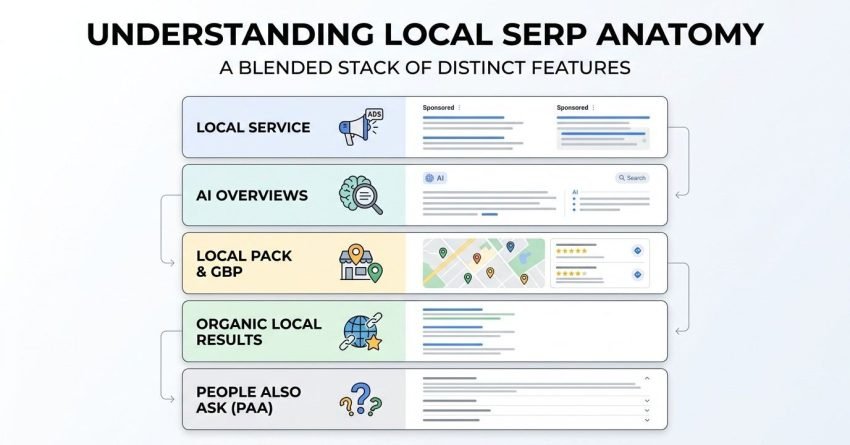
I’ve spent years staring at local search results, and I still see business owners confuse a screenshot of Google with a single “ranking.” A local SERP is actually a stack of distinct features, each with its own data source, ranking logic, and click behavior. Understanding that stack is the difference between guessing at SEO and directing it.
Local search results now blend Map Pack listings, AI-generated summaries, review snippets, and paid ads into one crowded page. Missing even one feature means missing a meaningful share of visibility, clicks, and calls.
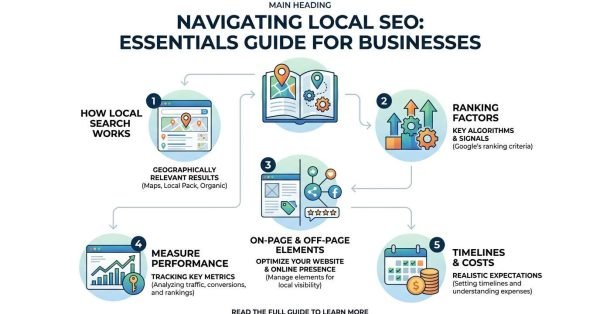
I’m going to walk through every feature that can appear on a local SERP. This guide covers the Local Pack, Google Business Profile elements, organic local results, AI Overviews, PAA boxes, Local Service Ads, review signals, and knowledge panels.
What Makes a SERP “Local” in 2026
Google decides a query is “local” the moment it detects proximity intent, and that decision reshapes the entire results page. A search for “plumber” behaves nothing like a search for “plumbing pipe materials,” even though both mention plumbing.
Local Intent Signals Google Detects
Google reads signals like the searcher’s device location, the presence of a city or neighborhood name, and query modifiers such as “near me” or “open now.” Google’s own local search documentation confirms that proximity is weighted alongside relevance and prominence for these queries.
How Local SERPs Differ From National SERPs
A national SERP is dominated by organic blue links and possibly a featured snippet. A local SERP replaces much of that space with a Map Pack, business profile data, and location-specific organic results, and that structural shift changes what “ranking well” even means.
The Local Pack (Map Pack) Explained
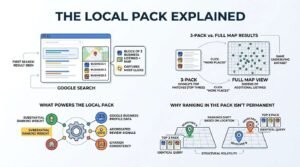
The Local Pack, often called the Map Pack, is the block of three business listings that appears with an embedded map for queries carrying local intent. It’s usually the first thing a searcher sees, and it captures a disproportionate share of clicks.
The 3-Pack vs. Full Map Results
Google shows a condensed 3-pack directly in search results, but clicking “more places” opens a full map view with dozens of additional listings. The 3-pack listings are pulled from the same underlying dataset as the full map, just filtered down to Google’s top three matches for that specific query and location.
What Data Powers the Local Pack
Local Pack rankings draw from Google Business Profile data, aggregated review signals, and citation consistency across the web. Moz’s Local Search Ranking Factors study found that Google Business Profile signals account for a substantial share of local ranking weight, ahead of traditional on-page factors.
Why Ranking in the Pack Isn’t Permanent
Map Pack positions shift based on searcher location, meaning two people in different parts of the same city can see completely different 3-packs for the identical query. That volatility is structural, not a sign that something broke.
Google Business Profile Features Inside the SERP
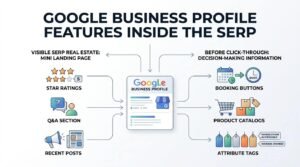
A single Google Business Profile can generate half a dozen visible SERP elements beyond the basic listing, and most business owners only notice a fraction of them.
Reviews, Q&A, and Posts as SERP Real Estate
Star ratings, the Q&A section, and recent Posts all pull directly from the profile and display inside the SERP itself, meaning the profile behaves like a mini landing page. Businesses that keep this data current typically see stronger click-through rates than those with stale profiles, according to BrightLocal’s Local Consumer Review Survey.
Booking Links, Products, and Attributes
Booking buttons, product catalogs, and attribute tags like “wheelchair accessible” or “women-owned” all surface directly inside the profile card, giving searchers decision-making information before they ever click through to a website.
Organic Local Results Below the Pack
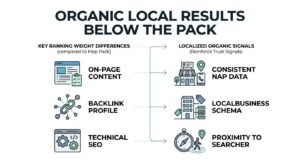
Beneath the Map Pack sits a second, often overlooked layer: organic local results that follow a slightly different ranking logic than the pack above them.
How Organic Local Rankings Differ From the Pack
Organic local rankings weigh on-page content, backlink profile, and technical SEO more heavily than the pack does, even though both are influenced by the same underlying location signals. A business can rank in organic local results without appearing in the Map Pack at all, and the reverse is equally common.
Localized Organic Signals (NAP, Schema, Proximity)
Consistent name-address-phone (NAP) data, structured LocalBusiness schema markup, and proximity to the searcher all feed into this organic layer, reinforcing the same trust signals Google uses for the pack above it.
AI Overviews and Local Search Results
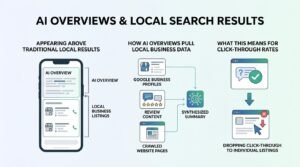
AI Overviews have started appearing above traditional local results for a growing share of queries, summarizing business information before a searcher scrolls any further.
How AI Overviews Pull Local Business Data
These summaries synthesize data from Google Business Profiles, review content, and crawled website pages, then present it as a conversational answer rather than a list of links. Search Engine Land’s coverage of AI Overview behavior notes that local queries are among the categories most frequently triggering this feature.
What This Means for Click-Through Rates
When an AI Overview fully answers a query, click-through to any individual listing tends to drop, since the searcher’s immediate question has already been resolved on the results page itself.
People Also Ask and Local Featured Snippets
PAA boxes and featured snippets appear less consistently on local SERPs than on informational ones, but they still show up for hybrid queries that mix location with a question.
How PAA Boxes Surface Local Business Content
PAA boxes typically pull short, direct answers from pages that explicitly address a specific question, and a business page structured around a clear question-and-answer format has a genuine shot at that placement even without massive domain authority.
Local Service Ads and Paid SERP Features
Local Service Ads sit above both the organic results and the Map Pack for many service-based queries, occupying the most valuable real estate on the entire page.
How LSAs Differ From Standard PPC
LSAs charge per lead rather than per click, and they require Google’s own background-check verification process before a business can even appear. That verification requirement makes LSAs a fundamentally different paid channel than standard search ads.
Review Snippets, Star Ratings, and Reputation Signals
Review data doesn’t stay confined to the Google Business Profile card; it echoes across multiple SERP features simultaneously.
Where Review Data Appears Across the SERP
Star ratings can surface in the Map Pack, in organic results carrying review schema, and inside AI Overview summaries all at once, meaning a single review score influences a business’s appearance in several places on the same page.
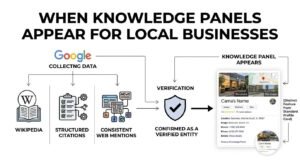
Image Packs, Local Panels, and Knowledge Panels
Larger or more established local businesses sometimes trigger a knowledge panel, a distinct feature from the standard business profile card.
When Knowledge Panels Appear for Local Businesses
Knowledge panels tend to appear once Google has gathered enough corroborating entity data from sources like Wikipedia, structured citations, and consistent web mentions, effectively confirming the business as a verified entity rather than just a listing.
How Local SERP Features Impact Rankings and Revenue
Every feature covered so far competes for the same limited attention span, and that competition directly shapes how much revenue a local SERP presence actually generates.
Zero-Click Behavior and What It Means for Traffic
A growing share of local searches now end without any click at all, resolved entirely by the Map Pack, review snippets, or an AI Overview. SparkToro’s zero-click search research estimates that a majority of searches now end without a subsequent website visit, a trend particularly pronounced in local queries.
Attribution Challenges Across Local SERP Features
Because a single customer might see a business in the Map Pack, read reviews, then call directly from the profile, standard analytics tools struggle to attribute that conversion back to any one SERP feature.
Tracking and Measuring Local SERP Performance
Once a business understands how fragmented the local SERP has become, measuring performance means tracking more than just organic rankings.
Tools for Monitoring Local Visibility
Rank tracking platforms built for local search, Google Search Console, and Google Business Profile’s own insights dashboard together give a fuller picture than any single tool alone. Realistic timelines matter here too, since local visibility gains typically build over months rather than days.
Conclusion
I’ve walked through every major feature stacking up on today’s local SERP, from the Map Pack to AI Overviews. Together, they show how fragmented local visibility has become.
Each feature pulls from different data and rewards different signals. Understanding that structure is what separates strategy from guesswork.
We build local SEO strategies around this exact anatomy. White Label SEO Service helps you show up across every feature that matters.
Frequently Asked Questions
What is a local SERP?
A local SERP is a search results page shaped by proximity intent, blending Map Pack listings, organic results, and AI-generated summaries tied to a specific location.
Why do I see different Map Pack results than my customers?
Google personalizes the Map Pack based on each searcher’s exact location, so two people in the same city often see different top-three businesses.
Does ranking in the Map Pack mean I’ll get more calls?
Not automatically. Zero-click behavior means many searchers get what they need directly from the SERP without ever calling or clicking through.
How is AI Overview different from a featured snippet?
AI Overviews synthesize information from multiple sources into a conversational summary, while featured snippets pull a single passage from one specific page.
Do Local Service Ads replace organic local SEO?
No. LSAs charge per lead and require verification, functioning as a separate paid channel alongside, not instead of, organic visibility.
Why do knowledge panels only appear for some local businesses?
Knowledge panels require enough corroborating entity data across the web, so newer or less-documented businesses typically don’t trigger one yet.
How long does it take to see local SERP visibility improve?
Meaningful gains typically build over several months as review signals, citations, and content accumulate rather than appearing overnight.