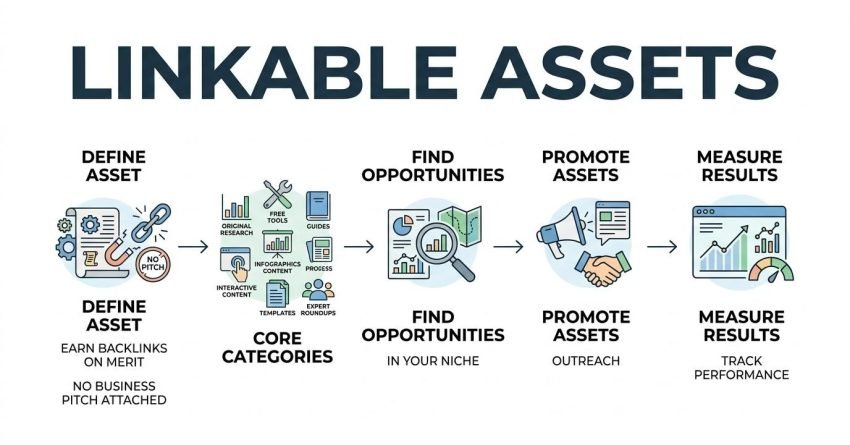
Most link-building campaigns fail not because outreach is weak, but because the content behind the outreach gives nobody a reason to link. A linkable asset is a piece of content or a tool built specifically to earn backlinks on its own merit, without a business pitch attached to it. I’ve watched this distinction separate campaigns that scale from campaigns that stall after month two.
Search engines still treat backlinks as one of the strongest ranking signals available today. Sites without a deliberate asset strategy plateau fast.
This guide covers what makes an asset linkable in the first place, the core categories that consistently earn links original research, free tools, guides, infographics, interactive content, templates, and expert roundups plus how to find opportunities in your niche, promote what you build, and measure whether it’s actually working.
What Are Linkable Assets?
A linkable asset is a piece of content, tool, or resource created specifically because other websites will want to reference or cite it. I think of it as content built backward from the link, not forward from a keyword.
This distinction matters because most blog posts are written to rank; linkable assets are written to be cited. A journalist covering a housing trend doesn’t link to a company’s service page, but they will link to an original data study on median home prices by region.
The best linkable assets share three traits: they contain information not available elsewhere, they solve a specific problem quickly, or they present existing information in a dramatically clearer format. I’ve found that missing even one of these traits usually caps how many links an asset earns.
Linkable Assets vs. Regular Content: What’s the Difference?
Regular content targets a keyword and aims to rank; a linkable asset targets an audience of other publishers and aims to get cited. The difference shows up in who the content is written for.
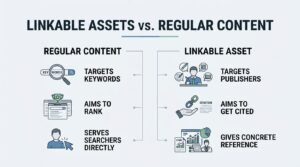
A blog post answering “how long does SEO take” serves searchers directly. A proprietary study on SEO timelines across 500 campaigns serves searchers AND gives journalists, bloggers, and researchers something concrete to reference. That second layer is what separates the two content types.
Why Linkable Assets Matter for SEO and Domain Authority
Linkable assets matter because backlinks remain one of Google’s top three ranking factors, and assets are the most scalable, white-hat way to earn them consistently. I’ve never seen a site build sustainable authority through outreach alone without something worth linking to.
An Ahrefs study of over 1 billion pages found that pages with more referring domains consistently rank higher, and more than 90% of pages analyzed got zero organic traffic largely due to a lack of backlinks. That gap is rarely a content quality problem; it’s an asset problem.
Domain authority compounds when a site consistently produces things worth citing. One strong data study can outperform fifty generic blog posts in total link value, because publishers link to sources, not summaries.
How Backlinks From Linkable Assets Impact Rankings
Backlinks from linkable assets tend to carry more ranking weight than typical guest post or directory links because they’re earned editorially rather than requested. Editorial links signal genuine third-party endorsement, which search engines weigh heavily.
A single link from a high-authority news site referencing an original study can move the needle more than dozens of low-quality directory links combined.
Types of Linkable Assets: An Overview
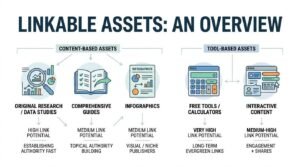
Linkable assets fall into two broad categories: content-based assets like research and guides, and tool-based assets like calculators and generators. The table below breaks down the main types and their typical link performance.
| Asset Type | Link Potential | Typical Effort | Best For |
| Original research/data studies | High | High | Establishing authority fast |
| Free tools/calculators | Very High | High | Long-term, evergreen links |
| Comprehensive guides | Medium | Medium | Topical authority building |
| Infographics | Medium | Low-Medium | Visual/niche publishers |
| Interactive content | Medium-High | Medium | Engagement + shares |
| Templates/checklists | Medium | Low | Niche B2B audiences |
| Expert roundups | Medium | Low-Medium | Fast relationship building |
| Glossaries | Low-Medium | Medium | Long-tail, compounding links |
Content-Based vs. Tool-Based Linkable Assets
Content-based assets rely on information value, while tool-based assets rely on functional value that keeps users coming back. Both earn links, but tools tend to accumulate links passively over years, while content-based assets earn most of their links in a concentrated burst after launch.
Original Research and Data Studies
Original research is a linkable asset built from proprietary data that doesn’t exist anywhere else, and it remains one of the highest-performing link magnets available. Journalists and bloggers need sources to cite, and original numbers are exactly what they’re searching for.
A Backlinko analysis of 11.8 million Google search results found that content featuring original statistics earned significantly more referring domains than opinion-based posts covering the same topic. That gap holds true across nearly every industry I’ve reviewed.
The strongest data studies pull from a proprietary dataset, a survey, or an analysis of publicly available data reframed in a new way. A study analyzing 10,000 client websites for average SEO timelines, for instance, gives outlets a specific, citable number instead of a vague industry claim.
How to Structure a Data Study for Maximum Link Potential
A well-structured data study opens with the single most surprising or useful number, then supports it with methodology and visual breakdowns. Publishers scan quickly, so the headline stat has to be extractable in one sentence.
Methodology transparency also matters. Studies that hide their sample size or data source get cited less because writers can’t verify the claim before referencing it.
Free Tools and Calculators as Link Magnets
Free tools are interactive resources that solve a specific, narrow problem instantly, and they generate more sustained backlinks than almost any other asset type. A tool keeps earning links for years after launch because it stays useful indefinitely.
Free tools generate link value that compounds over time rather than spiking once and fading, unlike most content-based assets. A backlink calculator, a headline analyzer, or a local SEO grader all solve one specific question in under thirty seconds, which is exactly the threshold that makes a tool shareable.
The tools that perform best solve a problem the audience already has, rather than inventing a new use case. A word counter succeeds because writers already need one; a niche tool nobody asked for rarely earns links regardless of build quality.
Examples of High-Performing Free Tools in SEO Campaigns
Domain authority checkers, readability scorers, and ROI calculators consistently rank among the most-linked tool types across marketing sites. These tools succeed because they answer a quick, specific question that a huge audience already has.
Comprehensive Guides and Ultimate Resources
A comprehensive guide becomes a linkable asset when it covers a topic more thoroughly than anything else available, making it the default citation for that subject. I’ve seen well-built guides earn links for years simply by being the most complete resource on page one.
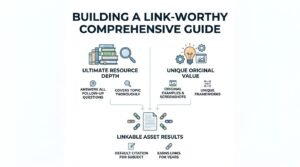
The difference between a guide that ranks and a guide that also earns links usually comes down to depth and structure. Bloggers link to guides that save them the work of explaining something themselves.
What Makes a Guide “Link-Worthy”
A link-worthy guide answers every reasonable follow-up question a reader might have without forcing them to search elsewhere. It also tends to include original examples, screenshots, or frameworks that can’t be found in five other articles on the same topic.
Infographics and Visual Data Assets
An infographic is a visual linkable asset that condenses data or a process into a format that’s easy to scan and easy to embed. Infographics still earn links well in visually-driven niches like health, finance, and real estate.
Publishers embed infographics because they save design time while adding a visual element to their own content. That trade free visual content for a credited backlink has powered infographic outreach for over a decade.
Designing Infographics That Earn Editorial Links
Infographics earn more links when the underlying data is sourced from original research rather than recycled statistics. A visual built on a proprietary survey gives outlets a reason to credit the source directly instead of screenshotting a competitor’s version.
Interactive Content and Quizzes
Interactive content is a linkable asset format that requires user input, such as quizzes, assessments, or configurators, and it tends to earn both links and social shares simultaneously. The engagement loop itself becomes part of the appeal for publishers looking to embed something dynamic.
A Content Marketing Institute survey found interactive content generates measurably higher engagement rates than static formats, which is part of why it attracts secondary coverage from sites writing about content trends.
Why Interactivity Increases Shareability
Interactive formats increase shareability because the output feels personalized to the user, which makes people more likely to share their specific result. A quiz result feels worth posting; a static article rarely does.
Templates, Checklists, and Downloadable Resources
A template or checklist becomes a linkable asset when it saves the reader meaningful time on a repeatable task, making it worth bookmarking and referencing. These assets perform especially well in B2B and technical niches where standardized processes are common.
Downloadable resources also tend to earn links from resource-roundup pages, which actively curate lists of “best templates for X.” That’s a link opportunity most content-based assets never qualify for.
Gated vs. Ungated Downloadable Assets
Ungated templates earn more backlinks than gated ones because publishers are reluctant to send their readers into an email capture form. Gating a resource behind a form trades link volume for lead volume, and the two goals rarely align on the same asset.
Industry Surveys and Expert Roundups
An expert roundup is a linkable asset built by collecting insights or predictions from multiple recognized voices in an industry, and it earns links largely because contributors share it with their own audiences. This built-in promotion mechanism is what makes roundups faster to scale than most other asset types.
How Expert Roundups Generate Natural Backlinks
Expert roundups generate backlinks because each contributor has a natural incentive to link back to the piece featuring their quote. That single dynamic often produces ten to thirty links from one piece of content with comparatively low production effort.
Glossaries and Definition Hubs
A glossary is a linkable asset that defines industry terminology in one centralized hub, and it earns links slowly but consistently over years as other writers link out for definitions instead of writing their own. This is one of the few asset types that keeps accumulating links with almost no ongoing promotion.
Structuring Glossaries for Long-Term Link Accumulation
A well-structured glossary uses one dedicated URL per term or a single hub page with clear jump-to navigation, both of which make individual definitions easy to cite. Consistent formatting across every entry also makes the resource feel more authoritative to writers deciding where to link.
How to Identify Linkable Asset Opportunities in Your Niche
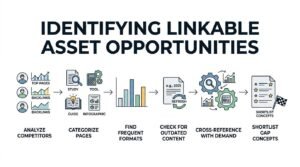
The fastest way to find asset opportunities is analyzing which pages earn the most backlinks for direct competitors and identifying the gaps in what they’ve built. Backlink analysis tools reveal exactly which content formats already work in a given industry.
Here’s the process I use to identify strong asset opportunities:
- Pull the top 20 most-linked pages for three to five competitors
- Categorize each page by asset type (study, tool, guide, infographic)
- Identify which asset types appear most frequently across competitors
- Check publication dates to spot outdated assets ready for a refresh
- Cross-reference topics against current search demand and news cycles
- Shortlist three to five asset concepts with the strongest gap potential
Competitor Backlink Analysis for Asset Ideation
Competitor backlink analysis reveals not just what earns links, but which publishers are actively linking, which becomes a built-in outreach list once a comparable asset launches. This dual benefit is why backlink analysis is usually the first step in any asset strategy.
Promoting Linkable Assets to Earn Backlinks
Promotion is the deliberate outreach process that connects a finished asset with the publishers, journalists, and bloggers most likely to reference it. Building the asset is only half the work; without promotion, even excellent assets can sit unnoticed for months.
The most effective promotion sequence I’ve used follows this order:
- Identify 50 to 150 sites that have linked to similar assets before
- Personalize outreach around why the asset helps their specific audience
- Lead with the data point or utility, not a generic pitch
- Follow up once after five to seven days if there’s no response
- Track which outreach angles convert best and refine the template
- Repeat outreach in waves as the asset gets updated or expanded
Outreach Strategies That Convert Assets Into Links
Outreach converts better when it references something specific about the target site rather than using a templated pitch. A message that mentions a related article the site already published earns dramatically higher response rates than a generic “I thought you’d like this” email.
Measuring the Success of a Linkable Asset
Measuring an asset’s success means tracking referring domains, not just total backlinks, since ten links from ten unique domains carry more weight than fifty links from one site. This distinction changes how a campaign’s ROI should be evaluated.
| Metric | What It Measures | Good Benchmark (First 90 Days) |
| Referring domains | Unique sites linking | 15+ for a strong asset |
| Domain rating of linkers | Authority of linking sites | Average DR 40+ |
| Organic traffic to asset | Search-driven visibility | Steady month-over-month growth |
| Branded search lift | Awareness impact | Measurable increase post-launch |
Key Metrics: Referring Domains, DR Impact, and Traffic
Referring domains are the single most important metric because they represent independent editorial decisions to link, while raw backlink counts can be inflated by a handful of sites linking multiple times.
Common Mistakes That Prevent Assets From Earning Links
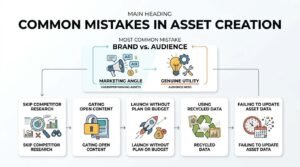
The most common mistake is building an asset around what a brand wants to say rather than what a specific audience actually needs. Assets built from a marketing angle instead of a genuine utility angle consistently underperform in outreach.
A few other recurring issues show up across failed campaigns:
- Skipping competitor research before choosing an asset format
- Gating content that should be freely accessible
- Launching without a promotion budget or outreach plan
- Using recycled data instead of original findings
- Failing to update the asset once data becomes outdated
How Linkable Assets Fit Into a Broader SEO Strategy
Linkable assets work best as one component inside a full SEO program that also includes technical health, content strategy, and consistent performance tracking. An asset can earn dozens of links and still underperform if the rest of the site isn’t structured to convert that authority into rankings.
I treat asset creation as the authority-building layer that sits alongside on-page optimization and technical fixes, not as a replacement for either one.
Conclusion
Linkable assets original research, free tools, guides, and interactive content earn backlinks because they genuinely help other publishers and their readers.
Domain authority compounds when a site consistently builds resources worth citing, rather than chasing links through outreach alone.
We help brands identify, build, and promote the right linkable assets through White Label SEO Service, turning content into sustainable organic growth.
Frequently Asked Questions
What is a linkable asset in SEO?
A linkable asset is a piece of content or a tool created specifically to earn backlinks on its own merit. It provides unique data, utility, or clarity that other sites want to reference.
How long does it take for a linkable asset to earn links?
Most linkable assets start earning links within 30 to 90 days of a promotion campaign. Tools and evergreen guides tend to keep earning links for years afterward.
What type of linkable asset earns the most backlinks?
Free tools and calculators typically earn the most backlinks over time because they stay useful indefinitely. Original data studies earn links fastest but usually in a shorter window.
Do linkable assets need to be gated behind an email form?
No, ungated assets consistently earn more backlinks than gated ones. Publishers are reluctant to send readers into a lead capture form.
How many backlinks should a good linkable asset generate?
A strong asset typically earns 15 or more referring domains within the first 90 days. Quality and diversity of linking domains matter more than raw link count.
Can infographics still earn backlinks in 2026?
Yes, infographics still earn links, particularly in visually-driven niches like health, finance, and real estate. Performance improves significantly when the data behind them is original.
How do I promote a linkable asset after publishing it?
Identify sites that have linked to similar assets before and send personalized outreach explaining its specific value to their audience. Following up once after a week improves response rates significantly.