Guest posting for links is the practice of writing and publishing an article on someone else’s website in exchange for a backlink to your own site. It works because search engines still treat relevant, editorially earned backlinks as a trust signal, and it matters most to site owners trying to build authority in a competitive niche.
Getting this wrong wastes months of outreach and can attract a Google penalty instead of rankings. I’ve watched businesses burn entire quarters chasing the wrong sites for the wrong reasons.
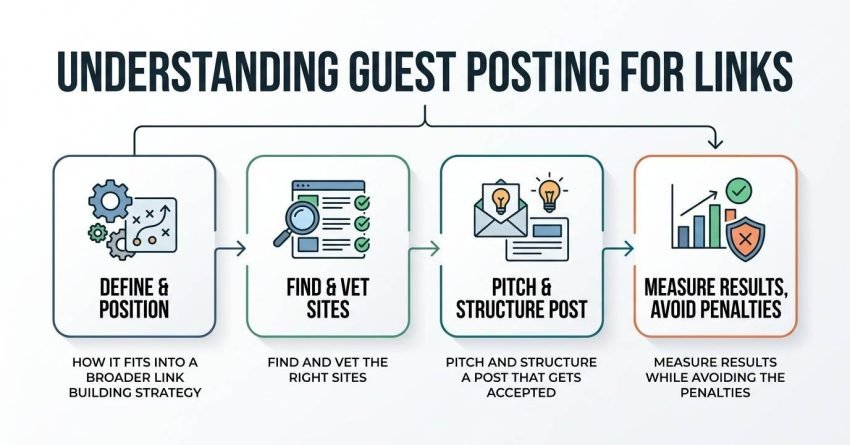
This guide covers what guest posting actually is and how it fits into a broader link building strategy, how to find and vet the right sites, how to pitch and structure a post that gets accepted, and how to measure results while avoiding the penalties that sink careless campaigns.
What Is Guest Posting and Why It Still Matters for SEO
Guest posting is the process of writing content for another website in your industry, usually in return for a link back to your own site. I still use it as one of the more reliable ways to earn relevant backlinks, because the link sits inside content an editor chose to publish rather than content you bought outright.
Link building is a broader discipline that includes guest posting, digital PR, resource link building, and outreach-based tactics. Guest posting is one tactic inside that discipline, not a replacement for it.
Google’s own guidance on link schemes treats large-scale guest posting done purely for links as a manipulative practice, which is why the content itself has to carry real value to the host site’s readers. I’ve seen sites get flagged for exactly this when every post existed only to plant an anchor.
Guest Posting vs. Other Link Building Tactics
Guest posting differs from other link building tactics in who initiates the content and where the value flows first. In broken link building, you find dead links and offer a replacement resource. In digital PR, you create something newsworthy, and journalists link to it on their own.
I find guest posting sits in the middle of these approaches. You’re creating original content, but you’re doing it on someone else’s platform, which means their editorial standards decide whether your link survives.
How Google Views Guest Post Links Today
Google evaluates guest post links the same way it evaluates any other backlink: by asking whether the link would exist if search rankings weren’t the goal. A study by Ahrefs found that guest posts published on topically relevant, moderate-traffic sites correlated with stronger ranking movement than posts on high-DA but topically unrelated domains.
I pay more attention to relevance than raw domain authority now. A site with 30% less traffic but tight topical overlap has outperformed bigger, unrelated domains in nearly every campaign I’ve run.
How Guest Posting Fits Into a Link Building Strategy
Guest posting works best as one channel inside a diversified link building strategy, not the entire strategy itself. I treat it as the channel that builds relationships and topical relevance, while other tactics like resource link building fill in volume and digital PR captures high-authority spikes.
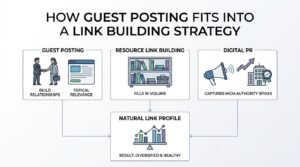
A site relying on guest posting alone tends to show an unnatural link profile over time, since every referring domain shares the same acquisition pattern. Mixing channels keeps the profile looking like something that happened naturally, because it did.
The Core Benefits of Guest Posting Beyond Links
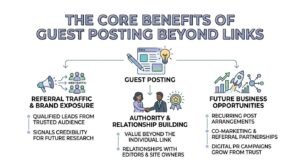
Guest posting delivers referral traffic, brand exposure, and industry relationships in addition to the backlink itself, which is why I keep recommending it even to clients who already rank well. The link is often the least valuable part of a well-placed guest post.
Referral Traffic and Brand Exposure
A guest post placed on a site with an engaged, relevant audience sends direct readers to your site, independent of any ranking movement. I’ve had single guest posts generate more qualified leads in a week than months of cold outreach, simply because the audience already trusted the host publication.
Brand exposure compounds here too. Being published on a recognized industry site signals credibility to anyone who later researches your company.
Authority and Relationship Building
Every successful guest post builds a relationship with an editor or site owner, and that relationship often becomes more valuable than the individual link. I’ve had single contacts turn into recurring guest posting arrangements, co-marketing opportunities, and even referral partnerships.
Digital PR campaigns often grow out of these same relationships, since editors who trust your first contribution are more likely to cover your future announcements.
How to Find Guest Posting Opportunities
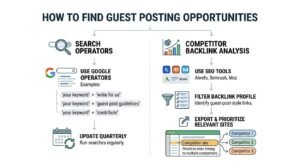
Finding guest posting opportunities starts with search operators, competitor backlink analysis, and niche-specific outreach lists rather than generic “write for us” directories. Generic directories tend to attract low-quality sites that exist only to sell links.
Search Operators for Finding Guest Post Sites
Search operators let you surface sites that explicitly accept guest contributions in your niche. Try combinations like “your keyword” + “write for us”, “your keyword” + “guest post guidelines”, or “your keyword” + “contribute” directly in Google.
I run these searches quarterly because new sites open up guest posting programs constantly, and old lists go stale within months.
Competitor Backlink Analysis for Prospecting
Competitor backlink analysis reveals exactly which sites have already agreed to publish content in your niche, since a link to a competitor’s guest post is proof the site accepts contributions. Tools like Ahrefs, Semrush, or Moz can filter a competitor’s backlink profile down to guest-post-style links specifically.
I export this list, filter for relevance and traffic, then prioritize sites that link to more than one competitor, since that pattern usually means an active, ongoing guest posting program.
How to Evaluate a Guest Post Site Before Pitching
Evaluating a guest post site before pitching means checking traffic, domain signals, and content quality rather than relying on a single metric like domain authority. A site can have a high DA score and still send zero organic traffic, which tells you the score alone is not enough.
Domain Authority and Traffic Signals
Domain authority is a third-party metric that estimates a website’s overall ranking strength based on its backlink profile, and it correlates loosely with how much ranking value a link from that site might pass. I cross-check it against actual organic traffic estimates in Ahrefs or Semrush before deciding a site is worth pitching.
| Signal | What It Tells You | Red Flag Threshold |
| Domain Authority/Rating | Overall backlink strength | Below 15–20 for niche sites |
| Organic Traffic | Real audience size | Under 500 monthly visits |
| Topical Relevance | Content overlap with your niche | Unrelated categories dominate |
| Outbound Link Ratio | Link scheme risk | Dozens of unrelated outbound links per post |
Red Flags of Low-Quality or Spammy Sites
A guest post site raises red flags when it publishes unrelated content across dozens of industries, sells links openly, or shows a spike in low-quality backlinks pointing to itself. I walk away immediately from any site that lists guest post prices on a public rate card, since that’s a direct violation of Google’s link scheme guidance.
Thin author bios, no editorial review process, and duplicate content lifted from other sites are the next three signals I check before ruling a site out entirely.
How to Pitch a Guest Post Successfully

Pitching a guest post successfully requires a personalized email, a relevant topic idea, and proof you understand the site’s existing content, sent to an actual editor rather than a generic contact form. Editors receive dozens of templated pitches weekly and delete most of them within seconds.
Crafting a Personalized Outreach Email
A strong outreach email references a specific article the site already published, explains why your proposed topic fills a gap in their existing coverage, and keeps the entire message under 150 words. I open by naming the specific piece I read, not with a generic compliment about “loving their blog.”
- Reference a specific published article on their site
- Propose one clear topic idea, not a list of five
- Explain the unique angle or data you’ll bring
- Include two or three writing samples
- Keep the total email under 150 words
Common Pitching Mistakes That Get Ignored
The most common pitching mistake is sending a mass email that never mentions the recipient’s site by name, which editors recognize instantly as a template. Asking for a dofollow link explicitly in the first email is the second fastest way to get ignored, since it signals the pitch is about SEO, not content.
I never mention links in the initial pitch at all. That conversation happens naturally once the editor agrees to the topic.
What Makes a Guest Post Get Accepted and Published
A guest post gets accepted when it matches the host site’s existing content quality, follows their stated guidelines exactly, and offers genuinely new information their audience hasn’t already read elsewhere. Editors reject far more posts for being generic than for being poorly written.
I study five to ten recent posts on the target site before writing a single word, matching their typical length, tone, and formatting conventions. A post that looks like it was written for a different site gets rejected regardless of how good the writing is.
How to Structure a Guest Post for Maximum Value

A well-structured guest post opens with a specific, useful hook, delivers actionable insight in the body, and includes a natural author bio link rather than a link stuffed into the article body. I structure most guest posts around one central argument or framework, supported by two or three concrete examples.
- Open with a specific problem or statistic, not a generic introduction
- State the core argument or framework in the first two paragraphs
- Support each section with a concrete example or data point
- Close with a practical takeaway, not a summary restatement
- Place your link in the author bio unless the site allows in-content links
Anchor Text and Link Placement Best Practices
Anchor text in a guest post should read naturally within the sentence and vary across your overall link profile, rather than repeating the same exact-match keyword phrase in every placement. Anchor text is the clickable, visible text of a hyperlink, and search engines use it as a relevance signal for the page it points to.
I mix branded anchors, naked URLs, and natural-phrase anchors across a guest posting campaign so the pattern doesn’t look manufactured. Exact-match anchors used repeatedly across dozens of guest posts are one of the clearest manual action triggers I’ve seen.
Common Guest Posting Mistakes Beginners Make
Beginners most often fail at guest posting by prioritizing domain authority over relevance, sending generic pitches, and requesting exact-match anchor text in every placement. Each of these mistakes compounds when repeated across a large campaign.
Paying for placements on clearly low-quality sites ranks as the costliest mistake I see, since it risks a manual penalty rather than simply wasting time. Ignoring a site’s existing content style and submitting a mismatched draft is the second most common failure point.
How to Measure the SEO Impact of Guest Posts
Measuring the SEO impact of guest posts means tracking referring domain growth, keyword ranking movement, and referral traffic in Google Search Console and Google Analytics over a 60 to 90 day window. A single guest post rarely moves rankings alone, so I always evaluate impact across a batch of placements rather than one at a time.
A Backlinko analysis of ranking factors found that referring domain count correlated more strongly with top-10 rankings than any other single link metric measured. I track that number monthly alongside organic traffic to the specific pages the guest posts were meant to support.
Guest Posting Costs: Free Outreach vs. Paid Placements
Guest posting costs range from zero dollars for manually pitched placements to several hundred dollars per post on established industry sites with editorial teams. Free outreach costs time instead of money, and that tradeoff matters when comparing the two approaches.
| Approach | Typical Cost | Time Investment | Risk Level |
| Manual outreach (free) | $0 | 5–10 hours per placement | Low |
| Paid placement (mid-tier site) | $150–$400 | 1–2 hours per placement | Medium |
| Paid placement (high-authority site) | $500–$1,500+ | Under 1 hour per placement | Medium-High |
| Link marketplace purchase | Varies widely | Minimal | High |
I favor manual outreach for small campaigns and shift toward vetted paid placements only once a site’s editorial standards and traffic are fully confirmed.
Guest Posting Risks and How to Avoid Google Penalties
Guest posting carries real risk when the primary purpose becomes manipulating rankings rather than reaching a genuine audience, and Google’s link spam systems are built specifically to catch that pattern. A manual action is a direct penalty applied by a Google reviewer after identifying a violation of the spam policies, and it can remove a site from search results entirely.
Google’s March 2024 spam update specifically targeted large-scale, low-quality guest posting networks built purely for link manipulation. I avoid this risk by capping the volume of guest posts pursued per month and refusing any site that shows obvious signs of existing purely to sell placements.
Diversifying anchor text, avoiding sites with existing spam signals, and disclosing sponsored content where required under FTC guidelines are the three practices I never skip.
Scaling Guest Posting Into a Sustainable Link Building Program
Scaling guest posting into a sustainable program means building a repeatable outreach process, a vetting checklist, and a content calendar rather than pitching sites reactively one at a time. I treat this the same way I’d treat any other recurring marketing channel, with clear monthly targets and quality thresholds.
A content calendar for guest posting typically includes target sites, pitch status, topic assignments, and publication dates, tracked in a shared spreadsheet or project management tool. Once a team has three or four reliable publishing relationships, the program starts generating its own momentum through referrals and repeat acceptances.
Conclusion
Guest posting connects content quality, editorial relationships, and backlink value into one repeatable channel. It works best alongside digital PR and other link building tactics inside a broader organic growth strategy.
We help businesses build these programs the right way. Reach out to White Label SEO Service to build a guest posting strategy that earns links safely.
Frequently Asked Questions
Is guest posting still effective for SEO?
Yes, guest posting still works for SEO when the target site is topically relevant, and the content provides genuine value. Google penalizes guest posting done purely for manipulative link volume, not the practice itself.
How many guest posts do I need to see SEO results?
Most campaigns need 5 to 10 quality placements before ranking movement becomes measurable. Results depend heavily on site relevance, competition level, and existing domain authority.
Do guest posts need to be dofollow to help rankings?
No, nofollow links still provide referral traffic, brand exposure, and indirect ranking signals. A natural link profile includes both dofollow and nofollow links from guest posts.
How much should I pay for a guest post?
Costs range from $0 for manual outreach to $500 or more on high-authority industry sites. Price should reflect the site’s traffic and topical relevance, not just its domain authority score.
Can guest posting hurt my website’s SEO?
Yes, guest posting can trigger a Google penalty when done at scale purely for link manipulation. Publishing on spammy, unrelated, or link-selling sites carries the highest risk.
What’s the difference between guest posting and link buying?
Guest posting involves creating original content in exchange for a link, while link buying pays directly for placement without editorial contribution. Google treats undisclosed paid links without content value as a violation of its spam policies.
How long does it take to get a guest post published?
Publishing timelines typically range from 2 to 6 weeks depending on the site’s editorial queue and review process. Faster turnaround is possible with established relationships or paid placements.