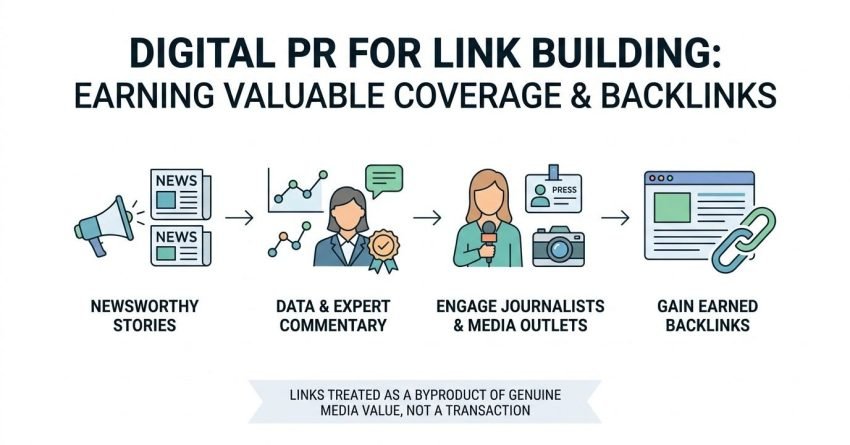
Digital PR for link building is the practice of using newsworthy stories, data, and expert commentary to earn coverage and backlinks from journalists and media outlets. I’ve watched this discipline pull businesses out of stagnant ranking positions faster than almost any other link acquisition method. It works because it treats links as a byproduct of genuine media value, not a transaction.
Search engines have gotten better at spotting manipulated links. Digital PR survives that scrutiny because the links come from real editorial decisions made by real journalists.
This guide covers what digital PR actually is and how it differs from traditional PR and link building, the campaign types and processes that earn coverage, how to measure results and budget realistically, and where digital PR fits inside a broader SEO strategy. We’ll also cover the tools, mistakes, and outreach tactics that separate successful campaigns from wasted budget.
What Is Digital PR?
Digital PR is a marketing discipline that uses online media relations, content, and storytelling to earn coverage, brand mentions, and backlinks from digital publications. It sits at the intersection of traditional public relations and modern SEO, borrowing tactics from both.
I think of it as PR built specifically for a search-visible internet. Every campaign has one eye on the story and one eye on the link that story generates.
How Digital PR Differs From Traditional PR
Traditional PR measures success through brand sentiment, share of voice, and offline media placements like TV or print. Digital PR measures success primarily through backlinks, referral traffic, and domain authority growth.
A traditional PR agency might celebrate a mention on the evening news. A digital PR team wants that same story published online, with a clickable, indexable link attached to it.
How Digital PR Differs From Traditional Link Building
Traditional link building often involves direct outreach asking site owners to add a link, guest posting, or building directories and resource pages. Digital PR earns links indirectly, as a natural result of journalists finding a story worth covering.
This distinction matters for risk. Manufactured link exchanges carry Google penalty risk, while editorially earned digital PR links generally don’t.
Why Digital PR Matters for SEO and Link Building
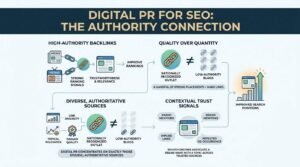
Digital PR matters for SEO because backlinks from high-authority media sites remain one of the strongest ranking signals search engines use to evaluate trustworthiness and relevance. I’ve seen sites move up several ranking positions after a handful of strong media placements landed within the same quarter.
It’s not just about volume. One link from a nationally recognized outlet often outweighs dozens of links from low-authority blogs.
The Connection Between Authority and Rankings
Domain authority isn’t a single Google metric, but it correlates with real ranking signals search engines do use, including link diversity, referring domain quality, and topical relevance. Sites with links from diverse, authoritative sources tend to rank more consistently across competitive terms.
Digital PR concentrates on exactly those diverse, authoritative sources rather than volume for its own sake.
Search Engine Trust Signals From Media Coverage
Media coverage sends contextual trust signals beyond the link itself. Brand mentions, even unlinked ones, contribute to what’s sometimes called “implied links,” where search engines associate a brand name with a topic based on repeated co-occurrence across trusted sources.
I don’t rely on unlinked mentions as a primary strategy, but I never discount them either.
How Digital PR Works: The Core Process
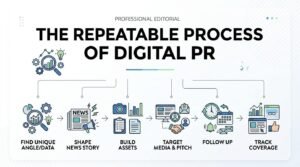
Digital PR works through a repeatable process that turns a business insight into a story journalists want to cover. The core steps stay consistent across almost every successful campaign I’ve run or reviewed.
- Identify a data source or unique angle: this might be proprietary company data, a survey, or an underreported trend.
- Shape the story around news value: journalists need timeliness, relevance, or surprise, not just interesting numbers.
- Build supporting assets: visualizations, quotes, and a press-ready summary make the story easy to cover.
- Build a targeted media list: journalists who’ve covered similar stories before are the highest-probability targets.
- Pitch with a clear, specific angle: generic pitches get ignored; specific, pre-packaged stories get opened.
- Follow up strategically: most placements come after a second or third touch, not the first email.
- Track coverage and links: confirming placements and monitoring whether links get added or need a follow-up request.
Skipping the story-shaping step is the single most common reason campaigns underperform.
Types of Digital PR Campaigns
Digital PR campaigns generally fall into a handful of proven formats, each suited to different budgets, timelines, and industries.
| Campaign Type | Best For | Typical Timeline | Link Volume Potential |
| Data-driven studies | Brands with access to unique datasets | 4-8 weeks | High |
| Newsjacking | Fast-moving industries, agile teams | 24-72 hours | Medium |
| Expert commentary | B2B, consultants, service brands | Ongoing | Medium-Low per placement |
| Surveys | Any industry with budget for research | 3-6 weeks | High |
Data-Driven Studies and Original Research
Data-driven studies analyze existing datasets, whether internal company data or public records, to surface a finding worth reporting on. These campaigns tend to earn the highest volume of links because journalists can cite the data directly in their own reporting.
Newsjacking and Reactive PR
Newsjacking involves attaching a brand’s expertise or commentary to a breaking news story while it’s still generating search and media interest. Speed matters more than polish here, since the news cycle window often closes within 48 hours.
Expert Commentary and Source Journalism
Expert commentary campaigns position a company spokesperson as a go-to source for journalists writing about a specific industry or topic. Platforms connecting journalists with sources have made this approach far more accessible for smaller brands without existing media contacts.
Surveys and Proprietary Data Campaigns
Original surveys generate net-new data that didn’t exist before the campaign, which makes them highly attractive to journalists looking for exclusive angles. Sample size and methodology transparency both affect whether a survey gets picked up by credible outlets.
The Anatomy of a Successful Digital PR Campaign
A successful digital PR campaign combines a genuinely newsworthy angle with precise timing and the right media targets. Missing any one of these three elements usually caps how far a campaign can travel.
Newsworthiness and Story Angles
A story angle earns coverage when it’s timely, surprising, locally relevant, or tied to a recognizable trend. I test every angle by asking whether a journalist with no relationship to the brand would still find it worth their readers’ time.
Timing and Trend Alignment
Campaigns launched around seasonal events, industry reports, or news cycles see meaningfully higher pickup rates than campaigns launched with no external hook. Coordinating a launch date around a relevant awareness month or annual data release period tends to outperform an arbitrary release date.
Digital PR vs. Traditional Link Building
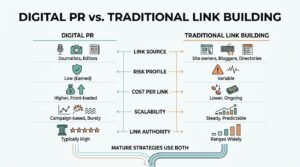
Digital PR and traditional link building both aim to earn backlinks, but the mechanisms, risk profiles, and scalability differ substantially.
| Factor | Digital PR | Traditional Link Building |
| Link source | Journalists, editors | Site owners, bloggers, directories |
| Risk profile | Low (earned links) | Variable (some tactics violate guidelines) |
| Cost per link | Higher, front-loaded | Lower, but often ongoing |
| Scalability | Campaign-based, bursty | Steady, more predictable |
| Link authority | Typically high | Ranges widely |
Most mature SEO strategies use both approaches together rather than choosing one exclusively.
How Digital PR Earns High-Authority Backlinks
Digital PR earns high-authority backlinks because journalists at established publications link out to sources as part of standard editorial practice when citing data or quotes. That single editorial habit is the entire mechanism behind why this channel produces stronger links than most manual outreach tactics.
Media Outlets, Domain Authority, and Link Equity
Publications with large, established audiences typically carry stronger domain authority, and a link from one passes more link equity than a link from a low-traffic site. This is why a single national media placement can outperform months of smaller-scale outreach.
Follow vs. Nofollow Links in Digital PR
Many major publications now default to nofollow links on external citations, which don’t directly pass ranking value in the traditional sense. I still pursue nofollow placements because referral traffic, brand signals, and the chance of a follow link from a secondary source all carry real value.
Measuring Digital PR Success
Digital PR success is measured through a mix of link metrics, referral traffic, and brand visibility indicators tracked consistently across each campaign. Relying on a single metric almost always produces a misleading picture of performance.
Key Metrics to Track
The core metrics worth tracking include total placements earned, the domain authority of linking sites, referral traffic generated, and any measurable ranking movement on target keywords. I check these numbers 30, 60, and 90 days after a campaign to capture both immediate and delayed pickup.
Attribution Challenges in Digital PR
Ranking improvements following a digital PR campaign often can’t be attributed to that campaign alone, since rankings respond to dozens of overlapping SEO factors. This makes coverage volume and link authority more reliable short-term indicators than ranking position alone.
Digital PR Outreach: Building Media Relationships
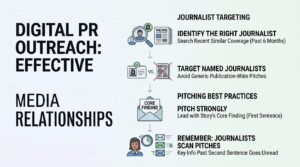
Digital PR outreach succeeds or fails based on whether a pitch reaches the right journalist with a story angle relevant to their beat. Generic mass-pitching campaigns consistently underperform targeted, relationship-based approaches.
Journalist and Publication Targeting
Effective targeting starts with identifying journalists who have written about similar topics within the past six months, since recent coverage is the strongest predictor of future interest. Publication-wide pitches without a named journalist tend to get filtered out before they’re ever read.
Pitching Best Practices
A strong pitch leads with the story’s core finding in the first sentence, not with company background or campaign context. Journalists scan dozens of pitches daily, so anything buried past the second sentence often goes unread.
Tools Used in Digital PR Campaigns
Digital PR campaigns rely on a mix of media database tools, journalist outreach platforms, and coverage tracking software to run efficiently at scale. Manual research alone can work for very small campaigns, but it doesn’t hold up once outreach volume grows.
Media database platforms help identify journalist contact details and past coverage history. Coverage tracking tools then monitor brand mentions and confirm whether promised links actually get published.
Common Digital PR Mistakes That Waste Budget
The most common digital PR mistake is pitching a story angle built around company promotion rather than genuine news value. Journalists reject promotional pitches almost immediately, regardless of how much budget went into producing them.
Other frequent mistakes include pitching too broadly instead of targeting relevant journalists, launching campaigns with no timing hook, and failing to follow up after the first pitch email goes unanswered.
How Much Does Digital PR Cost?
Digital PR campaigns typically cost between $3,000 and $15,000 per campaign, according to industry benchmarks from agencies running data-driven outreach at scale. Cost depends heavily on research depth, the size of the media list, and whether the campaign includes paid distribution or design assets.
Retainer-based digital PR programs, which run ongoing monthly campaigns rather than one-off pushes, often range from $5,000 to $20,000 per month depending on scope.
How Long Does Digital PR Take to Show Results?
Digital PR campaigns typically take four to eight weeks from research to first media placement, with link-driven ranking impact often appearing another one to three months after that. Reactive newsjacking campaigns can produce placements within days, but they represent the exception rather than the norm.
Patience matters here. The campaigns I’ve seen underperform are almost always the ones cut short before the outreach and follow-up cycle had time to run its course.
How to Build a Digital PR Strategy
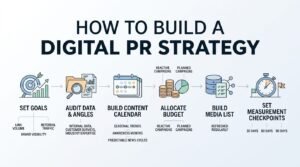
A digital PR strategy starts with clear goals, a realistic budget, and a content calendar aligned to industry events and data release cycles. Skipping the planning phase and jumping straight to outreach is the fastest way to burn through a budget with nothing to show for it.
- Set specific goals: link volume, referral traffic, or brand visibility, since each shapes different campaign choices.
- Audit available data and unique angles: internal data, customer surveys, or industry expertise all count.
- Build an annual content calendar tied to seasonal trends, awareness months, and predictable news cycles.
- Allocate budget across campaign types: mixing reactive and planned campaigns spreads risk.
- Build and maintain a media list: refreshed regularly as journalists change beats or publications.
- Set measurement checkpoints: 30, 60, and 90 days out, matching the metrics covered earlier.
Should you run digital PR in-house or outsource it to specialists? That decision usually comes down to internal media relationships and existing bandwidth.
Digital PR In-House vs. Agency vs. Freelancer
In-house digital PR teams offer the deepest brand knowledge but often lack existing journalist relationships that agencies have built over years of campaigns. Agencies typically produce faster initial results because of those pre-existing media contacts, while freelancers sit in between on both cost and reach.
Budget availability usually decides this more than anything else. Smaller businesses without dedicated PR headcount tend to see better ROI from agency partnerships than from building an in-house function from scratch.
How Digital PR Fits Into a Broader SEO Strategy
Digital PR functions as one link acquisition channel within a broader SEO strategy that also includes technical optimization, content creation, and on-page work. None of these components work in isolation, and a site with strong backlinks but weak technical health still struggles to rank.
I treat digital PR as the authority-building layer that supports content and technical SEO, rather than a standalone fix for ranking problems.
Conclusion
Digital PR earns authority through real media relationships, newsworthy stories, and measurable coverage rather than manufactured links. It works best as one layer inside a complete SEO strategy, alongside technical health and strong content.
We help brands build and execute digital PR campaigns that translate into real rankings and revenue. Partner with White Label SEO Service to turn media coverage into sustainable organic growth.
Frequently Asked Questions
What is digital PR in simple terms?
Digital PR is the practice of pitching newsworthy stories to online journalists to earn media coverage and backlinks. It combines traditional PR storytelling with SEO-focused outcomes like link authority.
Is digital PR the same as link building?
Digital PR is a subset of link building, not the same thing. It earns links indirectly through media coverage, while traditional link building often involves direct outreach for link placement.
How many links does a digital PR campaign typically earn?
Results vary widely, but a well-executed campaign often earns 5 to 25 media placements. Not every placement includes a link, since some journalists cite brands without linking.
Do digital PR links need to be dofollow to help SEO?
No, nofollow links still provide value through referral traffic and brand signals. Many major publications default to nofollow, and campaigns built only around dofollow links miss real opportunities.
What makes a digital PR story newsworthy?
A newsworthy story is timely, surprising, or tied to a recognizable trend that matters to a journalist’s audience. Data-backed stories with a clear, single takeaway tend to perform best.
Can small businesses do digital PR?
Yes, small businesses can run digital PR using proprietary data, local angles, or expert commentary opportunities. Budget requirements scale down for smaller, more targeted campaigns.
How do you measure digital PR ROI?
Digital PR ROI is measured through placement volume, linking domain authority, referral traffic, and eventual ranking movement. Attribution takes 60 to 90 days to become clear due to overlapping SEO factors.