Link building outreach emails are messages sent to website owners, editors, or content managers to request a backlink, collaboration, or content placement. A link building outreach email is a targeted message that asks a website owner or editor for a backlink, guest post placement, or content mention, and it succeeds or fails based on relevance, personalization, and a low-friction ask. I’ve read thousands of these emails from both sides of the inbox, and the pattern is always the same: the generic ones get deleted, and the specific ones get replies.
Most outreach campaigns fail before the first send, not after. Poor targeting and copy-paste templates waste hours and damage sender reputation fast.
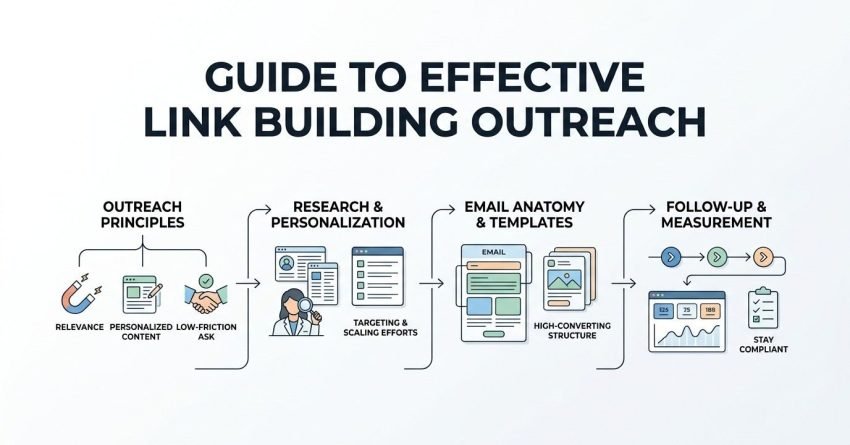
This guide covers what actually makes outreach effective, how to research and personalize at scale, the exact anatomy of a high-converting email, ready-to-use templates for different scenarios, and how to follow up, measure results, and stay compliant along the way.
What Makes a Link Building Outreach Email Effective?
An effective link building outreach email combines a relevant ask, a personalized opening, and a clear benefit to the recipient, all inside a message short enough to read in under thirty seconds. I’ve noticed that the emails I reply to always answer one silent question first: why me, specifically?
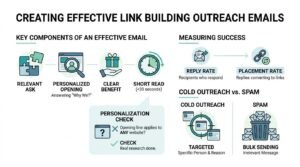
Reply rate and placement rate are the two numbers that actually matter here. Reply rate tracks how many recipients respond at all, while placement rate tracks how many of those replies convert into an actual link.
The Difference Between Cold Outreach and Spam
Cold outreach targets a specific person for a specific reason tied to their actual content. Spam sends the same message to thousands of addresses with no regard for relevance, and recipients can tell within one sentence which type they’re reading.
I always check whether my opening line could apply to literally any website. If it could, I haven’t done the research yet.
Key Metrics That Define “Effective” (Reply Rate, Placement Rate)
A strong link building campaign typically sees reply rates between 8% and 15%, according to Backlinko’s outreach benchmark study. Placement rates run lower, usually landing between 2% and 5% of total emails sent.
I track both numbers separately because a high reply rate with a low placement rate usually means the ask itself needs work, not the opener.
How Search Engines and Webmasters Evaluate Outreach Requests
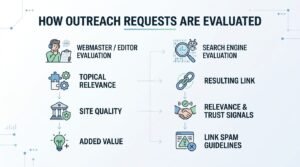
Webmasters and editors evaluate outreach requests based on topical relevance, site quality, and whether the request adds genuine value to their existing content. Search engines don’t read the email, but they do evaluate the resulting link the same way through relevance and trust signals.
I think about this from both angles at once. The email has to convince a human, and the resulting link has to hold up under the same scrutiny Google’s Search Central link spam guidelines apply to any placement.
Why Relevance and Trust Signals Matter to Recipients
An editor checks whether my site and request fit their existing content niche before opening the ask itself. Domain authority, topical overlap, and prior published work all factor into that snap judgment.
I’ve had far better luck referencing a specific, on-topic reason for the request than leading with domain metrics.
Pre-Outreach Research: Finding the Right Link Prospects
Prospect research for link building outreach means identifying websites that already publish content relevant to your topic and have a plausible reason to link to yours. I spend more time here than on writing the actual email, and it shows in the results.
The strongest prospects share three traits: topical relevance to my content, a history of linking out to similar resources, and an accessible, real contact.
Qualifying Prospects by Domain Relevance and Authority
Domain relevance measures how closely a prospect’s existing content matches the topic of the resource I’m pitching. I filter first by relevance and only then by authority metrics, because a highly relevant smaller site converts better than an irrelevant high-authority one.
An Ahrefs analysis of over 500,000 outreach campaigns found that topical relevance was a stronger predictor of placement than domain rating alone.
Finding the Correct Contact (Not Just info@)
The right contact for outreach is usually the content author, editor, or site owner, not a generic inbox that gets filtered by junior staff. I search the author bio, the About page, and LinkedIn before ever falling back on a contact form.
Direct-to-person emails consistently outperform generic aliases in my experience, largely because the message reaches someone with actual authority to act on it.
Personalization Techniques That Increase Response Rates
Personalization in outreach means referencing something specific and true about the recipient’s site, content, or work before making the ask. A Backlinko study of 100,000+ outreach emails found personalized subject lines increased open rates by 22%. I never open with a compliment I could paste into any email; it has to be something only that recipient could receive.
Referencing Specific Content on Their Site
I mention the exact article, section, or data point I’m referencing, and I explain briefly why it caught my attention. This single sentence does more work than the rest of the email combined.
Editors read this line first and decide within seconds whether the rest is worth their time.
Avoiding Generic Mail-Merge Red Flags
Mail-merge red flags include vague compliments, mismatched name fields, and references that could apply to any site in the niche. I run a quick gut check before sending: if I removed the recipient’s name, would the email still sound tailored?
If the answer is no, the personalization isn’t real; it’s just a mail-merge field with extra words around it.
Anatomy of a High-Converting Outreach Email
A high-converting outreach email follows a consistent structure: a relevant subject line, a credibility-building opener, a clear value proposition, and a low-friction ask, all inside 150 words or less. I treat every section of the email as a hurdle the recipient has to clear before they’ll reply, and each one needs to be easy to jump.
Subject Lines That Get Opened
The subject line’s only job is to get the email opened, and specificity beats cleverness every time I’ve tested it. Referencing the exact article title or a shared connection outperforms generic pitches like “Quick Question” or “Collaboration Opportunity.”
I keep subject lines under 50 characters so they don’t truncate on mobile inboxes, where Litmus reports over 60% of opens now happen.
Opening Lines That Build Immediate Credibility
The opening line establishes why the recipient should keep reading, usually by referencing their specific work or a shared point of relevance. I avoid starting with “My name is” or “I hope this finds you well” because neither line earns attention.
Instead, I lead with the exact detail that made me choose their site over the hundred others in my research list.
The Value Proposition (What’s In It for Them)
The value proposition answers what the recipient gains from responding, whether that’s a resource for their readers, a content update, or a mutual promotion. I state this in one sentence, directly after the credibility-building opener, before making any request.
Editors are busy, and they skip straight to “what’s in it for me,” whether the email states it explicitly or not.
The Ask: Clear, Low-Friction Call to Action
The ask should be a single, specific request that takes the recipient thirty seconds or less to say yes to. I never bundle multiple asks into one email, because every additional request lowers the odds of getting any of them.
A clear ask reads like “Would you be open to adding this as a resource?” rather than a vague “Let me know what you think.”
Outreach Email Templates for Different Link Building Scenarios
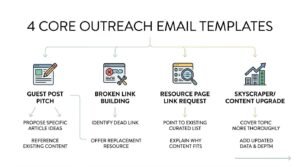
Outreach templates vary by scenario because a guest post pitch, a broken link report, and a resource page request each require a different value proposition. I keep a working library of four core templates and personalize the middle section for every send.
Guest Post Pitch Template
A guest post pitch template opens with a reference to the site’s existing content, proposes two to three specific article ideas, and links to writing samples. I always include actual titles, not vague topic areas, because specificity signals I’ve actually thought about their audience.
Broken Link Building Template
A broken link building template identifies a dead link on the recipient’s page and offers a working resource as a replacement. This template converts well because it does the recipient a favor before asking for anything in return.
Resource Page Link Request Template
A resource page link request template points to an existing curated list and asks whether a specific new resource fits its criteria. I reference the exact resource page URL and explain in one line why my content belongs alongside what’s already listed.
Skyscraper/Content Upgrade Template
A skyscraper content upgrade template shows the recipient that my resource covers their existing topic more thoroughly, with updated data or added depth. This works best when I can point to something concrete and missing, like outdated statistics or a shallow explanation.
Common Outreach Mistakes That Kill Response Rates
The most common outreach mistakes are generic personalization, unclear asks, and emails that read as templated rather than individually written. I still catch myself falling into these habits when I’m rushing a batch of sends late in the day.
Overly long emails lose readers before the ask even appears, and vague subject lines get ignored regardless of how strong the body copy is.
Follow-Up Email Strategy: Timing, Frequency, and Tone
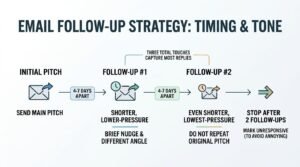
An effective follow-up strategy sends one to two additional emails, spaced four to seven days apart, each shorter and lower-pressure than the last. I never repeat the full original pitch in a follow-up; I just add a brief nudge and a slightly different angle.
Tone matters more in follow-ups than in the initial email, since a pushy second message can undo the goodwill the first one built.
How Many Follow-Ups Before You Stop
Most outreach professionals stop after two follow-ups, spaced roughly a week apart from the original send. I mark a prospect as unresponsive after that point rather than risk irritating them into a spam complaint.
Three total touches one pitch and two follow-ups capture the vast majority of eventual replies without crossing into annoying territory.
Email Deliverability Fundamentals for Outreach Campaigns
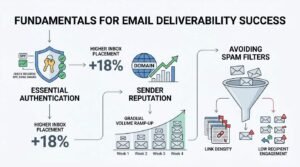
Email deliverability determines whether an outreach message reaches the inbox at all, and it depends on sender reputation, authentication records, and sending volume. I check my domain’s SPF, DKIM, and DMARC records before launching any new outreach campaign.
A Mailgun deliverability report found that properly authenticated domains saw 18% higher inbox placement than unauthenticated ones sending similar volume.
Avoiding Spam Filters and Domain Reputation Damage
Spam filters flag emails based on sending volume, link density, and recipient engagement patterns like opens and replies. I ramp up sending volume gradually on any new domain rather than blasting hundreds of emails in the first week.
Low engagement rates early on can damage domain reputation for months, so I treat the first few weeks of any new sending domain carefully.
Outreach Email Tools and Software for Scaling Campaigns
Outreach tools handle prospecting, email finding, sending, and reply tracking so campaigns can scale beyond what’s manageable manually. I rely on a combination of a prospecting tool, an email verification service, and a sending platform with built-in follow-up sequencing.
Manual outreach works for small, highly targeted campaigns, but anything beyond fifty emails a week benefits from at least basic automation.
How to A/B Test Your Outreach Emails
A/B testing outreach emails means sending two subject lines or opening lines to similar prospect segments and measuring which gets a higher reply rate. I only test one variable at a time; otherwise I can’t attribute the difference to a specific change.
Subject lines and opening lines produce the clearest, fastest signal, since they determine whether the email gets read at all.
Measuring Outreach Success: Reply Rates, Placement Rates, and ROI
Measuring outreach success means tracking reply rate, placement rate, and the resulting link’s impact on referring domains and organic visibility. I calculate cost per placement by dividing total campaign hours and tool costs by the number of links actually secured.
| Metric | What It Measures | Typical Benchmark |
| Reply Rate | Recipients who respond at all | 8%–15% |
| Placement Rate | Emails that convert to a link | 2%–5% |
| Cost Per Placement | Total effort divided by links secured | Varies by niche |
This table shows the three core numbers I check after every campaign to decide whether it’s worth repeating at the same scale.
Legal and Ethical Considerations in Link Building Outreach
Legal outreach practices require honest subject lines, a working unsubscribe option, and accurate sender information under U.S. law. I treat compliance as a baseline requirement, not an optional extra, regardless of campaign size.
CAN-SPAM Compliance Basics
CAN-SPAM compliance requires accurate header information, a clear unsubscribe mechanism, and honoring opt-out requests within ten business days. The FTC’s CAN-SPAM guidance applies to any commercial email, including outreach sent for link building purposes.
I keep a suppression list updated in real time so anyone who opts out never receives a follow-up by mistake.
How Outreach Fits Into a Broader Link Building Strategy
Outreach is one tactic within a broader link building strategy that also includes content creation, digital PR, and existing relationship leverage. I never treat outreach as the whole strategy; it’s the delivery mechanism for content that already deserves to be linked to.
The strongest outreach campaigns start with genuinely link-worthy content, since even perfect emails struggle to sell a weak resource.
Conclusion
Effective outreach combines research, personalization, and a clear, low-friction ask across every email you send. Link building outreach remains one piece of a larger organic growth strategy built on content, technical SEO, and consistent measurement.
We help businesses build outreach campaigns that actually convert. Talk to White Label SEO Service about building a link acquisition strategy that fits your growth goals.
Frequently Asked Questions
What is a good response rate for link building outreach emails?
A good response rate for link building outreach falls between 8% and 15%. Rates above this range usually reflect highly targeted, well-personalized campaigns to small prospect lists.
How long should a link building outreach email be?
A link building outreach email should stay under 150 words, ideally closer to 100. Shorter emails respect the recipient’s time and get read in full more often.
Should I use HTML or plain text emails for outreach?
Plain text emails generally perform better for outreach than HTML-designed emails. They read as personal messages rather than mass marketing, which builds more trust with recipients.
How many outreach emails can I send per day safely?
New domains should start at 20–30 emails per day and increase gradually over several weeks. Established domains with good reputation can typically send several hundred daily without deliverability issues.
What is the best time to send outreach emails?
Tuesday through Thursday mornings, in the recipient’s local time zone, typically see the highest open and reply rates. Avoid Mondays and Fridays, when inboxes are either flooded or ignored.
Do personalized emails really get more responses?
Yes, personalized emails consistently outperform generic templates in both open and reply rates. Studies show personalization can lift response rates significantly compared to mail-merge approaches.
Is link building outreach still effective in 2025?
Yes, link building outreach remains effective in 2025 when it’s targeted and personalized. Generic, high-volume approaches have declined in effectiveness as spam filters and recipient awareness have both improved.