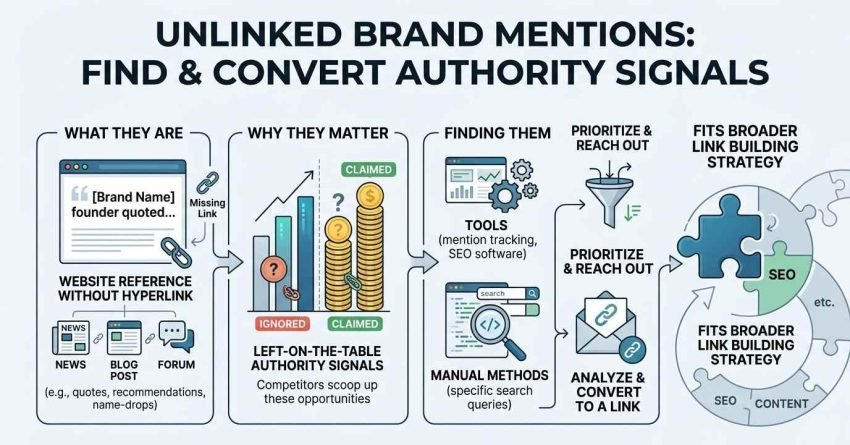
An unlinked brand mention happens when a website references your company, product, or founder by name without adding a hyperlink back to your site. I see this constantly when I audit client backlink profiles: a journalist quotes a founder, a blogger recommends a tool, or a forum thread name-drops a brand, and nobody links it.
These mentions sit on the table every single day for most brands. Ignoring them means leaving free authority signals unclaimed while competitors scoop up the same opportunities.
This guide covers what unlinked mentions are and why they matter, the tools and manual methods for finding them, how to prioritize and reach out for conversion, and how the whole process fits into a broader link building strategy.
What Are Unlinked Brand Mentions?
An unlinked brand mention is any reference to your brand name, product, or domain on another website that does not include a clickable link to your site. I run into these on news sites, review platforms, forums, and guest posts almost every week during outreach audits.
The mention itself already proves the third party found you worth talking about. What’s missing is the technical connection search engines use to pass authority and send referral traffic.
Linked vs. Unlinked Mentions Explained
A linked mention includes an anchor tag pointing to your domain, and it passes link equity the way any standard backlink does. An unlinked mention has the same editorial trust behind it but sends zero direct SEO value until someone adds the href attribute.
I treat unlinked mentions as half-finished backlinks. The hard part- earning the mention is already done.
Why Unlinked Mentions Happen
Writers often assume readers will search the brand name themselves, or they simply forget to link on deadline. Content management systems sometimes strip links during republishing, and syndicated articles frequently lose their original hyperlinks entirely.
None of this is personal or malicious. Most publishers will add the link if you ask politely and make it easy for them.
Why Unlinked Brand Mentions Matter for SEO
Unlinked brand mentions matter because search engines can associate your brand with a topic even without a hyperlink, but converting them into links adds direct ranking and referral value. Google’s own patents and public statements reference the concept of “implied links”: brand mentions that function similarly to citations in academic papers.
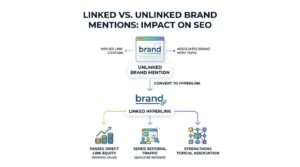
Three things happen when a mention gets converted to a link: it passes direct link equity, it sends qualified referral traffic from readers who click through, and it strengthens the topical association between your brand and the subject matter of that page.
Link Equity and Authority Signals
Link equity is the ranking value a page transfers to another page through a hyperlink, and it remains one of the strongest factors in Google’s algorithm. A mention with zero links passes none of this value, no matter how many times your brand name appears on the page.
Brand Signals vs. Direct Ranking Value
Brand signals are the associations search engines build between your company name and specific topics based on how often and where you’re mentioned. These signals support entity recognition even without a link, but they don’t substitute for the direct authority a hyperlink provides.
Types of Unlinked Mentions You Should Track
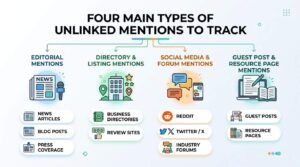
Four mention types account for most of the unlinked opportunities I find during a typical audit: editorial coverage, directory listings, social platforms, and guest content.
- Editorial mentions in news articles, blog posts, and press coverage
- Directory and listing mentions on business directories and review sites
- Social media and forum mentions on platforms like Reddit, Twitter/X, and industry forums
- Guest post and resource page mentions where your brand is referenced as an example or resource
Editorial Mentions in News and Blogs
Editorial mentions carry the highest link value because they come from sites with established topical authority and editorial standards. A single mention in an industry publication with strong domain authority often outweighs a dozen directory listings combined.
Directory and Listing Mentions
Directory mentions appear on business listing sites, local chambers of commerce, and industry-specific databases. These are usually the easiest to convert because directory operators expect and welcome link additions.
Social Media and Forum Mentions
Social platforms rarely pass direct SEO link equity because most social links carry a nofollow attribute, but forum threads on platforms without nofollow tags can still contribute value. Reddit threads discussing a brand by name are worth monitoring even though conversion rates run lower here.
Guest Post and Resource Page Mentions
Resource pages that list tools, services, or companies by name without linking represent some of the highest-converting outreach opportunities available. Page owners built these lists specifically to be useful references, so adding a missing link usually improves their own page.
How to Find Unlinked Brand Mentions
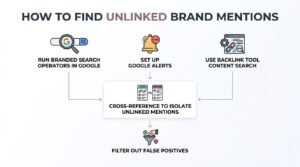
Finding unlinked brand mentions requires a combination of search operators, monitoring tools, and dedicated brand-tracking platforms run on a recurring schedule. I run this process monthly for active clients and quarterly for smaller brands with lower mention volume.
- Run branded search operators in Google to surface recent mentions
- Set up Google Alerts for real-time notification of new mentions
- Use a backlink tool’s content search feature to scan indexed pages
- Cross-reference results against your existing backlink profile to isolate unlinked ones
- Filter out false positives like unrelated companies sharing your brand name
Google Search Operators for Manual Discovery
Search operators like “brand name” -site:yourdomain.com isolate mentions across the web while excluding your own site from results. Adding modifiers like -inurl:yourdomain catches additional variations that simple exclusion misses.
Using Google Alerts for Ongoing Monitoring
Google Alerts sends automated email notifications whenever your specified brand terms appear in newly indexed content. I set these up on day one for every new client because it costs nothing and catches mentions between formal audit cycles.
Dedicated Brand Monitoring Tools
Platforms built specifically for mention tracking scan a far larger portion of the web than Alerts and typically include sentiment analysis and link-status detection built in. This category includes tools ranging from budget options to enterprise-grade brand monitoring platforms that track mentions across news, social, and forums simultaneously.
Using Ahrefs to Find Unlinked Mentions
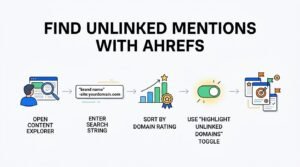
Ahrefs finds unlinked brand mentions through its Content Explorer tool, which searches billions of indexed pages for text matches to your brand name. I use this as my primary method for clients already paying for an Ahrefs subscription since it doubles as a full content research tool.
Content Explorer Search Method
The search string “brand name” -site:yourdomain.com inside Content Explorer returns pages mentioning the brand while excluding the brand’s own domain. Sorting results by Domain Rating surfaces the highest-authority opportunities first, and a built-in “Highlight unlinked domains” toggle flags exactly which results lack a hyperlink already.
Using Semrush to Find Unlinked Mentions
Semrush locates unlinked brand mentions primarily through its Brand Monitoring toolkit, which tracks mentions across the web on a scheduled basis. This tool works differently from Ahrefs in that it runs as an ongoing monitor rather than a one-time search.
Brand Monitoring Toolkit Method
Setting up a tracking query inside the Brand Monitoring toolkit generates a running feed of new mentions along with their link status. The toolkit separates results into linked and unlinked categories automatically, which removes the manual cross-referencing step Ahrefs and Google Alerts both require.
Using Google Alerts and Free Methods
Google Alerts and manual search operators provide a genuinely effective free alternative to paid monitoring tools for brands with lower mention volume. Combining Alerts with a monthly manual search operator sweep covers most of what a paid tool catches, just with more manual effort.
Setting up three or four alert variations exact brand name, common misspellings, and product names catches a wider net than a single alert alone. This costs nothing beyond the time spent reviewing weekly digest emails.
How to Prioritize Which Mentions to Pursue
Prioritizing unlinked mentions means scoring each one by the linking domain’s authority, topical relevance, and realistic traffic potential before spending outreach time on it. Not every mention deserves equal effort, and chasing low-value mentions wastes time better spent elsewhere.
Domain Authority and Relevance Scoring
A mention on a high-authority site directly relevant to your industry outranks a mention on a generic, unrelated site regardless of the linking domain’s raw authority score. I weight relevance roughly equal to authority when building outreach priority lists.
Traffic Potential and Page Context
Pages that still receive organic traffic or social shares pass more real-world value than old, stagnant pages nobody visits anymore. Checking a page’s estimated traffic before outreach helps avoid spending effort on pages that technically rank but attract no readers.
How to Reach Out and Request a Link
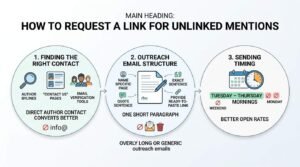
Requesting a link for an unlinked mention works best as a short, specific email that identifies the exact mention and makes adding the link as easy as possible for the recipient. Overly long or generic outreach emails get ignored or deleted within seconds.
Finding the Right Contact
Author bylines, “Contact Us” pages, and email verification tools typically produce a direct contact faster than generic info@ addresses. Direct author contact converts noticeably better than a generic editorial inbox in my outreach experience.
Outreach Email Structure and Timing
A converting email names the specific page, quotes the exact sentence containing the mention, and provides the ready-to-paste link in one short paragraph. Sending on Tuesday through Thursday mornings tends to produce better open rates than weekend or Monday sends.
Unlinked Mention Outreach Email Templates
A short template built around gratitude, specificity, and ease of action converts better than a templated-sounding pitch. The subject line should reference the specific article, not a generic “link request.”
| Element | Example |
| Subject | Quick fix for your [Article Title] piece |
| Opening | Thanks for mentioning [Brand] in your recent article |
| Ask | Would you mind adding a link to [URL] for readers? |
| Close | Happy to return the favor with a share or mention |
Common Mistakes When Converting Mentions to Links
Mass-emailing generic templates to every mention without personalization drops response rates dramatically. Chasing low-authority, irrelevant mentions wastes hours that would be better spent on high-value targets.
Following up too aggressively or too many times damages the relationship rather than helping it. Forgetting to track which mentions were contacted leads to duplicate, awkward outreach to the same person twice.
How Unlinked Mentions Fit Into a Broader Link Building Strategy
Unlinked mention reclamation works as one tactic inside a broader link building strategy that should also include original content promotion, digital PR, and relationship-based outreach. Treating mention reclamation as a standalone strategy caps its long-term impact.
The mentions themselves are usually a byproduct of PR work, product reviews, or organic word-of-mouth rather than something manufactured directly. I recommend running mention audits as a maintenance task alongside active link building campaigns < rather than as the sole focus of an SEO program.
Tools Comparison for Unlinked Mention Tracking
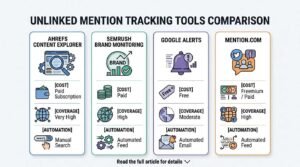
The table below compares the four most common methods for tracking unlinked brand mentions across cost, coverage, and automation level.
| Tool | Cost | Coverage | Automation |
| Ahrefs Content Explorer | Paid (subscription) | Very high (billions of pages) | Manual search |
| Semrush Brand Monitoring | Paid (subscription) | High | Automated feed |
| Google Alerts | Free | Moderate | Automated email |
| Mention.com | Freemium/Paid | High (includes social) | Automated feed |
How Often Should You Audit for Unlinked Mentions?
Most brands should audit for unlinked mentions monthly, though high-visibility brands with frequent press coverage benefit from a biweekly schedule. Waiting longer than a quarter between audits risks losing time-sensitive opportunities since older articles become harder to get updated.
Smaller brands with lower mention volume can reasonably stretch this to a quarterly cadence without losing much value.
Conclusion
Unlinked brand mentions represent authority already earned but not yet claimed, sitting across news sites, directories, forums, and guest content. Finding them takes the right combination of tools and manual search operators, and converting them takes a short, specific, well-timed outreach email.
Mention reclamation strengthens a broader link building program rather than replacing it, adding steady, low-cost authority gains alongside other strategy pillars. Consistent monthly audits keep this pipeline active instead of leaving mentions to expire unclaimed.
We help brands turn overlooked mentions into real ranking assets through our White Label SEO Service, so reach out and let’s start reclaiming your unlinked authority today.
Frequently Asked Questions
What is an unlinked brand mention?
An unlinked brand mention is a reference to your brand name or domain on another website without a clickable hyperlink attached. It provides brand recognition but no direct SEO link value until converted.
How do I find unlinked mentions of my brand?
You can find unlinked mentions using Google search operators, Google Alerts, or dedicated tools like Ahrefs and Semrush. Combining a free method with a paid tool typically produces the most complete coverage.
Are unlinked mentions bad for SEO?
Unlinked mentions are not bad for SEO, but they represent a missed opportunity rather than harm. They still may contribute weak brand signals even without passing direct link equity.
How long does it take to convert a mention into a link?
Most conversions happen within one to three weeks after a well-targeted outreach email, though response times vary by publisher. Larger publications often take longer due to editorial approval processes.
Is Ahrefs or Semrush better for finding unlinked mentions?
Ahrefs generally offers broader page coverage through Content Explorer, while Semrush provides more automated ongoing monitoring through its Brand Monitoring toolkit. The better choice depends on whether you prefer one-time searches or continuous tracking.
Do unlinked mentions still help SEO without a link?
Unlinked mentions may contribute minor brand association signals search engines use for entity recognition, but they provide no direct ranking value without a link. Converting them to links unlocks their full SEO potential.
How often should I check for new unlinked mentions?
Most brands should check monthly, while brands with frequent press coverage benefit from checking biweekly. Lower-visibility brands can reasonably check quarterly.