ChatGPT Search optimization is the process of structuring a website’s technical foundation, content, and authority signals so ChatGPT can retrieve, understand, and cite it as a source in conversational search answers. I’ve watched search behavior shift fast over the past year, and ChatGPT Search is no longer a side experiment; it’s a real referral channel for the sites that understand how it selects sources.
Businesses that ignore this shift lose visibility to competitors who adapt early. Search demand is fragmenting across AI assistants now, not just Google.
This guide covers how ChatGPT Search actually works and picks citations, the technical and content foundations that support visibility, the authority signals that influence trust, and how to measure and sustain results over time. We’ll move from the mechanics to the practical execution.
What Is ChatGPT Search and How Does It Work?
ChatGPT Search is a feature within ChatGPT that retrieves live web content to generate conversational answers with cited sources, rather than relying solely on its pretrained model knowledge. I think of it as a hybrid: part language model, part real-time retrieval engine. It blends indexed web data with generative reasoning to produce a direct answer instead of a list of links.
This matters because it changes what “ranking” even means. A page doesn’t need to rank #1; it needs to be retrievable, relevant, and quotable in the exact moment ChatGPT needs an answer.
How ChatGPT Search Differs from Traditional Google Search
Google Search returns a list of ranked links for a person to click through and evaluate themselves. ChatGPT Search instead synthesizes an answer directly, pulling fragments from multiple sources into one response.
I’ve noticed this shrinks the value of ranking position and increases the value of extractable, well-structured statements. A page buried on page two of Google can still get cited if the sentence structure is clean and the claim is well-supported.
Where ChatGPT Search Pulls Its Answers From
ChatGPT Search pulls from a combination of live web crawling, licensed content partnerships, and its underlying training data, weighted toward freshness for time-sensitive queries. OpenAI’s own documentation confirms that search results are blended with real-time retrieval for current events and factual lookups.
We treat this as a moving target. The exact source mix shifts as OpenAI expands partnerships and crawler access.
How ChatGPT Decides Which Sources to Cite
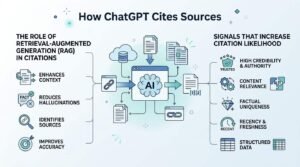
ChatGPT decides which sources to cite based on relevance to the query, content clarity, structural extractability, and perceived trustworthiness of the domain. It isn’t a single ranking formula; it’s closer to a retrieval-and-rerank process borrowed from information retrieval research.
I look at this the same way I look at featured snippet optimization, just with higher stakes. The sentence that gets pulled has to stand completely on its own.
The Role of Retrieval-Augmented Generation (RAG) in Citations
Retrieval-augmented generation, or RAG, is the technical process where a language model retrieves external documents at query time and grounds its response in that retrieved content instead of only its training data. This is the exact mechanism ChatGPT Search runs on.
RAG systems typically retrieve a shortlist of candidate documents, then generate an answer using the strongest passages from that shortlist. A passage that answers the question in one self-contained sentence gets selected over a passage that requires surrounding context to make sense.
Signals That Increase Citation Likelihood
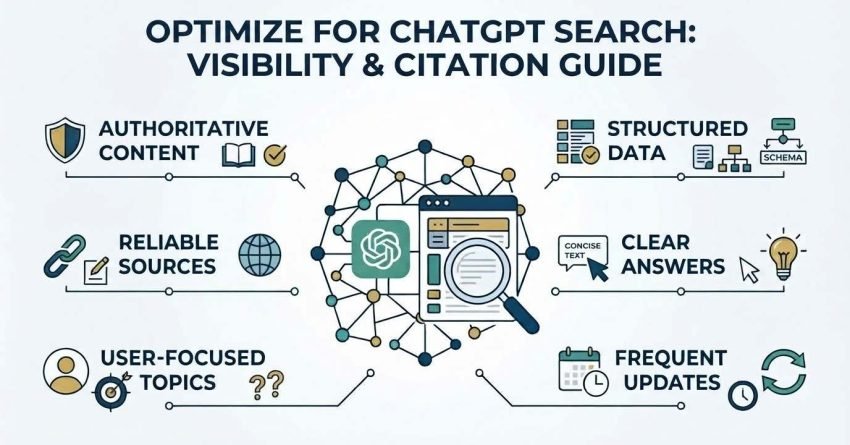
Several factors consistently increase how often a page gets pulled into ChatGPT’s answers. I’ve grouped the strongest ones below.
- Clear, self-contained answer sentences near the top of a section
- Structured data that confirms entity type and page purpose
- Recent publish or update dates on time-sensitive topics
- Domain-level trust signals like consistent citations elsewhere
- Original data or statistics not duplicated across many sites
ChatGPT Search vs. Traditional SEO: Key Differences
ChatGPT Search optimization and traditional SEO share a technical foundation but diverge sharply in what counts as success, since one rewards ranking position and the other rewards extractable, citable content. The table below breaks down where the two approaches split.
| Factor | Traditional SEO | ChatGPT Search Optimization |
| Success metric | Ranking position | Citation inclusion |
| User outcome | Click-through to site | Direct answer, optional click |
| Content format priority | Keyword-optimized pages | Self-contained, extractable statements |
| Freshness weight | Moderate | High for time-sensitive queries |
| Link building role | Core ranking factor | Trust signal, less direct |
I don’t treat these as competing strategies. A site built on strong technical SEO and clear content structure is already halfway to being AI-search-ready.
Technical Foundations for ChatGPT Search Visibility
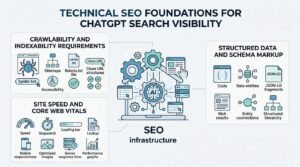
Technical SEO foundations for ChatGPT Search visibility start with making a site fully crawlable, properly structured with schema, and fast enough that content actually gets indexed and retrieved. None of this is new. It’s the same groundwork good SEO has always required, just with higher stakes now.
I still find sites with basic crawl errors blocking entire sections from being indexed at all. Fix the fundamentals first.
Crawlability and Indexability Requirements
A page has to be crawlable and indexable before it can ever be retrieved by any AI system, which means checking robots.txt rules, canonical tags, and server response codes regularly. I run this check before touching anything else on a new client site.
Blocked resources, broken canonicals, and orphaned pages quietly kill visibility long before content quality becomes a factor.
Structured Data and Schema Markup
Schema markup is structured code added to a webpage that explicitly tells search engines and AI systems what type of entity or content the page represents. Article, FAQ, and Organization schema all help disambiguate content for retrieval systems.
I add FAQ schema to nearly every guide we publish now. It maps cleanly onto the question-answer format ChatGPT Search favors.
Site Speed and Core Web Vitals
Site speed affects whether crawlers can efficiently access and re-index content, and slow sites get crawled less frequently overall. Google’s Core Web Vitals research found that sites meeting good thresholds see 24% lower bounce rates.
We treat this as table stakes rather than a differentiator. Every serious competitor already has it handled.
Content Structure That Gets Cited by ChatGPT
Content that gets cited by ChatGPT is structured so the first sentence under every heading directly answers that heading, without requiring the reader to scroll for context. This is the single biggest lever I’ve seen move citation frequency in practice.
Writers trained on traditional blog structure tend to build up to the answer. That habit actively hurts AI visibility.
Answer-First Writing and Extractable Formatting
Answer-first writing means the direct answer to a question appears in the opening sentence of a section, with supporting context following afterward rather than before. I rewrite more client content for this single issue than any other.
A sentence extracted and read alone has to make complete sense. If it depends on “this” or “it” referring back to an earlier sentence, it fails as a citation candidate.
Using Definitions, Lists, and Tables Strategically
Definitions, numbered lists, and comparison tables each map to a different query shape, and matching the format to the query type measurably increases extraction rate. “What is” queries want a definition. “How does X work” queries want a numbered process.
I assign one extractable format per section now rather than mixing several. It keeps the page scannable for both humans and retrieval systems.
Content Depth vs. Content Clarity
Content depth and content clarity solve different problems, and chasing depth at the expense of clarity actively reduces how often a passage gets cited. A 3,000-word section that never states its core claim plainly loses to a 200-word section that does.
I’d rather ship a shorter section with one bulletproof answer sentence than a comprehensive one that buries its point.
E-E-A-T and Authority Signals for AI Search
E-E-A-T stands for Experience, Expertise, Authoritativeness, and Trustworthiness, and it functions as a trust filter that both Google and AI search systems use to decide which sources deserve citation. I treat it as a checklist now, not an abstract concept.
Author bios, cited credentials, transparent sourcing, and consistent publishing history all feed into this signal. AI systems appear to weight domain-level trust heavily when multiple sources say roughly the same thing.
The Role of Original Data and Research in Citations
Original data and proprietary research get cited by ChatGPT more often than paraphrased statistics because unique numbers have no competing source to pull from instead. An Ahrefs study of AI citation patterns found that pages featuring original data appeared in AI-generated answers at a notably higher rate than pages repeating third-party stats.
I push every client toward publishing at least one original data point per major content piece now. It’s become the single most reliable citation lever available.
Building Topical Authority for AI Visibility
Topical authority is the depth and consistency of coverage a website demonstrates across every subtopic within its core subject area, and it strongly influences whether AI systems treat a domain as a trustworthy source. A single great article rarely earns citation trust on its own.
I build content clusters around every pillar topic specifically because retrieval systems seem to reward domains that cover a subject from multiple angles, not just once.
Off-Page Signals: Brand Mentions, Reviews, and Third-Party Validation
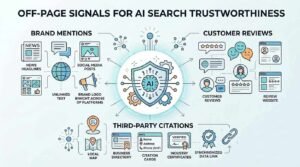
Off-page signals like brand mentions, customer reviews, and third-party citations reinforce the trustworthiness score that AI search systems apply when selecting sources. ChatGPT doesn’t just evaluate a page in isolation; it appears to weigh how often and how positively a brand is discussed elsewhere.
Unlinked brand mentions, review site profiles, and industry directory listings all contribute here, even without a direct backlink attached.
Optimizing for Featured Snippets and AI Overviews (Cross-Engine Impact)
Content optimized for Google’s featured snippets and AI Overviews tends to perform well in ChatGPT Search too, because both systems reward the same self-contained, answer-first sentence structure. I no longer treat these as separate optimization tracks.
Winning a featured snippet is now a leading indicator that a passage is structurally ready for AI citation across multiple platforms at once.
How to Monitor and Measure ChatGPT Search Visibility
Monitoring ChatGPT Search visibility requires tracking referral traffic patterns, manually testing target queries inside ChatGPT, and watching for citation mentions using emerging AI-tracking tools. This space still lacks the mature analytics Google Search Console offers, so measurement stays partly manual.
I check referral traffic segments weekly for any client actively pursuing AI search visibility.
Tracking Referral Traffic from ChatGPT
ChatGPT Search sends identifiable referral traffic that shows up in Google Analytics under the chat.openai.com or chatgpt.com referral source, separate from organic search traffic. I set up a dedicated segment for this the moment a client shows any AI referral volume.
Traffic volume from this channel is still small for most sites, but the growth curve over the last year has been steep.
Tools for Tracking AI Search Citations
A handful of dedicated AI visibility tools now track how often a domain gets cited across ChatGPT, Perplexity, and Google AI Overviews simultaneously. This category didn’t exist two years ago, and it’s evolving quickly.
I recommend running at least one such tool alongside traditional rank tracking rather than replacing it outright.
Common Mistakes That Prevent ChatGPT Citations
The most common mistake preventing ChatGPT citations is burying the direct answer to a question inside a long introduction instead of stating it in the first sentence. I see this on nearly every audit I run.
Other frequent issues include missing schema markup, outdated content on time-sensitive topics, and thin pages with no original insight to offer a retrieval system.
How Long It Takes to See Results in ChatGPT Search
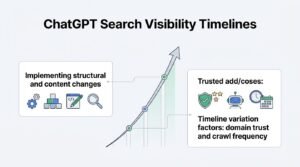
Most sites see measurable ChatGPT Search visibility within three to six months of implementing structural and content changes, though timelines vary based on domain trust and crawl frequency. This tracks closely with typical organic SEO timelines, which shouldn’t surprise anyone given the overlapping technical foundation.
I set this expectation with clients upfront now. Anyone promising instant AI citations is not being straight with you.
Building a Long-Term GEO (Generative Engine Optimization) Strategy
Generative Engine Optimization, or GEO, is the ongoing practice of structuring content, technical infrastructure, and authority signals specifically to earn citations across AI-driven search platforms. It sits alongside traditional SEO rather than replacing it.
I build GEO into every content roadmap we run now, treating it as a permanent discipline rather than a temporary trend.
Conclusion
ChatGPT Search rewards sites built on strong technical foundations, extractable content, and demonstrated topical authority. These same fundamentals also strengthen traditional organic performance across every search engine.
AI search will keep evolving, and the sites investing in structure and authority now will hold the advantage as retrieval systems mature further.
We help businesses build this foundation properly. Reach out to White Label SEO Service and let’s get your site ready for how search actually works today.
Frequently Asked Questions
What is ChatGPT Search optimization?
ChatGPT Search optimization is the process of structuring a website so ChatGPT can retrieve, understand, and cite it in conversational answers. It combines technical SEO, content clarity, and authority signals.
How is ChatGPT Search different from Google SEO?
ChatGPT Search rewards extractable, citable answers rather than ranking position alone. Google SEO focuses on ranking a page; ChatGPT Search focuses on whether a passage can stand alone as an answer.
Does ChatGPT Search use real-time web data?
Yes, ChatGPT Search blends real-time web retrieval with the model’s training data. Freshness matters most for time-sensitive or factual queries.
Can small businesses get cited in ChatGPT Search?
Yes, small businesses can absolutely earn citations by publishing original data and clear, well-structured content. Domain size matters less than content clarity and trust signals.
How long does it take to appear in ChatGPT Search results?
Most sites see measurable visibility within three to six months of structural and content improvements. Results depend on domain trust and how often the site gets crawled.
Do backlinks matter for ChatGPT Search visibility?
Backlinks still matter as a trust signal, though their role is less direct than in traditional ranking. They contribute to the broader authority profile AI systems evaluate.
What content format does ChatGPT prefer to cite?
ChatGPT tends to cite self-contained answer sentences, numbered lists, and comparison tables. The format should match the query type being answered.