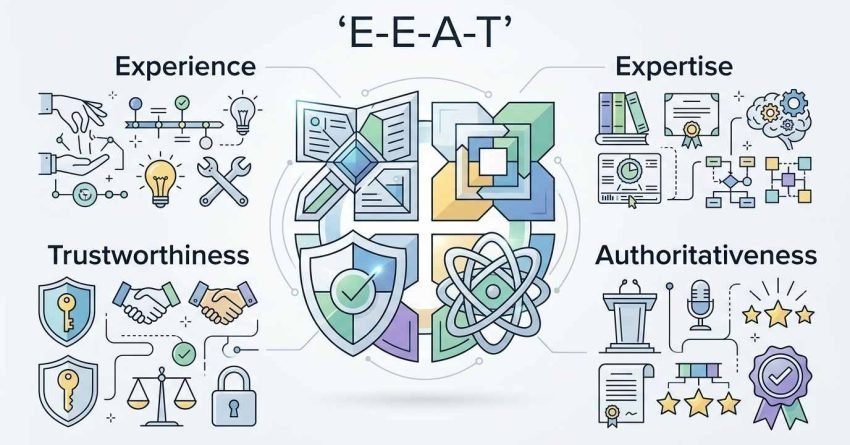
E-E-A-T is a Google quality framework standing for Experience, Expertise, Authoritativeness, and Trustworthiness, and it now shapes how AI search engines like AI Overviews decide which sources to cite and trust. I’ve watched this shift from a “nice-to-have” ranking signal into the actual gatekeeper of visibility.
Search engines can’t verify truth directly, so they verify signals of credibility instead. Ignoring those signals now costs both rankings and AI citations simultaneously.
This guide covers what E-E-A-T actually means and how AI models evaluate it, the four components broken down individually, how to build author and topical authority, the technical and content foundations that support trust, and how to audit and measure your progress.
What Is E-E-A-T and Why Does It Matter for AI Search?
E-E-A-T is a framework Google’s Search Quality Raters Guidelines use to assess content quality, and it stands for Experience, Expertise, Authoritativeness, and Trustworthiness. It isn’t a single ranking factor you can toggle on. It’s a lens search systems and AI models apply to decide whether a page deserves to be surfaced or cited.
I think of it less as a checklist and more as a reputation system. Google added the second “E” for Experience in December 2022, recognizing that first-hand experience is different from textbook expertise.
The Four Components of E-E-A-T
Each letter targets a different kind of credibility question. Experience asks whether the creator has actually done the thing. Expertise asks whether they understand it deeply.
Authoritativeness asks whether others recognize that expertise. Trustworthiness asks whether the site and content are accurate, secure, and transparent, and it sits above the other three as the most heavily weighted factor.
How E-E-A-T Differs From Traditional Ranking Factors
Traditional ranking factors are largely mechanical: page speed, keyword placement, backlink counts. E-E-A-T is evaluative and contextual, built to be assessed the way a human reader would judge credibility.
That distinction matters more now because AI systems generate answers instead of just listing links, and a generated answer inherits the credibility of whatever it cites.
How AI Search Engines Evaluate Trust and Authority
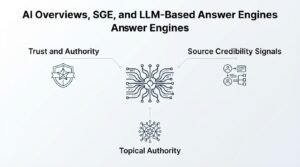
AI search engines evaluate trust and authority by retrieving passages from indexed content and ranking them based on source credibility signals before generating a synthesized answer. This retrieval step happens before any language generation, which means classic E-E-A-T signals still gate what the AI ever sees.
I’ve noticed AI Overviews consistently pull from pages with clear authorship, structured data, and citation-worthy statistics rather than generic marketing copy.
AI Overviews, SGE, and LLM-Based Answer Engines
AI Overviews, along with tools like ChatGPT search and Perplexity, don’t crawl the web fresh for every query. They rely on pre-built indexes and real-time retrieval layers that favor pages already demonstrating strong topical authority.
A page with thin authorship and no supporting citations rarely gets pulled into these systems, regardless of how well it’s written.
How Retrieval-Augmented Generation (RAG) Selects Sources
Retrieval-Augmented Generation works by fetching the most relevant, credible passages from a knowledge base and feeding them to the language model as grounding context. According to Google’s own AI features documentation, sources are selected based on the same quality signals used in traditional search, with an added emphasis on clear, extractable factual statements.
Content that answers questions directly, in self-contained sentences, has a structural advantage in this selection process.
Experience – Demonstrating First-Hand Knowledge
Experience refers to content created by someone who has genuine, first-hand involvement with the topic, such as a business owner describing their own SEO campaign results rather than paraphrasing someone else’s. Google explicitly added this signal because AI-generated and outsourced content often lacks it entirely.
Author Bios and Byline Credentials
A visible author bio connecting the writer to real credentials and past work is one of the clearest experience signals a page can carry. I always recommend linking that bio to an author page listing other published work and professional background.
Screenshots, original photos, and specific numbers from a real campaign all reinforce that the content wasn’t fabricated from secondhand research.
Expertise – Proving Subject-Matter Depth
Expertise means the content demonstrates deep, accurate knowledge of the subject, going beyond surface-level summaries into the mechanics of how something actually works. For YMYL topics like finance or health, formal credentials matter more; for topics like SEO, demonstrated skill often counts just as much.
Content Depth vs. Content Length
Depth is about answering the follow-up questions a knowledgeable reader would naturally ask, not about hitting a word count. A 600-word article that explains the “why” behind a mechanism often out-competes a padded 2,000-word piece that never gets specific.
I judge expertise by whether the content could only have been written by someone who understands the topic’s edge cases.
Authoritativeness – Building Topical and Industry Authority
Authoritativeness measures whether other credible sources, sites, and people recognize a website or author as a go-to reference on a given topic. It’s earned externally, through citations, mentions, and links from other authoritative sources, not claimed internally through self-description.
Topical Authority and Content Clusters
Topical authority is built by comprehensively covering a subject area through a structured hub of interlinked pages, rather than one isolated article. Search engines and AI systems both reward sites that demonstrate full-domain coverage over sites with a single strong page surrounded by thin content.
Digital PR and Third-Party Mentions
Digital PR campaigns generate the kind of independent, third-party mentions that function as authority votes AI systems can weigh. A study by Backlinko analyzing over 11 million search results found that referring domains remain one of the strongest correlating factors with top rankings.
Being quoted in industry publications or cited in journalist roundups builds authority signals that are difficult to fabricate at scale.
Trustworthiness – The Foundation Signal of E-E-A-T
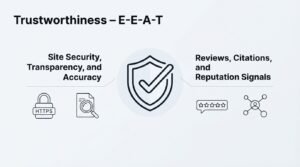
Trustworthiness is the degree to which a website’s content is accurate, transparent, and safe for users, and Google’s own guidelines treat it as the most important of the four E-E-A-T components. A page can show strong experience and expertise and still fail if the site itself feels unreliable or deceptive.
Site Security, Transparency, and Accuracy
Clear contact information, an accurate about page, HTTPS security, and factually correct content all contribute directly to trust signals. Sites that hide ownership information or make unverifiable claims struggle to earn AI citations even when the writing quality is high.
Reviews, Citations, and Reputation Signals
Third-party reviews on platforms like Google Business Profile or Trustpilot feed directly into how both users and AI systems assess reputation. Consistent, verifiable citations of the business across the web reinforce that the entity behind the content is real and established.
Author Entity Building and Knowledge Panels
An author entity is a recognized, structured identity that search engines associate with a specific person’s body of published work across the web. Building one turns an anonymous writer into a verifiable expert that AI systems can cross-reference.
Structured Data for Author Markup
Schema.org’s Person and Author markup lets search engines connect a byline to a consistent identity across multiple domains and publications. Consistent naming, matching social profiles, and a well-maintained author page all strengthen this entity over time.
Content Strategies That Signal E-E-A-T to AI Models
Content strategies that signal E-E-A-T center on producing original insight that couldn’t be copied from another source, rather than reformatting existing top-ranking content. AI models are specifically tuned to detect and deprioritize derivative, low-novelty content.
Original Research and Data
Publishing original surveys, proprietary data, or unique analysis gives AI systems something citable that exists nowhere else. This is one of the fastest ways a smaller site can out-rank a larger competitor on a specific query.
Case Studies and Real-World Examples
Documented case studies with specific numbers, timelines, and outcomes demonstrate experience and expertise simultaneously. Vague success stories without verifiable detail carry almost none of the same weight.
Technical Foundations That Support E-E-A-T
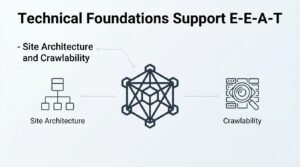
Technical SEO foundations support E-E-A-T by ensuring search engines and AI crawlers can actually access, render, and correctly interpret a site’s content. No amount of expertise matters if a crawler can’t reach the page or misreads its structure.
Site Architecture and Crawlability
A logical site architecture with clear internal linking helps both search bots and AI retrieval systems understand how topics relate to each other. Pages buried five clicks deep with no internal links rarely accumulate the authority signals needed for citation.
Backlinks and Off-Site Authority Signals
Backlinks remain one of the clearest external validation signals search engines use to gauge a page’s authority, functioning as votes of confidence from other sites. AI ranking systems inherit this signal because it was already baked into the search index they draw from.
Link Quality vs. Link Quantity
A handful of links from recognized, topically relevant publications outweighs hundreds of links from low-quality directories. I’ve seen single mentions from industry-leading publications move rankings more than months of volume-based outreach.
How to Audit Your Site’s Current E-E-A-T Signals
An E-E-A-T audit involves systematically reviewing author credentials, content accuracy, site trust signals, and external authority mentions across a website. Running this audit quarterly catches gaps before they affect rankings.
E-E-A-T Audit Checklist
- Confirm every article has a visible, credentialed author byline
- Verify About, Contact, and Privacy pages are complete and accurate
- Check for HTTPS and basic technical security signals
- Review whether claims are backed by cited sources
- Search the brand name to confirm third-party mentions exist
- Assess whether content clusters cover topics comprehensively
- Check Schema markup for Author and Organization entities
Common E-E-A-T Mistakes That Hurt AI Search Visibility
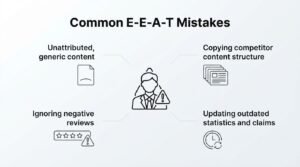
The most common E-E-A-T mistake is publishing unattributed, generic content with no visible author, credentials, or original insight. This single issue affects visibility more than any individual technical error.
Other frequent mistakes include copying competitor content structure without adding new value, ignoring negative reviews instead of addressing them, and neglecting to update outdated statistics and claims across older pages.
Measuring the Impact of E-E-A-T on Organic Performance
E-E-A-T’s impact is measured indirectly, through metrics like organic visibility, click-through rate, branded search volume, and AI citation frequency rather than a single dedicated score. There’s no “E-E-A-T score” in any Google tool, so tracking relies on correlated signals instead.
Key Metrics to Track (GSC, GA4, Rankings)
Google Search Console shows impressions and average position trends that often shift after authorship and trust improvements take hold. GA4 branded search traffic and direct visits tend to rise as authority-building efforts compound over several months.
Conclusion
E-E-A-T ties experience, expertise, authority, and trust into one reputation system that both traditional search and AI engines now depend on. As AI-generated answers keep expanding, the sites treating these signals as core strategy will keep earning citations while others fade.
We build these foundations into every campaign we run for clients. Partner with White Label SEO Service to turn your site’s credibility into measurable, sustainable organic growth.
Frequently Asked Questions
What does E-E-A-T stand for in SEO?
E-E-A-T stands for Experience, Expertise, Authoritativeness, and Trustworthiness. Google uses this framework to assess content quality, and Trustworthiness is weighted as the most important component.
Does E-E-A-T directly affect Google rankings?
E-E-A-T is not a single direct ranking factor but a quality framework that influences how algorithms and human raters assess content. Sites demonstrating strong E-E-A-T signals tend to rank and get cited more consistently.
How does E-E-A-T apply to AI search engines like AI Overviews?
AI Overviews retrieve and cite sources based on the same credibility signals E-E-A-T measures, including authorship and topical authority. Content lacking these signals is rarely selected for AI-generated answers.
Can a business improve E-E-A-T without a big-name author?
Yes, businesses can build E-E-A-T through verifiable credentials, original data, case studies, and transparent site information rather than celebrity authorship. Consistency and accuracy matter more than fame.
How long does it take to build E-E-A-T signals?
Meaningful E-E-A-T improvements typically take three to six months to influence rankings, since third-party trust signals accumulate gradually. Technical and on-page fixes show impact faster than authority-building efforts.
Does E-E-A-T matter more for YMYL websites?
Yes, Your-Money-Your-Life sites like finance, health, and legal services face stricter E-E-A-T scrutiny because inaccurate information carries higher real-world risk. Google’s raters apply extra scrutiny to author credentials on these topics.
What is the fastest way to start improving E-E-A-T?
The fastest starting point is adding complete, credentialed author bios and an accurate About page across the site. These changes are low-effort but directly address the most commonly missing trust signals.