Search engine optimization is the practice of improving a website so search engines can find, understand, and rank its pages for relevant queries. The history of SEO spans roughly three decades, moving from crude keyword matching in the early 1990s to entity-based, AI-mediated retrieval in 2026.
I have watched this shift up close, and the pattern matters more than the trivia. Every ranking tactic that ever collapsed collapsed for the same reason, and knowing that reason protects budget.
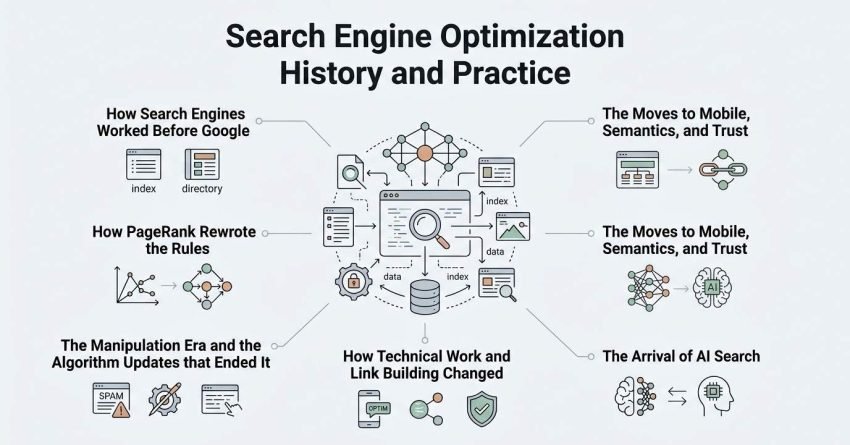
This guide covers how search engines worked before Google, how PageRank rewrote the rules, the manipulation era and the algorithm updates that ended it, the moves to mobile, semantics, and trust, how technical work and link building changed, the arrival of AI search, and what the whole record says about realistic timelines and safe investment today.
What Is SEO and Why Its History Still Shapes Rankings Today
SEO is the process of aligning a website’s technical structure, content, and authority signals with how a search engine retrieves and ranks results. Its history matters because Google rarely deletes old ranking logic. It layers new systems on top of the old ones.
I tell clients this constantly. Nothing in the 1998 link graph got switched off in 2024. It got supplemented, weighted differently, and wrapped in machine learning. The underlying question a search engine asks has never changed.
The Core Definition of Search Engine Optimization
Search engine optimization is a discipline that combines technical site health, content relevance, and external authority to earn organic visibility. Those three pillars appeared in different decades and now operate simultaneously.
Every serious SEO strategy still splits along those exact lines. The proportions shift by site and industry, but the categories do not.
Why Algorithm History Predicts Future Ranking Behavior
Google’s updates follow a repeating shape. A signal becomes cheap to manipulate, manipulation floods the index, quality drops, and an update devalues the signal without removing it entirely.
That cycle ran on keywords, then on links, then on content volume, and it is running right now on AI-generated pages. Recognising the shape early is worth more than memorising update names.
The Pre-Google Era: Directories, Crawlers, and the First Search Engines (1990–1997)
Before Google, search results came from either human-curated directories or primitive crawlers that ranked pages almost entirely on on-page keyword frequency. Neither approach measured whether a page was actually any good.
I find this period genuinely useful to understand. It shows what search looks like without an authority signal, and the answer is chaos.
Archie, Gopher, and the Birth of Web Indexing
Archie, released in 1990, is widely credited as the first internet search tool, indexing file names on public FTP servers. Gopher-based tools like Veronica followed, and the first true web crawlers, including WebCrawler and Lycos, arrived in 1994.
These systems indexed text. They had no way to judge importance.
Yahoo Directories vs. Early Crawler-Based Engines
Yahoo launched in 1994 as a hand-built directory where editors categorised sites manually. AltaVista, Excite, and Infoseek took the crawler route, ranking by keyword matching and meta tag content.
Directory inclusion depended on human review. Crawler rankings depended on repeating your target term, which meant the first optimisation tactic in history was simply saying the keyword more times than anyone else.
How PageRank Changed Everything: Google’s Arrival (1998–2002)
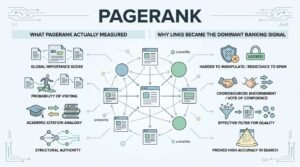
PageRank is a link analysis algorithm that scores a page’s importance based on the quantity and quality of pages linking to it. Google’s founders published it in 1998, and it solved the problem every earlier engine had failed to solve.
The insight was borrowed from academic citation. A paper cited by many respected papers is probably important. A page linked by many respected pages is probably important too.
What PageRank Actually Measured
PageRank measured the probability that a person randomly clicking links would arrive at a given page. A link from a highly-linked page passed more value than a link from an obscure one.
This made ranking resistant to on-page manipulation for the first time. You could not simply declare your own page important. Someone else had to.
Why Links Became the Dominant Ranking Signal
Because PageRank worked so well, the entire industry reoriented around acquiring links. Rankings became a function of link acquisition more than content quality throughout the early 2000s.
That created an obvious incentive. If links decide rankings, and links can be bought, built, or traded, then links will be bought, built, and traded at scale. Modern link building strategy still carries the scar tissue from what happened next.
The Keyword Stuffing and Link Farm Era (2000–2010)
Between 2000 and 2010, ranking manipulation was cheap, effective, and widespread. Google’s systems were strong enough to reward links but not yet strong enough to reliably detect artificial ones.
I started in this era. The tactics below worked, sometimes spectacularly, and almost all of them now carry penalty risk.
Common Manipulation Tactics of the Period
The dominant tactics were remarkably crude by current standards:
- Keyword stuffing – repeating a target phrase dozens of times in body copy, meta tags, and alt text
- Hidden text – white text on white backgrounds, or text pushed off-screen with CSS
- Doorway pages – thin pages built for one keyword variation each, funnelling to a single destination
- Link farms – networks of sites existing only to link to each other
- Reciprocal link schemes – “link to me and I’ll link to you” exchanges at scale
- Article spinning – software rewriting one article into hundreds of near-duplicates
- Comment and forum spam – automated link drops across unmoderated sites
Each one exploited a signal Google trusted more than it could verify.
Why These Tactics Worked and Then Stopped Working
They worked because Google’s early systems counted signals rather than evaluating them. A link was a link and a keyword was a keyword.
They stopped working when Google gained enough data and computing power to model what natural content and natural link profiles actually look like. Manipulation became statistically visible.
Google’s Major Algorithm Updates and What Each One Punished
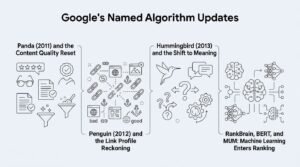
Google’s named algorithm updates each targeted a specific manipulation pattern that had grown too large to ignore. The table below shows what each major update addressed.
| Update | Year | Primary Target | Lasting Effect |
| Panda | 2011 | Thin, duplicate, low-value content | Content quality became a sitewide signal |
| Penguin | 2012 | Manipulative link profiles | Link quality outweighed link volume |
| Hummingbird | 2013 | Literal keyword matching | Query meaning replaced query strings |
| Mobilegeddon | 2015 | Non-mobile-friendly pages | Mobile usability became a ranking factor |
| RankBrain | 2015 | Unseen and ambiguous queries | Machine learning entered core ranking |
| Medic | 2018 | Low-trust health and finance sites | E-A-T applied to YMYL topics |
| BERT | 2019 | Misread query context | Natural language understanding improved |
| Core Web Vitals | 2021 | Poor page experience | Speed and stability became measurable inputs |
| Helpful Content | 2022 | Search-engine-first content | Content purpose became assessable |
| Site Reputation Abuse | 2024 | Parasite SEO on trusted domains | Host authority stopped transferring freely |
Panda (2011) and the Content Quality Reset
Panda was a Google algorithm update that demoted sites with thin, duplicated, or low-value content across the whole domain rather than page by page. It launched in February 2011 and affected roughly 12% of English queries according to Google’s own announcement.
Content farms producing thousands of shallow articles lost most of their traffic within weeks. Panda established that one section of weak pages could drag down an entire site.
Penguin (2012) and the Link Profile Reckoning
Penguin targeted sites whose backlink profiles showed clear signs of purchase, exchange, or automated creation. Launched in April 2012, it made unnatural links a liability rather than dead weight.
This was the moment link building split into two industries. One continued buying links and absorbing penalties, and the other moved toward earned coverage.
Hummingbird (2013) and the Shift to Meaning
Hummingbird rebuilt Google’s core ranking infrastructure to interpret the intent behind a query rather than matching its literal words. It was the first step toward semantic search, where concepts carry more weight than exact phrases.
After Hummingbird, a page could rank for a query containing none of its exact keywords, provided it answered the underlying question.
RankBrain, BERT, and MUM: Machine Learning Enters Ranking
RankBrain introduced machine learning to query interpretation in 2015, initially handling roughly 15% of daily queries Google had never seen before. BERT followed in 2019, applying transformer-based language models to understand prepositions and word relationships, and MUM arrived in 2021 with multimodal and multilingual capability.
These systems did not add new ranking factors. They improved Google’s reading comprehension, which quietly raised the bar on content quality standards without anyone announcing a threshold.
The Mobile Revolution and Page Experience (2015–2021)
Mobile search overtook desktop search in 2015, and Google’s ranking systems followed within the same year. Page experience stopped being a usability concern and became a measurable ranking input.
I still meet site owners who treat mobile as secondary. Google has indexed mobile-first by default since 2019.
Mobilegeddon and Mobile-First Indexing
The April 2015 update nicknamed Mobilegeddon boosted mobile-friendly pages in mobile search results. Mobile-first indexing followed, meaning Google crawls and evaluates the mobile version of a page as the primary version.
A desktop-perfect site with a broken mobile layout is now, functionally, a broken site.
Core Web Vitals as a Ranking Input
Core Web Vitals are a set of measurable page experience metrics covering loading speed, interactivity, and visual stability. Google confirmed them as ranking signals in the 2021 page experience update.
They act as tiebreakers rather than primary factors. Strong technical performance rarely outranks better content, but weak performance loses close contests.
From Keywords to Entities: The Semantic Search Shift
Semantic search is an approach where search engines rank pages based on understood concepts and their relationships rather than matching keyword strings. Google’s Knowledge Graph, launched in 2012, marked the formal beginning of this shift.
This is the single most important change for anyone planning content today. Optimising for a phrase is now less effective than covering a subject.
The Knowledge Graph and Entity Understanding
The Knowledge Graph is a database of entities: people, places, organisations, concepts and the verified relationships between them. Google announced it in May 2012 with over 500 million entities at launch.
Once Google models entities rather than strings, it can recognise that two pages using entirely different vocabulary discuss the same subject. Synonym stuffing stopped adding value overnight.
Topical Authority Replaces Keyword Density
Topical authority is the depth and completeness of a site’s coverage across a subject area, measured by how thoroughly it addresses related questions and entities. It replaced keyword density as the practical target for content planning.
A site covering one subject exhaustively outranks a site covering fifty subjects shallowly. That principle now drives how I structure every content plan, and it is why individual pages need to sit inside deliberate topic clusters rather than standing alone.
E-E-A-T and the Rise of Trust as a Ranking Framework
E-E-A-T is Google’s quality framework standing for Experience, Expertise, Authoritativeness, and Trustworthiness, used by human quality raters to evaluate search results. Google added the second E for Experience in December 2022.
E-E-A-T is not a direct ranking factor with a score attached. It describes what Google’s actual ranking systems are collectively trying to approximate.
What Search Quality Rater Guidelines Introduced
Google’s Search Quality Rater Guidelines are public documentation instructing thousands of human evaluators on how to assess result quality. The guidelines do not change rankings directly, but they reveal the target Google’s engineers are optimising toward.
Reading them tells you what “good” means to Google in plain language, which is more useful than most ranking factor lists.
YMYL Topics and Elevated Scrutiny
YMYL stands for Your Money or Your Life, covering topics that affect health, financial stability, safety, or wellbeing. Google applies substantially stricter quality standards to these queries.
The 2018 Medic update demonstrated the cost of failing here. Health and finance sites without visible author credentials lost significant visibility, and demonstrating author expertise became a structural requirement rather than a nice addition.
The Helpful Content Era and the War on Scaled Low-Value Pages (2022–2024)
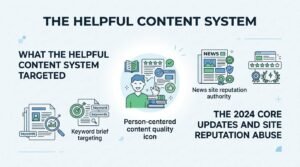
The Helpful Content System was a Google ranking signal launched in August 2022 that demoted content created primarily for search engines rather than people. It folded into Google’s core ranking systems in March 2024.
This period marked a shift in how Google framed quality. The question moved from “is this content accurate” to “why does this page exist?”
What the Helpful Content System Targeted
The system targeted content written to a keyword brief with no first-hand knowledge, sites covering topics far outside their established subject area, and pages summarising what others have written without adding anything.
Google’s March 2024 core update reduced low-quality, unoriginal content in search results by a reported 45%, according to Google’s Search Central announcement.
The 2024 Core Updates and Site Reputation Abuse
Site reputation abuse, often called parasite SEO, is the practice of publishing unrelated commercial content on a high-authority domain to borrow its ranking strength. Google introduced a specific policy against it in March 2024.
Established news sites hosting casino and coupon sections lost those sections from search. Domain authority stopped acting as a blanket permission slip.
How Technical SEO Evolved Alongside the Algorithms
Technical SEO is the practice of optimising a site’s infrastructure so search engines can crawl, render, and index its content efficiently. Its scope has widened with every change to how Google processes pages.
The work got harder as the web got more complex. Static HTML was easy to crawl, and modern JavaScript applications are not.
From Meta Tags to Crawl Budget and Rendering
Early technical SEO meant writing meta keywords and title tags. Current technical SEO covers crawl budget allocation, JavaScript rendering, server response times, canonical logic, and index bloat.
Crawl budget is the number of URLs a search engine will request from a site within a given period. It becomes a practical constraint on sites above roughly ten thousand URLs, and most large-site crawl issues trace back to it.
Structured Data and Machine-Readable Pages
Structured data is standardised markup that describes a page’s content to machines in an explicit, unambiguous format. Schema.org launched in 2011 as a joint effort by Google, Bing, Yahoo, and Yandex.
Structured data does not directly improve rankings. It improves how accurately machines understand the page, which matters more every year as AI systems parse content without rendering it visually.
How Link Building Changed From Volume to Editorial Merit
Link building shifted from a volume game measured in raw link counts to a relevance and editorial merit game measured in genuine coverage. Penguin forced the change in 2012, and every update since has reinforced it.
The economics reversed completely. Cheap links became a liability, and expensive links became the only ones worth acquiring.
Directory Submissions, Reciprocal Links, and PBNs
The old toolkit centred on submitting to hundreds of directories, trading links with anyone willing, and building private blog networks of expired domains pointing at money sites.
All three are now detectable at scale. Private blog networks in particular carry deindexation risk, not just ranking suppression.
Digital PR and Earned Authority
Digital PR is the practice of earning editorial coverage and links by producing newsworthy research, data, or commentary that journalists genuinely want to cite. It replaced acquisition tactics with publication tactics.
A single link from a national publication now outweighs hundreds of directory listings. The cost per link rose sharply, and so did the durability of the result.
The AI Search Era: AI Overviews, Chat Assistants, and Zero-Click Results
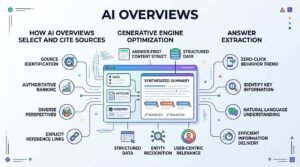
AI Overviews are AI-generated summaries that appear above organic results, synthesising information from multiple sources and citing them inline. Google began rolling them out broadly in May 2024.
This is the most significant interface change since the 2012 Knowledge Graph. Search results increasingly answer the question directly rather than routing users to a page.
How AI Overviews Select and Cite Sources
AI Overviews extract individual sentences and passages rather than ranking whole pages. A page can be cited without ranking in the top ten, and a page ranking first can be omitted entirely.
Extraction favours content where claims stand alone. A sentence that names its own subject, states a complete fact, and attributes its source inside the same sentence survives being lifted out of context.
Generative Engine Optimization and Answer Extraction
Generative engine optimization is the practice of structuring content so AI systems can accurately extract, attribute, and cite it. It does not replace traditional SEO; it sits on top of it.
The practical requirements are specific. Answer-first openings under every heading, self-contained sentences that avoid pronoun dependency, entity definitions written in a consistent shape, and source attribution placed in the same sentence as every statistic.
Zero-click behaviour is already measurable. Similarweb research from 2024 found the share of news-related searches ending without a click rose from 56% to 69% after AI Overviews launched.
What Has Never Changed in 30 Years of SEO
Three requirements have survived every algorithm update since 1998, and every tactic that ever worked was really just an attempt to satisfy one of them.
The Three Constants: Crawlability, Relevance, Authority
- Crawlability – a search engine must be able to reach, render, and index the page. This was true for AltaVista in 1995, and it is true for Google’s AI systems now.
- Relevance – the page must genuinely address what the searcher wants. The measurement moved from keyword matching to entity understanding, but the requirement never moved.
- Authority – something external must vouch for the page. PageRank measured it through links, and E-E-A-T measures it through a wider set of trust signals.
Every failed tactic in SEO history was an attempt to fake one of these three. Every durable strategy was an attempt to actually achieve them.
Realistic SEO Timelines Then and Now
Modern SEO typically produces meaningful organic traffic growth in four to twelve months, compared with weeks or a few months in the mid-2000s. The gap comes from higher competition, stricter quality thresholds, and Google’s longer evaluation periods for new sites.
I am direct with clients about this because unrealistic timelines cause more abandoned campaigns than poor execution does.
Why Rankings Moved Faster in 2005 Than 2026
In 2005, a site with correct on-page optimisation and a few dozen links could rank in weeks. Competition was thin, quality thresholds were low, and Google’s index was small enough that new pages surfaced quickly.
Three things changed. The index grew by orders of magnitude, the quality bar rose with every update, and Google introduced evaluation delays for new domains and new content.
What a Modern SEO Timeline Actually Looks Like
Here is the shape I see repeatedly across campaigns:
| Phase | Timeframe | What Happens |
| Foundation | Months 1–2 | Technical fixes, audit, keyword and content mapping |
| Early signals | Months 3–4 | Impressions rise, long-tail rankings appear |
| Traction | Months 5–8 | Mid-competition terms enter page one, traffic compounds |
| Momentum | Months 9–12 | Competitive terms move, conversions become predictable |
| Compounding | Month 12+ | Authority accrues, new content ranks faster |
Sites with existing authority compress this. Brand-new domains in competitive verticals extend it, and understanding realistic SEO timelines before committing budget prevents most of the frustration I see.
What does SEO history mean for how I should invest today?
Lessons From SEO History That Protect Your Investment Today
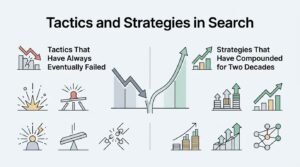
Thirty years of algorithm updates produced a clear and repeatable split between tactics that always eventually failed and strategies that compounded. The pattern is consistent enough to use as a filter.
Tactics That Have Always Eventually Failed
Every one of these delivered short-term gains before being devalued or penalised:
- Buying links at scale
- Publishing content primarily for search engines rather than readers
- Exact-match keyword repetition beyond natural use
- Thin pages built for keyword variations
- Borrowing another domain’s authority for unrelated content
- Automated content generation without editorial oversight
They share one trait. Each one attempts to signal quality without producing it.
Strategies That Have Compounded for Two Decades
Four approaches have gained value with every update rather than losing it: genuine subject depth, technical site health, earned editorial coverage, and demonstrated first-hand experience.
None of them produce fast results. All of them survive algorithm changes, which is the only durability that matters over a multi-year horizon.
Where Search Optimization Is Heading Next
Search is moving toward answer delivery rather than link delivery, and optimisation is following it. The measurable unit is shifting from ranking position to citation frequency across AI systems.
Three directions look settled. Extraction-ready content structure becomes a baseline requirement rather than an advantage, brand and entity recognition matter more than individual page optimisation, and first-hand experience becomes the hardest signal to fake as AI-generated content saturates the index.
The underlying work does not change. Crawlable, genuinely relevant, externally validated content still wins, and it will keep winning because no retrieval system has ever found a better proxy for quality.
Conclusion
Thirty years of SEO history show a single repeating pattern: manipulable signals get manipulated, then devalued, while genuine quality signals compound in value.
That record is the best available guide to the AI search era, where citation replaces clicks and extraction structure decides visibility.
We build strategies around what has always worked, not what works this quarter. Talk to White Label SEO Service about sustainable organic growth.
Frequently Asked Questions
When did SEO officially start?
SEO began around 1997, when the term first entered common use. Early optimisation tactics existed from 1994 onward, alongside the first web crawlers.
What was the first major Google algorithm update?
Florida, launched in November 2003, was the first major Google update to significantly disrupt rankings. It targeted keyword stuffing and low-quality affiliate sites.
Does keyword density still matter in SEO?
Keyword density no longer matters as a ranking factor. Google has used entity and intent understanding since Hummingbird in 2013, making topical coverage far more important.
How has AI changed SEO?
AI changed SEO by shifting visibility from ranked links to extracted citations. AI Overviews lift individual sentences, so content must be self-contained and clearly attributed.
Are backlinks still a ranking factor?
Backlinks remain a confirmed Google ranking factor. Link quality and editorial relevance now outweigh volume, and manipulative links carry penalty risk rather than value.
How long does SEO take to work now compared to the past?
SEO takes four to twelve months today, versus weeks in the mid-2000s. Higher competition and stricter quality thresholds extended every phase of the timeline.
Will SEO still exist in ten years?
SEO will exist as long as information retrieval exists. The interface changes, but crawlability, relevance, and authority remain the requirements every system measures.