SEO myths are widely repeated claims about search optimization that contradict how search engines actually rank and reward pages. The eight most damaging myths involve timelines, rankings, keywords, content volume, backlinks, technical work, paid search, and return on investment. Every one of them changes how a business buys SEO.
I have watched good companies waste entire annual budgets because nobody corrected the assumption underneath the purchase. The myth came first. The bad decision followed.
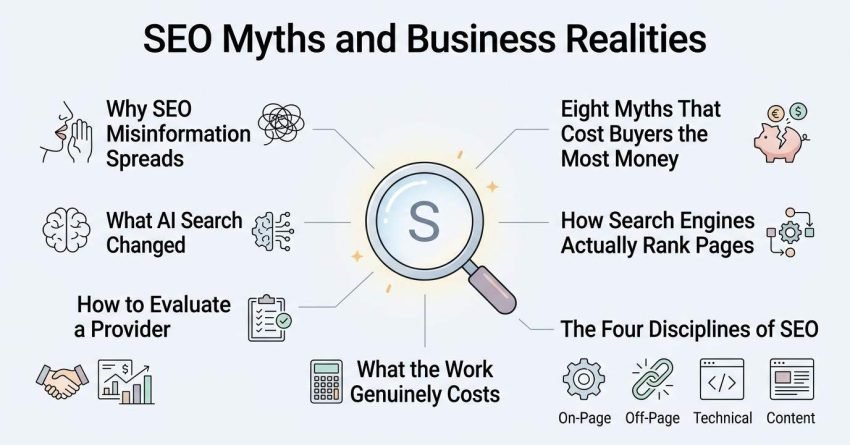
This guide covers why SEO misinformation spreads, the eight myths that cost buyers the most money, how search engines actually rank pages, the four disciplines of SEO and where each one fits, what the work genuinely costs, how to evaluate a provider, and what AI search changed about realistic expectations.
Why SEO Myths Persist in the Buying Process
SEO myths persist because search engines never publish a complete ranking formula, which leaves a vacuum that outdated advice, sales pressure, and confirmation bias rush to fill. Buyers have no easy way to verify claims before signing.
The information gap is real. Google confirms over 200 ranking signals exist but has never released the full list or their weightings, so every explanation in the market is an informed reconstruction rather than documented fact.
That ambiguity rewards confident voices over accurate ones. A provider promising page one in six weeks sounds more decisive than one explaining variance across competitive landscapes, and decisiveness closes deals.
Where Bad SEO Advice Comes From
Most bad SEO advice is simply expired advice. Tactics that worked in 2012 exact-match anchor text at scale, keyword density targets, article directory submissions were genuinely effective before Panda, Penguin, and a decade of machine learning rewrote the scoring.
The rest comes from incentive misalignment. Agencies paid on retainer have reason to emphasize the metrics they can move quickly, and clients who do not know which metrics matter accept whichever chart trends upward.
What Believing a Myth Actually Costs
A single SEO myth typically costs a business one to two quarters of wasted budget plus the opportunity cost of the correct work not being done. The second number is usually larger than the first.
I see it most often with link buying. A company spends four months acquiring paid placements, gets filtered or penalized, then spends another three months on cleanup before any real progress begins.
Myth 1: SEO Delivers Results in 30 Days
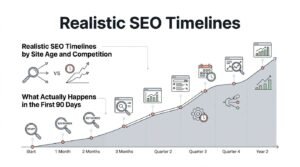
SEO does not deliver meaningful organic results in 30 days, and any provider promising it is either misrepresenting timelines or planning to report on vanity metrics. Realistic timelines for measurable traffic movement run four to twelve months depending on domain age, competition, and starting technical health.
An Ahrefs study of two million keywords found only 5.7% of pages reached the top 10 for any keyword within one year of publication, and the pages that did took an average of two to six months.
The delay is structural, not a sign of slow work. Google must crawl the change, reindex the page, observe user behavior across enough sessions to gather signal, and then revise its assessment a loop that takes weeks per iteration regardless of execution quality.
What Actually Happens in the First 90 Days
The first 90 days of any competent SEO engagement produce infrastructure, not rankings. Technical audit, crawl fixes, information architecture, keyword mapping, and initial content all land in this window, and none of them move revenue yet.
What you should see by day 90 is improved crawl coverage in Search Console, faster indexation of new URLs, and early impression growth on low-competition terms. Those are leading indicators.
Treating month three as a performance checkpoint rather than a results checkpoint is the single easiest expectation to reset with a leadership team.
Realistic SEO Timelines by Site Age and Competition
This table shows typical time-to-meaningful-traffic ranges across common starting positions.
| Starting position | Competition level | First measurable traffic lift | Material revenue impact |
| New domain, no history | Low | 6–9 months | 12–18 months |
| New domain, no history | High | 12–18 months | 18–24 months |
| Established site, weak SEO | Low | 3–5 months | 6–9 months |
| Established site, weak SEO | High | 6–10 months | 12–15 months |
| Established site, strong SEO | Any | 2–4 months | 5–8 months |
Domain age matters because trust signals accumulate slowly, and a site with existing crawl history and backlink equity starts several steps ahead of a domain registered last month.
Myth 2: Ranking #1 Is the Goal
Ranking first is a means, not a goal, because position one on a query nobody searches with no commercial intent produces zero business value. The goal is qualified organic traffic that converts, and position is one input into that outcome.
Click-through rates make the point plainly. Advanced Web Ranking’s CTR data shows position one averages roughly 28% organic CTR on desktop, meaning the majority of searchers still do not click the top result.
I would rather hold position four on a high-intent commercial query than position one on an informational term that never converts. Revenue does not care about ordinal position.
Why Position Alone No Longer Predicts Traffic
The modern SERP is not ten blue links, so position one frequently sits below AI Overviews, People Also Ask boxes, local packs, shopping carousels, and video results. A number-one ranking pushed below the fold by four SERP features performs as a number-five ranking did a decade ago.
Personalization and localization fragment it further. Two users in different cities searching the same term see different orderings, which makes any single reported rank position an average rather than a fact.
The Metrics That Actually Signal Progress
The metrics worth reporting are organic sessions from non-branded queries, impressions and average position trends in aggregate, assisted conversions, and organic pipeline value. Keyword position reports belong in the appendix, not the summary slide.
Search Console impression growth on a keyword cluster is often the earliest honest signal that a strategy is working, because impressions rise before positions consolidate.
Myth 3: More Keywords Means More Traffic
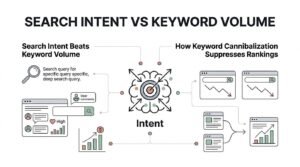
Targeting more keywords does not produce more traffic when those keywords carry no commercial or informational intent match to your pages. Traffic follows intent alignment, not keyword count.
Search intent is the specific outcome a searcher wants from a query, and it determines which page format can rank at all. A commercial query returns comparison and product pages, so a blog post targeting it loses regardless of quality.
I have audited sites tracking 3,000 keywords where 90 of them drove every conversion. The other 2,910 were reporting noise.
Search Intent Beats Keyword Volume
Volume tells you how many people search; intent tells you whether they will buy, and only the second one pays for the work. A term with 200 monthly searches and clear purchase intent regularly outperforms one with 20,000 searches and informational intent.
Proper keyword research classifies every target by intent type before any content is written, which is why the research phase decides more of the outcome than the writing phase.
How Keyword Cannibalization Suppresses Rankings
Keyword cannibalization is a situation where multiple pages on one site compete for the same query, splitting link equity and confusing which URL the search engine should surface. The usual result is that none of the competing pages rank as well as a single consolidated page would.
It happens quietly. A team publishes four articles over two years that all substantially answer the same question, and aggregate rankings for that cluster slowly decline while everyone assumes the topic is simply competitive.
Myth 4: Content Volume Wins
Publishing more content does not improve rankings when that content lacks depth, differentiation, or genuine search demand behind it. Google’s systems reward pages that satisfy a query completely, and volume without quality dilutes a site’s overall assessment.
The Google helpful content guidance states site-wide signals are considered, meaning a large volume of unhelpful pages can suppress the performance of genuinely good pages on the same domain.
Four thin posts a week for a year produce 200 pages that each fail to fully answer anything. One thorough page per week produces 52 that can each own a query.
Why Thin Content Dilutes Site Quality
Thin content is a page that adds no substantive information beyond what already ranks, and it costs more than the wasted production time. Every thin URL consumes crawl budget, creates cannibalization risk, and contributes to a site-wide quality signal that applies to your best pages too.
Pruning is frequently the highest-ROI content action available on an established site. Removing or consolidating 100 underperforming URLs often lifts the remaining pages within a single crawl cycle.
Topical Depth vs Publishing Frequency
Depth and frequency solve different problems, and this table shows where each one actually applies.
| Approach | Best for | Primary risk | Typical outcome |
| High frequency, shallow depth | News, trends, recency-dependent topics | Thin content dilution, cannibalization | Short traffic spikes, no compounding |
| Low frequency, high depth | Evergreen, commercial, competitive topics | Slow initial coverage | Durable rankings that compound |
| Structured clusters | Building topical authority in a niche | Requires upfront planning | Strongest long-term position |
Building topical authority covering a subject comprehensively enough that a search engine treats your domain as a credible source on it comes from structured coverage rather than raw output.
Myth 5: Backlinks Can Be Bought Safely
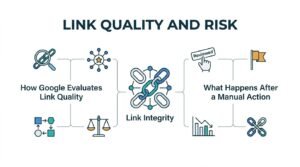
Buying backlinks is never safe in the sense buyers mean, because paid links that pass ranking signals directly violate Google’s link spam policies and carry both algorithmic filtering and manual action risk. The relevant question is not whether you get caught but when the filter catches up.
Enforcement has become quieter and more damaging. Instead of a visible penalty notification, most paid links are now simply devalued, meaning the money is spent, and the links do nothing while the buyer keeps paying for more.
I have never seen a bought-link program produce durable results past eighteen months. The pattern is always the same: rise, plateau, correction.
How Google Evaluates Link Quality
Link evaluation weighs these factors more heavily than raw quantity:
- Topical relevance between the linking page and the target page
- The linking domain’s own authority and traffic profile
- Editorial context: whether the link sits inside genuine content
- Anchor text naturalness across the full backlink profile
- Link velocity relative to the site’s normal acquisition rate
- Whether the linking site sells links to unrelated industries
A single contextual link from a relevant industry publication outperforms fifty directory listings, and the gap has widened every year since 2016.
What Happens After a Manual Action
A manual action is a human review decision at Google that suppresses or removes a site from search results for policy violations, and recovery takes months rather than days. The process requires identifying every offending link, removing or disavowing it, documenting the cleanup, and submitting a reconsideration request.
Recovery is rarely complete. Sites typically return to a lower baseline than they held before the penalty, because the artificial links that inflated performance are now gone.
Myth 6: Technical SEO Is a One-Time Fix
Technical SEO is a continuous maintenance discipline, not a one-time project, because every deployment, plugin update, CMS migration, and content addition introduces new crawl and indexation risk. A site audited clean in January is rarely clean in June.
Technical debt accumulates invisibly. Nothing on the front end looks broken while orphaned pages, redirect chains, duplicate parameter URLs, and broken canonicals quietly degrade crawl efficiency.
Why Technical Debt Accumulates
Most technical debt comes from normal business activity rather than negligence. A marketing team launches campaign landing pages that never get internal links, a developer ships a staging robots directive to production, an ecommerce platform generates faceted URLs by the thousand.
Each individual decision is reasonable. The cumulative effect is a crawl budget spent on URLs that should never be indexed.
The Ongoing Technical Maintenance Cycle
A functional technical SEO maintenance cycle runs on this cadence:
- Weekly – monitor Search Console coverage and Core Web Vitals reports for new errors
- Monthly – run a full crawl and compare against the previous month’s baseline
- Quarterly – review internal linking depth, orphaned pages, and redirect chains
- Per release – validate that no deployment altered robots directives, canonicals, or structured data
- Annually – reassess site architecture against current content volume
A technical SEO audit performed once and shelved is a snapshot of a site that no longer exists.
Myth 7: Google Ads Improves Organic Rankings
Running Google Ads does not improve organic rankings, and Google has stated repeatedly that paid and organic systems operate independently. Ad spend buys placement in the ad slots, nothing more.
The myth survives because correlation looks like causation. A company launches ads and organic traffic rises the same quarter, when the actual cause was the content and technical work running alongside the campaign.
How Paid and Organic Actually Interact
Paid and organic interact through data and SERP real estate rather than ranking influence. Search query reports from paid campaigns reveal converting terms faster than organic testing can, which makes paid a legitimate research accelerator for SEO strategy.
Holding both a paid and an organic listing on the same query also increases total click share, even though neither placement improves the other’s position.
Myth 8: SEO Is a Cost, Not an Asset
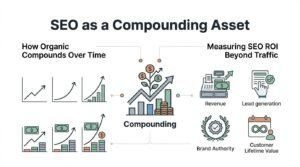
SEO is a compounding asset because the content, links, and technical foundation built this quarter continue producing traffic in future quarters without repeat payment. Paid media stops the day the budget stops; organic does not.
BrightEdge research found organic search drives roughly 53% of all website traffic across industries, making it the largest single acquisition channel for most businesses.
The accounting treatment misleads people. SEO appears as an operating expense on the P&L while behaving economically like a capital investment.
How Organic Compounds Over Time
Compounding happens through three mechanisms working together. Published pages accumulate backlinks over time without further spend, existing rankings improve as domain authority builds from unrelated work, and each new page benefits from the internal link equity of everything published before it.
A page published in year one that earns links through year three ranks better in year three than it did at launch, with no additional investment in that page.
Measuring SEO ROI Beyond Traffic
SEO ROI should be calculated as organic-attributed pipeline value minus total program cost, divided by total program cost, measured across a rolling twelve-month window rather than monthly. Shorter windows systematically understate returns because the cost lands before the revenue.
The useful comparison is paid equivalent value: what you would pay in ad spend to acquire the same organic sessions at current CPCs. On competitive commercial terms, that figure often exceeds the entire SEO retainer within a year.
How Search Engines Actually Rank Pages
Search engines rank pages through a three-stage process: crawling, indexing, and serving, where a page must successfully complete each stage before ranking becomes possible. Most ranking problems are actually stage-one or stage-two problems misdiagnosed as stage-three problems.
Understanding the sequence changes how you prioritize work. There is no point optimizing content on a page that is blocked from crawling.
Crawling, Indexing, and Serving
The pipeline works in this order:
- Discovery – the crawler finds a URL through links, sitemaps, or submitted requests
- Crawling – the crawler requests the page and renders it, including JavaScript
- Indexing – the system parses content, extracts entities, and decides whether to store the page
- Serving – for a given query, candidate pages are retrieved, scored, and ordered
- Refinement – user interaction data feeds back into future scoring for that query
Indexing is not guaranteed. Google explicitly declines to index pages it judges low value, which is why crawl coverage reports matter more than most teams realize.
The Ranking Signals That Carry Real Weight
The signals with the most consistent observable impact are content relevance to query intent, topical authority of the domain, backlink quality and relevance, page experience metrics, and freshness where the query demands it. Exact weighting varies by query type.
Query intent modulates everything. Freshness dominates news queries and barely registers on definitional queries, so a single fixed list of ranking factors describes no real SERP accurately.
The Four Disciplines of SEO and Where Each Fits
SEO divides into four disciplines: technical, on-page and content, off-page authority, and local, and a strategy that neglects any one of them caps the results achievable by the others. Buyers frequently purchase one discipline while believing they purchased all four.
This table shows what each discipline covers and when it becomes the constraint.
| Discipline | Covers | Becomes the bottleneck when |
| Technical SEO | Crawlability, indexation, site speed, structured data, architecture | Pages exist but do not get indexed or rendered properly |
| On-page and content | Intent matching, depth, internal linking, on-page elements | Pages index fine but never reach page one |
| Off-page authority | Backlink acquisition, digital PR, brand mentions | Content is strong, but competitors outrank it consistently |
| Local SEO | Google Business Profile, citations, local landing pages, reviews | Rankings exist nationally but not in the map pack |
Technical SEO
Technical SEO is the discipline that ensures search engines can access, render, and index a site efficiently. It is foundational work invisible when correct, and a hard ceiling on everything else when broken.
On-Page and Content SEO
On-page and content SEO covers matching page content to search intent and structuring it so both readers and parsers extract the answer. This is where most competitive gaps are actually won or lost.
Off-Page and Authority Building
Off-page SEO covers signals originating outside your domain, primarily editorial backlinks and brand mentions that establish credibility. Link building remains the slowest and most expensive discipline, which is exactly why shortcuts stay tempting.
Local SEO
Local SEO optimizes visibility for geographically-qualified queries and map pack placement. It runs on a partially separate signal set: proximity, prominence, and profile completeness, and a nationally strong site can still be invisible locally.
What SEO Costs and What Drives the Price
SEO in the US market typically costs $1,500 to $10,000 per month for retained services, with the range driven by competition level, site size, content volume, and link acquisition targets. Anything under roughly $1,000 monthly rarely funds enough senior hours to move a competitive market.
Price tracks labor, because SEO is almost entirely a services cost. A strategist, technical specialist, writer, and link acquisition resource each consume hours, and the retainer reflects how many hours the scope requires.
Common SEO Pricing Models
| Model | Typical range (US) | Best suited for |
| Monthly retainer | $1,500–$10,000/mo | Ongoing programs needing consistent output |
| Project-based | $5,000–$30,000 | Migrations, audits, one-time builds |
| Hourly consulting | $100–$300/hr | In-house teams needing direction only |
| Performance-based | Variable | Rarely advisable – incentivizes short-term tactics |
Red Flags in an SEO Proposal
Specific ranking guarantees are the clearest disqualifier, because no provider controls the algorithm and anyone claiming otherwise is either inexperienced or dishonest. Guaranteed page-one placement on named keywords belongs in the same category.
Watch for undisclosed link sources, deliverables measured in article count rather than outcome, month-to-month reporting that never mentions revenue, and proposals that skip technical discovery entirely.
How to Evaluate an SEO Provider
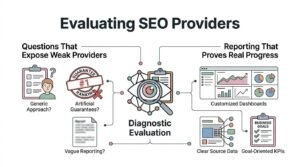
Evaluate an SEO provider on their diagnostic process rather than their promised outcomes, because the quality of the questions they ask before proposing predicts the quality of the work far better than any case study. A provider who quotes before auditing is guessing.
Ask what they would do first and why. A strong answer names a specific constraint on your site; a weak answer describes a generic package.
Questions That Expose Weak Providers
- What would make you decline this engagement?
- Which of our current pages would you remove, and why?
- How do you acquire links, and can you name the last five placements you earned?
- What does month six look like if this goes badly?
- Which metric should we fire you over?
The last question is the most revealing. Providers confident in their process name a metric; providers who are not deflect to “it depends.”
Reporting That Proves Real Progress
Useful SEO reporting leads with organic pipeline contribution, then non-branded organic sessions, then impression and coverage trends, with keyword positions appearing last as supporting detail. Reports that open with rankings are usually hiding weak business results.
I want to see what changed, what it cost, and what it produced, in that order, every month.
How AI Search Changed What SEO Buyers Should Expect
AI Overviews and AI assistants have shifted the outcome of SEO from clicks alone toward citation, meaning a page can influence a buyer without ever receiving a session. Buyers evaluating SEO in 2025 need to accept that some value now arrives unattributed.
Pew Research Center found users clicked a traditional search result on just 8% of visits where an AI summary appeared, compared with 15% where none did.
This does not make SEO obsolete. AI answers are assembled from indexed pages, so the pages that rank are the pages that get cited, and visibility now compounds across two surfaces instead of one.
AI Overviews and Zero-Click Behavior
Zero-click searches are queries resolved entirely within the results page without any onward click, and their share has risen steadily as AI summaries expanded. Informational queries absorb most of the impact while commercial and transactional queries still drive clicks.
The practical response is to shift content investment toward queries where a user must visit a site to complete their task comparisons, pricing, configuration, and purchase decisions.
Why Citation Now Matters as Much as Ranking
Being cited in an AI answer places a brand in front of a buyer at the exact moment of research, even without a click. Generative engine optimization, structuring content so AI systems can extract and attribute it cleanly, has become a parallel discipline to traditional SEO.
The structural requirements overlap heavily with good SEO: direct answers, self-contained sentences, clear entity definitions, and in-sentence source attribution.
Setting Realistic SEO Expectations With Your Team
Set SEO expectations internally by defining what each quarter should produce before the work starts, so leadership evaluates progress against agreed milestones rather than against an imagined timeline. Most SEO engagements fail politically before they fail technically.
The conversation to have upfront is what happens if month six shows infrastructure progress and no revenue yet. Agreeing on that answer in advance prevents a good program from being cancelled at its slowest visible point.
Milestones Worth Reporting Each Quarter
- Q1 – technical baseline clean, keyword map approved, first content live, indexation improving
- Q2 – impression growth on target clusters, first page-two positions, link acquisition underway
- Q3 – page-one positions on lower-competition terms, measurable non-branded session growth
- Q4 – organic-attributed pipeline visible, compounding evident on Q1 content
Anchoring the team to this sequence converts an abstract wait into a tracked build, which is the difference between patience and doubt.
Conclusion
These eight myths share one root cause: SEO produces compounding, delayed results while buyers evaluate it on immediate, visible ones.
Correct expectations change decisions. Understanding timelines, ranking mechanics, link risk, and true ROI turns SEO from a gamble into a planned, measurable investment.
We built White Label SEO Service for teams who want that clarity. Talk to us about what realistic growth looks like for your site.
Frequently Asked Questions
How long does SEO take to show results?
SEO typically shows measurable traffic movement in four to twelve months. New domains and competitive markets sit at the longer end, while established sites with existing authority move faster.
Is SEO still worth it with AI Overviews?
SEO remains worth it because AI Overviews are assembled from indexed pages, so ranking content becomes cited content. Commercial and transactional queries still drive clicks reliably.
Can I do SEO myself or do I need an agency?
You can handle SEO in-house with a dedicated resource and the right tools. Most businesses hire out because the work spans four disciplines requiring different specialist skills.
How much should a small business spend on SEO?
Small businesses in the US typically spend $1,500 to $5,000 monthly on SEO. Budgets below $1,000 rarely fund enough senior hours to compete in an active market.
Do backlinks still matter in 2025?
Backlinks still matter significantly as a ranking signal. Quality and topical relevance now outweigh quantity, and paid links carry both devaluation and manual action risk.
Why did my rankings drop after a Google update?
Rankings drop after updates when a site’s content quality, authority, or intent match falls below the new threshold. Recovery requires addressing the underlying quality issue, not waiting.
What is the difference between SEO and paid search?
SEO earns organic placements through content, technical health, and authority, while paid search buys ad slots directly. SEO compounds over time; paid stops the day spend stops.