Local SEO is the broader practice of optimizing a business’s online presence to rank in geographically relevant searches, while a Google Business Profile is one specific, free tool inside that practice that controls how a business appears on Google Maps and in the local pack. I see business owners use these terms interchangeably all the time, and that mix-up costs them visibility. Understanding the difference changes how you budget, plan, and measure results.
Confusing the two leads to under-investment in one area while over-relying on the other. We see this constantly with SMEs who set up a profile and stop there.
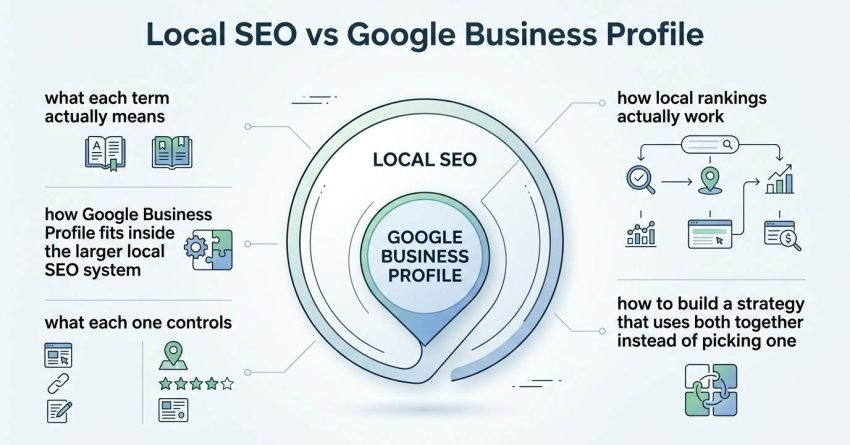
This guide covers what each term actually means, how Google Business Profile fits inside the larger local SEO system, what each one controls, how local rankings actually work, and how to build a strategy that uses both together instead of picking one.
What Is Local SEO?
Local SEO is the practice of optimizing a business’s website, content, and off-site signals so it ranks higher in search results tied to a specific geographic area. It pulls in on-page signals, backlinks, citations, and user engagement data, not just one platform.
I think of local SEO as the umbrella. It includes everything from how your website’s title tags mention your service area to how many local news sites link back to your site. Google’s own local search documentation confirms that relevance, distance, and prominence all factor into how a business ranks, and prominence draws on signals from across the web, not a single profile.
Local SEO is a long-term discipline. It compounds over months as content, links, and technical signals accumulate, which is different from the faster, more direct control you get inside a single platform.
What Is a Google Business Profile?
A Google Business Profile is a free listing that a business owner controls directly through Google, which displays business information, reviews, and photos across Google Search and Google Maps. It replaced what used to be called Google My Business back in 2021.
The profile itself is a single account you manage. You add hours, categories, photos, and respond to reviews inside one dashboard.
Because it’s a direct input to Google’s local algorithm, a Google Business Profile gives you faster, more visible control than most other local SEO levers. But it is still just one input among several, not the entire system.
How Local SEO and Google Business Profile Relate to Each Other
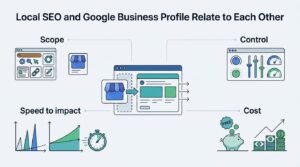
A Google Business Profile functions as one ranking input inside the much larger local SEO system, feeding proximity, relevance, and prominence signals directly into Google’s local algorithm. I’ve watched businesses treat the two as separate strategies, and that’s where the confusion starts.
Think of local SEO as the strategy and Google Business Profile as one of its most direct execution channels. Your website’s on-page local SEO signals, backlink profile, and citation consistency all feed the same prominence signal that your Google Business Profile activity also influences.
| Aspect | Google Business Profile | Local SEO (Broader) |
| Scope | Single Google-owned platform | Website, citations, links, content, and GBP combined |
| Control | Direct dashboard control | Indirect, built over time through multiple channels |
| Speed to impact | Days to weeks | Months, compounding |
| Cost | Free to maintain | Requires ongoing strategic investment |
This table shows why treating GBP as a complete substitute for local SEO leaves major ranking signals unaddressed.
Key Differences Between Local SEO and Google Business Profile
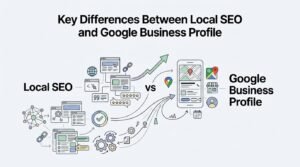
The core difference between local SEO and Google Business Profile comes down to scope: local SEO is a strategy spanning your entire online presence, while Google Business Profile is a single, free tool inside that strategy.
| Factor | Local SEO | Google Business Profile |
| Definition | Full strategy across web properties | One Google-owned listing tool |
| Primary channels | Website, backlinks, citations, content, reviews | Google Maps, Google Search local pack |
| Time to results | 4 to 12 months typically | Days to weeks for basic optimizations |
| Ranking factors covered | Relevance, distance, prominence (broad) | Feeds prominence and relevance directly |
| Ongoing effort | Continuous content and link building | Periodic updates, review responses, posts |
An Ahrefs study of local ranking factors found that businesses with optimized on-page signals combined with active profiles consistently outperform those relying on either alone.
What Google Business Profile Controls
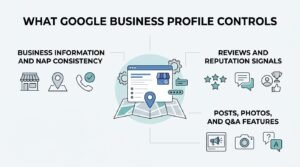
Google Business Profile controls the direct, visible business information that appears in the local pack and Google Maps, including your name, address, phone number, hours, and customer reviews.
Business Information and NAP Consistency
Your business name, address, and phone number, commonly called NAP, live at the center of your profile. Inconsistent NAP data across the web confuses Google’s prominence calculations and directly weakens local pack visibility.
Reviews and Reputation Signals
Reviews collected through your Google Business Profile directly influence local pack rankings and consumer trust. A 2024 BrightLocal survey found that 98% of consumers read online reviews for local businesses before making a purchase decision.
Response rate and recency both factor into how Google weighs review signals. I recommend responding to every review within 48 hours, since responsiveness itself sends a trust signal.
Posts, Photos, and Q&A Features
Google Business Profile posts function like mini social updates that appear directly in your listing. Photos and the Q&A section add engagement signals that keep your profile active in Google’s eyes.
What Local SEO Controls Beyond Your Profile
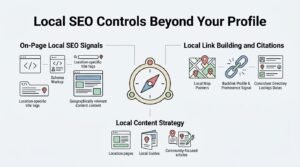
Local SEO controls the technical, content, and authority signals that exist entirely outside your Google Business Profile, including your website structure, backlink profile, and local content strategy.
On-Page Local SEO Signals
On-page local SEO signals include location-specific title tags, schema markup, and geographically relevant content on your website. These signals tell Google explicitly which areas your business serves, something your profile alone cannot fully communicate.
Local Link Building and Citations
Local link building and citation consistency across directories build the prominence signal Google uses to rank businesses. A citation is any online mention of your business name, address, and phone number, and consistency across these mentions strengthens trust in your data.
Local Content Strategy
A dedicated local content strategy involves creating location pages, local guides, and community-focused content that signals genuine geographic relevance. This type of content strategy works over months, not days, building topical and geographic authority that a profile alone cannot generate.
How Local Search Rankings Actually Work (The Local Pack Explained)
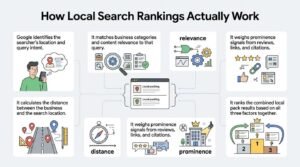
Google ranks businesses in the local pack based on three factors: relevance, distance, and prominence, combining signals from both your website and your Google Business Profile. Relevance measures how well your listing matches what the searcher is looking for.
Distance measures how close your business is to the searcher’s location or specified area. Prominence measures how well-known your business is, drawing from reviews, links, citations, and general web presence.
- Google identifies the searcher’s location and query intent.
- It matches business categories and content relevance to that query.
- It calculates the distance between the business and the search location.
- It weighs prominence signals from reviews, links, and citations.
- It ranks the combined local pack results based on all three factors together.
Do You Need Both Local SEO and a Google Business Profile?
Yes, businesses need both local SEO and a Google Business Profile, because each addresses ranking factors the other cannot fully cover on its own. Relying on just a profile means missing out on the website and content authority signals that build long-term prominence.
Relying only on broader local SEO tactics while ignoring your profile means missing the direct, fast-moving control that a well-optimized listing provides. I’ve seen businesses with beautifully optimized websites lose local pack visibility simply because their profile sat unclaimed or outdated.
Common Mistakes That Confuse Local SEO With Google Business Profile
Common mistakes include treating a Google Business Profile as a complete local SEO strategy, ignoring website-based local signals, and assuming profile optimization alone guarantees rankings. Businesses often stop investing once their profile looks complete.
This creates a visibility ceiling, because prominence signals from citations, backlinks, and content never get built. Another frequent mistake is duplicating or inconsistent business listings across multiple directories, which confuses Google’s data matching.
How Long It Takes to See Results From Each
Google Business Profile optimizations typically show visible changes within days to a few weeks, while broader local SEO improvements usually take four to twelve months to produce measurable ranking movement. This gap in timeline is exactly why business owners misjudge how each channel performs.
Profile changes like adding photos, updating categories, or responding to reviews can shift local pack position quickly because Google indexes profile data almost immediately. Local SEO work like earning backlinks and building topical content compounds gradually, which means slower but more durable results.
How to Know Which to Prioritize First for Your Business
Businesses with an incomplete or unclaimed Google Business Profile should prioritize that first, since it delivers fast, direct visibility gains before longer-term local SEO work compounds. New businesses or those in highly competitive markets benefit most from starting here.
Established businesses with a fully optimized profile but stagnant rankings usually need to prioritize broader local SEO investment instead, since their prominence ceiling comes from a lack of citations, links, or content depth. Competitive market density is often the deciding factor for where to focus budget first.
How to Measure Performance for Both
Measuring Google Business Profile performance relies on Google’s built-in Business Profile Insights, while broader local SEO performance requires tools like Google Search Console and dedicated local rank trackers. Each tool captures a different layer of the local visibility picture.
| Metric | Best Tool | What It Shows |
| Profile views and searches | Google Business Profile Insights | Direct listing engagement |
| Organic keyword rankings | Google Search Console | Website-level search visibility |
| Local pack position tracking | Local rank tracking tools | Where you rank by geography |
| Website traffic from local search | Google Analytics | Conversion and engagement data |
This table shows why relying on a single dashboard leaves gaps in understanding true local performance.
Building a Combined Local Visibility Strategy
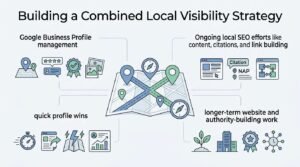
A combined local visibility strategy integrates Google Business Profile management with ongoing local SEO efforts like content, citations, and link building into a single coordinated roadmap. Agencies typically sequence quick profile wins alongside longer-term website and authority-building work.
This sequencing keeps visibility moving in the short term while the compounding local SEO signals mature. White Label SEO Service builds this kind of integrated roadmap for clients who need both fast wins and durable, long-term local authority.
Conclusion
Local SEO and Google Business Profile work together, not separately, each covering ranking signals the other cannot fully reach.
Mastering both means treating your profile as one piece of a larger, ongoing local visibility strategy across your entire web presence.
We help businesses build that combined strategy at White Label SEO Service, turning local visibility into consistent, measurable growth.
Frequently Asked Questions
Is Google Business Profile part of local SEO?
Yes, Google Business Profile is one component of local SEO, specifically the platform-based piece that feeds directly into Google’s local ranking algorithm. It works alongside website and citation signals, not in place of them.
Can I rank locally without a Google Business Profile?
Ranking in the local pack without a Google Business Profile is extremely difficult, since Google uses profile data as a core input for local pack results. Organic website rankings can still appear, but local pack visibility relies heavily on the profile.
Does Google Business Profile cost money?
No, Google Business Profile is completely free to create, claim, and maintain. Optional paid features like Google Ads can appear alongside it, but the core listing itself carries no cost.
How often should I update my Google Business Profile?
Google Business Profile should be updated at least monthly, including new photos, posts, and prompt responses to reviews. Frequent, recent activity signals relevance and keeps engagement metrics active.
What is the difference between GBP and a website for local rankings?
A Google Business Profile is a Google-controlled listing focused on map and local pack visibility, while a website is a fully owned property that supports broader organic rankings and content depth. Both feed different parts of the local ranking system.
Why did Google rename Google My Business to Google Business Profile?
Google renamed Google My Business to Google Business Profile in 2021 to reflect a shift toward managing listings directly through Search and Maps rather than a separate app. The rebrand simplified how business owners access and edit their information.
How much does local SEO cost compared to managing a Google Business Profile?
Managing a Google Business Profile costs nothing beyond time, while broader local SEO typically requires ongoing investment in content, links, and technical work. Local SEO budgets vary widely based on market competitiveness and business goals.