Local SEO typically takes four to six months to show measurable ranking improvements and six to twelve months to produce consistent lead flow for most small businesses. The exact timeline depends on domain age, competition level, and how much technical work a website needs before it can compete. Business owners who understand this timeline make better decisions and avoid abandoning strategies that were just starting to work.
Rushing local SEO or expecting month-one results sets you up for disappointment and often leads to switching strategies right before they pay off. I have watched businesses quit two months before a ranking breakthrough simply because nobody set the right expectations upfront.
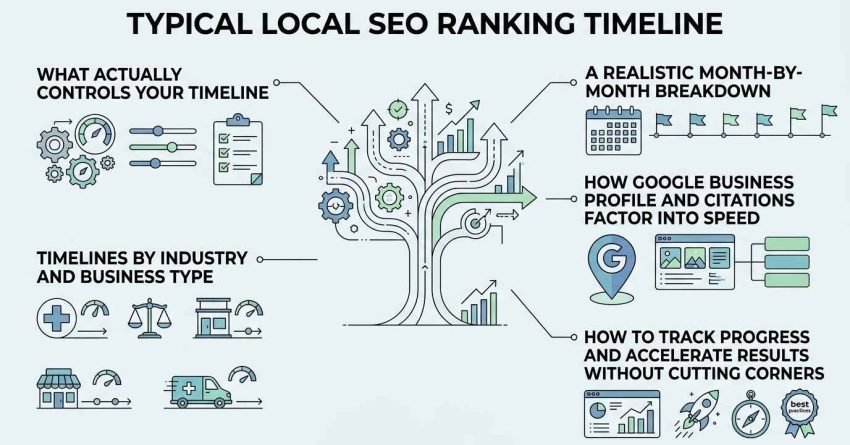
This guide covers what actually controls your timeline, a realistic month-by-month breakdown, how Google Business Profile and citations factor into speed, timelines by industry and business type, and how to track progress and accelerate results without cutting corners.
What Determines How Long Local SEO Takes to Work
Local SEO speed depends primarily on three factors: your website’s existing authority, how competitive your local market is, and the current technical health of your site. A brand-new website in a competitive city takes considerably longer than an established site making incremental improvements in a smaller market.
Website Age and Domain Authority
Domain age and authority function as a trust signal that search engines weigh heavily when deciding how quickly to rank a page. A site with three or more years of consistent content and backlinks generally sees ranking movement faster than a domain registered within the past year, according to Ahrefs’ study of two million keywords, which found that pages older than a year captured a disproportionate share of top-10 rankings.
I always check domain age first when setting client expectations. A newer domain simply needs more time to accumulate the trust signals that older, established competitors already have.
Competition Level in Your Local Market
Local market competition directly shapes how many months it takes to see meaningful ranking movement, since more competitors bidding for the same map pack spots means more signals to outrank. A dentist in a small town might rank in eight weeks, while the same effort in a major metro area could take five or six months.
We factor in competitor density before ever quoting a timeline to a new client.
Current Technical SEO Health
Technical SEO health refers to how well a website’s crawlability, site speed, mobile usability, and indexation currently perform, and it acts as the foundation everything else builds on. A site riddled with broken links, slow load times, or duplicate content needs remediation before any content or citation work can take full effect.
Skipping this step is the single biggest reason timelines stretch longer than expected.
Realistic Local SEO Timeline: Month-by-Month Breakdown
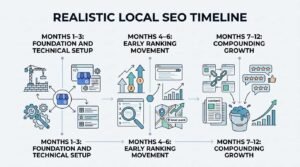
Most local SEO campaigns follow a predictable three-phase arc: foundational setup in months one through three, early ranking movement in months four through six, and compounding growth from month seven onward. Understanding this arc helps set realistic expectations from day one.
Months 1–3: Foundation and Technical Setup
The first three months focus on technical fixes, Google Business Profile optimization, and citation building rather than visible ranking jumps. This is unglamorous work, but skipping it guarantees a longer road later.
We rarely see meaningful ranking changes in this window, and that is expected, not a red flag.
Months 4–6: Early Ranking Movement
Rankings typically begin shifting for lower-competition keywords during months four through six as search engines start crawling and trusting the new signals sent through citations and content. Traffic increases become noticeable in analytics even before map pack visibility improves.
This is usually when clients start asking whether it is “working yet,” and the honest answer is: it is starting to.
Months 7–12: Compounding Growth
Local SEO compounds after month six because accumulated backlinks, reviews, and content begin reinforcing each other rather than working in isolation. Businesses in moderately competitive markets often see their strongest lead growth during this window.
I tell every client that months seven through twelve are where the investment finally outpaces the effort put in.
Google Business Profile Optimization Timeline
Google Business Profile optimization can influence local pack visibility within two to four weeks, making it one of the fastest-moving levers in local SEO. Complete profile fields, accurate categories, and regular photo uploads all contribute to this speed.
Review velocity plays a particularly outsized role here. Profiles that gain new reviews at a steady weekly pace outperform those with sporadic review bursts, since consistency signals an actively managed business.
On-Page Local SEO and How Fast It Impacts Rankings
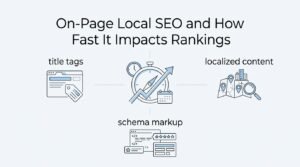
On-page local SEO, including title tags, localized content, and schema markup, typically produces measurable ranking shifts within four to eight weeks of implementation. Search engines need to recrawl and reindex updated pages before any change registers.
Pages with location-specific service content tend to move faster than generic pages retrofitted with a city name.
Local Citations and NAP Consistency Timelines
Citation building and NAP (name, address, phone) consistency work usually takes eight to twelve weeks to fully influence local rankings, since data aggregators need time to redistribute corrected information across directories. Inconsistent NAP data across even a handful of directories can suppress rankings that otherwise look well optimized.
I always audit existing citations before adding new ones. Fixing conflicting information matters more than volume.
Local Link Building and Its Effect on Ranking Speed
Local link building, meaning backlinks from geographically or topically relevant websites, tends to show ranking impact within three to six months of consistent acquisition. Links from local news outlets, chambers of commerce, and industry associations carry more weight than generic directory links.
This is one of the slower-moving levers, but also one of the most durable once it takes hold.
Content Creation’s Role in Local SEO Speed
Fresh, location-relevant content published consistently accelerates local SEO timelines by signaling ongoing relevance and expertise to search engines. Blog posts, service pages, and location pages built around genuine search demand tend to gain traction within two to four months.
Thin or duplicated content across multiple location pages actively slows this process down rather than helping it.
Industry-Specific Local SEO Timelines
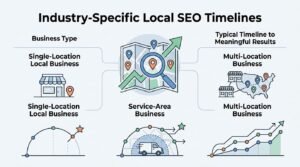
Different business models experience local SEO timelines differently based on how many locations they manage and how their service area is structured.
| Business Type | Typical Timeline to Meaningful Results | Primary Speed Factor |
| Single-Location Local Business | 4–6 months | Google Business Profile and reviews |
| Service-Area Business | 5–7 months | Content depth across service areas |
| Multi-Location Business | 7–12 months | Consistency across all location listings |
Service-Area Businesses
Service-area businesses, which serve customers without a storefront customers visit, generally need five to seven months because they rely more heavily on content and citations than physical location signals. Google weighs service-area signals differently than it does storefront proximity.
Multi-Location Businesses
Multi-location businesses typically require seven to twelve months since each location needs its own optimized profile, citations, and localized content without cannibalizing the others. Coordinating this across ten or more locations multiplies the technical complexity considerably.
Single-Location Local Businesses
Single-location businesses often see the fastest results, sometimes within four months, because all optimization efforts concentrate on one Google Business Profile and one set of local signals rather than being spread thin.
Why Local SEO Takes Longer in Competitive Markets
Competitive markets extend local SEO timelines because more established competitors already hold accumulated authority, reviews, and backlinks that a newer or smaller business must overcome. A market with a dozen well-optimized competitors requires substantially more sustained effort than one with only two or three.
We adjust timeline projections upward by several months whenever a client operates in a saturated metro market.
How Google’s Local Algorithm (Local Pack) Affects Timing
The local pack is the three-listing map result that appears above organic listings for location-based searches, and it weighs proximity, relevance, and prominence as its core ranking signals. Prominence, built through reviews, citations, and links, is the slowest of the three signals to develop.
Businesses closer to the searcher’s location have a built-in proximity advantage that no amount of optimization fully overcomes.
Signs Your Local SEO Is Working Before Rankings Show
Several measurable signals appear before rankings visibly improve, and tracking them prevents premature judgment about whether a strategy is working.
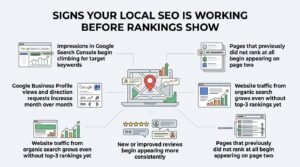
- Impressions in Google Search Console begin climbing for target keywords
- Google Business Profile views and direction requests increase month over month
- Website traffic from organic search grows even without top-3 rankings yet
- New or improved reviews begin appearing more consistently
- Pages that previously did not rank at all begin appearing on page two
Common Reasons Local SEO Takes Longer Than Expected
Local SEO stalls or extends beyond typical timelines for a handful of predictable, correctable reasons.
- Inconsistent NAP data across directories confuses search engines about business legitimacy
- Thin or duplicate content across multiple location pages dilutes relevance signals
- Slow website speed or poor mobile experience suppresses otherwise solid content
- Inconsistent review acquisition creates gaps in prominence signals
- Switching strategies or agencies every few months resets accumulated progress
How to Track Local SEO Progress Month to Month
Tracking local SEO progress requires monitoring four core metrics on a monthly basis: keyword rankings, organic traffic, Google Business Profile engagement, and conversion data. Google Search Console and Google Analytics together cover most of this tracking without additional tools.
- Export keyword ranking positions from a rank tracker at the start of each month
- Review organic traffic trends in Google Analytics, filtering for local landing pages
- Check Google Business Profile insights for views, calls, and direction requests
- Compare lead or call volume against the previous month
- Document technical or content changes made so results can be attributed correctly
Local SEO vs. Paid Ads: Speed Comparison
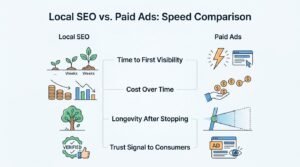
Paid ads generate visibility within hours, while local SEO requires months to build the same visibility organically and sustainably.
| Factor | Local SEO | Paid Ads |
| Time to First Visibility | 4–8 weeks | Immediate |
| Cost Over Time | Decreases as authority builds | Remains constant or increases |
| Longevity After Stopping | Results persist for months | Visibility stops immediately |
| Trust Signal to Consumers | Higher (organic listings) | Lower (labeled as ad) |
How to Speed Up Local SEO Results Without Cutting Corners
Local SEO can be accelerated through a handful of legitimate tactics that compress the timeline without risking penalties: prioritizing technical fixes first, front-loading Google Business Profile completeness, and requesting reviews systematically rather than sporadically. None of these tactics bypass the underlying trust-building process; they simply remove friction from it.
Consolidating duplicate or thin location pages before publishing new content also prevents wasted effort competing against yourself. Businesses that fix technical debt in month one consistently outpace those that layer content on top of unresolved issues.
What Happens If You Stop Local SEO Efforts
Local SEO rankings gradually decline after efforts stop, typically within three to six months, as competitors continue building signals while your existing ones stagnate or age. Unlike paid ads, which stop generating traffic immediately, organic rankings degrade slowly rather than disappearing overnight.
Reviews stop accumulating, content stops refreshing, and citation consistency can drift as business information changes elsewhere online. This gradual decline is often mistaken for an algorithm penalty when it is actually just neglect.
Conclusion
Local SEO success comes down to technical health, consistent citations, quality content, and sustained link building working together over time. Most businesses see real traction between months four and twelve, with compounding growth afterward.
The businesses that win treat local SEO as an ongoing investment rather than a one-time project, continuously refining their Google Business Profile, content, and authority signals.
We help businesses build and sustain that long-term visibility. Reach out to White Label SEO Service to build a realistic, data-backed local SEO roadmap for sustainable growth.
Frequently Asked Questions
How long does local SEO take to show results?
Most businesses see measurable ranking improvements within four to six months. Full lead-generation impact typically develops between six and twelve months depending on competition.
Can local SEO work faster for new businesses?
New businesses can see faster initial movement in low-competition markets, sometimes within eight to ten weeks. Competitive markets still require the standard four-to-six-month window regardless of business age.
Does Google Business Profile rank faster than website SEO?
Google Business Profile typically shows ranking movement faster, often within two to four weeks. Website-based rankings usually take four to eight weeks longer to reflect changes.
How long until I rank in the local map pack?
Map pack visibility commonly appears within three to six months for moderately competitive markets. Highly competitive metro areas can extend this to nine months or longer.
Why did my local rankings drop after improving?
Ranking drops after improvement often result from competitor activity, algorithm updates, or inconsistent review and citation maintenance. Reviewing recent changes to NAP data and content usually identifies the cause.
Is local SEO faster than national SEO?
Local SEO generally moves faster because it targets a smaller, more specific competitive set. National SEO typically requires twelve months or more due to broader keyword competition.
How often should I check my local SEO progress?
Monthly tracking captures enough data to spot trends without overreacting to normal ranking fluctuations. Weekly checks are useful only during active technical changes or campaign launches.