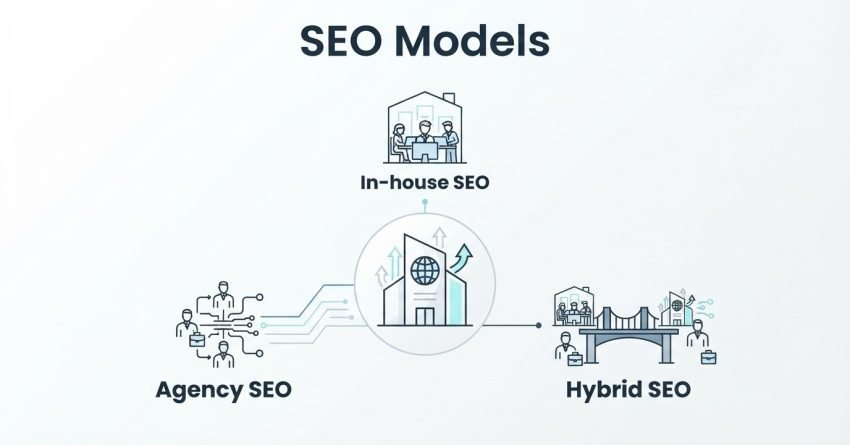
In-house, agency, and hybrid SEO are the three core models businesses use to manage search engine optimization, each differing in cost, control, and speed to results. I’ve watched founders burn six months choosing the wrong one, and it usually comes down to not understanding the trade-offs before signing a contract or making a hire. Every business faces this decision the moment organic traffic becomes a real growth channel worth investing in.
Getting this choice wrong wastes budget and delays the traffic, leads, and revenue SEO is supposed to deliver. We’ve seen companies spend a full year with the wrong setup.
This guide covers what each model actually looks like day-to-day, a full cost and pros/cons breakdown for all three, how long results typically take under each setup, and a practical framework for deciding which one fits your business right now.
What Is In-House SEO?
In-house SEO is a model where a business hires and manages its own dedicated SEO staff instead of outsourcing the work externally. I think of it as building SEO expertise as a permanent internal capability rather than renting it. The team sits inside the company, reports to internal marketing leadership, and works exclusively on that one business’s search visibility.
Most in-house setups start small, often a single SEO specialist reporting to a marketing director before expanding as traffic and revenue targets grow. We see this structure most often in companies past $5M in annual revenue where organic search is already a proven channel worth owning internally.
What Does an In-House SEO Team Do?
An in-house SEO team typically owns technical audits, on-page optimization, content strategy, and coordination with developers and writers. They work inside existing company systems, which means faster access to the CMS, engineering resources, and internal data than an outside partner usually gets.
This proximity is the model’s biggest structural advantage. An internal SEO lead can walk over to a developer’s desk and get a site speed fix prioritized the same day, something that takes agencies far longer through ticketing systems.
Typical In-House SEO Team Structure
A mature in-house team usually includes a strategist or lead, a technical SEO specialist, a content coordinator, and sometimes a dedicated link building or digital PR hire. Smaller companies compress these roles into one or two people wearing multiple hats.
In-house SEO team structure and staffing decisions directly shape how much ground a company can cover without outside help, and gaps in that structure are usually where hybrid arrangements start to make sense.
What Is Agency SEO?
Agency SEO is a model where a business outsources its search optimization work to an external company specializing in SEO strategy and execution. I’ve found this is the fastest way for a business to access a full team of specialists without the overhead of hiring five separate people. The agency brings existing tools, processes, and cross-client experience from day one.
This model works well for companies that need SEO results without building internal infrastructure. A good agency has already solved problems your business hasn’t encountered yet, because they’ve solved them for other clients first.
What Services Do SEO Agencies Typically Provide?
Agencies commonly bundle technical audits, keyword research, content production, link building, and monthly reporting into a single retainer. Some also handle conversion rate optimization and broader digital marketing alongside core SEO work.
The bundled nature of agency services means a business gets full-spectrum coverage immediately, rather than filling gaps one hire at a time the way in-house teams often have to.
Types of SEO Agencies (Full-Service, Specialized, White Label)
Types of SEO agencies break down into three broad categories: full-service agencies handling every SEO discipline, specialized agencies focused on one area like link building or local SEO, and providers built specifically to deliver work under another company’s brand.
Full-service agencies suit businesses wanting one point of contact. Specialized agencies suit businesses that already have some internal capability and need to fill one specific gap.
What Is Hybrid SEO?
Hybrid SEO is a model where a business combines an internal team member or department with an external agency or specialist partner. I consider this the middle path: you keep strategic ownership internal while outsourcing execution capacity you don’t want to hire for directly. It’s become the fastest-growing model among mid-sized companies over the last few years.
The hybrid approach solves a specific problem: full in-house teams are expensive and slow to build, but pure agency reliance means limited internal institutional knowledge. Hybrid splits the difference.
How Hybrid SEO Models Typically Split Responsibilities
The most common hybrid split has an internal marketing manager owning strategy and stakeholder communication, while an external partner executes technical work, content production, or link building. Some companies flip this, keeping content in-house and outsourcing only technical SEO.
Hybrid SEO model structures vary enormously by company size and existing skill gaps, which is exactly why there’s no single “correct” split; it depends on what’s already covered internally.
In-House vs Agency vs Hybrid SEO: Side-by-Side Comparison
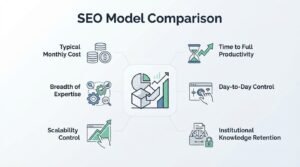
The three SEO models differ most sharply across five dimensions: cost, speed to results, breadth of expertise, day-to-day control, and scalability. This table lays out how each model compares on the factors that matter most to a hiring or buying decision.
| Factor | In-House | Agency | Hybrid |
| Typical Monthly Cost | $8,000-$15,000+ (salary + tools) | $2,500-$10,000 retainer | $4,000-$12,000 combined |
| Time to Full Productivity | 3-6 months onboarding | 2-4 weeks | 1-3 months |
| Breadth of Expertise | Limited to hires made | Full team across disciplines | Blended |
| Day-to-Day Control | Highest | Lowest | Moderate-High |
| Scalability | Slow (hiring cycles) | Fast (retainer adjustments) | Moderate |
| Institutional Knowledge Retention | Highest | Lowest | Moderate-High |
Cost comparisons like this rarely tell the full story on their own, since a single in-house hire earning $70,000 a year still can’t replace the combined disciplines a $5,000/month agency retainer typically covers.
Pros and Cons of In-House SEO
In-house SEO delivers the deepest institutional knowledge and fastest internal coordination, but it comes with higher fixed costs and slower ramp-up time. I’ve seen this model pay off best for companies with over $10M in revenue and SEO already proven as a core growth channel.
Advantages of Building an In-House SEO Team
Internal teams understand company history, brand voice, and product nuance in ways no outside partner can match on day one. They also don’t compete for attention across other client accounts, so priority-setting stays entirely within your control.
Full ownership of strategy and execution also means faster decision-making. There’s no retainer scope to negotiate before testing a new idea.
Disadvantages and Hidden Costs of In-House SEO
In-house SEO costs extend well beyond salary; tool subscriptions (Ahrefs, Semrush, Screaming Frog), training, and management overhead often add 30-40% on top of base compensation. A Backlinko analysis of SEO industry compensation found average in-house SEO manager salaries in the US now exceed $75,000 annually before tools and benefits.
Hiring risk is the other hidden cost. A single bad hire can cost six months of lost momentum, and specialist skills like technical SEO or digital PR are hard to vet without existing expertise on staff.
Pros and Cons of Agency SEO
Agency SEO trades some day-to-day control for immediate access to a full team of specialists and proven processes. This tradeoff works well for companies that need results fast and don’t want to manage a growing internal department.
Advantages of Outsourcing SEO to an Agency
Agencies bring cross-client pattern recognition; they’ve already seen what works across dozens of similar businesses, which shortens the trial-and-error period most in-house teams go through. Onboarding is also dramatically faster than hiring and training internal staff.
Retainers scale up or down without the friction of hiring or layoffs, which gives businesses flexibility during growth spurts or budget-tightening periods.
Disadvantages and Risks of Agency SEO
How to vet an SEO agency becomes critical because quality varies enormously across providers, and a poor agency fit can mean months of wasted spend before problems surface in the data. Communication lag is also common; agencies manage multiple clients, so response times and priority attention aren’t guaranteed to match an in-house team’s speed.
Contract terms matter too. Long lock-in periods with vague deliverables are a common complaint among businesses switching agencies.
Pros and Cons of Hybrid SEO
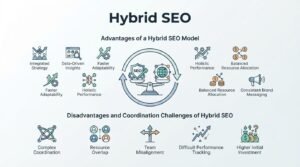
Hybrid SEO balances internal control with external execution capacity, which suits companies past the startup phase but not yet ready for a full internal team. The model’s success depends heavily on how clearly responsibilities get divided between the internal and external sides.
Advantages of a Hybrid SEO Model
Hybrid setups let a business keep strategic decision-making and brand knowledge internal while renting specialized execution capacity like technical audits or link building. This often costs less than a full in-house team while retaining more control than a pure agency relationship.
It also creates a natural growth path: a company can start hybrid and gradually shift more work in-house as budget and confidence grow.
Disadvantages and Coordination Challenges of Hybrid SEO
Hybrid SEO coordination challenges center on unclear ownership boundaries when both an internal hire and an external partner touch the same deliverables; accountability gaps appear quickly if roles aren’t documented from the start. Miscommunication between the internal and external side is the most commonly cited hybrid failure point.
Tool and data access also needs careful setup, since external partners need CMS and analytics permissions without compromising security.
How Much Does Each SEO Model Cost?
SEO costs range from roughly $2,500 a month for a small agency retainer to $15,000+ a month for a fully staffed in-house team, with hybrid models typically landing in between. Company size, industry competitiveness, and geographic market all shift these numbers substantially.
| Model | Small Business (< $1M rev) | Mid-Market ($1M-$10M rev) | Enterprise ($10M+ rev) |
| In-House | Rarely viable alone | $8,000-$12,000/mo (1-2 staff) | $15,000-$40,000+/mo (full team) |
| Agency | $1,500-$4,000/mo | $4,000-$10,000/mo | $10,000-$25,000+/mo |
| Hybrid | $3,000-$6,000/mo | $6,000-$14,000/mo | $12,000-$30,000/mo |
SEO pricing shifts most dramatically based on the competitiveness of the target keywords, not just company size. A local service business and a national SaaS company face very different cost realities even at similar revenue levels.
What Skills and Roles Does an SEO Strategy Require?
A complete SEO strategy requires four core skill areas: technical SEO, content strategy, link building or digital PR, and analytics interpretation. Very few individuals are genuinely strong across all four, which is exactly why most effective SEO setups involve more than one person or partner.
Core SEO Skill Sets (Technical, Content, Link Building, Analytics)
SEO team roles typically split across a technical specialist who handles site speed, crawlability, and schema; a content strategist who handles keyword mapping and on-page writing; a link building specialist who handles outreach and digital PR; and an analyst who interprets Google Search Console and Google Analytics data to guide strategy.
Businesses evaluating any SEO model should map these four skill areas against whoever they’re hiring or contracting, since gaps in any one area quietly cap overall performance.
How Long Does It Take to See Results With Each Model?
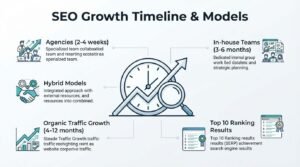
Most SEO efforts take four to twelve months to produce meaningful organic traffic growth, regardless of which model manages the work. Model choice affects speed to start rather than speed to results. Agencies typically begin executing within 2-4 weeks, while in-house teams often need 3-6 months just to reach full staffing and process maturity.
Hybrid models tend to land in the middle, since the external partner can start executing quickly while the internal hire ramps up in parallel. An Ahrefs study of two million keywords found that only 5.7% of new pages reach the top 10 search results within a year, underscoring that the ranking timeline itself doesn’t change based on who’s doing the work; competitive difficulty and content quality still dominate.
When Should a Business Choose In-House SEO?
In-house SEO makes the most sense once a business has proven organic search as a reliable growth channel and has the budget to support a dedicated team long term. Companies generating over $10M in annual revenue with SEO already contributing meaningful pipeline typically see the best return from this investment.
It also fits businesses in highly specialized or regulated industries where outside partners take too long to reach the required subject matter depth.
When Should a Business Choose an SEO Agency?
An SEO agency fits best for companies that need full-spectrum SEO execution without the time or budget to build an internal team from scratch. Startups and SMEs testing whether SEO will work as a growth channel benefit most from this lower-commitment entry point.
It also suits businesses without any existing marketing leadership capable of managing an internal SEO hire’s day-to-day work.
When Should a Business Choose a Hybrid SEO Model?
A hybrid model fits companies with some internal marketing capability that need to fill specific gaps, like technical SEO or content production capacity, without a full internal build-out. Mid-market companies between $1M and $10M in revenue land here most often.
It also suits businesses that want to retain brand and strategic control internally while outsourcing the more execution-heavy or specialized components of the work.
How to Decide Which SEO Model Is Right for You
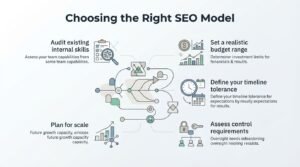
Choosing the right SEO model comes down to weighing budget, existing internal capability, and how quickly results are needed against each model’s tradeoffs. This decision framework breaks the choice into five concrete steps.
- Audit existing internal skills – identify which of the four core SEO skill areas (technical, content, links, analytics) already exist on staff.
- Set a realistic budget range – compare that number against the cost tables above for each model at your revenue tier.
- Define your timeline tolerance – agencies and hybrid models start executing faster than building an in-house team from zero.
- Assess control requirements – regulated industries or highly technical products often need tighter internal oversight.
- Plan for scale – consider whether the chosen model can grow with projected traffic and revenue targets over the next 12-24 months.
Running through these five steps in order usually narrows the decision to one clear frontrunner rather than leaving all three models feeling equally viable.
Common Mistakes Businesses Make When Choosing an SEO Model
The most frequent mistake is choosing based on cost alone without accounting for onboarding time, hidden fees, or the skill gaps a cheaper option leaves uncovered. SEO mistakes to avoid during model selection also include skipping reference checks on agencies and underestimating how long internal hires take to reach full productivity.
Another common error is treating the decision as permanent. Businesses that revisit their SEO model annually as revenue and internal capability change consistently outperform those locked into a single approach out of inertia.
White Label SEO: A Growing Hybrid Alternative
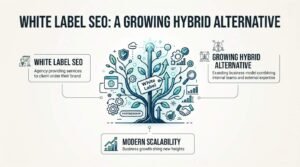
White label SEO is a model where an agency delivers SEO execution under another company’s brand, often used by marketing agencies or consultants who want to offer SEO without building internal delivery capacity. What is white label SEO comes up frequently among agencies themselves, not just end businesses, since it lets a marketing firm expand its service list without hiring specialists directly.
This model functions as a specialized hybrid: the client-facing business owns strategy and communication, while the white label partner handles execution entirely behind the scenes.
Conclusion
In-house, agency, and hybrid SEO each solve the same problem differently; cost, control, and speed shift depending on which model a business chooses. Every growing company eventually revisits this decision as budget and internal capability change.
We built White Label SEO Service to give agencies and businesses the execution capacity to make any of these three models work at scale. Reach out to map the right fit for your current stage and goals.
Frequently Asked Questions
Is it cheaper to hire in-house SEO or an agency?
Agency SEO is typically cheaper upfront than in-house SEO. A single in-house hire often costs more than a full agency retainer once salary, tools, and training are included.
Can a small business do SEO in-house?
Small businesses can manage basic SEO in-house, but full in-house teams are rarely cost-effective under $1M in annual revenue. Most small businesses see better ROI from agency or hybrid models.
How do I know if my SEO agency is doing a good job?
A good SEO agency shows steady organic traffic growth, transparent reporting, and clear communication about strategy changes. Watch for vague reports or reluctance to explain methodology.
What is the difference between white label SEO and hybrid SEO?
White label SEO means an agency executes work invisibly under another brand’s name. Hybrid SEO means an internal team and external partner work together openly under the client’s own brand.
How many people do you need for an in-house SEO team?
A minimum viable in-house team needs one to two people covering strategy, technical work, and content. Mature teams often expand to four or more specialized roles.
Do hybrid SEO models work for small businesses?
Hybrid models work for small businesses once they have at least one internal marketing hire who can manage an external partner. Below that threshold, a straight agency relationship usually works better.
How long should I commit to an SEO model before switching?
Most SEO models need six to twelve months before their results can be fairly evaluated. Switching sooner rarely gives any model, in-house, agency, or hybrid, enough time to show its real impact.