SEO services are a set of technical, content, and authority-building activities that improve how a website performs in organic search results. Business owners ask the same sixty questions about them, and most of those questions come down to three things: how long it takes, what it costs, and how you know it worked.
I have answered these questions for years, and the pattern never changes. The confusion is not about tactics. It is about expectations, and bad expectations kill good campaigns.
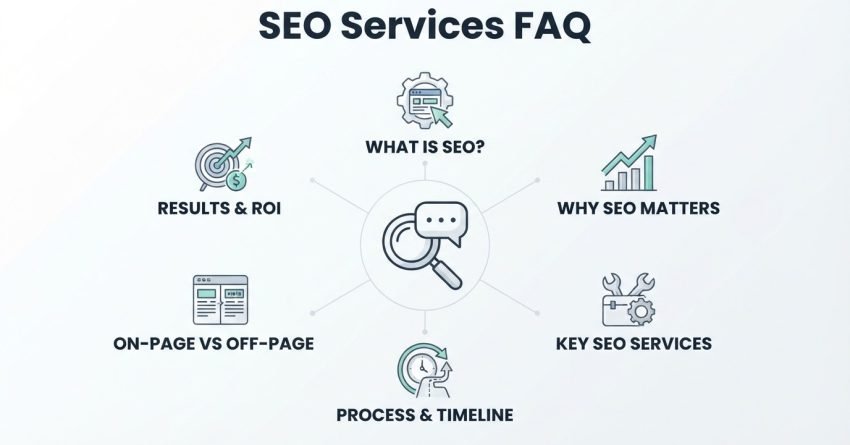
This guide covers what SEO services actually include and how search engines rank pages, realistic timelines and pricing, the technical and content foundations, keyword research and link building, local and ecommerce specifics, AI search, measurement and ROI, penalty recovery, and how to hire the right team.
What SEO Services Actually Include
SEO services include four core disciplines: technical SEO, on-page optimization, content production, and authority building. Everything a legitimate provider does falls into one of those four buckets, and a campaign missing any one of them will underperform.
I have seen plenty of retainers that were really just content mills. The site published four articles a month, nobody fixed the crawl issues, and nothing moved for eight months.
The four core disciplines of SEO
Here is what each discipline does and why it matters:
| Discipline | What it does | Typical share of effort |
| Technical SEO | Makes pages crawlable, indexable, and fast | 15–25% |
| On-page optimization | Aligns pages with search intent and keywords | 20–30% |
| Content production | Builds topical coverage and earns rankings | 30–40% |
| Authority building | Earns links and brand mentions that signal trust | 20–30% |
Those percentages shift by site. A ten-year-old site with 40,000 URLs needs far more technical work than a new five-page site does.
Deliverables you should expect each month
A monthly retainer should produce visible artifacts, not vague activity. I expect a keyword and page-level performance report, a list of technical fixes completed, the content shipped or optimized, and the links earned.
Anything vaguer than that is a warning sign. If your provider cannot name what changed on your site last month, nothing meaningful changed.
What SEO services do not cover?
SEO services do not include paid advertising, conversion rate optimization, or brand design, though all three affect results. Paid search buys clicks immediately and stops the moment you stop paying, which is the opposite of how organic compounds.
I mention this because a lot of owners expect SEO to fix a website that simply does not convert. Traffic cannot rescue a broken offer.
How Search Engines Rank Pages
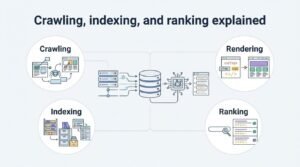
Search engines rank pages in three stages: crawling, indexing, and ranking. A page must survive all three to appear in results, and most SEO problems are a failure at one specific stage rather than a general “ranking” issue.
Crawling, indexing, and ranking explained
This is the sequence every page goes through:
- Crawling – a bot requests the URL and downloads the HTML
- Rendering – the engine executes JavaScript to see the final page
- Indexing – the engine stores the page and understands its topic
- Ranking – the engine scores the page against a specific query
Diagnosing which stage fails changes the fix entirely. A page blocked by robots.txt never gets crawled. A page with a noindex tag gets crawled but never indexed. A page that ranks on page four is indexed fine and simply loses on relevance or authority.
Google confirms it uses hundreds of ranking signals, weighted differently by query type.
Why rankings change without warning
Rankings move daily because the index updates constantly and competitors publish new pages. Small fluctuations of two or three positions are normal noise and not worth reacting to.
I only investigate when a page drops more than five positions and stays there across two weeks. Anything shorter is usually a test or a temporary re-crawl.
SEO Timelines: How Long Results Actually Take
Most SEO campaigns produce meaningful organic traffic growth between month four and month nine, with competitive markets taking twelve months or longer. An Ahrefs study of two million keywords found only 5.7% of pages reached the top ten within a year of publication.
That statistic surprises people. It should not; it just reflects how much content is already competing.
Month-by-month expectations
Here is what a typical mid-competition campaign looks like:
| Period | What happens | Visible result |
| Months 1–2 | Technical fixes, keyword mapping, content plan | Crawl and index improvements |
| Months 3–4 | Content shipping, on-page work | Long-tail rankings appear |
| Months 5–8 | Authority building, content depth | Traffic curve bends upward |
| Months 9–12 | Competitive terms move | Leads and revenue follow |
The traffic curve is not linear. It sits flat, then bends, and owners who quit at month five quit right before the bend.
What changes the timeline
Four variables move SEO timelines more than anything else: domain age and existing authority, competition level in your niche, how much content you can ship per month, and how fast your development team implements fixes.
Implementation speed is the one nobody expects. I have watched campaigns lose two full months waiting on a developer to deploy redirects.
SEO Pricing, Budgets, and Contracts
SEO pricing in the US typically ranges from $1,500 to $10,000 per month for agency retainers, with freelancers starting lower and enterprise engagements running well above. The number itself matters less than what the budget actually buys in hours and output.
Common pricing models
These are the four structures you will encounter:
| Model | How it works | Best suited to |
| Monthly retainer | Fixed fee for ongoing work | Most businesses, ongoing growth |
| Project-based | One-time fee for a defined scope | Migrations, audits, rebuilds |
| Hourly | Billed per hour of work | Consulting, small fixes |
| Performance-based | Payment tied to rankings or traffic | Rare, often high-risk |
I avoid performance-based deals. They push providers toward short-term tactics that rank fast and collapse later.
What a realistic monthly budget buys
A $2,000 monthly budget buys roughly twenty to thirty hours of senior work, which covers two to four content pieces plus light technical and link work. A $6,000 budget doubles output and adds dedicated strategy and outreach capacity.
Price your competition, not your comfort. If the three sites above you invest $8,000 a month, a $1,500 budget is not a slower path to the same place; it is a different destination.
Technical SEO Questions
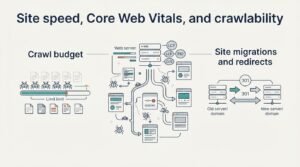
Technical SEO is the practice of optimizing a website’s infrastructure so search engines can crawl, render, and index it efficiently. It rarely creates rankings on its own, but it removes the ceilings that prevent good content from ranking.
Site speed, Core Web Vitals, and crawlability
Core Web Vitals measure loading performance, interactivity, and visual stability, and Google uses them as a ranking signal. The current thresholds are 2.5 seconds for Largest Contentful Paint, 200 milliseconds for Interaction to Next Paint, and 0.1 for Cumulative Layout Shift, per Google’s Web Vitals documentation.
Crawl budget becomes a real constraint above roughly 10,000 URLs. Below that, most sites waste crawl budget through duplicate parameters rather than sheer size.
Site migrations and redirects
Site migrations lose traffic when URL mapping is incomplete or redirects chain through multiple hops. I map every old URL to a new one before launch, with no exceptions, because a 404 on a page that had links destroys that page’s accumulated authority.
Expect a two- to six-week dip after even a clean migration. Recovery beyond that means something in the mapping was missed.
Keyword Research and Search Intent
Keyword research is the process of identifying the queries your audience searches and matching each one to a page that can realistically rank for it. Search intent determines whether a page should inform, compare, or sell, and mismatched intent is the most common reason a well-written page never ranks.
How keywords are selected
Good keyword selection weighs four factors: search volume, competitive difficulty, commercial intent, and whether your site can plausibly compete. A term with 10,000 monthly searches is worthless to you if the top ten results are all national publishers with 90+ authority scores.
I start with the terms your customers use when they are ready to buy, then work backward toward awareness-stage topics.
Search volume vs. commercial value
Low-volume keywords frequently outperform high-volume ones on revenue. A term searched 90 times a month by buyers with a clear need converts better than one searched 9,000 times by researchers.
Volume is a proxy metric. Revenue per ranking position is the real one.
Content Strategy and Topical Authority
Topical authority is a site’s demonstrated depth across an entire subject area, built by covering a topic and its related subtopics comprehensively rather than publishing scattered individual posts. Search engines reward sites that cover a domain thoroughly because depth signals genuine expertise.
How much content is enough
Enough content means full coverage of your topic cluster, not a fixed post count. A cluster is complete when every question a buyer asks during their decision has a page that answers it properly.
For most service businesses, that lands between 25 and 60 pages per core topic. I would rather ship fifteen genuinely useful pages than sixty thin ones.
Content refresh vs. new content
Refreshing existing content usually produces faster gains than publishing new pages, because refreshed pages already have crawl history and some link equity. I audit pages that rank between positions five and twenty-first, since those need the smallest push to reach page one.
New content is for gaps. Refreshed content is for near-misses.
On-Page Optimization Questions
On-page optimization is the alignment of a page’s title, headings, body copy, and internal links with the query it targets. It is the highest-leverage work available because changes ship fast and results appear within weeks rather than months.
Titles, headings, and internal links
A title tag should front-load the primary keyword and stay under roughly 60 characters so it displays fully. H2 headings should map to the subtopics a reader actually needs, and each one should be answerable on its own.
Internal linking is the part most sites neglect. Every page needs links pointing to it from related pages, or search engines struggle to judge its importance.
Keyword placement without stuffing
Place the primary keyword in the title, the H1, the first hundred words, and naturally through the body where it fits the sentence. Beyond that, use variations and related entities rather than repeating the exact phrase.
Keyword stuffing has not worked since roughly 2012. It now actively hurts, because it makes the page unreadable to both people and language models.
Link Building and Authority
Link building is the practice of earning links from other websites to signal that your content is credible and worth citing. Links remain one of the strongest ranking signals, though quality now matters far more than quantity.
What makes a link valuable
A valuable link meets four conditions:
- It comes from a site in a genuinely related topic area
- The linking page has its own organic traffic
- The link sits inside editorial content, not a footer or sidebar
- The anchor text describes the destination naturally
One link meeting all four beats fifty that meet none. I would rather spend a month earning three genuine citations than buy three hundred directory listings.
Risky link tactics to avoid
Private blog networks, paid link placements, and mass guest posting on low-quality sites all violate Google’s link spam policies. They work briefly, then get devalued or penalized.
The cleanup costs more than the original campaign did. I have spent six months disavowing links that took six weeks to build.
Local SEO for Service-Area Businesses
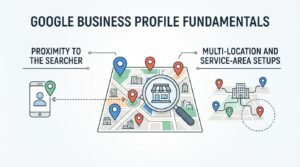
Local SEO is the optimization of a business’s presence for geographically-qualified searches, centered on the Google Business Profile, local citations, and location-relevant content. It runs on partially different ranking signals than national organic search.
Google Business Profile fundamentals
Your Google Business Profile drives most local map pack visibility, and completeness is the first lever. Fill every field, choose the most specific primary category available, add real photos, and collect reviews consistently rather than in bursts.
Proximity to the searcher is a heavy ranking factor you cannot control. Category accuracy and review velocity are the ones you can.
Multi-location and service-area setups
Businesses with physical locations need a distinct, genuinely useful page per location, not a template with the city name swapped. Service-area businesses without storefronts should define their service radius in the profile and build content around the areas they actually serve.
Thin location pages get filtered out. Ten real pages outperform two hundred generated ones every time.
Ecommerce SEO Questions
Ecommerce SEO focuses on making category and product pages rank for commercial queries while controlling the duplicate content that large catalogs naturally generate. The technical challenges scale with catalog size in a way service sites never face.
Category vs. product page priorities
Category pages usually deserve priority because they target higher-volume commercial terms and consolidate authority across the products inside them. Product pages target narrower, lower-competition queries with higher purchase intent.
| Page type | Targets | Typical volume | Conversion rate |
| Category | “running shoes for flat feet” | Higher | Moderate |
| Product | “Brooks Adrenaline GTS 23 size 11” | Lower | High |
I optimize categories first on most catalogs, then work down into the products that already get impressions.
Duplicate content and faceted navigation
Faceted navigation creates near-infinite URL combinations that waste crawl budget and split ranking signals. Control it with canonical tags, selective noindex rules, and parameter handling rather than letting every filter combination get indexed.
A 500-product store can generate 50,000 crawlable URLs through filters alone. That is how crawl budget disappears.
AI Search, AI Overviews, and the Future of SEO
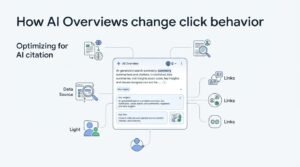
AI Overviews are AI-generated answer summaries that appear above traditional organic results and cite the sources they draw from. They change click behavior significantly, with research from Pew Research Center finding users clicked a traditional result on just 8% of visits where an AI summary appeared, versus 15% without one.
How AI Overviews change click behavior
Informational queries lose the most clicks, because the answer sits right there in the summary. Commercial and transactional queries are far less affected, since people still need to compare and buy on an actual site.
This shifts where SEO value lives. Being cited in the overview now carries brand value even without the click.
Optimizing for AI citation
AI systems cite sentences, not pages. A sentence gets lifted when it answers a question directly, names its own subject without depending on the previous sentence, and attributes any statistic inside the same sentence as the number.
I write every section opener as if it will appear alone. That single habit does more for AI visibility than any schema markup.
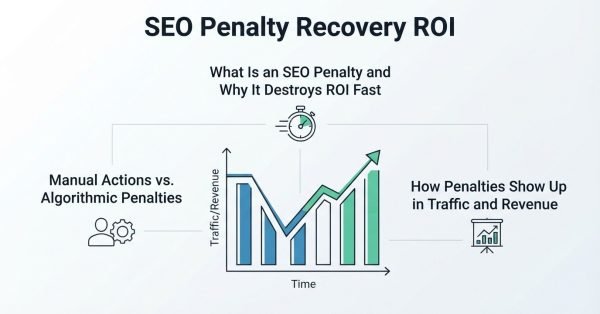
Measuring SEO Performance and ROI
SEO performance is measured through organic traffic, keyword rankings, conversions, and revenue attributed to organic sessions. Rankings alone prove nothing, because a site can gain a hundred positions on terms nobody buys from.
Metrics that matter vs. vanity metrics
Here is how I separate the two:
| Metric that matters | Vanity metric it replaces |
| Organic conversions | Total organic sessions |
| Revenue from organic | Average ranking position |
| Non-branded organic traffic | Total keyword count |
| Qualified leads per month | Domain authority score |
Domain authority is a third-party estimate, not a Google metric. It is useful for comparing link prospects and useless as a campaign KPI.
Attribution and reporting cadence
Monthly reporting is the right cadence for most campaigns, with quarterly strategy reviews. Weekly reporting encourages reacting to noise, which is how good strategies get abandoned early.
Attribution gets harder as journeys lengthen. Most organic leads touch three to seven pages before converting, so last-click attribution undercounts SEO’s real contribution.
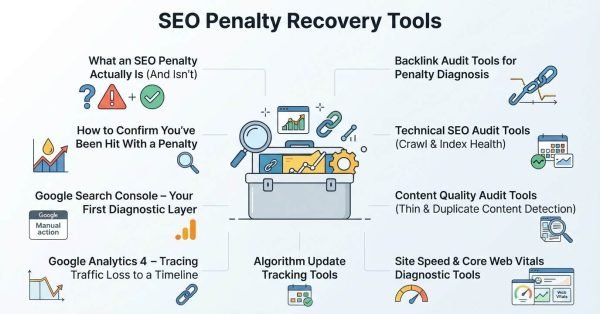
SEO Penalties, Recovery, and Algorithm Updates
An SEO penalty is a manual or algorithmic suppression of a site’s rankings caused by violating search engine guidelines. Most sudden traffic drops are not penalties at all; they are algorithm updates that recalibrated what the engine rewards.
Manual actions vs. algorithmic drops
A manual action appears as a notice in Google Search Console and requires a reconsideration request after cleanup. An algorithmic drop shows no notice and recovers only when the site genuinely improves, and a subsequent update reassesses it.
Check Search Console first, always. Half the panic I see comes from owners assuming a penalty when the answer was a core update.
Recovery timelines
Manual action recovery takes two to eight weeks after a successful reconsideration request. Algorithmic recovery is slower and often waits for the next core update, which means three to six months is realistic.
There is no way to accelerate a core update. Fix the underlying quality problem and wait.
Hiring an SEO Agency, Freelancer, or In-House Team

The right SEO hire depends on budget, internal capacity, and how much specialist range you need. Agencies bring breadth, freelancers bring focus and lower cost, and in-house teams bring context but need external support for technical depth.
Questions to ask before signing
Ask these five before any contract:
- What specifically will you do in the first ninety days?
- Which metrics will you report, and how often?
- Who actually does the work, and where are they based?
- Can you show a campaign in my industry and its results?
- What happens to the content and links if we end the engagement?
The last question separates partners from vendors. If the assets are not yours, you are renting your own rankings.
Red flags and guarantee scams
Anyone guaranteeing a number one ranking is either lying or planning to rank you for a term nobody searches. Nobody controls Google’s index, and guarantees require control.
Other warning signs include secret proprietary methods, refusal to name link sources, and monthly reports full of impressions with no conversion data.
How to Sequence Your First 12 Months of SEO
The correct SEO sequence fixes technical foundations first, then builds content, then earns authority, because each stage multiplies the value of the next. Starting with link building on a site that cannot be crawled wastes the entire investment.
Run it in this order:
- Months 1–2 – technical audit, crawl fixes, analytics setup
- Months 2–3 – keyword research and content mapping
- Months 3–8 – content production and on-page optimization
- Months 5–12 – authority building and digital PR
- Ongoing – measurement, refresh cycles, and competitive monitoring
The overlaps are intentional. Content starts before technical work finishes, and link building starts once there is something worth linking to.
SEO Myths Business Owners Still Believe
Most persistent SEO myths come from tactics that genuinely worked a decade ago and stopped working after specific algorithm updates. Believing them costs money and time.
Here are the ones I still hear weekly:
| Myth | Reality |
| “SEO is a one-time project” | Competitors publish continuously, so rankings decay without maintenance |
| “More keywords means more traffic” | Intent match beats keyword density every time |
| “Meta keywords tag still matters” | Google stopped using it in 2009 |
| “You need to submit to search engines” | Crawlers find linked pages automatically |
| “Social shares are a direct ranking factor” | They drive traffic and visibility, not direct ranking weight |
| “Longer content always ranks better” | Length correlates with depth, but padding hurts |
The pattern is consistent. Every myth substitutes a simple proxy for the harder work of genuinely serving search intent.
Conclusion
These sixty questions cover the full scope of SEO services: how ranking works, what timelines and budgets look like, and how results are measured.
SEO rewards sequencing and patience more than any single tactic, and the deeper resources linked throughout expand each area further.
We build sustainable organic growth for businesses that want compounding results, not shortcuts. Talk to White Label SEO Service about your campaign.
Frequently Asked Questions
How long does SEO take to show results?
SEO typically shows meaningful traffic growth between months four and nine. Competitive industries often need twelve months or more before revenue impact becomes clear.
How much should a small business spend on SEO monthly?
Most small businesses in the US spend between $1,500 and $5,000 per month. The right number depends on competition, not company size.
Can I do SEO myself without an agency?
Yes, for basic on-page work and content. Technical SEO, link building, and competitive analysis usually need specialist tools and experience to do safely.
Does SEO still work with AI Overviews taking clicks?
Yes, SEO still works. Commercial and transactional queries retain most of their clicks, and AI Overviews cite well-structured pages as sources.
What is the difference between SEO and paid search?
SEO earns organic rankings that compound over time. Paid search buys immediate clicks that stop the moment the budget stops.
Why did my rankings suddenly drop?
Sudden drops usually come from algorithm updates, technical errors, or lost backlinks. Check Google Search Console first for manual actions.
Are SEO guarantees legitimate?
No, ranking guarantees are not legitimate. No provider controls Google’s index, so any guaranteed position is either meaningless or dishonest.