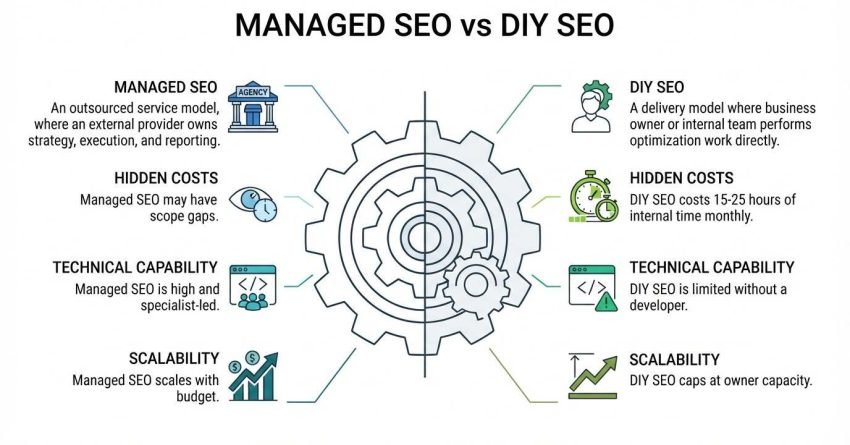
Managed SEO is an outsourced service model where an external provider owns the strategy, execution, and reporting for your organic search program. DIY SEO is the opposite: you or your internal team handle keyword research, content, technical fixes, and link acquisition using your own hours and tools.
Choosing wrong costs you two things at once. You burn budget on an agency you cannot evaluate, or you burn eighteen months of founder time learning a discipline you never needed to master yourself.
This guide covers what each model actually delivers, an honest pros and cons breakdown for both, the real cost and time commitments behind each, where the four disciplines of SEO expose each model’s weak points, a decision framework matched to your business stage, and what changes once you commit either way.
What Managed SEO Actually Means
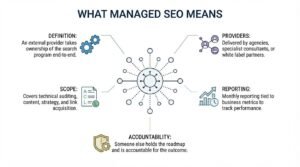
Managed SEO is a service arrangement in which an external agency, consultant, or white label partner takes ownership of your search program end-to-end, including strategy, technical fixes, content production, link acquisition, and performance reporting. You approve direction. They do the work.
I want to be precise here, because “managed” gets used loosely. A freelancer who writes four blog posts a month is not running managed SEO. Managed SEO means someone else holds the roadmap and is accountable for the outcome.
The distinction matters when you compare quotes. Two providers at the same monthly rate can deliver wildly different scopes, and the word “managed” on a proposal tells you almost nothing on its own.
What a managed SEO engagement includes
A complete managed engagement typically covers technical auditing and remediation, keyword and topic strategy, content briefs or full content production, on-page optimization, digital PR or link acquisition, and monthly reporting tied to business metrics.
Some providers bundle all six. Many bundle three and charge separately for the rest. I always ask for the scope in writing before the pricing conversation, because scope is where the real cost hides.
The reporting layer is the one most businesses undervalue. Without it, you cannot tell a stalled campaign from a slow-compounding one, and those two look identical for the first four months.
Who delivers managed SEO
Managed SEO comes from four provider types: full-service agencies, specialist SEO agencies, independent consultants, and white label partners who deliver under another agency’s brand.
Full-service agencies fold SEO into broader marketing. Specialist agencies go deeper but cost more. Consultants give you senior thinking at the price of limited capacity.
White label partners sit behind other agencies, which is why you rarely see them marketed directly. They handle the execution while the client-facing agency owns the relationship.
What DIY SEO Actually Means
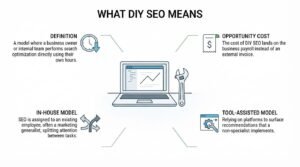
DIY SEO is a delivery model where the business owner or an internal team member performs search optimization work directly, using their own hours, a tool subscription or two, and self-directed learning rather than an external provider.
DIY does not mean amateur. Plenty of in-house teams outperform agencies, particularly in niches where product knowledge beats generic optimization skill.
What DIY always means is that the opportunity cost lands on your payroll instead of an invoice. That cost is real even when it never appears on a line item.
The in-house DIY model
The in-house model assigns SEO to an existing employee, usually a marketing generalist, who splits attention between search and three other responsibilities.
This works when the site is small, and the competitive landscape is soft. It breaks when technical debt accumulates faster than a part-time owner can clear it.
I see the failure point most often around month nine. The easy wins are gone, and what remains requires skills the generalist was never hired for.
The tool-assisted DIY model
The tool-assisted model relies on a platform like Ahrefs, Semrush, or Screaming Frog to surface recommendations that a non-specialist then implements.
Tools are excellent at finding problems. They are poor at prioritizing them against your specific business goals, and they will happily hand you 400 “critical” issues that do not matter.
Judgment is the gap. The software identifies; someone still has to decide what is worth fixing this quarter.
Managed SEO vs DIY SEO: Side-by-Side Comparison
Managed SEO trades money for speed, expertise, and accountability, while DIY SEO trades time and risk tolerance for cost savings and total control. Neither is universally better, and the right answer shifts as a business grows.
The table below compares both models across the six factors that actually change outcomes.
| Factor | Managed SEO | DIY SEO |
| Monthly cash cost | $1,500–$10,000+ | $100–$500 in tools |
| Hidden cost | Scope gaps, retainer lock-in | 15–25 hours/month of internal time |
| Time to competence | Immediate | 6–12 months of learning |
| Technical capability | High, specialist-led | Limited without a developer |
| Link acquisition | Established relationships | Slow, often cold outreach |
| Control over direction | Shared, approval-based | Complete |
| Risk of penalty | Lower, but depends on provider | Higher, from untested tactics |
| Scalability | Scales with budget | Caps at owner capacity |
Read the hidden cost row twice. It is the line most businesses skip, and it is where DIY quietly becomes the more expensive option.
The Pros and Cons of Managed SEO
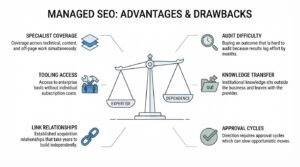
Managed SEO delivers senior expertise, faster execution, and external accountability, at the cost of monthly spend, reduced day-to-day control, and dependence on the provider’s quality. The model rewards businesses that can afford consistency more than they can afford a learning curve.
I have watched the same engagement succeed brilliantly for one client and stall for another at identical spend. The difference is almost always internal readiness, not the agency.
Advantages of hiring a managed SEO provider
The strongest case for managed SEO is compressed time to competence. A provider brings pattern recognition from dozens of sites, which is something no amount of reading replicates.
Key advantages:
- Specialist coverage across technical, content, and off-page work simultaneously
- Access to enterprise tooling without individual subscription costs
- Established link acquisition relationships that take years to build independently
- Accountability through contracted deliverables and reporting
- Capacity that scales without hiring, onboarding, or training
The tooling point is underrated. An agency stack can run $2,000 a month before a single hour of labor, and that cost is spread across their client base rather than yours alone.
Drawbacks and risks of outsourcing SEO
The main drawback is that you are buying an outcome you cannot easily audit. SEO results lag effort by months, which gives underperforming providers a long window to look busy.
Key drawbacks:
- Monthly retainers continue during the slow early phase with little visible return
- Provider quality varies enormously, and credentials are hard to verify
- Institutional knowledge sits outside your business and leaves when they do
- Scope creep charges accumulate for work you assumed was included
- Direction requires approval cycles, which slows opportunistic moves
The knowledge transfer problem is the one that bites hardest at the eighteen-month mark. If the engagement ends and nothing was documented internally, you restart from close to zero.
The Pros and Cons of DIY SEO
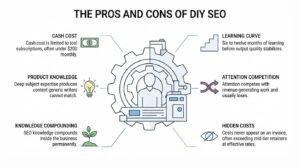
DIY SEO gives you complete control, near-zero cash cost, and permanent internal knowledge, at the cost of significant time, a steep learning curve, and higher exposure to expensive mistakes. It suits businesses with more hours than budget and a genuine tolerance for slow progress.
The model is undervalued in agency marketing for obvious reasons. For an early-stage business with a small site, DIY is frequently the correct call.
Advantages of running SEO in-house
The biggest advantage is product knowledge. Nobody understands your customer’s objections, vocabulary, and buying triggers better than the people who sell to them daily.
Key advantages:
- Cash cost limited to tool subscriptions, often under $200 monthly
- Complete control over priorities, messaging, and publishing speed
- Knowledge compounds inside the business permanently
- No approval cycles, so opportunistic content ships same-day
- Deep subject expertise produces content generic writers cannot match
That last point drives real results. Topical depth is a ranking advantage, and in-house teams start with it while agencies have to acquire it.
Drawbacks and hidden costs of DIY SEO
The main drawback is that the cost never appears on an invoice, so it goes unmeasured. Twenty hours a month at a founder’s effective rate frequently exceeds a mid-tier retainer.
Key drawbacks:
- Six to twelve months of learning before output quality stabilizes
- Technical SEO often requires developer time you have to borrow or buy
- Link acquisition through cold outreach converts poorly without relationships
- Attention competes with revenue-generating work and usually loses
- Mistakes surface months later, when correction is far more expensive
Attention competition is the silent killer. SEO is never urgent on any given Tuesday, so it slips, and a program that slips for two months has effectively stopped.
The Four Disciplines of SEO and Where Each Model Struggles
SEO breaks into four disciplines: technical, on-page and content, off-page authority, and analytics. Managed and DIY models each handle some disciplines well and struggle badly with others, which is why the choice is rarely all-or-nothing.
This table maps where each model typically holds up.
| Discipline | DIY viability | Managed viability | Main constraint |
| Technical SEO | Low to medium | High | Developer access |
| On-page and content | High | Medium to high | Subject expertise |
| Off-page authority | Low | High | Relationships |
| Analytics and reporting | Medium | High | Measurement setup |
Technical SEO
Technical SEO covers crawlability, indexation, site speed, structured data, and architecture the infrastructure layer that determines whether your content can rank at all.
DIY struggles here because diagnosis and remediation require different skills. Spotting a crawl budget problem is a reading exercise; fixing it is an engineering one.
On-page and content
On-page work is where DIY performs best. Internal teams know the customer language, the objections, and the edge cases that make content genuinely useful.
Agencies compensate with process and volume, but they rarely match in-house depth on niche subjects without a long ramp.
Off-page and authority
Off-page authority building is where DIY falls furthest behind. Editorial links come from relationships, and relationships take years that a solo operator does not have spare.
Cold outreach at low volume converts poorly. Providers with existing publisher contacts operate on entirely different economics here.
Analytics and reporting
Analytics determines whether you know what is working. Google Search Console and Google Analytics are both free, so the barrier is interpretation rather than access.
Most DIY programs collect data and never act on it. That is worse than not measuring, because it creates false confidence.
The Real Cost of Managed SEO vs DIY
Managed SEO in the US typically runs $1,500 to $10,000 monthly depending on scope and competition, while DIY costs $100 to $500 in tools plus 15 to 25 internal hours monthly. Converting those hours to money is what makes the comparison honest.
An Ahrefs survey of 348 SEO professionals found the median monthly retainer sits around $3,209, with hourly consulting clustering between $75 and $150.
Managed SEO pricing models
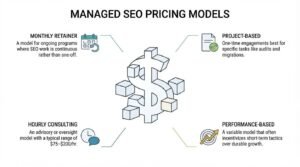
Managed SEO is sold four ways: monthly retainer, project-based, hourly, and performance-based. Retainers dominate because SEO work is continuous rather than one-off.
| Model | Typical range | Best for |
| Monthly retainer | $1,500–$10,000/mo | Ongoing programs |
| Project-based | $3,000–$25,000 | Audits, migrations |
| Hourly consulting | $75–$200/hr | Advisory, oversight |
| Performance-based | Variable | Rarely advisable |
I avoid performance-based deals. They incentivize short-term ranking tactics over durable growth, and the metric definitions are almost always written in the provider’s favor.
The true cost of DIY (time, tools, salary)
The true cost of DIY equals tool subscriptions plus internal hours valued at their real opportunity cost. At 20 hours monthly and a $100 effective hourly rate, DIY costs $2,200 per month including a $200 tool stack.
That number lands squarely inside mid-tier retainer territory. The difference is that the retainer buys specialist hours and the DIY spend buys generalist hours during a learning curve.
For a founder whose time generates revenue directly, the math gets worse, not better.
Time Investment: How Many Hours Each Model Demands
DIY SEO requires 15 to 25 hours per month for a small site and 40 or more for a competitive one, while managed SEO requires 2 to 5 hours monthly from the client for approvals, briefings, and reporting reviews.
That gap is the actual product being sold. You are not primarily buying rankings; you are buying back 15 to 20 hours.
The client-side hours under a managed engagement are not zero, and pretending otherwise causes engagements to fail. Providers need subject matter input, approvals, and access, and a client who disappears gets generic work.
Skill Requirements: What DIY SEO Actually Asks of You
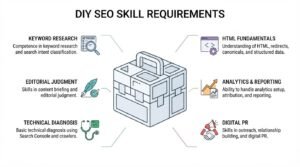
DIY SEO requires competence in keyword research, content strategy, basic HTML and site architecture, analytics interpretation, and outreach five distinct skill areas that rarely sit in one person.
Realistic skill checklist:
- Keyword research and search intent classification
- Content briefing and editorial judgment
- Basic technical diagnosis in Search Console and a crawler
- HTML, redirects, canonicals, and structured data fundamentals
- Analytics setup, attribution, and reporting
- Outreach, relationship building, and digital PR
Most marketers arrive with two or three. The remaining gaps are where DIY programs quietly stall, usually on technical and off-page work.
Honest self-assessment here saves a year. If four of the six are genuine gaps, DIY is a two-year project, not a six-month one.
SEO Timelines: Does Either Model Get Results Faster?
Managed SEO typically produces measurable movement 25 to 50 percent faster than DIY, but both models operate on the same underlying timeline of four to twelve months for meaningful organic traffic growth.
Google indexes and re-evaluates on its own schedule regardless of who did the work. A provider compresses the execution phase, not the algorithm’s evaluation period.
An Ahrefs study of 2 million keywords found only 5.7% of newly published pages reach the top 10 within a year. That figure applies to agency work and DIY work alike.
Where managed SEO genuinely wins on speed is avoiding dead ends. A specialist skips the six months a beginner spends optimizing things that were never the constraint.
Risk, Penalties, and Quality Control
DIY SEO carries a higher risk of self-inflicted technical and link-related damage, while managed SEO carries the risk of a provider using tactics you cannot evaluate until the damage appears. Both risks are real, and both are manageable with the right controls.
Manual actions are rare. Algorithmic suppression from low-quality links or thin content is far more common and much harder to diagnose.
Where DIY goes wrong
DIY damage usually comes from three sources: purchased links from marketplaces, mass-produced thin content, and technical changes made without understanding the consequences.
The redirect mistake is the classic one. A site migration handled without proper 301 mapping can erase years of accumulated authority in a single afternoon.
Where bad agencies go wrong
Bad agencies fail predictably: private blog networks, recycled content across clients, vanity metric reporting, and locked-in contracts that outlast their usefulness.
Ask for a full backlink sample before signing. A provider unwilling to show where links come from is telling you something important.
Scalability and Growth Ceilings
DIY SEO caps at the capacity of whoever runs it, typically around 4 to 8 new content pieces monthly, while managed SEO scales with budget and can support 20 or more pieces plus concurrent technical and link work.
Every DIY program eventually hits a ceiling. The ceiling is not skill; it is hours in a week that are already spoken for.
Recognizing the ceiling early matters. Businesses that scale their content operations past a solo operator’s capacity usually have to choose between hiring internally or outsourcing, and both take lead time.
The Hybrid Model: Managed SEO Plus In-House Execution
The hybrid model splits SEO by discipline, keeping content and subject expertise in-house while outsourcing technical work, link acquisition, and strategy to a provider. It is the most common arrangement among mid-sized businesses, and frequently the most cost-effective.
A workable split looks like this:
- Strategy and keyword roadmap: provider, with client input
- Technical audits and remediation: provider
- Content briefs: provider
- Content writing: in-house, using subject expertise
- On-page implementation: in-house
- Link acquisition and digital PR: provider
- Reporting and analysis: provider, reviewed monthly in-house
This structure puts each discipline where it performs best. You keep the product knowledge advantage and buy out the relationship-dependent and technically demanding work.
Cost typically lands 30 to 50 percent below full managed retainers, since content production is usually the largest line item in any proposal.
How to Choose: A Decision Framework
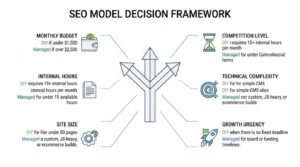
Choose managed SEO when budget exceeds available time, competition is high, or technical complexity is significant. Choose DIY when budget is constrained, the site is small, and someone genuinely has 15+ monthly hours to commit.
The framework below scores the five variables that actually determine fit.
Decision criteria checklist
| Criterion | Points to DIY | Points to Managed |
| Monthly budget | Under $1,500 | Over $2,500 |
| Available internal hours | 15+ per month | Under 10 per month |
| Site size | Under 50 pages | Over 200 pages |
| Competition level | Low, niche terms | High, commercial terms |
| Technical complexity | Simple CMS site | Custom build, JS-heavy, ecommerce |
| Growth urgency | No fixed deadline | Board or funding timeline |
| Existing skill in-house | 4+ of 6 skills | 2 or fewer |
Score four or more rows toward one column and the answer is clear. Split results point toward the hybrid model.
Scenario matching by business stage
| Business stage | Recommended model | Reasoning |
| Pre-revenue startup | DIY | No budget, founder has hours, small site |
| Early SME, under $500k | DIY or hybrid | Tools plus outsourced technical work |
| Growing SME, $500k–$5M | Hybrid | In-house content, outsourced authority |
| Established, $5M+ | Managed | Competitive terms, complex site, opportunity cost |
| Agency reselling SEO | White label managed | Capacity without hiring |
Agencies reselling to their own clients occupy a distinct position. A white label SEO partner provides delivery capacity under the agency’s brand, which avoids both hiring cost and the margin loss of referring work away.
Signs You’ve Outgrown DIY SEO
You have outgrown DIY SEO when rankings plateau despite consistent effort, technical issues exceed your diagnostic ability, or the hours required now displace higher-value work.
Clear signals:
- Traffic flat or declining for three consecutive months despite publishing
- Search Console errors you cannot interpret or resolve
- Competitors outranking you on terms you previously held
- Content backlog growing faster than you clear it
- Link profile static for six months or longer
- SEO tasks consistently postponed for urgent work
Two or more signals for two consecutive months is the threshold. Waiting past that point turns a maintenance problem into a recovery project.
How to Vet a Managed SEO Provider
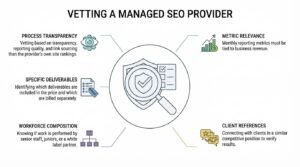
Vet a managed SEO provider on process transparency, reporting quality, link sourcing, and client references in comparable industries, not on rankings they claim for their own site.
Self-ranking proves nothing. Agency terms are often less competitive than their clients’ terms, and some strong providers deliberately keep a low profile.
Questions to ask before signing
- What specific deliverables are included, and which are billed separately?
- Where do links come from, and can you show a sample backlink profile?
- Who does the work: senior staff, juniors, or a white label partner?
- What metrics appear in monthly reporting, and are they tied to revenue?
- What does the first 90 days look like, week by week?
- What happens to the strategy documentation if we part ways?
- Can you connect me with two clients in a similar competitive position?
Question three matters more than most buyers realize. Subcontracting is not automatically bad, but you should know who is actually doing the work you are paying for.
Question seven is the one weak providers avoid. A provider with results will connect with you without hesitation.
How to Transition from DIY to Managed SEO
Transition from DIY to managed SEO by documenting existing work, granting scoped access, agreeing to a 90-day audit-first plan, and preserving what already performs rather than rebuilding from scratch.
Sequence:
- Export current rankings, traffic baselines, and backlink profile
- Document past tactics, including anything you suspect was risky
- Grant read-only analytics and Search Console access first
- Require an audit and prioritized roadmap before execution begins
- Agree which existing pages are protected from changes
- Set a 90-day review with defined success criteria
Disclosing past shortcuts is uncomfortable and essential. A provider who finds purchased links three months in has lost three months.
How to Measure Success Under Either Model
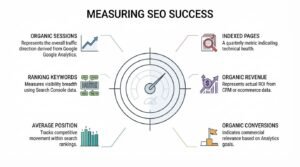
Measure SEO success on organic sessions, ranking keyword count, qualified conversions, and revenue attributed to organic, reviewed monthly, judged quarterly. Model choice does not change which metrics matter.
| Metric | Source | Review cadence | What it tells you |
| Organic sessions | Google Analytics | Monthly | Overall traffic direction |
| Ranking keywords | Search Console | Monthly | Visibility breadth |
| Average position | Search Console | Monthly | Competitive movement |
| Organic conversions | Analytics goals | Monthly | Commercial relevance |
| Revenue from organic | CRM or ecommerce | Quarterly | Actual ROI |
| Indexed pages | Search Console | Quarterly | Technical health |
Judge quarterly, not monthly. Monthly data is noisy enough to justify any narrative you want to believe.
Common Mistakes in Both Models
The most common mistakes across both models are impatience, chasing vanity metrics, neglecting technical foundations, and switching strategy before the current one has had time to work.
Shared mistakes:
- Abandoning a strategy at month three, before results are measurable
- Optimizing for traffic volume rather than qualified traffic
- Publishing content without fixing crawl and indexation problems first
- Measuring rankings only, ignoring conversions and revenue
- Treating SEO as a project with an end date rather than an ongoing program
The month-three abandonment is the expensive one. Switching approach resets the evaluation clock, and businesses that do it repeatedly never get past the starting phase.
Conclusion
Managed SEO buys expertise, speed, and accountability. DIY buys control, savings, and permanent internal knowledge. Hybrid models combine both, and most growing businesses land there.
Your budget, available hours, site complexity, and competitive pressure determine the answer. The framework above scores those variables honestly, and the deeper resources linked throughout cover each in detail.
We help agencies and businesses scale organic growth without adding headcount. Talk to White Label SEO Service about the right delivery model for your position.
Frequently Asked Questions
Is managed SEO worth the cost for a small business?
Managed SEO is worth it when your time is worth more than the retainer. Below roughly $1,500 monthly, DIY or hybrid usually delivers better returns.
Can I do SEO myself with no experience?
Yes, but expect six to twelve months before output quality stabilizes. Start with content and on-page work, which are the most learnable disciplines.
How long before managed SEO shows results?
Managed SEO typically shows measurable movement in four to six months and meaningful traffic growth by month nine. Competitive niches take longer.
What is the cheapest way to get professional SEO help?
Hourly consulting is the cheapest professional option, typically $75 to $200 per hour. You buy strategy and execute in-house.
Does hiring an agency guarantee better rankings?
No. Agency quality varies enormously, and a poor provider performs worse than a committed DIY effort. Vetting matters more than the model.
Should I switch agencies if results are slow?
Not before month six. Switching resets the evaluation period, and slow early progress is normal rather than a failure signal.
What is a hybrid SEO model?
A hybrid SEO model keeps content and subject expertise in-house while outsourcing technical work, link acquisition, and strategy to a provider.