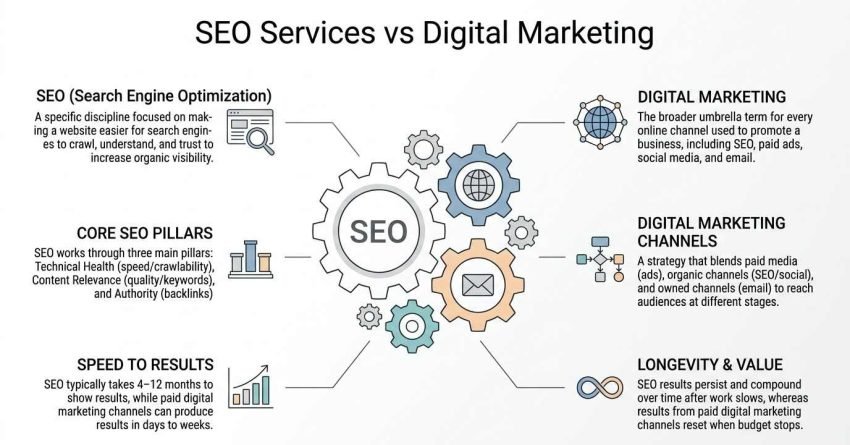
SEO services and digital marketing are not the same thing: SEO is a specific discipline focused on organic search visibility, while digital marketing is the broader umbrella that includes SEO alongside paid ads, social media, and email. I get this question constantly from business owners who’ve been quoted for one and assumed they were buying the other. And the confusion is understandable.
Getting this wrong costs real budget and real time. Misallocating spend between the two delays growth and muddies how you measure results.
This guide covers what each discipline actually is, how their strategies and costs differ, what’s included in a typical SEO versus digital marketing engagement, how the two work together in practice, and how to decide which one your business needs right now.
What Is SEO?
SEO is a set of technical, content, and authority-building practices designed to increase a website’s visibility in organic (unpaid) search engine results. I think of it as the discipline of making a website easier for search engines to crawl, understand, and trust enough to rank.
Search engine optimization works by aligning a site’s technical structure, on-page content, and external reputation with what search engines look for when deciding rankings. We build strategies around three pillars: technical health, content relevance, and authority signals.
The Core Components of SEO
Technical SEO covers site speed, crawlability, indexing, and mobile usability. On-page SEO covers content quality, keyword targeting, and internal structure. Off-page SEO covers backlinks and brand authority signals from other sites.
Each component reinforces the others, and a weakness in one usually limits results from the rest, no matter how strong the others are.
What SEO Aims to Achieve
SEO aims to grow qualified organic traffic that converts into leads or sales without ongoing ad spend. I’ve seen businesses treat this as a vanity metric, chasing rankings instead of revenue.
The real objective is compounding visibility. Every piece of optimized content and every earned link keeps working long after it’s published, which is fundamentally different from how paid channels behave.
What Is Digital Marketing?
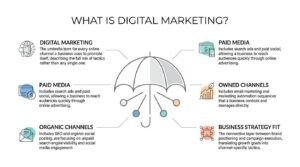
Digital marketing is the umbrella term for every online channel a business uses to promote itself, including SEO, paid advertising, social media, email, and content marketing. I use this term with clients to describe the full mix, not any single tactic.
Digital marketing pulls together multiple channels working toward shared business goals like awareness, leads, and revenue. Each channel plays a distinct role, and none of them replace the others.
The Channels Under the Digital Marketing Umbrella
Paid media includes search ads and paid social. Organic channels include SEO and organic social posting. Owned channels include email marketing and marketing automation sequences.
A digital marketing strategy typically blends several of these channels rather than relying on just one, since each reaches audiences at a different stage of the buying journey.
How Digital Marketing Fits Into a Business Strategy
Digital marketing sits underneath the broader business and revenue strategy, translating growth goals into channel-specific tactics. We treat it as the connective layer between brand positioning and day-to-day campaign execution.
Budget allocation across channels usually reflects how fast a business needs results and how much it can invest upfront.
SEO vs Digital Marketing: The Core Relationship
SEO is one channel inside digital marketing, not a competing alternative to it. I explain this to almost every new client because the framing changes how they budget and measure success.
Why SEO Is a Subset, Not a Substitute
SEO cannot replace the awareness-building speed of paid social, and paid social cannot replace the compounding, low-cost-per-lead nature of organic search over time. Each channel does something the others don’t.
Businesses that treat SEO as their entire digital marketing plan often miss short-term revenue opportunities that paid channels capture quickly.
A Side-by-Side Comparison Table
The table below shows how SEO and full-scope digital marketing differ across the factors that matter most to a buyer.
| Factor | SEO | Digital Marketing (Full Mix) |
| Scope | One organic channel | Multiple channels (SEO, paid, social, email) |
| Speed to results | 4–12 months | Days to weeks for paid channels |
| Cost model | Ongoing service fee, compounding value | Ad spend + management fee, resets with budget |
| Longevity of results | Persists after work slows | Stops when spend stops |
| Primary metric | Organic traffic, rankings, organic leads | Channel-specific: CTR, CPL, ROAS, engagement |
Key Differences in Strategy and Approach
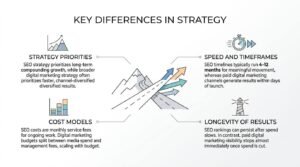
SEO strategy prioritizes long-term compounding growth, while broader digital marketing strategy often prioritizes faster, channel-diversified results. I structure client roadmaps differently depending on which one is the primary lever.
Timeframes: Long-Term vs Multi-Channel Speed
SEO timelines typically run four to twelve months before meaningful ranking movement appears, depending on competition and site history. Paid digital marketing channels can generate traffic and leads within days of launch.
This timing difference is why we usually recommend running both simultaneously rather than sequentially.
Cost Structures and Budget Allocation
SEO costs are typically a flat or tiered monthly service fee that funds ongoing technical work, content, and link building. Digital marketing budgets split between media spend and management fees, meaning results scale directly with ad budget.
A business cutting SEO spend still retains most of its earned rankings for a period. A business cutting paid spend loses visibility almost immediately.
What Does an SEO Service Actually Include?
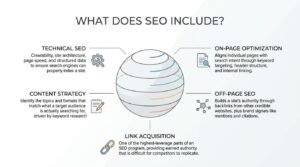
A comprehensive SEO service typically includes technical audits, on-page optimization, content strategy, and link acquisition, delivered as an ongoing monthly engagement. I break this into three functional layers with clients so they know exactly what they’re paying for.
Technical SEO
Technical SEO covers crawlability, site architecture, page speed, and structured data. According to Google’s own Search Central documentation, sites that fail basic crawlability checks often see indexing delays that suppress ranking potential regardless of content quality.
We audit these technical foundations before any content or link work begins, since fixing structural issues later usually means redoing work.
On-Page and Content Optimization
On-page optimization aligns individual pages with search intent through keyword targeting, header structure, and internal linking. Content strategy identifies the topics and formats that match what a target audience is actually searching for.
Keyword research drives this process, mapping search demand to content gaps a site hasn’t yet filled.
Off-Page Authority Building (Link Acquisition)
Off-page SEO builds a site’s authority through backlinks from other credible websites, plus broader brand signals like mentions and citations. An Ahrefs study of over one billion pages found a clear correlation between the number of referring domains a page has and the organic traffic it receives.
Link acquisition remains one of the slowest but highest-leverage parts of an SEO program because earned authority is difficult for competitors to replicate quickly.
What Does a Digital Marketing Service Actually Include?
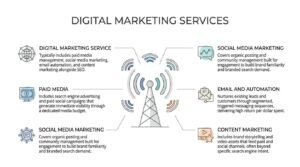
A full digital marketing service typically includes paid media management, social media marketing, email automation, and broader content marketing alongside SEO. I position this as the coordinated layer that surrounds and amplifies organic search work.
Paid Media (PPC, Paid Social)
Paid media includes search engine advertising and paid social campaigns, both billed against a media budget plus a management fee. These channels generate immediate visibility that SEO cannot match in its early months.
Social Media Marketing
Social media marketing covers organic posting, community management, and platform-specific content built for engagement rather than search visibility. It builds brand familiarity that indirectly supports search performance through branded search demand.
Email and Marketing Automation
Email marketing and automation nurture existing leads and customers through segmented, triggered messaging sequences. This channel typically delivers the highest return per dollar spent of any digital marketing channel, since it targets people who already know the brand.
Content Marketing (Beyond SEO)
Content marketing beyond SEO includes brand storytelling, video, and top-of-funnel assets not necessarily built around search intent. This content often feeds paid and social channels even when it isn’t optimized for organic ranking.
How SEO and Digital Marketing Work Together
SEO and digital marketing work together by sharing audience data, content assets, and performance insights across channels rather than operating in isolation. I’ve run campaigns where paid search data directly shaped which keywords we prioritized in the organic content plan.
Shared Data and Audience Insights
Paid search data reveals which keywords convert before a business invests months into ranking for them organically. This cross-channel data exchange shortens the guesswork in both directions.
Integrated Campaign Examples
A product launch might combine paid ads for immediate visibility, social content for awareness, and SEO-optimized landing pages built to capture search demand once it starts appearing weeks later. Each channel supports the others instead of competing for the same budget line.
Realistic SEO Timelines: What to Expect
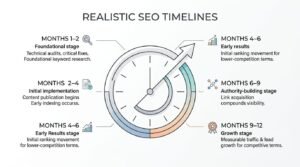
Most SEO campaigns take four to twelve months to produce meaningful organic traffic growth, depending on site history, competition, and technical starting point. I set this expectation with every client upfront because mismatched timelines are the most common source of frustration.
Month-by-Month Progress Benchmarks
The list below outlines what typically happens at each stage of a new SEO engagement.
- Months 1–2: Technical audit, fixes, and foundational keyword research
- Months 2–4: Content publication begins, and early indexing occurs
- Months 4–6: Initial ranking movement for lower-competition terms
- Months 6–9: Authority-building link acquisition compounds visibility
- Months 9–12: Measurable traffic and lead growth for competitive terms
Factors That Speed Up or Slow Down Results
Domain age, existing authority, technical debt, and competitive density all affect how quickly results appear. A site with a clean technical foundation and some existing authority can see movement faster than the general four-to-twelve-month range.
How SEO ROI Compares to Other Digital Marketing Channels
SEO typically delivers a lower cost per lead over time than paid channels because organic rankings continue generating traffic without ongoing spend per click. A study by Backlinko analyzing search behavior found the top five organic results capture over 67% of all clicks, a share paid ads rarely reach.
Measuring Organic Growth Over Time
Organic growth is measured through rankings, organic sessions, and organic-attributed leads tracked in Google Search Console and analytics platforms. We track these monthly against a baseline set during the technical audit phase.
Why SEO Compounds While Paid Channels Don’t
A ranking page earned through SEO keeps generating traffic without additional spend, while a paid ad stops generating clicks the moment the budget runs out. This compounding effect is why long-term organic investment often outperforms paid spend on a twelve-month or longer horizon.
Which Ranking Factors Matter Most Right Now
Content quality signals, technical site health, and demonstrated expertise currently carry the most weight in how search engines evaluate and rank pages. I prioritize these three areas above nearly everything else in current SEO work.
E-E-A-T and Content Quality Signals
E-E-A-T stands for experience, expertise, authoritativeness, and trustworthiness, a framework search engines reportedly use to assess content credibility. Content demonstrating first-hand experience and citing credible sources tends to outperform generic, unsupported content.
Core Web Vitals and Technical Health
Core Web Vitals measure loading performance, interactivity, and visual stability as reported through Google’s PageSpeed Insights. Sites failing these thresholds often see suppressed rankings even when their content quality is strong.
When to Choose SEO Services, Digital Marketing, or Both
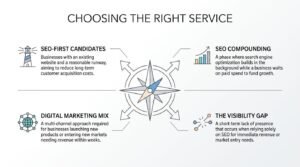
Choose SEO first when you need sustainable, long-term organic growth, and choose broader digital marketing when you need faster, immediate visibility across multiple channels. I ask new clients about their timeline and cash flow before recommending either path.
Signs You Need SEO First
A business with a reasonable runway, an existing website, and a goal of reducing long-term customer acquisition costs is usually a strong SEO-first candidate. Waiting on paid spend to fund growth while SEO compounds in the background often works well here.
Signs You Need a Full Digital Marketing Mix
A business launching a new product, entering a new market, or needing revenue within weeks typically needs paid and social channels running alongside any SEO work. Relying on SEO alone in these situations usually leaves too large a visibility gap in the short term.
Common Misconceptions About SEO and Digital Marketing
The most common misconception is that SEO and digital marketing are competing options rather than complementary parts of the same growth strategy. I hear this framing constantly from business owners comparing quotes.
Why “Fast SEO Results” Claims Are a Red Flag
Any provider promising first-page rankings within days or weeks is describing paid placement, not organic SEO, or is using tactics that risk search engine penalties. Genuine organic ranking growth follows the technical, content, and authority timeline outlined earlier in this guide.
How to Choose the Right SEO or Digital Marketing Partner
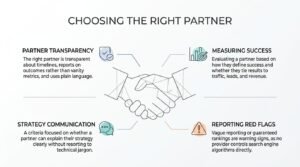
The right partner is transparent about timelines, reports on business outcomes rather than vanity metrics, and explains their methodology in plain language. I evaluate potential partners on these three criteria before anything else.
Questions to Ask Before Signing a Contract
Ask how they measure success, what their reporting cadence looks like, and whether they can explain their strategy without resorting to jargon. A partner who can’t answer these clearly in a sales conversation likely won’t communicate clearly during the engagement either.
Red Flags in Reporting and Transparency
Vague reporting focused only on rankings, without tying results to traffic, leads, or revenue, is a warning sign. Guaranteed rankings or guaranteed timelines are another, since no reputable provider controls search engine algorithms directly.
Conclusion
SEO and digital marketing serve different but connected roles, with SEO compounding organic visibility while broader digital marketing drives faster, multi-channel reach. Understanding this relationship helps you budget, plan, and measure results realistically across both.
We build strategies that combine technical SEO, content, and authority work with the broader digital marketing picture your business needs. Talk to White Label SEO Service to map out a strategy built around your actual timeline and growth goals.
Frequently Asked Questions
Is SEO part of digital marketing or separate from it?
SEO is one channel within the broader digital marketing umbrella, not a separate discipline. Digital marketing includes SEO alongside paid media, social, and email.
How long does SEO take to show results?
Most SEO campaigns take four to twelve months to show meaningful traffic growth. Timelines depend on competition, technical health, and existing domain authority.
Is SEO more cost-effective than paid digital marketing?
SEO typically costs less per lead over time because rankings persist without ongoing per-click spend. Paid channels cost more per lead but deliver faster initial results.
Can a business succeed with only SEO and no other digital marketing?
Some businesses succeed with SEO alone, particularly those with longer sales cycles and adequate runway. Most benefit from at least some paid or social support during SEO’s ramp-up period.
What’s the difference between an SEO agency and a digital marketing agency?
An SEO agency specializes solely in organic search strategy and execution. A digital marketing agency manages multiple channels, including SEO, paid ads, social, and email.
How do I measure ROI from SEO versus digital marketing?
SEO ROI is measured through organic traffic, rankings, and organic-attributed leads over months. Digital marketing ROI is measured per channel using metrics like cost-per-lead and return on ad spend.
Do SEO and digital marketing use the same tools?
Some tools overlap, like Google Analytics and Google Search Console, used across both disciplines. Paid channels also rely on platform-specific tools like ad managers that SEO doesn’t require.