Local SEO is the practice of optimizing a business’s online presence so it appears in search results for people searching in a specific geographic area, and it matters because most local buying decisions now start with a search engine. I’ve watched businesses with excellent products lose customers to weaker competitors simply because they never showed up in a local search. This isn’t a niche marketing tactic anymore.
Ignoring local search puts a business at a real disadvantage against competitors who already rank well. We see this pattern repeat across nearly every local industry we work with.
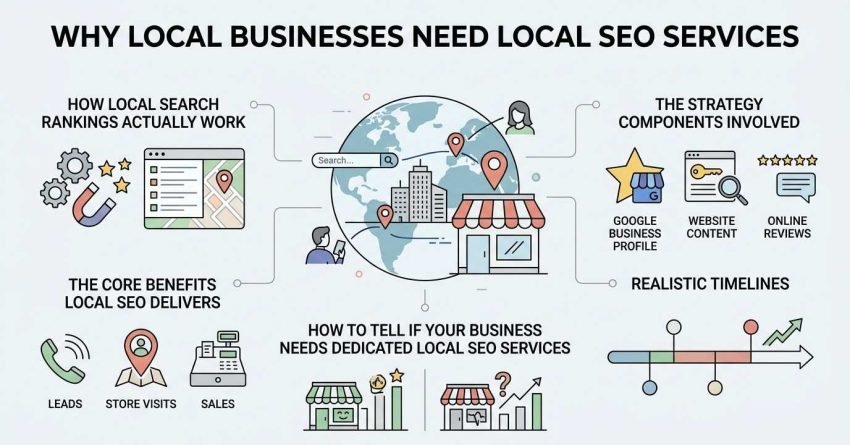
This guide covers how local search rankings actually work, the core benefits local SEO delivers, the strategy components involved, realistic timelines, and how to tell if your business needs dedicated local SEO services. I’ll walk through each piece with the same lens I’d use for my own business.
What Local SEO Actually Means for a Local Business
Local SEO is the process of optimizing a business’s website, listings, and online signals so it ranks for searches tied to a specific city, region, or “near me” intent. It’s different from general SEO because it’s built around geography, not just keywords.
A bakery ranking nationally for “best sourdough recipe” gains nothing if a hungry local customer three blocks away can’t find its storefront. That’s the gap local SEO closes. I think of it as making sure the right people, in the right location, find you at the exact moment they’re ready to buy.
How Local SEO Differs From Traditional SEO
Traditional SEO chases broad, often national visibility. Local SEO layers in location signals, proximity, service areas, and local citations that traditional SEO doesn’t need to touch. A business ranking well nationally can still be invisible in its own hometown if these local signals are ignored.
I’ve seen sites with strong domain authority miss out on the map pack entirely because their Google Business Profile was never optimized. The two disciplines overlap, but they solve different problems.
How Local Search Rankings Actually Work
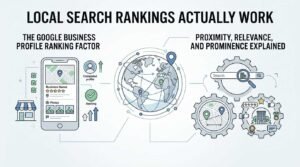
Google ranks local results using three main factors: relevance, distance, and prominence, and no amount of general SEO work substitutes for optimizing these directly. I explain this to nearly every client because it reframes how they think about their marketing spend.
Relevance measures how well a business matches what someone searched for. Distance measures how close the business is to the searcher or the location implied in the query. Prominence reflects how well-known and well-reviewed the business is, both online and off.
The Google Business Profile Ranking Factor
A Google Business Profile is a free business listing that powers most of what appears in the local map pack and local knowledge panels. It’s arguably the single highest-leverage asset a local business has, and it’s shocking how many leave it half-finished.
I’ve watched fully optimized profiles with complete categories, photos, services, and posts outperform competitors with objectively better websites. The profile does most of the heavy lifting in local rankings.
Proximity, Relevance, and Prominence Explained
These three factors interact constantly. A business close to the searcher with weak relevance still loses to a slightly farther business with a perfectly optimized listing and strong reviews.
| Ranking Factor | What It Measures | What Influences It |
| Relevance | Match to search intent | Categories, keywords, services listed |
| Distance | Physical proximity | Business address, service area settings |
| Prominence | Overall reputation | Reviews, backlinks, citations, media mentions |
Why Local Businesses Lose Customers Without Local SEO
Businesses without local SEO lose customers because searchers rarely scroll past the first few local results before choosing where to go. I’ve reviewed dozens of local search results where the map pack captured nearly all of the visible clicks above the fold.
If your business isn’t in that map pack or the first page of organic results, you’re effectively invisible to a huge share of ready-to-buy searchers. That’s not a hypothetical risk; it’s happening every day a listing sits unoptimized.
The Cost of Being Invisible in Local Search
An Ahrefs analysis of local search behavior found that the top three map pack results capture the overwhelming majority of local clicks, leaving little visibility for anything below them. That single data point tells the whole story of why ranking position matters so much locally.
I’ve calculated this cost with clients directly: multiply average lifetime customer value by the number of local searches happening monthly for their core service. The number is almost always larger than they expected.
Key Benefit: Increased Visibility in the Local Map Pack
The single biggest benefit of local SEO is earning a spot in the local map pack, the three-listing block that appears above organic results for local searches. This is prime digital real estate, and it drives a disproportionate share of local clicks and calls.
I treat map pack visibility as the primary success metric for almost any local campaign we run. Everything else citations, reviews, on-page work feeds into earning and keeping that spot.
Key Benefit: Higher-Quality, Ready-to-Buy Local Traffic
Local SEO traffic converts at a higher rate because the searcher has already expressed geographic and purchase intent by including a location or “near me” in their query. This traffic isn’t casual browsing; it’s someone actively looking to buy, book, or visit.
![Infographic titled KEY BENEFIT: HIGHER-QUALITY, READY-TO-BUY LOCAL TRAFFIC illustrating a search query for '[SERVICE] NEAR ME' converting through map discovery and wallet intent into foot traffic visits, scheduled bookings, and direct retail purchases.](https://whitelabelseoservice.com/wp-content/uploads/2026/09/Benefit-of-Higher-Quality-Ready-to-Buy-Local-Traffic-100kb-300x167.jpeg)
I’ve compared conversion rates between local organic traffic and broader paid social traffic across multiple clients, and local search consistently wins on intent quality. People searching “plumber near me” are rarely just curious.
Key Benefit: Building Trust Through Reviews and Reputation
Online reviews function as a trust signal for both search engines and human searchers, directly influencing whether a business appears in the map pack and whether users choose to click through. I never separate reputation management from local SEO strategy anymore; they’re the same discipline.
A business with consistent, recent, well-responded-to reviews reads as active and trustworthy. One with old, unanswered, or sparse reviews reads as neglected, even if the business itself is thriving.
Why Review Volume and Response Rate Matter
Review volume signals popularity and prominence, while response rate signals that a business is actively engaged with its customers. Both factors feed into how Google evaluates a listing’s overall trustworthiness.
I recommend a simple standard to clients: respond to every review, positive or negative, within 48 hours. It’s a small habit that compounds into a strong reputation signal over time.
Key Benefit: Competitive Advantage Over Local Competitors
Local SEO creates a durable competitive advantage because most small and mid-sized competitors still underinvest in it, leaving the map pack and local organic results easier to win than crowded national keywords. I see this gap constantly in industries like home services and healthcare.
Outranking three or four local competitors is a fundamentally different challenge than outranking thousands of national sites. This is where local SEO delivers outsized returns relative to effort.
Key Benefit: Long-Term, Compounding ROI Versus Paid Ads
Local SEO builds an asset that keeps generating traffic long after the initial work is done, unlike paid ads that stop producing leads the moment spending stops. I always frame this distinction clearly for clients weighing budget between the two channels.
A well-optimized listing and website keep ranking, keep collecting reviews, and keep compounding in authority. That compounding effect is what separates SEO’s long-term value from the short-term nature of paid media.
Core Components of a Local SEO Strategy
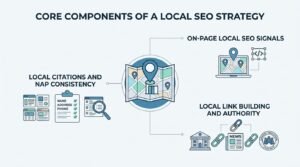
A complete local SEO strategy combines on-page optimization, citation building, review management, and local link acquisition working together toward the same ranking factors. Skipping any one piece weakens the entire system.
I structure every local campaign around these four pillars because each one reinforces a different ranking signal Google evaluates.
On-Page Local SEO Signals
On-page local SEO signals include location-specific keywords, embedded maps, city or region names in titles and headers, and structured data marking up the business’s address and service area. These tell search engines exactly where and who the business serves.
I always start here because it’s the fastest signal to fix, and it directly supports relevance, one of the three core local ranking factors.
Local Citations and NAP Consistency
A citation is any online mention of a business’s name, address, and phone number, commonly abbreviated as NAP, and consistency across every citation is one of the most overlooked local ranking factors. Mismatched NAP data confuses search engines about which listing is authoritative.
I run a citation audit on nearly every new client and consistently find outdated addresses or phone numbers sitting on directories they forgot existed.
Local Link Building and Authority
Local link building earns backlinks from other locally relevant or regionally authoritative websites, such as chambers of commerce, local news outlets, or industry associations. These links carry geographic relevance that generic national backlinks don’t provide.
I prioritize local link sources over higher-authority national ones when the goal is specifically local ranking improvement, because relevance often outweighs raw domain authority here.
How Local SEO Supports Mobile and “Near Me” Search Behavior
Local SEO directly supports the surge in mobile “near me” searches, which rely heavily on device location data paired with optimized business listings. Mobile search behavior has fundamentally shifted how people find local businesses.
I watch mobile-vs-desktop traffic splits closely for local clients, and mobile consistently dominates for service categories like restaurants, auto repair, and healthcare.
Industries and Business Types That Benefit Most From Local SEO
Any business serving customers within a defined geographic area benefits from local SEO, but home services, healthcare providers, restaurants, legal practices, and retail storefronts see some of the strongest returns. These industries share high local search volume and high purchase intent.
I’ve noticed multi-location businesses see compounding benefits because each optimized location listing reinforces the brand’s overall local footprint.
Realistic Local SEO Timelines and What to Expect
Local SEO typically takes three to six months to show meaningful ranking movement, though competitive markets can extend that timeline further. I set this expectation with every client up front because misaligned timelines cause more frustration than any technical issue.
The first few weeks focus on foundational fixes: listing accuracy, on-page signals, citation cleanup. Meaningful map pack movement usually starts appearing after month two or three, with compounding gains continuing well beyond month six.
Common Local SEO Mistakes That Hold Businesses Back
The most common local SEO mistake is leaving a Google Business Profile incomplete or unmonitored, which directly undermines relevance and prominence signals. I still find businesses with missing categories or outdated hours costing them visibility every day.
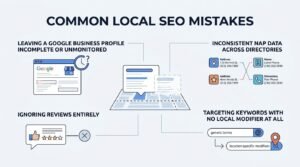
Other frequent mistakes include inconsistent NAP data across directories, ignoring reviews entirely, and targeting keywords with no local modifier at all. Each mistake compounds the others, making the whole listing weaker than any single fix could explain.
How to Know If Your Business Needs Local SEO Services
A business needs local SEO services if it depends on customers from a specific geographic area and isn’t consistently appearing in the local map pack for its core services. That’s the clearest signal I use to qualify a prospect.
I ask a simple question before any consultation: search your own core service plus your city right now. If you don’t see your business in the top three map pack results, there’s a visibility gap worth closing.
Choosing the Right Local SEO Partner or Service
The right local SEO partner should provide clear reporting, transparent strategy, and realistic timeline expectations rather than guaranteed rankings, which no ethical provider can promise. I’m always wary of any pitch that skips this nuance.
We built White Label SEO Service around exactly this kind of transparency, pairing technical execution with ongoing performance tracking so businesses always know what’s working and why. If your business needs a partner to take local visibility seriously, that’s the conversation worth starting now.
Frequently Asked Questions
What is local SEO and how is it different from regular SEO?
Local SEO optimizes a business’s visibility for geographically specific searches, while traditional SEO targets broader, non-location-based rankings. Local SEO relies heavily on Google Business Profile, citations, and reviews.
How long does local SEO take to show results?
Most businesses see meaningful ranking movement within three to six months. Competitive local markets or heavily damaged listings can extend that timeline further.
How much does local SEO cost for a small business?
Costs vary widely based on market competitiveness and service scope, typically ranging from a few hundred to a few thousand dollars monthly. Highly competitive cities generally require larger ongoing investment.
Do I need local SEO if I already run Google Ads?
Yes, because paid ads stop generating traffic the moment spending stops, while local SEO builds lasting organic visibility. The two channels work best together, not as substitutes for each other.
What is the Google Business Profile and why does it matter?
A Google Business Profile is a free listing that controls how a business appears in Google Maps and local search results. It’s one of the strongest ranking signals for local visibility.
Can a business with multiple locations use local SEO?
Yes, multi-location businesses can optimize each location with its own listing and location-specific content. Each properly optimized location reinforces the brand’s overall local search presence.
How do online reviews affect local search rankings?
Online reviews influence both ranking prominence and searcher trust, making them a direct ranking factor. Businesses with more recent, higher-volume reviews generally rank better in the map pack.