Managed local SEO costs businesses between $300 and $2,500 per month, while DIY local SEO trades that cash outlay for 5-15 hours of weekly time investment, and the right choice depends on how much your time is worth versus your budget flexibility. I’ve watched business owners burn months chasing rankings themselves before realizing the real cost wasn’t the tools; it was the opportunity cost of not running their business.
Getting this decision wrong costs more than money. It costs months of visibility you can’t easily win back later.
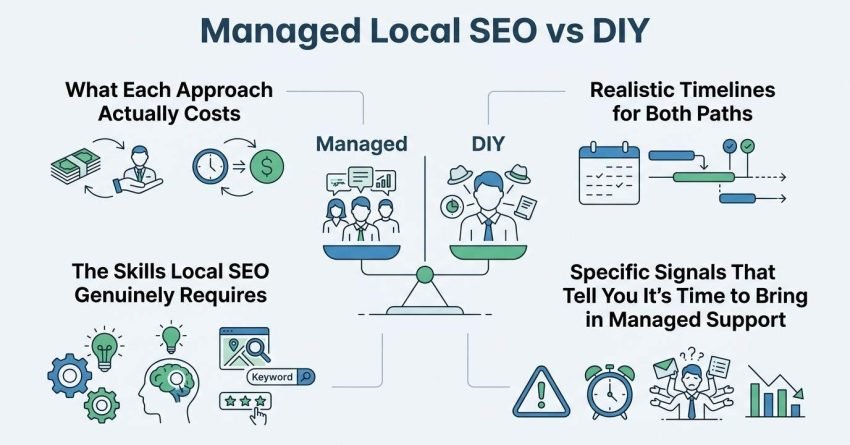
This guide breaks down what each approach actually costs, the skills local SEO genuinely requires, realistic timelines for both paths, and the specific signals that tell you it’s time to bring in managed support instead of going it alone.
What Managed Local SEO and DIY Local SEO Actually Mean
Managed local SEO is a service where an agency or specialist handles your search visibility strategy, execution, and reporting on an ongoing retainer basis. DIY local SEO means you or someone on your team handles that same work internally, using your own time instead of paying for outside expertise.
I think the terms get muddled because “managed” sounds like it should mean more oversight from you, when it actually means less. You’re handing off execution, not adding a layer of management to your own plate.
What “Managed” Local SEO Includes
A managed local SEO engagement typically bundles Google Business Profile optimization, citation building, on-page fixes, content strategy, and monthly reporting into one retainer. The provider owns execution and strategy, and you review results.
Most agencies structure these as month-to-month or quarterly contracts. I’ve found the better providers tie deliverables to specific ranking or traffic goals rather than vague “optimization” language.
What DIY Local SEO Involves
DIY local SEO means the business owner or an internal team member handles keyword research, on-page optimization, citation management, and Google Business Profile updates without outside help. Every task shifts from a line item on an invoice to a line item on your calendar.
That tradeoff sounds simple. It rarely stays simple once local link building enters the picture.
How Much DIY Local SEO Really Costs
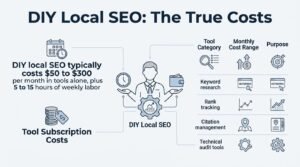
DIY local SEO typically costs $50 to $300 per month in tools alone, plus 5 to 15 hours of weekly labor that most business owners undervalue. The subscription costs are the visible part. The time cost is where DIY budgets actually blow up.
Tool Subscription Costs
| Tool Category | Monthly Cost Range | Purpose |
| Keyword research | $99–$199 | Search volume, difficulty scoring |
| Rank tracking | $20–$100 | Position monitoring |
| Citation management | $30–$80 | NAP consistency across directories |
| Technical audit tools | $99–$179 | Site health, crawl errors |
This table shows where the visible DIY budget goes each month, separate from the time investment covered next.
The Real Cost of Your Own Time
An owner spending 10 hours a week on local SEO at a $75 hourly opportunity cost is effectively paying $3,000 a month in unbilled time, according to SCORE’s small business time-value research. That number usually exceeds what a managed provider would charge for the same output.
I always ask business owners to actually track their hours for two weeks before deciding. Most underestimate by half.
How Much Managed Local SEO Costs
Managed local SEO retainers in the US typically range from $300 to $2,500 per month, depending on market competitiveness, service scope, and agency experience level. Price mostly tracks how much competition exists in your specific local market, not just the services included.
Typical Monthly Retainer Ranges
| Business Size | Monthly Retainer | Typical Scope |
| Single-location small business | $300–$700 | GBP, citations, basic on-page |
| Multi-location or competitive market | $700–$1,500 | Full technical SEO, content, links |
| Enterprise or multi-market | $1,500–$2,500+ | Advanced strategy, dedicated team |
This table breaks down what businesses at different scales typically pay and what that spend covers.
What Drives Price Differences Between Providers
Local SEO pricing swings on three factors: the competitiveness of your specific market, the number of locations you’re optimizing, and whether link building and content creation are included versus billed separately. A single-location dentist in a small town pays far less than a multi-location law firm in a major metro.
I’d rather see a provider price transparently by scope than quote a flat number without explaining what drives it.
The Skills Local SEO Actually Requires
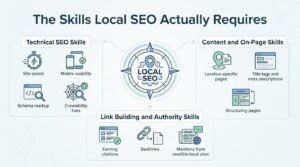
Local SEO requires three core skill sets: technical SEO knowledge, content and on-page optimization ability, and link building or authority-building expertise. Most DIY attempts cover one of these well and neglect the other two entirely.
Technical SEO Skills
Technical SEO skills cover site speed optimization, mobile usability, schema markup implementation, and crawlability fixes that search engines use to evaluate a site’s health. These are the skills most likely to require ongoing monitoring rather than a one-time fix.
I see business owners handle a technical audit once, then never revisit it. Search engines don’t work that way.
Content and On-Page Skills
Content and on-page skills involve writing location-specific pages, optimizing title tags and meta descriptions, and structuring pages so both users and search engines understand relevance. This is usually the skill set business owners are most comfortable doing themselves.
Link Building and Authority Skills
Link building and authority skills involve earning citations, backlinks, and mentions from other credible local sites and directories to signal trust to search engines. This is consistently the hardest skill set to DIY successfully, and it’s covered in more depth in the local link building section below.
Google Business Profile Management: DIY vs Managed
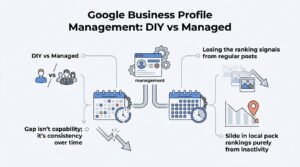
Google Business Profile management can be handled by either approach, but managed providers typically monitor and update profiles weekly while DIY owners update theirs sporadically. The gap isn’t capability; it’s consistency over time.
A Google Business Profile left untouched for months starts losing the ranking signals that come from regular posts, updated photos, and prompt review responses. I’ve watched profiles slide in local pack rankings purely from inactivity, not from doing anything wrong.
Local Citations and NAP Consistency: Who Should Handle It
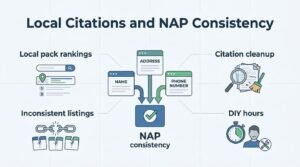
NAP consistency, meaning your business name, address, and phone number matching exactly across every online directory, directly affects local pack rankings. Inconsistent listings confuse search engines about which business information to trust.
Citation cleanup is tedious, repetitive work across dozens of directories. It’s exactly the kind of task that eats DIY hours without feeling like meaningful progress.
Local Link Building: Why This Is Where DIY Usually Breaks Down
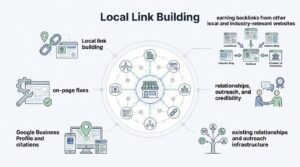
Local link building, the process of earning backlinks from other local and industry-relevant websites, is the skill set where DIY local SEO most often stalls out. Unlike on-page fixes, link building depends on relationships, outreach, and credibility that take years to build.
I’ve seen business owners nail their Google Business Profile and citations, then plateau for a year because nobody’s earning them backlinks. Local link building rewards existing relationships and outreach infrastructure that a solo owner rarely has time to develop from scratch.
Time Investment: What DIY Local SEO Actually Demands Weekly
DIY local SEO realistically requires 5 to 15 hours per week, depending on how competitive your local market is and how much content and citation work is needed. Here’s what that time typically breaks down into:
- Content creation and blog updates: 3-5 hours
- Google Business Profile posts and monitoring: 1-2 hours
- Citation building and cleanup: 2-4 hours
- Technical monitoring and fixes: 1-2 hours
- Outreach for links and mentions: 2-4 hours
This list shows where DIY hours actually go each week, and it’s rarely the content writing that owners expect to take the most time.
Local SEO Timelines: DIY vs Managed Results
Managed local SEO typically produces visible ranking movement in 3 to 6 months, while DIY efforts often take 6 to 12 months to reach the same results due to inconsistent execution. Consistency, not raw effort, is what separates the two timelines.
Typical DIY Timeline Expectations
| Milestone | DIY Timeline |
| GBP fully optimized | 1–2 months |
| Citations cleaned up | 2–4 months |
| First ranking improvements | 4–8 months |
| Meaningful traffic growth | 8–12 months |
Typical Managed Timeline Expectations
| Milestone | Managed Timeline |
| GBP fully optimized | 2–4 weeks |
| Citations cleaned up | 4–6 weeks |
| First ranking improvements | 2–4 months |
| Meaningful traffic growth | 4–6 months |
These tables compare how quickly each approach typically reaches the same milestones, and the gap widens most at the link building stage.
Tools You Need for Local SEO (And What They Cost)
Local SEO requires four categories of tools regardless of whether you go DIY or managed: keyword research, rank tracking, citation management, and technical auditing platforms. The table below breaks down typical costs across each category.
| Tool Type | Example Function | Monthly Cost |
| Keyword research | Search volume and competition data | $99–$199 |
| Rank tracker | Daily position monitoring | $20–$100 |
| Citation builder | Directory submission and cleanup | $30–$80 |
| Site auditor | Crawl errors, speed, schema checks | $99–$179 |
Managed providers typically absorb these costs into the retainer, while DIY owners pay for each subscription separately.
Common DIY Local SEO Mistakes That Cost Businesses Rankings
The most common DIY local SEO mistakes are inconsistent NAP data, neglecting Google Business Profile updates, and ignoring technical site health issues that compound over time. Here are the mistakes I see most often:
- Listing different phone numbers or addresses across directories
- Abandoning Google Business Profile posts after the first month
- Never checking site speed or mobile usability scores
- Writing content without matching actual local search intent
- Giving up on link building because it feels too slow
This list captures the recurring patterns that quietly stall DIY local SEO progress.
Signs It’s Time to Hire a Local SEO Provider
Three signals reliably indicate it’s time to hire managed local SEO support: rankings have plateaued for 3+ months, your team lacks bandwidth for consistent execution, or competitors are consistently outranking you despite your efforts. Each signal points to a different underlying problem.
- Rankings stall despite regular content publishing.
- Weekly SEO tasks keep getting pushed to “next week”
- Local competitors dominate the map pack consistently
- Technical issues pile up faster than they get fixed
- Link building has stayed flat for six months or more
This list gives a practical checklist for deciding whether DIY is still working or whether it’s time to bring in outside help.
How to Evaluate a Managed Local SEO Provider
A qualified managed local SEO provider should offer transparent reporting, clear deliverables tied to specific goals, and case studies from businesses in similar markets or industries. Vague promises about “improving visibility” without specifics are a warning sign.
Questions to Ask Before Signing
Ask any prospective provider how they measure success, what reporting cadence they use, and whether link building is included in the retainer or billed separately. Their answers reveal whether they’re running a real strategy or reselling generic packages.
Red Flags in Local SEO Contracts
Watch for long-term lock-in contracts, guaranteed rankings (which no legitimate provider can promise), and reporting that only shows vanity metrics like “keywords tracked” rather than traffic or leads. These patterns usually signal a provider optimizing for retention over results.
Hybrid Approach: Combining In-House Effort With Managed Support
A hybrid local SEO model involves handling content creation internally while outsourcing technical SEO and link building to a managed provider. This split plays to each side’s strengths, since business owners usually understand their own customers better than any outside agency.
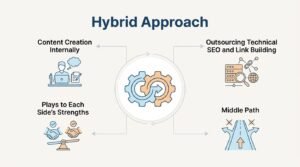
I’ve seen this work well for businesses with a marketing person on staff who can write authentically but doesn’t have time for technical audits or outreach campaigns. It’s a middle path that neither the full-DIY nor full-managed framing above fully captures.
ROI Comparison: Calculating Real Value Between DIY and Managed
Calculating real ROI between DIY and managed local SEO means comparing total cost, including your time at a fair hourly rate, against the revenue generated from new local customers over the same period. Most comparisons that only look at cash spend miss this entirely.
If DIY costs you $3,000 in unbilled time monthly and produces the same leads a $1,200 managed retainer would generate in half the time, the “cheaper” option isn’t actually cheaper. I’d rather see business owners run this math honestly before committing to either path for a full year.
Conclusion
Local SEO success comes down to matching technical, content, and link building work with realistic time and budget capacity. DIY works when you have hours to spare; managed works when time matters more than cash.
Both paths lead to the same destination if executed consistently, whether you build the skills yourself or bring in outside expertise to fill the gaps.
We help businesses skip the trial-and-error phase entirely. Reach out to White Label SEO Service to build a local SEO strategy that fits your actual bandwidth and budget.
Frequently Asked Questions
Is DIY local SEO actually free?
No, DIY local SEO isn’t free once you account for tool subscriptions and time. Most businesses spend $50-$300 monthly on tools plus 5-15 hours of weekly labor.
How much should I budget for managed local SEO monthly?
Budget $300 to $2,500 monthly depending on market competitiveness and business size. Single-location businesses in smaller markets typically fall at the lower end.
Can a small business realistically do local SEO alone?
Yes, small businesses can handle local SEO alone with consistent weekly time investment. The main challenge is sustaining effort past the first few months, especially with link building.
What’s the biggest risk of DIY local SEO?
The biggest risk is inconsistency, since local SEO requires ongoing effort to maintain rankings. Owners often start strong, then abandon updates after a few months.
How long before managed local SEO shows results?
Managed local SEO typically shows ranking improvements within 3 to 6 months. Full traffic growth usually follows within 4 to 6 months of consistent execution.
Do I need an SEO agency or a freelancer?
It depends on scope, since agencies typically offer broader skill coverage while freelancers cost less but may lack technical or link building expertise. Match the provider type to your specific gaps.
What happens if I stop paying for managed local SEO?
Rankings typically decline gradually over 3 to 6 months without ongoing optimization and link building. Citations and content stay in place, but competitive gains erode without maintenance.