Local SEO is a search optimization discipline that improves a business’s visibility for geographically constrained searches, so it appears in map results, local packs, and location-based organic listings when nearby customers search for what it sells. It applies to anyone serving a defined geographic area.
Nearly half of all Google searches carry local intent, and those searchers convert at rates most national campaigns never reach. Ignoring local search hands nearby revenue to competitors.
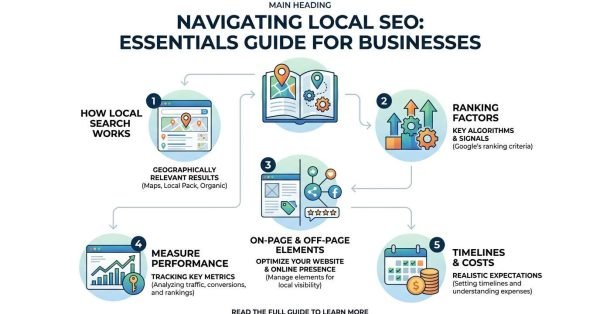
This guide covers what local search is and how Google assembles local results, the ranking factors that actually move position, the asset layer of profiles, citations, pages, and reviews, the authority and technical work underneath it, how to measure performance and read realistic timelines, and how to sequence a strategy and budget it properly.
What Is Local SEO?
Local SEO is a branch of search engine optimization that increases a business’s visibility for searches tied to a specific place, such as “plumber near me” or “accountant in Austin.” Traditional SEO competes nationally on relevance and authority. Local SEO adds a third dimension Google weighs heavily: physical distance between the searcher and the business.
I think of it as three overlapping assets rather than one channel. There is the business listing itself, the website behind it, and the reputation signals surrounding both. Weak performance in any one of them caps the other two.
The practical difference shows up in the results page. A national query returns ten blue links. A local query returns a map, three highlighted businesses, and only then the organic listings.
How Local SEO Differs From Traditional SEO
Local SEO differs from traditional SEO in ranking surface, ranking inputs, and competitive set. A national result set is decided largely by content quality and backlink authority. A local result set is decided by proximity, listing accuracy, review signals, and category relevance, with website authority acting as a supporting rather than primary lever.
That changes the work substantially. I spend more time on data consistency and profile hygiene for a local client than I ever would on a national one.
The competitive set narrows too. A regional business competes against a handful of firms within a radius, not against every publisher in the country.
Who Local SEO Actually Serves
Local SEO serves any business whose customers are geographically bounded, including storefronts, service-area businesses, multi-location brands, franchises, and professional practices. A national SaaS product gains nothing from it. A dental clinic in Denver gains almost everything from it.
Service-area businesses without a public storefront still qualify. Contractors, mobile mechanics, and home service providers all compete in local results using a hidden address.
The test is simple. If a customer would type a city name, a neighborhood, or “near me” before your service, you are in a local market.
How Local Search Results Work
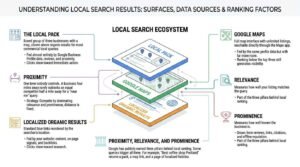
Local search results are assembled from three distinct surfaces that Google populates using different data sources. Understanding which surface a query triggers tells you which asset to fix first.
Those three surfaces are the local pack, Google Maps, and localized organic listings. Each one draws on a different mix of profile data and website data.
They also convert differently. Pack clicks skew toward immediate action, while organic clicks skew toward research.
The Local Pack, Maps, and Organic Results
Here is how each local surface behaves and what feeds it:
- Local Pack: the boxed group of three businesses with a map, shown above organic results for most commercial local queries. Fed almost entirely by Google Business Profile data, reviews, and proximity.
- Google Maps: the full map interface with unlimited listings, reachable directly through the Maps app. Fed by the same profile data but with far more room, so ranking below the top three still generates visibility.
- Localized organic results: standard blue links reordered by the searcher’s location. Fed by your website: content, on-page signals, and backlinks.
Some queries trigger all three. “Best coffee shop Portland” returns a pack, a map link, and a page of localized listicles.
Proximity, Relevance, and Prominence
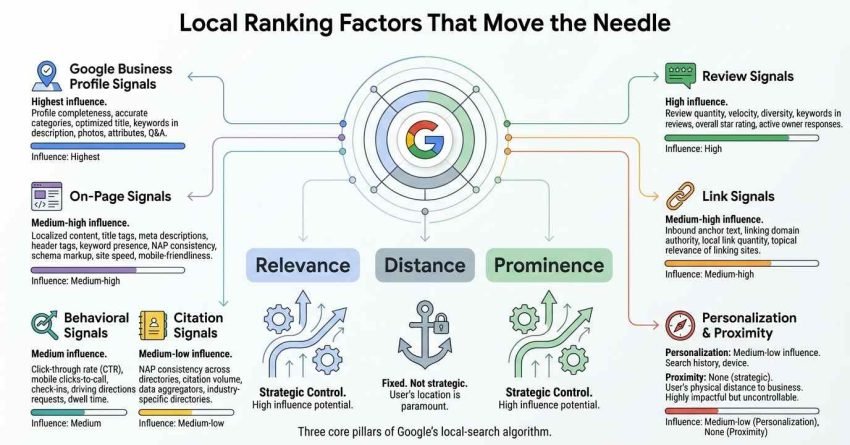
Google has publicly named three pillars behind local ranking: relevance, distance, and prominence. Relevance measures how well your listing matches the query. Distance measures how far the business sits from the searcher or the search location. Prominence measures how well known the business is, drawn from reviews, links, citations, and offline reputation.
Proximity is the one lever nobody controls. A business four miles away rarely outranks an equal competitor half a mile away for a “near me” query.
That constraint sets the strategy. You compete by dominating relevance and prominence, because distance is fixed.
Local Ranking Factors That Move the Needle
Local ranking factors are the signals Google weighs when ordering map pack and localized organic results, led by Google Business Profile signals, review signals, on-page signals, and link signals. Whitespark’s 2023 Local Search Ranking Factors survey placed Google Business Profile signals as the single largest contributor to local pack rankings at roughly 32% of the weighting.
I treat these as tiers, not a flat list. Fix tier one before touching tier three.
This table shows the main factor groups, their approximate influence, and how much direct control you have over each:
| Factor group | Influence on local pack | Your level of control |
| Google Business Profile signals | Highest | High |
| Review signals | High | Medium |
| On-page signals | High | High |
| Link signals | Medium-high | Medium |
| Behavioral signals | Medium | Low |
| Citation signals | Medium-low | High |
| Personalization and proximity | High | None |
Primary Ranking Signals
The primary local ranking signals are profile category selection, business title accuracy, review quantity and quality, on-page location relevance, and inbound links from locally relevant domains. Category selection alone reorders results dramatically, because Google uses the primary category to decide which query sets a listing is even eligible for.
Reviews compound. Volume, average rating, recency, and keyword content inside the review text all register.
On-page signals still matter for the pack, not just organic. Google reads the landing page a profile points to.
Signals With Diminishing Influence
Some signals that once carried weight have flattened out, including raw citation volume, exact-match business names, and keyword-stuffed descriptions. Citation building past the core directory set produces very little movement now, though inaccurate citations still cause harm.
The pattern is consistent across the industry. Signals that were easy to manipulate got downweighted.
Effort has shifted toward reviews, genuine local links, and page-level relevance.
Google Business Profile Optimization
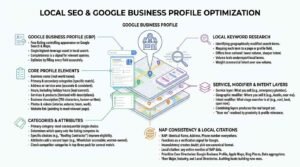
A Google Business Profile is a free business listing that controls how a business appears across Google Search and Google Maps, and it is the single highest-leverage asset in local search. Optimizing it means filling every available field accurately, choosing categories precisely, and keeping the profile active with fresh content.
Most profiles I audit are half complete. Missing hours, no service list, generic category, three photos from 2019.
Completeness itself is a signal. Google states that complete listings are more likely to be considered for relevant queries.
Core Profile Elements
These are the profile fields worth completing before anything else:
- Business name: the real-world name, without added keywords
- Primary and secondary categories: the most specific match available
- Address or service area: accurate and consistent with your website
- Hours, including holiday hours: kept current
- Services and products: itemized with descriptions
- Business description: 750 characters, written for humans
- Photos and videos: interior, exterior, team, work samples
- Website link pointing to the most relevant location page
Each field feeds the relevance calculation. Empty fields are missed matching opportunities.
Categories and Attributes
Primary category is the most consequential single choice in a Google Business Profile, because it determines which query sets the listing competes in. A business listed as “Contractor” instead of “Roofing Contractor” loses eligibility for the queries that actually convert.
Attributes add a second layer. Wheelchair accessible, women-owned, free Wi-Fi, and appointment required all filter results for searchers who care.
Check competitor categories in the top three pack positions. Their choices reveal what Google considers the correct match.
Local Keyword Research
Local keyword research is the process of identifying the geographically modified search terms your customers use, then mapping each one to a page or profile field that can rank for it. It differs from national keyword research because search volume is lower, intent is sharper, and the same term behaves differently in every city.
Volume tools underreport local terms badly. A keyword showing 50 monthly searches nationally can carry meaningful demand in one metro.
I weight commercial intent over raw volume for every local project.
Service, Modifier, and Intent Layers
Local keywords stack in three layers that combine to produce the terms worth targeting:
| Layer | Purpose | Examples |
| Service layer | What you sell | emergency plumber, tax preparation, HVAC repair |
| Geographic modifier | Where you sell it | Austin, near me, downtown Chicago, 78704 |
| Intent modifier | What stage the searcher is at | cost, best, open now, same day, reviews |
Combining layers produces the real target set. “Emergency plumber Austin open now” is a different page than “plumbing repair cost Austin.”
“Near me” terms are not typed keywords you optimize for directly. Google resolves them by proximity and profile relevance, which loops back to the profile work.
NAP Consistency and Local Citations
NAP consistency is the practice of publishing an identical business name, address, and phone number everywhere the business is listed online, and it functions as a verification signal for Google. A local citation is any online mention of that NAP data, whether on a directory, an industry association page, or a news site.
Inconsistency creates doubt. Three phone numbers across four directories tell Google it cannot confirm which is correct.
The fix is unglamorous and effective. Pick one canonical format and enforce it everywhere.
Core Directories vs. Niche Directories
Core directories are the high-authority aggregators and platforms Google cross-references most often. Niche directories are industry- or region-specific listings that add relevance rather than volume.
Prioritize in this order:
- Google Business Profile: the source of truth
- Apple Maps, Bing Places: the other major map ecosystems
- Data aggregators: Foursquare, Data Axle, Neustar Localeze
- Major directories: Yelp, Facebook, Yellow Pages, Better Business Bureau
- Industry directories: Avvo for lawyers, Healthgrades for clinics, Houzz for contractors
- Local directories: chamber of commerce, city business associations
Past that set, returns flatten sharply. Auditing and correcting existing citations beats building new ones.
On-Page Optimization for Local Search
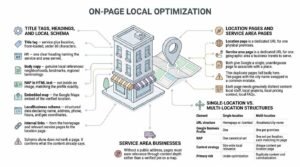
On-page local optimization is the work of signaling geographic relevance through a website’s own content, markup, and structure so localized organic results and the local pack both register the business as a match. It covers title tags, headings, body copy, internal structure, and structured data.
The landing page a profile points to carries disproportionate weight. Google reads it when evaluating the listing.
Generic homepages hurt here. A page that never names a city cannot rank for a city.
Title Tags, Headings, and Local Schema
These on-page elements carry the most local weight:
- Title tag: service plus location, front-loaded, under 60 characters
- H1: one clear heading naming the service and area served
- Body copy: genuine local references: neighborhoods, landmarks, regional terminology
- NAP in HTML text, not inside an image, matching the profile exactly
- Embedded map: the Google Maps embed of the verified location
- LocalBusiness schema: structured data declaring name, address, phone, hours, and geo coordinates
- Internal links from the homepage and relevant service pages to the location page
Local business schema markup gives Google a machine-readable version of the same facts, which removes ambiguity when the crawler parses the page.
Schema alone does not rank a page. It confirms what the content already says.
Location Pages and Service Area Pages
A location page is a dedicated URL for one physical premises, and a service area page is a dedicated URL for one geographic area a business travels to serve. Both exist to give Google a single, unambiguous page to associate with a place, rather than forcing one homepage to represent every market.
Thin duplicate pages fail badly here. Ten pages with the city name swapped is the most common local SEO mistake I see.
Each page needs genuinely distinct content: local staff, local projects, local pricing context, local FAQs.
Single-Location vs. Multi-Location Structures
Here is how the two structures differ in practice:
| Element | Single location | Multi-location |
| URL structure | Homepage or /contact | /locations/city-name |
| Google Business Profile | One | One per premises |
| NAP | One canonical set | One set per location, each matching its page |
| Content strategy | Site-wide local relevance | Unique content per location page |
| Primary risk | Under-optimization | Duplicate content and cannibalization |
Service area businesses complicate this. Without a public address, the pages must earn relevance through content depth rather than a verified pin on a map.
Local Content Strategy
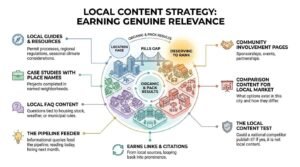
Local content strategy is the practice of publishing material that demonstrates genuine involvement in a place, not just repetition of a city name, so a site earns relevance for that area across both organic and pack results. It fills the gap between having a location page and deserving to rank for that location.
Most local sites publish nothing beyond service pages. That leaves every informational query in the market unclaimed.
Those informational queries feed the pipeline. Someone reading about permit requirements today hires a contractor next month.
Content Types That Earn Local Relevance
These content types produce local relevance because they cannot be written by an out-of-market competitor:
- Local guides and resources: permit processes, regional regulations, seasonal considerations specific to the climate
- Case studies with place names: projects completed in named neighborhoods
- Local FAQ content: questions tied to the area’s housing stock, weather, or municipal rules
- Community involvement pages: sponsorships, events, partnerships
- Comparison content for the local market: what options exist in this city and how they differ
Each piece earns links and citations from local sources, which loops back into prominence.
The test for any local content idea is whether a national competitor could publish it. If they could, it is not local content.
Online Reviews and Reputation Signals
Reviews are customer-published ratings and written feedback attached to a business listing, and they influence both local ranking position and click-through behavior. BrightLocal’s 2024 Local Consumer Review Survey found that 75% of consumers read online reviews when evaluating local businesses.
Review signals split into three measurable components. Volume, average rating, and recency all register independently.
Response behavior matters too. Google explicitly recommends replying to reviews, and the reply text is indexed content.
Review Velocity, Volume, and Response
Review velocity is the rate at which new reviews arrive over time, and steady velocity outperforms a single burst of reviews followed by silence. A profile that gained forty reviews in one week and none since reads as manipulated.
Build the request into the operational workflow:
- Ask at the moment of satisfaction or job completion, not a week later
- Send a direct link to the Google review form, removing every step you can
- Respond to every review within a few days, positive and negative
- Never gate or incentivize; both violate Google’s policies and risk removal
- Track the mix across Google, industry platforms, and Facebook
Negative reviews are not fatal. A measured, specific public response often converts better than a flawless five-star average that reads as fake.
Local Link Building and Local Authority
Local link building is the acquisition of backlinks from geographically or topically relevant websites, which raises the prominence component of local ranking. National link building chases domain authority. Local link building chases regional relevance, and a link from a city newspaper often outperforms a higher-authority national site.
The opportunity set is different too. Community organizations, suppliers, and local media all link readily when there is a genuine reason.
Volume expectations should be modest. A handful of strong local links moves more than fifty directory submissions.
Community, Sponsorship, and Supplier Links
These link sources produce local relevance reliably:
- Local sponsorships: youth sports teams, charity events, community festivals, each typically carrying a sponsor page link
- Chamber of commerce and trade associations: membership listings with links
- Supplier and partner pages: manufacturers listing authorized dealers or certified installers
- Local media coverage: expert commentary on regional stories, new hires, expansions
- Educational and institutional pages: scholarship listings, local resource pages
- Event participation: organizer sites linking to participating businesses
Every one of these requires a real-world action first. That barrier is exactly why the links carry weight.
Technical Foundations for Local Visibility
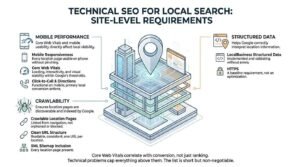
Technical SEO for local search is the set of site-level requirements that let Google crawl, render, and correctly interpret location information, including mobile performance, indexability, and structured data. Local search skews heavily mobile, which raises the stakes on page speed and usability.
Technical problems cap everything above them. A location page that renders slowly on a phone loses the clicks the ranking earned.
The list is short but non-negotiable.
Mobile Performance, Crawlability, and Structured Data
These are the technical requirements that most directly affect local visibility:
- Mobile responsiveness: every location page usable on a phone without pinching
- Core Web Vitals: loading, interactivity, and visual stability within Google’s thresholds
- Crawlable location pages linked from navigation, not orphaned or blocked
- Clean URL structure: readable, consistent, one URL per location
- LocalBusiness structured data implemented and validated without errors
- HTTPS: a baseline requirement, not an optimization
- Click-to-call and click-to-directions functional on mobile, since these are the primary local conversion actions
- XML sitemap inclusion for every location page present
Core Web Vitals correlate with conversion, not just ranking. A slow page loses the customer regardless of position.
Multi-Location and Franchise Local SEO
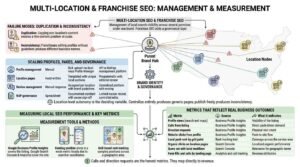
Multi-location SEO is the management of local search visibility across several premises under one brand, where each location needs its own profile, its own page, and its own reputation while sharing a single brand identity. Franchise SEO adds a governance layer, because individual owners control some assets and the parent brand controls others.
The failure mode is duplication. Copying one location’s content across forty pages creates a thin-content problem at scale.
The second failure mode is inconsistency. Franchisees editing their own profiles without guidelines produce forty different business names.
Scaling Profiles, Pages, and Governance
Here is how requirements change as location count grows:
| Requirement | 2–5 locations | 6–50 locations | 50+ locations |
| Profile management | Manual | Bulk upload via Business Profile Manager | API or listings management platform |
| Location pages | Hand-written | Templated with unique local sections | Programmatic with editorial review |
| Review management | Manual response | Assigned per location with brand guidelines | Centralized platform with routing |
| NAP governance | Spreadsheet | Documented standard with owner sign-off | Locked master record, controlled edits |
Location-level autonomy is the deciding variable. Brands that let each site publish freely produce inconsistency; brands that centralize entirely produce generic pages that rank for nothing.
Measuring Local SEO Performance
Local SEO measurement tracks visibility, engagement, and conversion across both the Google Business Profile and the website, because pack performance and organic performance are reported in separate systems. Google Business Profile Insights covers the listing. Google Search Console and Google Analytics cover the site.
Ranking position alone is a weak metric locally, since results vary by the searcher’s exact coordinates. Two people on opposite sides of a city see different packs.
Grid-based rank tracking solves this by sampling positions across a geographic area rather than a single point.
Metrics That Reflect Real Business Outcomes
This table maps the metrics worth tracking to what each one actually tells you:
| Metric | Source | What it indicates |
| Profile views (search and maps) | Business Profile Insights | Visibility of the listing |
| Calls from listing | Business Profile Insights | Direct pack-driven demand |
| Direction requests | Business Profile Insights | Physical visit intent |
| Website clicks from profile | Business Profile Insights | Pack-to-site flow |
| Local pack rank by grid point | Rank tracking tool | Coverage across the service area |
| Organic clicks on location pages | Search Console | Localized organic performance |
| Query set with local modifiers | Search Console | Relevance for geographic terms |
| Form fills and calls by landing page | Analytics and call tracking | Revenue attribution |
Calls and direction requests are the honest metrics. They map directly to revenue in a way impressions never do.
Local SEO Timelines and What to Expect
Local SEO typically produces measurable movement in three to six months, with competitive markets requiring six to twelve months for stable local pack positions. Ahrefs’ study of ranking pages found that only 5.7% of pages reach the top 10 for any keyword within a year, though local results move faster than national ones because the competitive set is smaller.
Speed depends heavily on starting conditions. A verified profile with existing reviews moves in weeks; a brand-new business with no digital footprint takes far longer.
I set expectations by phase, not by a single date.
Month-by-Month Progression
This table shows the typical progression for a business starting from a partially optimized position:
| Phase | Timeframe | What changes |
| Foundation | Weeks 1–4 | Profile completed and verified, citations corrected, location pages built |
| Early signal | Months 2–3 | Profile views rise, first pack impressions for low-competition terms |
| Traction | Months 4–6 | Consistent pack placement for secondary terms, review volume compounding |
| Competitive position | Months 6–12 | Pack placement for primary commercial terms, organic location page rankings |
| Compounding | Months 12+ | Defensible position, review moat, local link profile |
Three factors compress this timeline: existing review volume, an established website with authority, and low local competition. Three factors extend it: a suspended or new profile, inconsistent NAP data across many directories, and a saturated urban market.
Common Local SEO Mistakes and Penalties
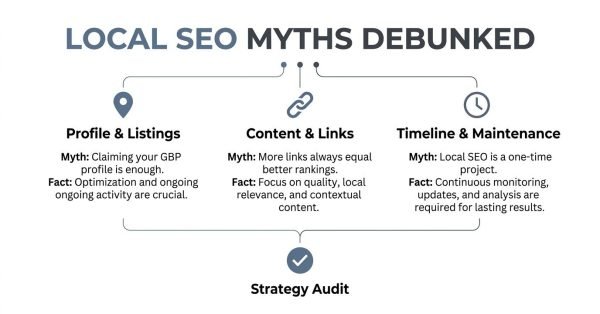
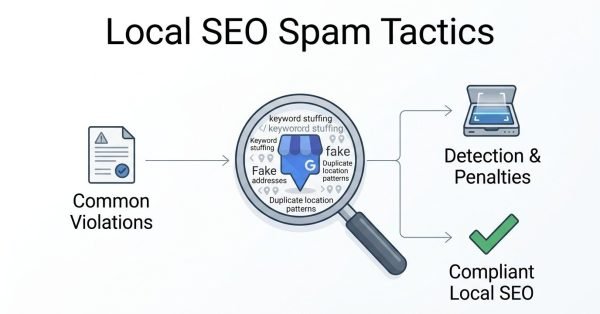
The most damaging local SEO mistakes are Google Business Profile policy violations, because they trigger listing suspension rather than gradual ranking decline. A suspended profile disappears from the pack and maps entirely, and reinstatement takes weeks.
Ranking mistakes cost position. Policy mistakes cost presence.
Knowing which category a tactic falls into decides how cautious to be.
Suspension Triggers and Recovery
These are the actions that most commonly trigger a Google Business Profile suspension:
- Keyword stuffing the business name, adding services or cities to the legal name
- Using a virtual office or mailbox as a verified address
- Creating multiple listings for one location
- Listing a service-area business with a public address it does not staff
- Review manipulation: incentivized, gated, or purchased reviews
- Frequent significant edits changing name, address, and category in quick succession
Recovery starts with correcting the violation before appealing. Google requires evidence, so gather signage photos, utility bills, and business registration documents before submitting a reinstatement request.
Prevention costs nothing. Every one of those triggers is avoidable.
How do I actually start with local SEO?
How to Build a Local SEO Strategy Step by Step
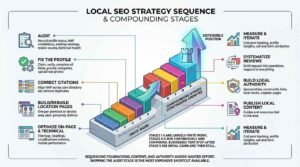
A local SEO strategy sequences foundational fixes, asset creation, and authority building in an order that avoids wasted effort, because each stage depends on the one before it. Building links to a page that does not exist, or driving reviews to an unverified profile, produces nothing.
I run every local engagement through the same sequence. The order rarely changes; the time spent in each stage does.
Skipping the audit stage is the most expensive shortcut available.
Sequencing Foundations, Content, and Authority
Work through these stages in order:
- Audit: record current profile status, NAP consistency across major directories, existing rankings by grid, review counts, and website technical health
- Fix the profile: claim, verify, complete every field, choose precise categories, upload real photos
- Correct citations: align NAP across the core directory set, remove duplicates
- Build or rebuild location pages: one per premises or service area, each genuinely distinct
- Optimize on-page and technical: title tags, headings, LocalBusiness schema, mobile performance
- Systematize reviews: build the request into operations, respond to everything
- Build local authority: sponsorships, community links, local media, supplier pages
- Publish local content: guides and resources tied to the area
- Measure and iterate: grid rank tracking, profile insights, call and form attribution
Stages one through five are largely finite work. Stages six through nine run continuously and compound.
Businesses that stop after stage five see initial gains and then stall. The compounding stages are where a defensible position comes from.
Local SEO Costs and In-House vs. Agency Decisions
Local SEO costs in the US typically range from $500 to $3,000 per month for a single-location business, with multi-location and franchise programs running considerably higher based on location count. BrightLocal’s agency pricing research puts the median monthly retainer for local SEO services in that band.
Cost scales with location count and competitive density, not with business size. A single dentist in Manhattan costs more to rank than three in a small town.
The in-house versus agency question comes down to whether the work is finite or ongoing.
Where Budget Actually Goes
This table shows where a typical local SEO budget is allocated:
| Work area | Share of budget | Nature of work |
| Profile and citation management | 15–20% | Front-loaded, then maintenance |
| Content production | 25–35% | Ongoing |
| Link acquisition and outreach | 20–30% | Ongoing |
| Technical and on-page | 10–15% | Front-loaded, periodic |
| Reporting and strategy | 10–15% | Ongoing |
In-house works when a business has one location, a marketing person with capacity, and a market that is not saturated. Agencies earn their fee on multi-location programs, competitive urban markets, and situations requiring link acquisition at volume.
The hybrid model is common and effective. Operations own reviews and profile updates; an external partner owns content, links, and measurement.
Conclusion
Local search visibility comes from three connected assets working together: an accurate Google Business Profile, location-relevant website content, and compounding reputation and link signals.
Each subtopic here supports deeper work: profile optimization, citation audits, review systems, and local link acquisition all reward dedicated attention.
We build these programs end-to-end at White Label SEO Service, from audit through measurable local growth.
Frequently Asked Questions
Is local SEO worth it for a small business?
Local SEO is worth it for any small business serving a defined geographic area. It reaches customers at the moment of purchase intent, and it costs less than paid acquisition long-term.
How long does local SEO take to work?
Local SEO usually shows measurable movement within three to six months. Competitive urban markets take six to twelve months for stable local pack placement.
Do I need a physical address for local SEO?
A physical address is not required for local SEO. Service-area businesses verify with a hidden address and define the regions they travel to serve.
How many reviews do I need to rank in the local pack?
There is no fixed review count for local pack ranking. What matters is having more relevant, recent reviews than the competitors currently occupying those three positions.
Can I do local SEO myself?
You can do local SEO yourself for a single location. Profile optimization, citation correction, and review requests are all manageable without specialist tools.
Does local SEO work without a website?
Local SEO works partially without a website, since a Google Business Profile can rank on its own. Without a site, you lose organic rankings and conversion control entirely.
What is the difference between local SEO and Google Ads?
Local SEO earns unpaid visibility that compounds over time. Google Ads buys immediate placement that stops the moment the budget stops.