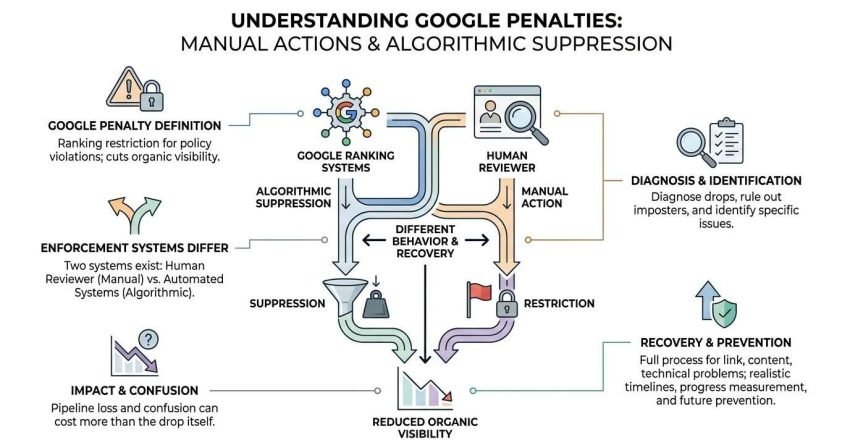
A Google penalty is a ranking restriction Google applies to a website that violates its search spam policies, delivered either as a manual action issued by a human reviewer or as algorithmic suppression applied automatically by Google’s ranking systems. Both cut organic visibility, but they behave differently and recover differently.
I have watched businesses lose half their pipeline in a week because nobody could tell the difference between a penalty and a bad Tuesday. Confusion costs more than the drop itself.
This guide covers what penalties actually are and why Google issues them, how the two enforcement systems differ, the specific manual actions and algorithmic systems you can hit, how to diagnose a drop and rule out imposters, the full recovery process for link, content, and technical problems, realistic timelines and how to measure progress, and how to stop it happening again.
What a Google Penalty Actually Is
A Google penalty is a downgrade in a site’s ability to rank, applied because Google’s systems or reviewers determined the site breached published spam policies. The demotion targets either the whole domain or a specific set of pages, and it persists until the underlying violation is fixed and re-evaluated.
I use the word “penalty” the way clients do, because that is the word everyone searches. Google’s own vocabulary is narrower, and it matters for diagnosis.
Manual Actions vs. Algorithmic Suppression
A manual action is a penalty applied by a human reviewer at Google and reported inside Google Search Console. Algorithmic suppression happens without any human involvement, produces no notification anywhere, and is simply the ranking system deciding your pages deserve less visibility.
That single distinction drives everything downstream. One has a submit button. The other does not.
Penalties vs. Ranking Drops That Are Not Penalties
Most traffic drops I investigate turn out not to be penalties at all. Indexing failures, tracking breakage, seasonality, and competitors outranking you produce identical-looking graphs.
The diagnostic work exists to separate these before you spend a month fixing the wrong thing.
What Google Officially Calls a Penalty
Google only uses “manual action” for the reviewer-issued restrictions listed in Search Console. Everything else Google frames as ranking systems working normally, not as punishment.
Google’s spam policies documentation sets out the specific behaviours that trigger enforcement, and reading it end to end takes about twenty minutes.
Why Google Issues Penalties in the First Place
Google issues penalties to protect the reliability of its results, because search only holds users if the top results are trustworthy. Enforcement is the mechanism that stops manipulation from outcompeting genuine quality.

Search Quality and Spam Policies
Google publishes a defined set of spam policies covering link schemes, scraped content, cloaking, keyword stuffing, and several other practices. Violating any of them puts a site inside enforcement scope regardless of intent.
Intent is not a defence here. A contractor who bought links on your behalf still produced a link scheme on your domain.
The Economics Behind Enforcement
Manipulated results cost Google users, and users are the entire business. Google’s parent company reported $198 billion in search and other advertising revenue for 2024, which is the size of the asset that search quality protects.
That number explains why enforcement is aggressive and why appeals are slow. The cost of letting spam through is far higher than the cost of a wrongly demoted site.
The Two Enforcement Systems: Manual Actions and Algorithms
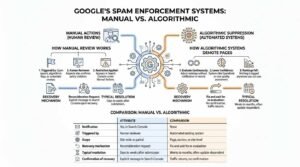
Google enforces its spam policies through two separate systems: manual actions issued by human reviewers, and algorithmic systems that demote pages automatically during ranking. Every penalty you will ever face comes from one of these two paths.
I check which one I am dealing with before doing anything else. Getting this wrong wastes months.
How Manual Review Works
A human reviewer at Google inspects a site, confirms a policy violation, and applies a restriction that appears in Search Console under Manual Actions. Reviews get triggered by spam reports, algorithmic flags, or systematic sweeps of a known-abusive pattern.
How Algorithmic Systems Demote Pages
Algorithmic systems evaluate every page continuously and adjust rankings without notification or record. When a system like SpamBrain or a core quality assessment lowers its confidence in your pages, rankings fall, and nothing is logged anywhere you can see.
Comparison Table: Manual vs. Algorithmic
The table below compares the two enforcement systems across the attributes that change how you respond.
| Attribute | Manual Action | Algorithmic Suppression |
| Notification | Yes, in Search Console | None |
| Triggered by | Human reviewer | Automated ranking system |
| Scope | Site-wide or partial | Page, section, or site-level |
| Recovery mechanism | Reconsideration request | Fix and wait for re-evaluation |
| Typical resolution | Days to weeks after submission | Weeks to months, often update-dependent |
| Confirmation of recovery | Explicit message in Search Console | Traffic returns, no confirmation |
Types of Manual Actions Google Issues
Google issues manual actions across roughly a dozen defined categories, each naming a specific spam policy breach. Search Console names the exact category, which tells you precisely what to fix.
Site-Wide vs. Partial Matches
A site-wide match suppresses the entire domain, while a partial match restricts only specific URLs or directories. Partial matches are more common and considerably faster to resolve.
Unnatural Links (Inbound and Outbound)
Unnatural link manual actions cover both links pointing at your site and links you sell or place elsewhere. Paid links, excessive reciprocal schemes, and large-scale guest post networks all qualify.
Inbound and outbound versions require different fixes, and I have seen teams remediate the wrong direction for weeks.
Thin, Scraped, and Auto-Generated Content
Google issues thin content manual actions when pages add no meaningful value beyond what already exists. Scraped copy, doorway pages, and mass-produced templated output all sit inside this category.
Cloaking, Sneaky Redirects, and Hacked Content
Cloaking shows different content to Googlebot than to users, and it triggers enforcement almost immediately once detected. Hacked content manual actions arrive when an attacker injects spam pages into a legitimate site, and the site owner is still responsible for cleanup.
Structured Data and User-Generated Spam
Structured data manual actions apply when markup describes content that is not on the page. User-generated spam actions land on sites whose forums, comments, or profile pages have been overrun by third-party spam.
Algorithmic Systems That Suppress Rankings
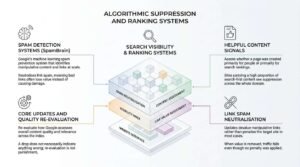
Algorithmic suppression comes from ranking systems that lower a site’s visibility automatically, without any notification or Search Console record. These systems produce the majority of the drops I get called about.
Spam Detection Systems (SpamBrain)
SpamBrain is Google’s machine learning spam prevention system that identifies manipulative content and links at scale. Google has stated SpamBrain neutralises link spam rather than always penalising the recipient site, which means bad links often lose value instead of causing damage.
Helpful Content Signals
Google’s helpful content signals assess whether a page was created primarily for people or primarily for search rankings. Sites carrying a high proportion of search-first content see suppression across the whole domain, not just the offending pages.
Core Updates and Quality Re-Evaluation
Core updates re-evaluate how Google assesses overall content quality and relevance across the index. Google runs several core updates each year, and its core update guidance states plainly that a drop does not necessarily indicate anything wrong with your pages.
That framing frustrates people, but it is accurate. Re-evaluation is not punishment.
Link Spam Neutralisation
Google’s link spam updates devalue manipulative links rather than penalise the target site in most cases. When neutralisation removes the value your rankings depended on, traffic falls even though no penalty was applied.
How to Diagnose Whether You Have Been Penalised
Diagnosing a penalty takes five steps: check Search Console for a manual action, read the shape of the traffic drop, correlate the date with known update timelines, rule out technical and tracking causes, and only then classify the cause. Skipping straight to remediation is the most expensive mistake in this whole process.
Checking Google Search Console Manual Actions
The Manual Actions report in Search Console is the only authoritative confirmation that a manual penalty exists. An empty report means no manual action, full stop, and any drop you are seeing has another cause.
Reading the Traffic Drop Curve
The shape of the curve tells you a great deal about the cause. A vertical cliff on a single day suggests a manual action or a technical failure, while a stepped decline over several days points toward an algorithmic rollout.
Gradual erosion over months is almost never a penalty. That is usually competitors, decay, or intent shift.
Correlating Drops With Update Timelines
Matching your drop date against confirmed Google update rollouts is the fastest way to identify algorithmic causes. Google publishes rollout dates in its search status dashboard, and a drop that lands inside a rollout window is strong evidence.
Ruling Out Technical and Tracking Causes
Before concluding anything, I confirm that pages are still indexed, the server returned normal status codes, robots.txt did not change, and analytics tracking still fires. A surprising share of “penalties” turn out to be a broken tag or an accidental noindex.
Traffic Drops That Are Not Penalties
Most sudden organic traffic drops are caused by indexing problems, tracking failures, SERP layout changes, seasonality, or competitor movement rather than any penalty. Ruling these out first saves months of misdirected work.
Indexing, Crawling, and Server Issues
An accidental noindex tag, a robots.txt disallow, or extended server downtime removes pages from results as effectively as any penalty. These show up clearly in Search Console’s indexing reports and resolve in days once found.
SERP Feature and Intent Shifts
When Google adds an AI Overview, a featured snippet, or a shopping module to a query, organic clicks fall even at unchanged rankings. Impressions holding steady while clicks collapse is the signature of this problem.
Seasonality, Analytics Errors, and Competitor Gains
Seasonal demand cycles, misconfigured analytics, and a competitor publishing something better all produce declines that look alarming in isolation. Year-over-year comparison separates seasonality from everything else in about ten minutes.
The Penalty Recovery Process, Step by Step
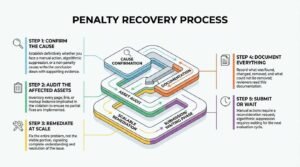
Penalty recovery follows five steps: confirm the cause, audit every affected asset, remediate at scale, document the work, then submit a reconsideration request or wait for re-evaluation. The sequence matters, because remediating before confirming wastes the effort entirely.
Step 1: Confirm the Cause
Establish definitively whether you face a manual action, algorithmic suppression, or a non-penalty cause. Write the conclusion down with the evidence supporting it, because you will need that evidence later.
Step 2: Audit the Affected Assets
Inventory every page, link, or markup instance implicated in the violation. Partial audits produce partial fixes, and partial fixes get reconsideration requests rejected.
Step 3: Remediate at Scale
Fix the entire problem, not the visible portion of it. Removing forty of two hundred paid links signals that you understood the issue and chose not to solve it.
Step 4: Document Everything
Record what you found, what you changed, what you removed, and what you could not remove despite trying. Reviewers read this documentation, and it materially affects the outcome.
Step 5: Submit or Wait
Manual actions end with a reconsideration request submitted through Search Console. Algorithmic suppression has no submission step, so you finish the work and wait for the next evaluation cycle.
Recovering From a Manual Action
Recovering from a manual action requires fixing every instance of the violation, then submitting a reconsideration request through Search Console explaining what happened and what changed. Google reviews the request manually and either revokes the action or explains why it stands.
Writing a Reconsideration Request That Passes
A successful reconsideration request states the violation honestly, describes the remediation in specific detail, and provides evidence of the work. Google’s reconsideration request guidance asks for exactly this, and vague submissions get declined.
I keep them short and factual. Excuses read as denial, and denial reads as unfixed.
What Reviewers Look For
Reviewers look for evidence that you understand the violation, fixed the whole of it, and changed the process that created it. Documentation of removal attempts carries weight even when removal failed.
What Happens After Rejection
A rejected request usually means the remediation was incomplete rather than the explanation being poor. Google names what remains, and the correct response is to finish the work before resubmitting.
Recovering From an Algorithmic Suppression
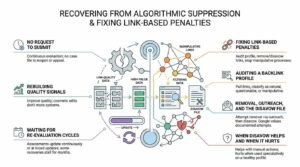
Recovering from algorithmic suppression means improving the quality signals the system evaluated poorly, then waiting for Google’s systems to re-assess the site. No request exists, no confirmation arrives, and recovery is visible only through returning traffic.
Why There Is No Request to Submit
Algorithmic systems evaluate continuously and hold no case file to reopen. There is nothing to appeal because nobody made a decision to appeal against.
Rebuilding Quality Signals
Rebuilding means removing or improving low-value pages, strengthening demonstrated expertise, and making pages genuinely more useful than the alternatives ranking above you. Cosmetic edits do not move these systems.
Waiting for Re-Evaluation Cycles
Some algorithmic assessments update continuously, while others refresh only when Google runs a broad update. Google has confirmed that certain quality assessments recover fully only at update refreshes, which is why some recoveries stall for months before moving at once.
Fixing Link-Based Penalties
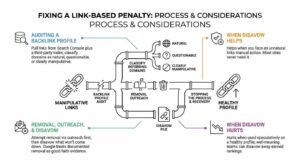
Fixing a link-based penalty requires auditing the full backlink profile, removing or disavowing the manipulative links, and stopping whatever process created them. Backlink profile auditing is the largest single task in most recovery projects.
Auditing a Backlink Profile
Pull links from Search Console plus at least one third-party index, then classify each referring domain as natural, questionable, or clearly manipulative. Volume makes this tedious, and patterns make it manageable.
Removal, Outreach, and the Disavow File
Attempt removal first through outreach, then disavow what will not come down. Google treats documented removal attempts as evidence of good faith even when publishers ignore you.
When Disavow Helps and When It Hurts
The disavow tool helps when you face an unnatural links manual action and hurts when used speculatively on a healthy profile. Google has repeatedly stated most sites never need it, and I have seen well-meaning teams disavow away rankings they earned legitimately.
Fixing Content-Based Penalties
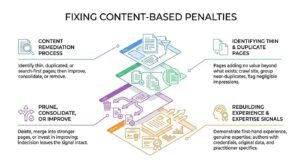
Fixing a content-based penalty means identifying every thin, duplicated, or search-first page, then improving, consolidating, or removing it. Content remediation takes longer than link cleanup because judgment is required page by page.
Identifying Thin and Duplicate Pages
Thin content is any page that adds no value beyond what already exists elsewhere on the web or on your own domain. Crawl the site, group near-duplicates, and flag anything with negligible impressions and no unique substance.
Prune, Consolidate, or Improve
Each flagged page gets one of three decisions: delete it, merge it into a stronger page, or invest properly in improving it. Indecision here leaves the signal intact.
Rebuilding Experience and Expertise Signals
Google’s quality systems assess whether content demonstrates first-hand experience and genuine expertise. Named authors with real credentials, original data, and specifics that only a practitioner would know all strengthen this signal.
Fixing Technical and Deceptive-Practice Penalties
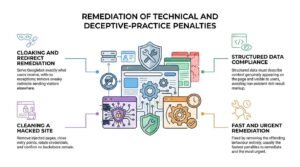
Technical and deceptive-practice penalties are fixed by removing the offending behaviour entirely: eliminating cloaking, cleaning injected content, correcting redirects, and aligning structured data with what users actually see. These are usually the fastest penalties to remediate and the most urgent.
Cloaking and Redirect Remediation
Cloaking remediation means serving Googlebot exactly what users receive, with no exceptions and no user-agent branching. Sneaky redirects that send search visitors somewhere other than the indexed page must be removed completely.
Cleaning a Hacked Site
Cleaning a hacked site requires removing injected pages, closing the entry point, rotating credentials, and confirming no backdoors remain. Reinfection after a partial clean is common, and it restarts the whole process.
Structured Data Compliance
Structured data must describe content that genuinely appears on the page and is visible to users. Marking up reviews, prices, or FAQs that do not exist triggers enforcement and removes rich results.
Realistic Recovery Timelines and What to Expect
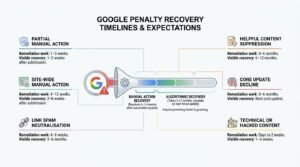
Manual action recovery typically resolves within one to four weeks of a successful reconsideration request, while algorithmic recovery commonly takes three to twelve months and often depends on the next broad update. Anyone promising faster is guessing.
The table below sets expectations by penalty type based on the pattern I see in practice.
| Penalty type | Remediation work | Time to visible recovery |
| Partial manual action | 1–3 weeks | 1–2 weeks after submission |
| Site-wide manual action | 4–12 weeks | 2–6 weeks after submission |
| Link spam neutralisation | 4–8 weeks | 3–6 months |
| Helpful content suppression | 3–6 months | 6–12 months |
| Core update decline | 3–6 months | Next core update |
| Technical or hacked content | Days to 2 weeks | 1–4 weeks |
Manual Action Timelines
Google typically responds to reconsideration requests within a few days to a few weeks, and rankings return once the action is revoked. Return is not always to the previous position, because the links or pages you removed were carrying value.
Algorithmic Recovery Timelines
Algorithmic recovery runs on Google’s evaluation schedule rather than yours. Sites suppressed by helpful content signals frequently wait two or more update cycles before movement appears.
Partial vs. Full Traffic Recovery
Full recovery to prior traffic levels is uncommon, because the traffic often depended partly on whatever got penalised. I plan for sixty to eighty percent recovery and treat anything above that as upside.
Measuring Recovery With Data
Measuring recovery means tracking impressions, average position, and indexed page counts by segment rather than watching total sessions. Segment-level movement appears weeks before aggregate traffic changes.
Search Console Metrics That Matter
Impressions move first, average position moves second, and clicks move last. Watching clicks alone hides progress that is already underway.
Segmenting by Page Group and Query Type
Split reporting by directory, template, and query intent so recovery in one section is not masked by decline in another. Aggregate numbers hide everything useful.
Leading Indicators Before Traffic Returns
Rising impressions on previously suppressed queries, returning indexed pages, and improving positions on page three all precede traffic. These indicators give you weeks of early warning that the work is landing.
Preventing Future Penalties
Preventing penalties requires publishing standards, vendor controls, and monitoring cadence that catch problems before Google does. Every penalty I have investigated was preventable with governance that already existed on paper somewhere.
Governance, Review, and Publishing Standards
Define what qualifies for publication, who reviews it, and what evidence supports factual claims. Standards that live in a document nobody enforces prevent nothing.
Vendor and Agency Risk Controls
Ask every SEO vendor exactly where links come from and demand the list. A link building supplier who will not disclose sources is the single most reliable predictor of a future unnatural links manual action.
Ongoing Monitoring Cadence
Check Search Console manual actions monthly, review new referring domains monthly, and audit content quality quarterly. Monitoring costs hours, and penalties cost quarters.
Contextual border: What does penalty recovery cost, and when should we bring in outside help?
Cost, Resourcing, and When to Get Help
Penalty recovery typically requires forty to two hundred hours of specialist work depending on site size and penalty type, and the decision to outsource comes down to whether your team has the diagnostic experience to avoid a wrong turn. Getting the diagnosis wrong is more expensive than any fee.
In-House vs. Specialist Support
In-house teams handle technical and content remediation well when the cause is already confirmed. Specialist support earns its cost on diagnosis, large-scale link audits, and reconsideration requests where a rejection costs another month.
What Recovery Work Actually Involves
Recovery work is auditing, classification, removal, rewriting, documentation, and patience. Nobody enjoys it,t and there is no shortcut through the middle of it.
Conclusion
Google penalties come from two systems, manual actions and algorithmic suppression, and each demands a different diagnosis, remediation path, and timeline expectation.
Recovery is methodical rather than clever. Confirm the cause, fix everything, document it, and let Google’s evaluation cycles do their work.
We help businesses diagnose penalties accurately and rebuild organic visibility properly. Talk to White Label SEO Service about your recovery.
Frequently Asked Questions
How do I know if I have a Google penalty?
Check the Manual Actions report in Google Search Console first. An empty report means no manual penalty exists, so investigate algorithmic or technical causes instead.
How long does it take to recover from a Google penalty?
Manual action recovery usually takes one to four weeks after a successful reconsideration request. Algorithmic recovery commonly takes three to twelve months.
Can a Google penalty be permanent?
No penalty is permanent once the underlying violation is fully fixed. Recovery stalls when remediation is incomplete, not because Google refuses to reconsider.
Does the disavow tool fix penalties?
Disavow helps with unnatural links manual actions and rarely helps otherwise. Most sites never need it, and speculative use can remove links you earned legitimately.
Will my traffic return to previous levels after recovery?
Partial recovery is more common than full recovery. Traffic that depended on penalised pages or devalued links does not return with the rest.
Is a core update drop the same as a penalty?
A core update drop is a re-evaluation of quality, not a punishment for a violation. Recovery requires genuine improvement, not policy compliance alone.
Can I be penalised for links I did not build?
Google’s systems typically neutralise unnatural inbound links rather than penalise the target site. Manual actions arrive when evidence suggests you participated.