Full-service SEO is a managed engagement where an external team owns technical SEO, content, and authority building, while DIY SEO is the practice of running those same functions in-house using your own time and tools. The difference is not quality of intent. The difference is capacity, speed, and risk tolerance.
I see the same pattern every month. A business picks a model based on budget alone, then discovers eighteen months later that the real cost was the time it lost.
This guide covers what each model actually delivers, how the two compare on cost, timeline, skills, and penalty exposure, which business scenarios favour each approach, how a hybrid setup works in practice, how to vet a provider and measure results, and a framework for making the call.
What Full-Service SEO Actually Includes
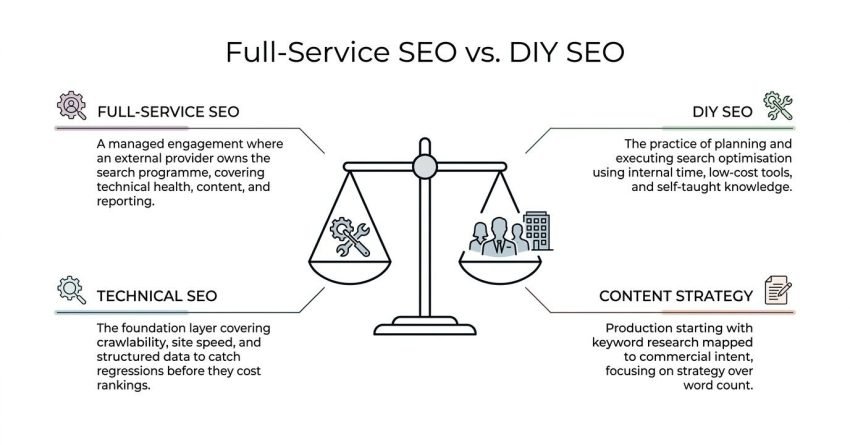
Full-service SEO is a managed engagement where an external provider owns the full search programme, covering technical health, content production, authority acquisition, and performance reporting under one accountable team. You are buying execution capacity and judgement, not a list of tasks.
The scope matters more than the label. Plenty of providers sell “full-service” and deliver monthly blog posts.
Technical SEO and site health
Technical work is the foundation layer. It covers crawlability, indexation, site speed, structured data, internal architecture, and the ongoing technical SEO audit cycle that catches regressions before they cost rankings.
A provider running this properly monitors Search Console coverage weekly, not quarterly.
Content strategy and production
Content under a full-service model starts with keyword research mapped to commercial intent, then moves through briefs, drafts, editing, and publication. The value sits in the strategy layer deciding what to write and why far more than in the word count.
Authority building and reporting
Authority building means earning links and mentions from sites your audience already trusts. Reporting closes the loop, tying rankings and sessions back to pipeline. Good providers report on revenue contribution. Weak ones report on impressions.
What DIY SEO Actually Involves
DIY SEO is the practice of planning and executing your own search optimisation using internal time, free or low-cost tools, and self-taught knowledge. It is entirely viable for some businesses and quietly disastrous for others.
The deciding factor is rarely intelligence. It is available hours and the cost of learning on a live site.
The tasks you can genuinely self-manage
Some work transfers cleanly to an owner or marketer. Writing helpful content about your own industry, claiming and optimising a Google Business Profile, fixing obvious title tags, and answering customer questions on your site all sit comfortably in-house.
These tasks reward subject knowledge more than technical training.
The tasks that break without experience
Other work punishes inexperience. Site migrations, canonical logic, JavaScript rendering issues, log file analysis, and link acquisition all carry real downside when handled badly.
I have watched a single botched migration erase four years of organic growth in a fortnight.
Full-Service SEO vs. DIY SEO: Side-by-Side Comparison
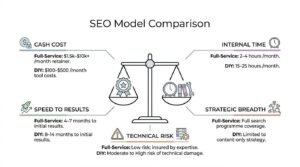
The table below compares both models across the five factors that decide most outcomes.
| Factor | Full-Service SEO | DIY SEO |
| Monthly cash cost | $1,500–$10,000+ retainer | $100–$500 in tools |
| Internal time required | 2–4 hours per month | 15–25 hours per month |
| Skill required | Provided by provider | Self-taught, ongoing |
| Speed to first results | 4–7 months | 8–14 months |
| Risk of technical damage | Low, insured by expertise | Moderate to high |
| Scalability | Scales with retainer | Capped by your calendar |
| Strategic breadth | Full programme | Usually content-only |
Cash cost is the visible number. Internal time is the one that actually decides whether a DIY programme survives past month three.
A founder spending 20 hours a month on SEO at a notional $100 per hour is spending $2,000 of opportunity cost, which lands squarely inside agency retainer territory.
The Real Cost of Each Approach
Full-service SEO in the US typically runs $1,500 to $10,000 per month depending on scope, while a competent DIY tool stack costs $100 to $500 per month plus 15 to 25 hours of internal time. Neither number tells the whole story alone.
Agency retainer ranges in the US
Retainers scale with competitiveness and scope. Local single-location businesses often sit at the lower end. National ecommerce and SaaS programmes sit far higher, because the content volume and link acquisition required to move a competitive SERP is genuinely large.
Ask what the retainer buys in hours and deliverables, not just outcomes.
DIY tool stack and hidden labour cost
A functioning DIY setup needs a keyword research platform, a crawler, rank tracking, and analytics. Search Console and Google Analytics are free. The paid layer starts around $99 per month and climbs quickly.
The hidden cost is labour. Twenty hours a month is half a working week gone.
Cost of doing it wrong
The most expensive SEO is the SEO you have to undo. Cheap link packages, thin AI-spun pages, and mishandled redirects all create cleanup projects that cost more than doing it properly the first time.
How Long Each Approach Takes To Show Results
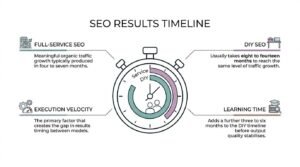
Full-service SEO typically produces meaningful organic traffic growth in four to seven months, while DIY SEO usually takes eight to fourteen months to reach the same point. The gap comes from execution velocity, not from secret knowledge.
Typical full-service timeline
Months one and two go to audit, fixes, and strategy. Months three to five deliver content and links at volume. Months four to seven are where compounding starts showing in the reports.
An Ahrefs study of two million keywords found only 5.7% of pages reach the top 10 within a year of publication.
Typical DIY timeline
DIY runs the same sequence at a fraction of the speed, because everything competes with your actual job. Learning time adds a further three to six months before output quality stabilises.
The Skills and Tools DIY SEO Demands
Running SEO yourself requires competence across six distinct areas, and weakness in any one of them caps the whole programme.
Core skill set required
- Keyword research and search intent interpretation
- On-page optimisation, including titles, headings, and internal linking
- Technical diagnostics, covering crawl, index, and speed issues
- Content writing that satisfies intent rather than word count
- Link acquisition through outreach, digital PR, or partnerships
- Analytics interpretation in GA4 and Search Console
Most self-taught marketers reach solid competence in three or four of these. The remaining gaps are where growth stalls.
Minimum viable tool stack
The realistic floor is Google Search Console, Google Analytics 4, a crawler such as Screaming Frog, and one keyword research platform. Rank tracking becomes necessary once you have enough pages to lose track of.
Risk, Compliance, and Penalty Exposure
DIY SEO carries a higher risk of self-inflicted damage, because the mistakes that hurt most are invisible until traffic drops. Google’s systems do not send a warning before a ranking decline.
Where DIY most often goes wrong
- Buying links from marketplaces, which violates Google’s link spam policies
- Publishing scaled, low-value content that triggers quality demotions
- Mishandling redirects during a redesign or platform change
- Blocking key templates in robots.txt or applying noindex site-wide
- Duplicating content across location pages with no genuine differentiation
Manual actions appear in Search Console. Algorithmic demotions do not, which is what makes them hard to diagnose without experience.
Business Scenarios Where DIY SEO Makes Sense
DIY SEO makes sense when your market is low-competition, your site is small and technically simple, and you have genuine weekly hours to commit. Those three conditions have to hold together, not individually.
The strongest DIY candidates share a profile:
- Local service businesses competing within a single city
- Sites under roughly 50 pages on a mainstream CMS
- Founders with existing writing ability and subject depth
- Businesses testing whether organic search converts at all before committing budget
- Niche B2B where the total addressable keyword set is small
In these cases, the ceiling is low enough that expert execution buys you less than it costs.
Business Scenarios Where Full-Service SEO Wins
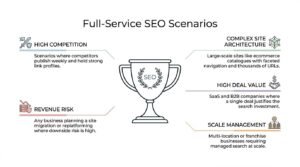
Full-service SEO wins when competition is high, the site is complex, or organic search carries real revenue weight. The decision usually hinges on downside risk rather than upside potential.
The clearest cases:
- Ecommerce catalogues with faceted navigation and thousands of URLs
- SaaS and B2B companies where a single deal justifies months of retainer
- Multi-location or franchise businesses managing local SEO at scale
- Any business planning a site migration or replatform in the next year
- Markets where competitors publish weekly and hold strong link profiles
- Teams with budget but no internal hours
When a single lost month costs more than the retainer, the maths stops being a debate.
The Hybrid Model: In-House Plus External Support
The hybrid model splits SEO between an internal owner who handles subject-matter work and an external specialist who handles technical execution and strategy. It is the model most growing companies eventually land on.
Hybrid works because it allocates each task to whoever can do it most cheaply at acceptable quality.
What you keep in-house
Keep the work that depends on knowing your customers. Content drafting, product knowledge, customer language, and internal approvals all move faster with someone who already understands the business.
What you outsource
Outsource the work that depends on repetition and specialist tooling. Technical audits, information architecture, link acquisition, and reporting infrastructure sit better with a team doing it across many sites.
| Function | Best owner |
| Keyword strategy | External |
| Content drafting | Internal |
| Content optimisation | External |
| Technical fixes | External |
| Link building | External |
| Customer insight | Internal |
How To Vet a Full-Service SEO Provider
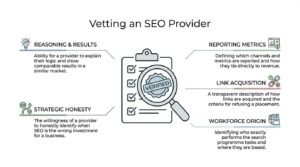
Vetting an SEO provider comes down to whether they can explain their reasoning, show comparable results, and describe how they would fail. Anyone promising guaranteed rankings has already answered the question.
Questions that expose weak agencies
- Which channels and metrics will you report against, and how do they tie to revenue?
- Show me a client in a comparable market and walk me through the first six months.
- How do you acquire links, and what would make you refuse a placement?
- Who exactly does the work, and where are they based?
- What does month one look like before any content goes live?
- What would cause you to tell me SEO is the wrong investment?
Strong providers answer question six honestly. That answer tells you more than the case studies.
How To Measure Success Under Either Model
Success under both models is measured by organic revenue contribution, not by rankings alone. Rankings are a leading indicator, and treating them as the outcome is the most common reporting mistake I see.
The metrics that actually matter
| Metric | What it tells you | Review cadence |
| Organic sessions to key pages | Demand capture | Monthly |
| Non-branded impressions | Visibility growth | Monthly |
| Keyword position distribution | Portfolio health | Monthly |
| Organic conversions | Commercial output | Monthly |
| Organic pipeline or revenue | Business impact | Quarterly |
| Indexed page count | Technical health | Monthly |
Branded search inflates every dashboard. Segment it out before judging any programme, internal or external.
Which model fits my business right now?
A Decision Framework For Choosing Your SEO Model
Five questions settle the choice between full-service and DIY for almost every business. Answer them honestly, and the model usually picks itself.
- How many hours per week can you genuinely protect? Under five, DIY fails.
- What is one new customer worth? High values justify retainers quickly.
- How competitive is your keyword set? Established incumbents mean you are buying velocity.
- How complex is your site? Faceted, multilingual, or JavaScript-heavy sites need specialists.
- What happens if organic traffic drops 40% next quarter? If the answer is serious, do not experiment on a live site.
Three or more answers pointing toward complexity, value, or risk mean full-service. Three or more pointing toward simplicity and available time means DIY is a reasonable starting position.
When To Switch From DIY To Full-Service
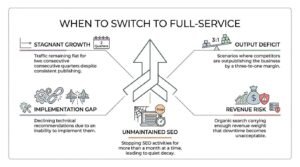
The right time to switch is when your own execution becomes the bottleneck rather than your knowledge. That moment is usually obvious in hindsight and easy to miss in the present.
Clear switching signals:
- Traffic has been flat for two consecutive quarters despite consistent publishing
- You are declining technical recommendations because you cannot implement them
- Competitors are outpublishing you three to one
- A migration, rebrand, or replatform is scheduled
- Organic now carries enough revenue that downtime is unacceptable
- You have stopped doing SEO for more than a month at a time
The last signal is the most common. Unmaintained SEO decays quietly.
Conclusion
Full-service SEO and DIY SEO solve the same problem with different resources, trading cash against time, and expertise against learning curve.
Most businesses start with DIY, hit a ceiling built from hours rather than knowledge, and move toward specialist support as organic revenue grows.
We help partners scale organic results without building an in-house team. Talk to White Label SEO Service about the right model for your growth stage.
Frequently Asked Questions
Can I do SEO myself without any experience?
Yes, for a small, low-competition site. Start with Google Search Console, clear title tags, and helpful content, then expand as results confirm the effort is working.
How much does full-service SEO cost per month in the US?
Most US retainers run $1,500 to $10,000 monthly. Local businesses sit at the lower end, while competitive ecommerce and SaaS programmes sit considerably higher.
Is DIY SEO cheaper than hiring an agency?
Only in cash terms. Once you price 15 to 25 internal hours per month at your real hourly value, the gap narrows sharply or disappears entirely.
How long before DIY SEO shows results?
Usually eight to fourteen months. Learning time, limited weekly hours, and slower content output all extend the timeline compared with a resourced team.
What is the biggest risk of doing SEO yourself?
Technical mistakes you cannot see. Bad redirects, accidental noindex tags, and purchased links cause damage that surfaces weeks after the error was made.
Can I combine in-house SEO with an external provider?
Yes, and most scaling companies do. Keep content and customer knowledge internal, then outsource technical work, link acquisition, and strategy to specialists.
What should I ask before hiring an SEO agency?
Ask who does the work, how links are acquired, and what would make them advise against SEO. Honest answers to that last question reveal the most.