Professional SEO services are a managed set of technical, content, and authority-building activities that improve a website’s visibility in organic search results and convert that visibility into qualified traffic, leads, and revenue. Search is where most buying journeys start, and the businesses that show up early in that journey win disproportionately.
I have watched too many companies treat search visibility as a side project, lose eighteen months to guesswork, and then wonder why competitors outrank them everywhere that matters.
This guide covers what professional SEO actually includes, how search engines decide who ranks, the real business case against paid media, realistic timelines and budgets, the four working disciplines of technical SEO, keyword research, content, and links, how to measure return, what AI search changed, and how to vet a provider before you sign anything.
What Professional SEO Services Actually Include
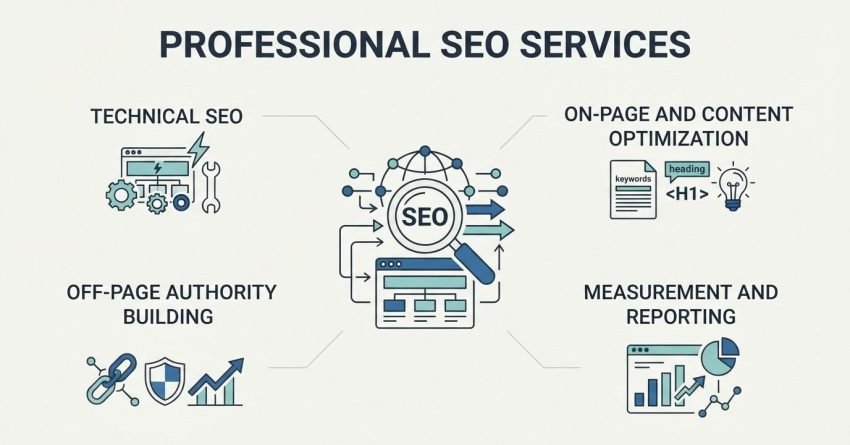
Professional SEO services include four working disciplines: technical optimization, on-page and content work, off-page authority building, and measurement. Everything a credible provider does falls into one of those four buckets, and a gap in any one of them caps results in the other three.
Most confusion about SEO comes from people experiencing only one slice of it. Someone who once hired a link builder thinks SEO is links. Someone who once hired a blogger thinks SEO is content.
Technical SEO
Technical SEO is the discipline that makes a site crawlable, indexable, and fast enough for search engines to process efficiently. This covers site architecture, page speed, Core Web Vitals, structured data, canonical handling, and index management.
Nothing else works properly until this layer does. I have seen sites publish excellent content for a year while a stray noindex directive quietly kept half of it out of the index.
On-Page and Content Optimization
On-page SEO is the practice of aligning individual pages with the intent behind the queries they target. That means titles, headings, internal structure, and above all whether the page actually answers the question someone typed.
Content is where most of the compounding happens. It is also where most agencies quietly underinvest, because writing well at volume is genuinely hard.
Off-Page Authority Building
Off-page SEO is the work of earning references from other websites that signal credibility to search engines. Link building sits here, alongside digital PR, brand mentions, and partnerships.
Authority is the slowest lever to move and the hardest to fake. It is also the one most likely to get a site penalised when someone tries.
Measurement and Reporting
Measurement turns activity into evidence. Rankings, organic sessions, assisted conversions, and revenue attribution together tell you whether the other three disciplines are actually working.
I treat reporting as the discipline that keeps the other three honest.
| Discipline | Primary output | Typical time to impact |
| Technical SEO | Crawlability, speed, indexation | 2–8 weeks |
| Content and on-page | Relevance, coverage, intent match | 3–6 months |
| Off-page authority | Trust, competitive ranking power | 6–12 months |
| Measurement | Attribution, budget decisions | Ongoing |
How Search Engines Decide Which Businesses Rank
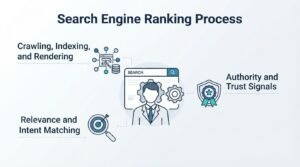
Search engines rank pages by crawling and indexing them, assessing how well they match the intent behind a query, and then weighting that match against signals of authority and trust. Those three stages happen in sequence, and failing an earlier stage makes later ones irrelevant.
Here is the sequence in practice:
- A crawler requests your URLs and follows internal links to discover more
- The rendering system processes the page, including JavaScript, to see final content
- The indexer stores a processed version, or declines to
- At query time, candidate pages are retrieved based on relevance
- Ranking systems reorder candidates using quality, authority, and user signals
- The result set is assembled, sometimes with an AI Overview layered on top
Crawling, Indexing, and Rendering
Crawl budget is the number of URLs a search engine requests from a site in a given period. I watch it closely on any site above roughly 10,000 URLs, because wasted crawl on faceted parameters starves the pages that matter.
Indexation is not automatic. Google indexes a fraction of what it crawls, and that fraction skews heavily toward pages it judges useful.
Relevance and Intent Matching
Search intent is the underlying goal behind a query, usually classified as informational, navigational, commercial, or transactional. Matching it correctly decides whether a page can rank at all, regardless of how well written it is.
A product page will not rank for “how does it work.” A blog post will not rank for “buy near me.” I check intent before I check anything else.
Authority and Trust Signals
Authority signals tell search engines whether a site is a credible source on a topic. Links from relevant, established sites remain the strongest external signal, supported by brand search volume, consistent entity data, and demonstrable experience.
Google’s own Search Quality Rater Guidelines describe experience, expertise, authoritativeness, and trust as the framework raters use to assess page quality. It is not a direct ranking factor, but it describes what the ranking systems are built to approximate.
Why DIY SEO Usually Stalls Out
DIY SEO usually stalls because it requires specialist tooling, sustained weekly execution, and pattern recognition built from working across many sites, and most business owners can afford one of those three at best. The tactics are public. The consistency is not.
I am not arguing that nobody should touch their own SEO. Small local businesses with simple sites often do fine.
The Tooling and Data Gap
Professional SEO runs on crawl data, backlink indexes, rank tracking, and log file analysis. That stack costs several hundred dollars a month before anyone has done any thinking with it.
More importantly, tools tell you what changed. They do not tell you why it changed or what to do next.
The Time and Consistency Problem
SEO rewards sustained publishing and fixing over months, not bursts of activity. The most common failure pattern I see is three months of enthusiastic work followed by nine months of nothing.
That pattern produces almost no compounding. Search visibility decays when left alone, because competitors keep publishing.
The Business Case: What SEO Returns Compared to Paid
SEO and paid search solve the same problem with opposite cost curves: paid delivers immediate traffic that stops the moment spending stops, while SEO delivers delayed traffic that persists and compounds after the work is done. Most businesses need both, weighted by cash position and time horizon.
This table compares how the two channels behave over a typical engagement:
| Factor | Paid search | SEO |
| Time to first traffic | Hours | 3–6 months |
| Cost behaviour | Linear with volume | Front-loaded, then flattens |
| Traffic when spending stops | Ends immediately | Persists and decays slowly |
| Click share of results | Minority of clicks | Majority of clicks |
| Attribution clarity | High | Moderate |
| Competitive moat | None | Builds over time |
Cost Per Acquisition Over Time
Paid CPA stays roughly flat or rises as competition increases. SEO CPA starts very high in month one and falls every month afterward as the same fixed investment produces more traffic.
The crossover point usually lands somewhere between month eight and month eighteen, depending on how competitive the niche is.
Compounding vs. Rented Traffic
Organic rankings are an asset. Paid clicks are a rental agreement with no equity at the end.
I have seen companies cut a six-figure ad budget overnight and keep a meaningful share of their pipeline, purely because organic had been built underneath it.
How Long Professional SEO Takes to Work
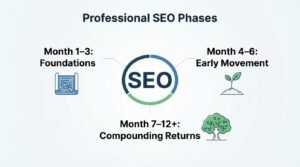
Professional SEO typically takes four to six months to show measurable movement and nine to twelve months to produce meaningful commercial return, with competitive niches and new domains sitting at the longer end of that range. An Ahrefs study of two million keywords found only 5.7% of pages reached the top 10 for any keyword within a year of publication.
That number is sobering and worth sitting with before you set expectations internally.
| Phase | Months | What happens | What you should see |
| Foundations | 1–3 | Audit, technical fixes, keyword mapping, first content | Indexation improves, impressions rise |
| Early movement | 4–6 | Content volume, first links, on-page iteration | Long-tail rankings, first organic leads |
| Compounding | 7–12+ | Authority builds, mid-tail terms move | Consistent lead flow, measurable ROI |
Month 1–3: Foundations
The first quarter is diagnostic and corrective. Technical debt gets cleared, keyword research maps demand to pages, and the first content ships.
Traffic barely moves. Impressions in Search Console move first, and that is the signal I watch.
Month 4–6: Early Movement
Long-tail terms start ranking because they face the least competitive resistance. The first genuine organic enquiries usually arrive in this window.
This is also where most impatient engagements get cancelled, one quarter before the curve turns.
Month 7–12+: Compounding Returns
Authority accumulated over the previous two quarters starts unlocking mid-tail and head terms. Pages published in month three begin ranking properly in month nine.
The work compounds because internal links, topical coverage, and external authority reinforce each other.
Technical SEO: The Foundation Everything Sits On
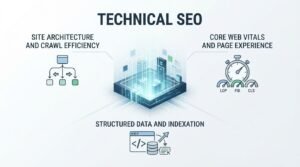
Technical SEO is the discipline that ensures search engines can find, render, understand, and index a site’s pages efficiently. It rarely creates rankings on its own, but it removes the ceilings that stop everything else from working.
I audit this first on every engagement, without exception.
Site Architecture and Crawl Efficiency
Site architecture is the hierarchical organisation of pages and the internal links connecting them. Good architecture puts every important page within three clicks of the homepage and concentrates link equity where revenue lives.
Poor architecture buries commercially valuable pages under pagination and filters. Crawlers spend their budget on parameter combinations nobody searches for.
Core Web Vitals and Page Experience
Core Web Vitals are Google’s field-data metrics for loading performance, interactivity, and visual stability. They are a genuine ranking input, though a modest one compared with relevance and authority.
The real argument for fixing them is conversion, not ranking. Slow pages lose revenue regardless of position.
Structured Data and Indexation Control
Structured data is standardised markup that describes page content explicitly to search engines. Schema markup drives rich results, feeds knowledge panels, and increasingly helps AI systems parse what a page is about.
Indexation control decides what enters the index at all. Robots directives, canonicals, and sitemaps together determine which pages compete and which stay out of the way.
Keyword Research and Search Demand Mapping
Keyword research is the process of identifying the queries a target audience actually types, estimating their volume and difficulty, and mapping each one to a specific page. It converts guesswork about demand into a concrete publishing plan.
Done badly, it produces a spreadsheet nobody uses. Done well, it becomes the roadmap for eighteen months of work.
Intent Classification
Every keyword gets classified by what the searcher wants: to learn, to compare, to find a specific site, or to buy. Search intent determines page type, format, and depth before a single word gets written.
I check the current SERP for each target term rather than guessing. Google has already decided what intent it serves.
Difficulty vs. Opportunity
Difficulty scores estimate how hard ranking will be based on the authority of incumbent pages. Opportunity is difficulty weighed against volume, commercial value, and how well your site already covers the topic.
New domains should ignore head terms entirely for the first two quarters. Winning long-tail builds the authority that makes head terms reachable later.
Content Strategy and Topical Authority
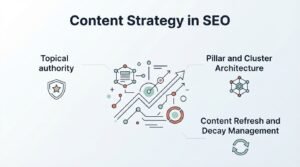
Content strategy in SEO is the deliberate planning of what to publish, in what order, and how pieces interlink to demonstrate comprehensive coverage of a subject. Topical authority is the resulting perception that a site is a credible source across an entire subject area rather than a single query.
Isolated blog posts rarely rank against sites with genuine domain coverage. Depth beats volume, but depth requires volume to express itself.
Pillar and Cluster Architecture
A pillar page covers a broad topic at orientation depth and links out to cluster pages that go deep on each subtopic. This page is itself built that way.
The structure works because it mirrors how search engines model topics. Coverage plus internal linking signals that a site owns a subject.
Content Refresh and Decay Management
Content decay is the gradual loss of rankings and traffic that happens to published pages as competitors update and search intent shifts. Roughly a third of a mature site’s organic traffic comes from pages that need refreshing rather than new pages.
I schedule refresh work alongside new publishing rather than treating it as cleanup.
Link Building and Digital PR
Link building is the practice of earning links from other websites to increase a site’s authority and ranking power. It remains one of the strongest external ranking signals and one of the easiest things to do badly enough to cause damage.
The gap between good and bad link acquisition is wider than in any other SEO discipline.
What Makes a Link Valuable
Valuable links share four traits, and a link missing two or more contributes almost nothing:
- Topical relevance: the linking page discusses a related subject
- Genuine authority: the domain has real traffic and its own earned links
- Editorial placement: the link sits in body content, placed by a human decision
- Natural anchor text: the anchor describes the destination without exact-match stuffing
Tactics That Trigger Penalties
Paid link networks, private blog networks, and large-scale reciprocal schemes all violate Google’s spam policies and carry real manual action risk. Google’s link spam policies explicitly name link buying and exchange schemes as manipulative behaviour.
Recovery from a manual action takes months. I have never seen a client conclude the shortcut was worth it.
Local SEO for Location-Based Businesses
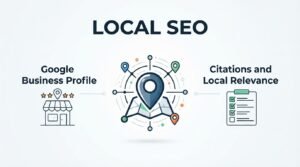
Local SEO is the practice of optimising a business’s visibility for geographically qualified searches and map results. It runs on a partly separate ranking system driven by proximity, prominence, and relevance rather than classic link authority alone.
Any business with a physical location or defined service area needs this layer alongside conventional SEO.
Google Business Profile
A Google Business Profile is the listing that determines whether a business appears in map packs and local finder results. Category selection, review velocity, photo freshness, and hours accuracy all feed local ranking.
It is the highest-leverage asset in local search, and the one most businesses fill out once and abandon.
Citations and Local Relevance
Citations are mentions of a business’s name, address, and phone number across directories and data aggregators. Consistency matters more than volume, because conflicting data undermines the entity confidence that local ranking depends on.
Localised landing pages handle the relevance half, provided each one says something genuinely different.
Ecommerce and B2B SEO Differences
Ecommerce and B2B SEO diverge sharply in page architecture, keyword targeting, and how conversion gets measured, even though both use the same technical and authority foundations. Applying a B2B content playbook to a catalogue site wastes months.
This table shows where the disciplines split:
| Factor | Ecommerce SEO | B2B SEO |
| Primary page type | Category and product pages | Solution and resource pages |
| Keyword focus | Transactional, product modifiers | Problem-aware, comparison, research |
| Main technical risk | Faceted navigation, duplicate content | Thin service pages, gated content |
| Conversion event | Purchase | Demo, enquiry, download |
| Sales cycle | Minutes to days | Weeks to quarters |
| Attribution difficulty | Low | High |
Ecommerce Considerations
Ecommerce SEO lives or dies on category page optimisation and faceted navigation control. Product pages rarely rank for competitive terms, while well-built category pages routinely do.
Out-of-stock handling and index bloat from filter combinations cause more lost revenue than any content gap.
B2B and Long Sales Cycle Considerations
B2B buyers research for weeks before contacting anyone, so content has to serve the entire journey rather than the final query. Ranking for problem-aware terms matters more than ranking for your own product category.
Attribution is genuinely hard here. A lead that converts in month seven often first arrived through a blog post in month one.
Measuring SEO Performance and ROI
SEO performance is measured through a layered set of indicators running from leading signals like impressions and rankings through to lagging outcomes like organic revenue and pipeline contribution. Judging engagement on any single metric produces bad decisions.
This table shows which metric to watch at which stage:
| Metric | Type | When it moves | What it tells you |
| Indexed pages | Leading | Weeks 2–8 | Technical work is landing |
| Impressions | Leading | Month 2–4 | Visibility expanding |
| Average position | Leading | Month 3–6 | Relevance improving |
| Organic sessions | Mid | Month 4–8 | Rankings reaching clickable positions |
| Organic conversions | Lagging | Month 6–12 | Traffic quality is right |
| Organic revenue | Lagging | Month 9–18 | Commercial return confirmed |
Leading vs. Lagging Indicators
Leading indicators move first and predict later outcomes. Impressions rising while position stays flat means you are entering new query sets, which almost always precedes traffic growth.
I report leading indicators heavily in the first two quarters, because they are the only honest evidence available.
Attribution and Revenue Tracking
SEO ROI requires connecting organic sessions to closed revenue, which means conversion tracking, CRM integration, and an agreed attribution model before work starts. Last-click attribution systematically undervalues organic, because organic frequently starts journeys it does not finish.
Set the model up front. Retrofitting attribution after twelve months is a negotiation nobody wins.
Reporting Cadence
Monthly reporting suits execution updates. Quarterly reviews suit strategy and budget decisions, because SEO does not produce meaningful month-over-month deltas early on.
Weekly rank reports create anxiety and bad decisions. I avoid them.
SEO and AI Search: What Changed

AI Overviews and AI assistants changed how search results get consumed by answering some queries directly on the results page, reducing clicks on purely informational terms while increasing the value of being the cited source. The underlying ranking systems did not change; the presentation layer did.
Pages that already ranked well are the ones getting cited. Authority still decides who appears.
AI Overviews and Zero-Click Behavior
Zero-click searches are queries answered on the results page without the user visiting any site. Informational and definitional queries lost the most clicks, while commercial and transactional queries were largely unaffected.
The strategic response is to shift informational content toward earning citations and weight commercial intent more heavily in keyword selection.
Getting Cited by AI Assistants
Getting cited requires content structured so individual sentences survive extraction: direct answers under headings, self-contained claims that name their own subject, and statistics attributed inside the same sentence. Answer engine optimization formalises this as a discipline.
Vague, pronoun-heavy prose cannot be quoted. That is the whole mechanic.
How do I know if an SEO provider is actually any good?
What SEO Pricing Models Look Like
Professional SEO in the US is typically priced through monthly retainers, one-off projects, or hourly consulting, with most sustained engagements for small and mid-sized businesses falling between $1,500 and $10,000 per month depending on competition and scope. Anything meaningfully below that range usually buys reporting rather than execution.
This table shows what different structures and budgets buy:
| Model | Typical range | Best suited to |
| Monthly retainer | $1,500–$10,000/mo | Ongoing growth, most businesses |
| Project-based | $5,000–$30,000 | Audits, migrations, one-off builds |
| Hourly consulting | $100–$300/hr | In-house teams needing direction |
| Performance-based | Variable | Rarely advisable, misaligned incentives |
Retainer, Project, and Performance Models
Retainers fund the sustained execution SEO actually requires. Projects suit bounded work like a migration or a technical audit where the deliverable is finite.
Performance-based SEO pricing sounds appealing and usually misaligns incentives toward short-term ranking wins over durable growth.
What Different Budget Tiers Buy
At the lower end, you get technical maintenance and modest content output. In the mid-range, you get genuine content velocity plus link acquisition.
Above that, you are funding digital PR, dedicated strategy, and the volume competitive niches demand.
How to Vet an SEO Provider
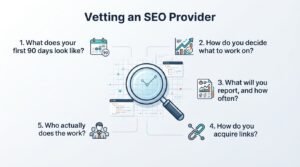
Vetting an SEO provider means checking their process transparency, their measurement discipline, and whether their claims are consistent with how search actually works. The strongest filter is asking what they would do in month one and listening for whether the answer is diagnostic or generic.
Questions Worth Asking
These five questions separate operators from salespeople:
- What does your first 90 days look like? Should start with audit and diagnosis, not publishing
- How do you decide what to work on? Should reference data, not a fixed package
- What will you report, and how often? Should include leading and lagging metrics
- How do you acquire links? Should describe an editorial process, not a volume promise
- Who actually does the work? Should be answerable specifically
Red Flags and Guarantee Claims
Guaranteed rankings are the clearest disqualifier, because no provider controls Google’s ranking systems. Google states plainly in its documentation on hiring an SEO that no one can guarantee a number one ranking.
Other reliable SEO red flags include secrecy about tactics, refusal to give client references, and contracts that withhold access to your own analytics.
In-House, Agency, or White Label
The right delivery model depends on volume of work, availability of senior strategic oversight, and whether search is a core competitive channel or a supporting one. Most businesses under fifty employees cannot justify a full in-house team.
| Model | Strength | Weakness | Best fit |
| In-house | Product knowledge, availability | Narrow skill coverage, hiring cost | Search-led businesses at scale |
| Agency | Breadth, tooling, cross-site experience | Less product context | Most SMEs and mid-market |
| White label | Capacity without headcount | Requires a managing partner | Agencies reselling SEO |
| Hybrid | Strategy in-house, execution external | Coordination overhead | Growing teams |
Matching Model to Business Stage
Early-stage companies get more from an agency, because they need breadth rather than depth. Businesses where organic drives most revenue eventually bring strategy in-house and keep execution external.
Agencies serving clients without SEO capacity use white label SEO to deliver under their own brand without hiring specialists directly.
Common SEO Mistakes That Waste Budget
These seven mistakes account for most wasted SEO spend I encounter:
- Stopping at month four: abandoning the engagement one quarter before compounding starts
- Publishing without keyword mapping: producing content nobody searches for
- Ignoring technical debt: building content on a site search engines struggle to index
- Chasing head terms too early: targeting keywords the domain cannot yet compete for
- Buying links: accepting manual action risk for a temporary lift
- Measuring rankings only: optimising for a metric that does not pay the bills
- Migrating without an SEO plan: the single fastest way to lose years of progress
Most of these are budget decisions rather than technical failures. SEO migration mistakes in particular cause more sudden traffic loss than any algorithm update.
Building an SEO Roadmap for the Next 12 Months
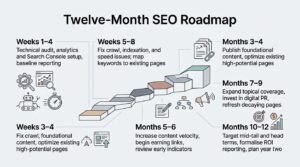
A twelve-month SEO roadmap sequences technical remediation first, then content coverage, then authority building, with measurement running throughout so budget decisions stay evidence-based. Sequencing matters as much as the activities themselves.
Here is the sequence I use:
- Weeks 1–4: Technical audit, analytics and Search Console setup, baseline reporting
- Weeks 5–8: Fix crawl, indexation, and speed issues; map keywords to existing pages
- Months 3–4: Publish foundational content, optimise existing high-potential pages
- Months 5–6: Increase content velocity, begin earning links, review early indicators
- Months 7–9: Expand topical coverage, invest in digital PR, refresh decaying pages
- Months 10–12: Target mid-tail and head terms, formalise ROI reporting, plan year two
Each phase depends on the one before it. Publishing content before fixing indexation wastes the content, and building links to a thin site wastes the links.
The roadmap is also the accountability document. If a provider cannot produce something resembling this, they are improvising with your budget.
Conclusion
You now understand what professional SEO includes, how ranking works, what timelines and budgets look like, and how measurement connects search visibility to revenue.
Search rewards businesses that treat it as infrastructure rather than a campaign, and the cluster resources linked throughout go deeper on each discipline.
We build that infrastructure for agencies and brands every day. Talk to White Label SEO Service about your next twelve months.
Frequently Asked Questions
How much do professional SEO services cost?
Professional SEO services typically cost between $1,500 and $10,000 per month in the US. Pricing depends on competition, site size, and content volume.
How long before SEO produces leads?
SEO usually produces its first organic leads between months four and six. Meaningful, consistent lead flow generally arrives between months nine and twelve.
Is SEO still worth it with AI Overviews?
Yes, SEO remains worth it because AI Overviews cite pages that already rank well. Commercial and transactional queries saw minimal click loss.
Can I do SEO myself instead of hiring someone?
You can handle basic SEO yourself if your site is small and competition is light. Competitive niches require tooling, time, and specialist judgement.
What is the difference between SEO and paid search?
Paid search buys immediate clicks that stop when spending stops. SEO earns traffic slowly, then retains most of it without ongoing spend.
How do I measure SEO ROI?
Measure SEO ROI by tracking organic conversions and revenue against total SEO investment. Set up conversion tracking and attribution before work begins.
What happens if I stop doing SEO?
Rankings decay gradually rather than collapsing, usually over six to twelve months. Competitors publishing consistently will overtake your positions first.