SEO services are a bundle of technical, content, and authority-building work designed to increase a website’s organic search visibility and traffic over time. I’ve watched businesses waste budget hiring too early, and I’ve watched others lose years of growth by waiting too long. Getting this decision right matters for anyone competing for visibility online.
Search engines now reward sites that consistently invest in structure, content, and trust signals. Businesses that delay this work often lose ground to competitors who started sooner.
This guide covers what SEO services actually include, the clearest signs you need them (and when you can wait), how DIY compares to hiring help, what it costs, realistic timelines, and how to evaluate a provider and measure return once you invest.
What SEO Services Actually Include
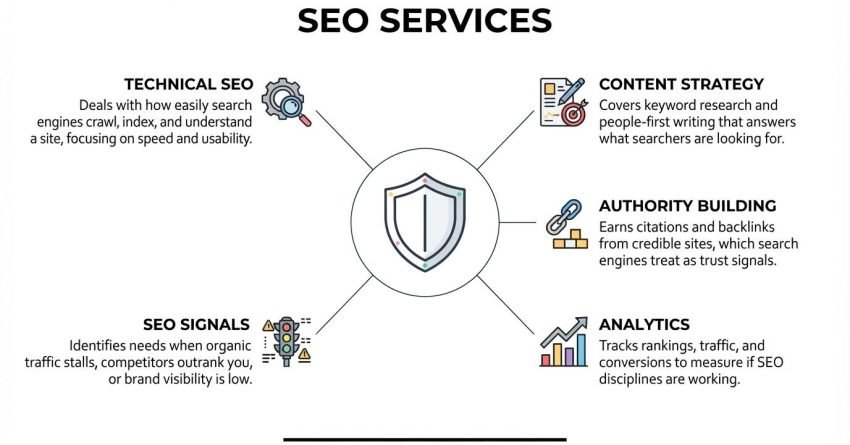
SEO services combine technical fixes, content development, and authority building to help a website rank higher and attract more qualified organic traffic. Most providers structure their work around four connected disciplines rather than a single tactic.
Technical SEO deals with how easily search engines can crawl, index, and understand a website. I look at site speed, mobile usability, structured data, and crawl errors first, because content and links can’t perform if the technical foundation is broken.
Content strategy covers keyword research, topic planning, and the actual writing that answers what searchers are looking for. Google’s own documentation on helpful content emphasizes people-first writing over content built purely to game rankings.
Link building and authority work earns citations and backlinks from other credible sites, which search engines treat as trust signals. Weak or spammy link profiles tend to hold sites back regardless of how strong the on-page work is.
Analytics and reporting close the loop, tracking rankings, traffic, and conversions through tools like Google Search Console and Google Analytics. Without this layer, it’s difficult to know whether the other three are actually working.
Signs Your Business Actually Needs SEO
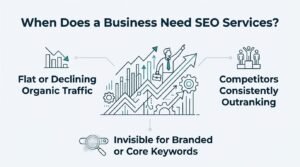
A business needs SEO services when organic traffic has stalled, competitors consistently outrank it, or its own brand and core offerings are hard to find in search results. These signals usually show up together rather than in isolation.
Flat or declining organic traffic is often the first red flag I check for. A Backlinko study of 11.8 million Google search results found that pages in position one earn roughly 27.6% of all clicks, which means stagnant rankings translate directly into lost visitors.
Being invisible for branded or core keyword searches for your own company name or main services points to deeper technical or authority problems. I treat this as urgent because it affects trust as much as traffic.
Watching competitors consistently outrank you on terms you should logically win is another clear trigger. It usually means they’ve invested longer or more strategically in the same four disciplines covered above.
When You Can Skip SEO Services (For Now)
Skipping SEO services temporarily makes sense for pre-product-market-fit startups, hyper-local businesses with minimal digital demand, and short-term campaigns where long-term visibility isn’t the goal. SEO is a compounding investment, and compounding needs a stable base to compound on.
Pre-product-market-fit startups often burn SEO budget chasing rankings for a product that’s still changing shape. I usually recommend waiting until messaging and offer stabilize before investing in content built around it.
Hyper-local businesses with limited digital demand, a single-location shop with a small, walk-in customer base, sometimes see more return from local listings and reviews than from broad organic strategy.
Short-term or one-off campaigns, like a single event or a limited product drop, rarely justify SEO’s multi-month timeline. Paid channels usually deliver faster, more measurable results for these situations.
DIY SEO vs. Hiring a Professional

DIY SEO works for basic on-page fixes and simple content updates, while hiring a professional becomes necessary for technical audits, competitive link building, and scaling content production. The line between the two usually comes down to complexity and time.
What you can realistically do in-house includes writing blog posts, updating meta titles and descriptions, fixing broken links, and submitting a sitemap through Google Search Console. These tasks require attention but not deep technical training.
What requires specialized expertise includes crawl budget optimization, structured data implementation, competitive backlink analysis, and diagnosing algorithm-related traffic drops. These tasks demand tools and experience most in-house teams don’t have time to build.
| Task Type | DIY Feasible? | Needs a Professional |
| Meta tag updates | Yes | — |
| Blog content writing | Yes | — |
| Technical site audits | Rarely | Yes |
| Backlink strategy | Rarely | Yes |
| Algorithm recovery | No | Yes |
In-House SEO vs. Agency vs. Freelancer
Choosing between an in-house team, an agency, or a freelancer depends on budget, workload, and how quickly a business needs specialized skills across technical SEO, content, and link building. Each model trades cost against speed and depth of expertise.
An in-house team offers the deepest product and brand knowledge but is expensive to build across all four SEO disciplines at once. Most businesses under a certain size can’t justify hiring separate technical, content, and outreach specialists.
An SEO agency brings a full team and established processes immediately, which suits businesses that need multiple disciplines covered without hiring internally. Agencies also tend to have more exposure to different industries and algorithm changes.
A freelance SEO consultant offers lower cost and more flexibility but usually specializes in one or two areas rather than the full scope. This model fits businesses with a narrow, well-defined need.
How Much SEO Services Cost
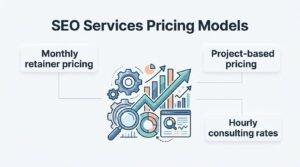
SEO services in the US typically cost between $1,500 and $5,000 per month for small to mid-sized businesses, with project-based work and hourly consulting as common alternatives. Pricing scales with the competitiveness of the industry and the scope of work.
Monthly retainer pricing is the most common model, covering ongoing technical maintenance, content production, and link building as ongoing work rather than a one-time fix.
Project-based pricing suits businesses that need a specific deliverable, like a technical audit or a site migration, without committing to ongoing monthly work.
Hourly consulting rates typically range from $100 to $300 per hour according to Ahrefs’ industry pricing research, and fit businesses that need targeted expert input rather than full execution.
Realistic SEO Timelines
Most SEO campaigns take four to twelve months to show meaningful ranking and traffic improvements, with early technical wins possible in the first few months. Setting accurate expectations here prevents businesses from abandoning strategies too early.
- First 3 months: technical fixes, keyword research, and initial content go live, with minimal ranking movement expected yet.
- 4 to 6 months: early rankings emerge for lower-competition terms, and organic traffic begins trending upward.
- 6 to 12+ months: competitive keywords start ranking, and compounding content and authority produce sustained traffic growth.
Key Ranking Factors SEO Services Address
Search engines rank pages based on content relevance, technical crawlability, and the strength of a site’s backlink profile. SEO services are structured specifically to address these three pillars together rather than in isolation.
On-page and content relevance measures how well a page’s topic, structure, and depth match what a searcher is actually looking for. Thin or outdated content struggles here regardless of technical quality.
Technical health and crawlability determine whether search engines can efficiently access and index a site’s pages at all. A fast, mobile-friendly, error-free site gives every other ranking factor room to work.
Backlinks and authority signals remain one of the strongest predictors of ranking position, according to multiple large-scale industry studies. Sites with stronger, more relevant backlink profiles consistently outrank technically similar competitors with weaker links.
How to Evaluate an SEO Provider
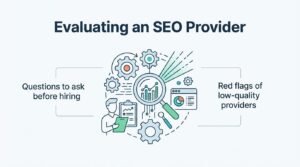
Evaluating an SEO provider means checking their reporting transparency, past client results, and whether their tactics align with search engine guidelines rather than shortcuts. A good provider explains their process instead of guarding it as a black box.
Questions to ask before hiring include what tools they use for tracking, how they report progress, and whether they can share anonymized case studies or references from similar industries.
Red flags of low-quality providers include guaranteed rankings, refusal to explain their link building sources, and reporting limited to vanity metrics like traffic without conversion context.
Measuring SEO ROI
SEO ROI is measured by tracking organic traffic growth, keyword ranking improvements, and how many of those visitors convert into leads or revenue. Traffic alone doesn’t prove value without a clear line to business outcomes.
Traffic and ranking metrics: organic sessions, keyword position changes, and click-through rate show whether visibility is improving month over month.
Lead and revenue attribution: connects that visibility to actual business impact, typically tracked through goal completions and conversion tracking inside Google Analytics.
Common SEO Myths That Affect Hiring Decisions
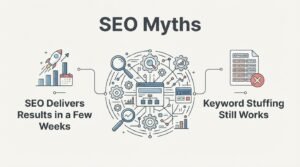
Several persistent SEO myths cause businesses to either overpay for the wrong services or delay hiring help they actually need. Separating fact from outdated advice leads to better decisions.
The myth that SEO delivers results in a few weeks ignores how search engines index and trust new content over time. The myth that keyword stuffing still works ignores over a decade of algorithm updates prioritizing relevance and user experience.
Conclusion
SEO services combine technical work, content, and authority building to drive sustainable organic growth. Understanding your timeline, costs, and provider fit helps you invest wisely.
The broader path to search visibility keeps evolving alongside algorithm updates and search behavior. Staying informed protects your investment over time.
We built White Label SEO Service to help businesses make this decision with confidence. Let’s find the right SEO approach for your growth stage together.
Frequently Asked Questions
How do I know if my business needs SEO services?
Your business needs SEO services if organic traffic has stalled, competitors outrank you, or you’re invisible for branded searches. These signals typically indicate underlying technical or content gaps.
Is SEO worth it for a small business?
SEO is worth it for most small businesses targeting sustainable, long-term traffic growth. It compounds over time, unlike paid ads that stop generating traffic once the budget runs out.
How much do SEO services typically cost per month?
SEO services typically cost between $1,500 and $5,000 per month for small to mid-sized businesses. Pricing depends on industry competitiveness and scope of work involved.
How long does it take to see SEO results?
Most businesses see meaningful results within four to twelve months of consistent SEO work. Early technical improvements can show impact sooner than content or link building.
Can I do SEO myself instead of hiring an agency?
You can handle basic SEO tasks like content updates and meta tag fixes yourself. Technical audits and competitive link building typically require specialized professional expertise.
What’s the difference between an SEO agency and a freelancer?
An SEO agency provides a full team covering technical, content, and link building work. A freelancer usually specializes in one or two areas at a lower cost.
How do I measure if my SEO investment is working?
Measure SEO ROI through organic traffic growth, keyword ranking improvements, and lead or revenue attribution. Traffic alone doesn’t confirm value without conversion tracking.