I’ve spent years watching business owners stare at their Google Search Console data, confused about why their site isn’t ranking. Search engines are automated systems that crawl the web, store pages in massive indexes, and rank them algorithmically based on relevance, authority, and user experience signals. Understanding this process is the foundation of every SEO decision you’ll ever make.
Most SEO frustration comes from misunderstanding this system entirely. Skipping the fundamentals leads directly to wasted budgets and unrealistic expectations.
This guide covers how crawling and indexing actually work, the ranking factors and algorithms that decide who wins the top spots, how technical and on-page SEO feed into that system, and what realistic timelines and measurement look like once your strategy is live.
What Is a Search Engine and How Does It Actually Work?
A search engine is a software system that finds, organizes, and retrieves information from the web in response to a user’s query. I think of it as a three-stage pipeline: discovery, storage, and retrieval, and each stage has to work correctly before your page ever has a chance to rank.
Search engines exist because the web is too large for anyone to browse manually. Google alone processes over 8.5 billion searches per day, and every one of those queries gets matched against an index containing hundreds of billions of pages.
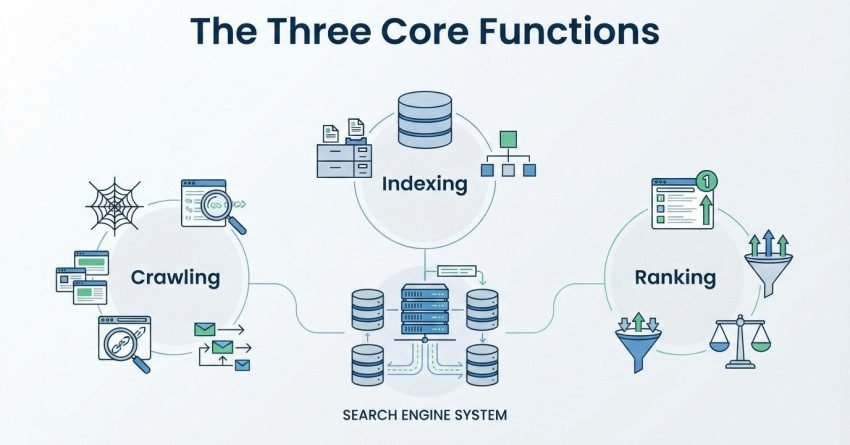
The Three Core Functions – Crawling, Indexing, Ranking
Crawling is the discovery phase, where automated bots find new and updated pages across the web. Indexing is the storage phase, where search engines analyze and file those pages into a massive database. Ranking is the retrieval phase, where algorithms decide the order pages appear in for a given search.
I always tell clients that a page failing at any one of these three stages simply won’t show up, no matter how good the content is.
How Web Crawlers (Spiders) Discover Your Website
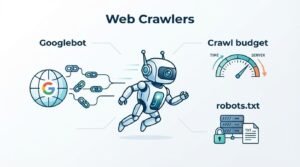
Web crawlers are automated bots, like Googlebot, that systematically browse the internet by following links from page to page. We watch crawl activity constantly because a site that isn’t being crawled efficiently can’t get fresh content indexed.
Crawlers rely on internal links, XML sitemaps, and external backlinks to find new URLs. Crawl budget refers to the number of pages a search engine is willing to crawl on your site within a given timeframe, and it becomes a real constraint once a site grows past a few thousand pages.
A properly configured robots.txt file tells crawlers which sections of a site to avoid, preventing wasted crawl budget on low-value pages like internal search results or filtered category duplicates. I’ve fixed more ranking issues by cleaning up robots.txt rules than almost any other single technical change.
What Happens During the Indexing Process
Indexing is the process where a search engine analyzes a crawled page and stores it in its database for potential retrieval in search results. Not every crawled page gets indexed, and that gap surprises most site owners the first time they check Search Console.
A page can be crawled but excluded from the index for reasons like duplicate content, thin content, or a noindex tag left over from staging. Canonicalization tells search engines which version of a duplicate or near-duplicate page should be treated as the primary one.
I check the “Page Indexing” report in Search Console before touching anything else on a new client audit, because indexing problems make every other SEO effort pointless.
How Search Engines Rank Pages: The Core Ranking Factors
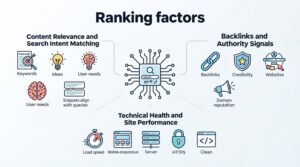
Ranking factors are the signals search engines use to determine which pages best answer a given query and in what order to display them. Google has confirmed it uses more than 200 factors in ranking, though only a handful carry meaningful weight for most queries.
I group these into three buckets that matter most in practice: relevance, authority, and technical health. Getting all three roughly right beats obsessing over any single factor.
Content Relevance and Search Intent Matching
Content relevance measures how well a page’s subject matter and depth align with what a searcher is actually trying to accomplish. A page can be well-written and still fail to rank if it answers the wrong question for the query it targets.
Search engines evaluate relevance through topic coverage, semantic keyword usage, and how directly the content satisfies the underlying intent behind a search.
Backlinks and Authority Signals
A backlink is a link from one website to another that search engines interpret as a vote of confidence in the linked page’s credibility. Backlinko’s analysis of 11.8 million search results found that the number of referring domains correlates more strongly with rankings than almost any other single factor studied.
Not all backlinks carry equal weight. A link from an established, topically relevant site transfers far more authority than dozens of links from low-quality directories.
Technical Health and Site Performance
Technical health covers the infrastructure factors, like site speed, mobile usability, and crawlability, that determine whether search engines can access and properly evaluate a page at all. A technically broken site suppresses the value of even the strongest content and backlink profile.
I run a technical audit before any content or link work begins, because fixing technical health issues after the fact usually means redoing completed work.
The Role of Search Algorithms and Algorithm Updates
A search algorithm is the formula and set of rules a search engine uses to sort and rank indexed pages for a specific query. Google runs thousands of algorithm experiments each year, though most are minor refinements rather than the sweeping changes site owners fear.
Core updates are broad changes to Google’s ranking systems that can shift visibility across entire categories of websites, sometimes without any specific technical cause. Google’s helpful content system evaluates whether content was created primarily to serve people rather than to manipulate search rankings.
I explain to every client that algorithm volatility is normal and expected, not a signal that something is broken.
On-Page SEO: How Search Engines Read Your Content
On-page SEO refers to the optimization of individual page elements, like titles, headers, and content structure, so search engines can accurately understand and rank that page. This is the layer most business owners can control directly without technical help.
Title tags and header structure give search engines a hierarchy of what a page covers and in what priority order. Semantic HTML, meaning properly structured heading tags and descriptive markup, helps search engines parse content meaning rather than just raw text.
I’ve seen pages jump several positions purely from cleaning up header structure and rewriting a misleading title tag.
Technical SEO: The Infrastructure Search Engines Depend On
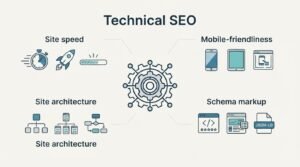
Technical SEO is the practice of optimizing a website’s backend infrastructure, so search engines can crawl, render, and index it efficiently. Site speed, mobile-friendliness, and clean site architecture all fall under this umbrella.
A slow-loading site risks both poor rankings and higher visitor abandonment, since Google’s research on mobile page speed found that as page load time goes from one to three seconds, bounce probability increases by 32%.
Schema markup is structured data code added to a page that helps search engines understand specific entities and relationships on that page, like products, reviews, or business hours.
Off-Page SEO and the Role of Backlinks in Search Rankings
Off-page SEO covers the actions taken outside your own website, primarily earning backlinks and brand mentions, that influence how search engines perceive your site’s authority. This is the hardest ranking factor category to influence directly because it depends on other sites choosing to link to you.
Link equity is the value or authority passed from one page to another through a hyperlink, and it diminishes as it passes through multiple links away from the original source. Anchor text, the clickable words in a link, gives search engines additional context about what the linked page is about.
I always prioritize earning links through genuinely useful content and relationships over any shortcut tactic, because manipulative link schemes carry real penalty risk.
How Search Engines Understand User Intent
Search intent is the underlying goal a user has when typing a query, whether that’s finding information, navigating to a specific site, comparing options, or making a purchase. Search engines have gotten remarkably good at inferring this even from short, ambiguous queries.
The four main intent categories are informational, navigational, transactional, and commercial investigation. A query like “best CRM software” signals commercial investigation, while “CRM login” signals navigational intent, and search engines display very different result formats for each.
Matching content format to intent matters as much as matching topic to keyword.
How Google’s Algorithm Uses AI and Machine Learning
Machine learning is a subset of artificial intelligence that allows Google’s ranking systems to improve their query interpretation without being explicitly reprogrammed for every case. RankBrain, introduced in 2015, was Google’s first major machine learning system used to interpret ambiguous or never-before-seen queries.
BERT and MUM extended this further, allowing Google to understand natural language nuance and context across longer, more conversational queries. AI Overviews now generate synthesized answers directly in search results, pulling from multiple sources rather than sending users to a single ranked page.
I track AI Overview citations for clients now the same way we’ve always tracked featured snippets, because visibility inside these AI-generated answers is becoming its own ranking objective.
SERP Features: How Results Are Displayed to Users
SERP features are the non-standard result formats, like featured snippets, knowledge panels, and image packs, that appear alongside or above traditional blue-link listings. These formats change how much organic traffic even a first-position ranking actually receives.
A featured snippet pulls a direct answer from a ranking page and displays it at the top of results, often above the traditional first organic listing. The People Also Ask box shows an expandable list of related questions, each revealing an answer pulled from a different ranking page when clicked.
Realistic SEO Timelines: How Long It Takes to Rank
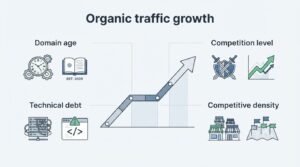
Most websites need four to twelve months of consistent SEO work before seeing meaningful organic traffic growth, according to industry benchmarking data from Ahrefs. This range depends heavily on domain age, competition level, and how much technical debt exists at the start.
A brand-new domain in a competitive industry sits at the slower end of that range, while an established site fixing specific technical or content gaps can see movement in as little as two to three months. I set this expectation with every client on day one because early impatience is the number one reason businesses abandon SEO before it compounds.
Competitive density matters more than most people assume. A local service business competing in a smaller market often ranks faster than a national ecommerce brand entering a saturated category with entrenched competitors.
Mobile-First Indexing and Core Web Vitals Explained
Mobile-first indexing means Google predominantly uses the mobile version of a website’s content for indexing and ranking, even for searches performed on desktop. This shift happened because mobile devices account for the majority of global web traffic.
Core Web Vitals are a specific set of page experience metrics, measuring loading performance, interactivity, and visual stability, that Google factors into rankings. The three metrics are Largest Contentful Paint, Interaction to Next Paint, and Cumulative Layout Shift.
Local Search: How Search Engines Rank Businesses Nearby
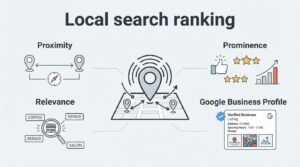
Local search ranking is the process search engines use to determine which nearby businesses to display for location-based queries like “plumber near me.” Proximity, relevance, and prominence are the three primary factors Google uses to rank the local pack.
A complete and accurate Google Business Profile strengthens local visibility significantly, since it feeds the direct data search engines use to match businesses to nearby search intent. Review count and review recency also factor heavily into local pack rankings, more so than in standard organic results.
Common SEO Myths About How Search Engines Work
Misinformation about SEO spreads fast, and I regularly meet business owners operating on rules that stopped being true a decade ago. Clearing these up saves wasted effort on tactics that do nothing or actively hurt rankings.
The meta keywords tag has had zero ranking influence since Google officially stopped using it in 2009. Keyword stuffing, once a functional shortcut, now actively triggers spam detection systems and can suppress rankings entirely.
Another persistent myth is that submitting a sitemap guarantees indexing. Sitemaps only help discovery; they don’t override quality or relevance evaluations that determine whether a page actually gets indexed.
How to Measure and Track Search Engine Performance
Measuring SEO performance means tracking specific metrics, like organic traffic, keyword rankings, and conversion rates, against defined business goals over time. Without this, it’s impossible to know whether an SEO strategy is actually working or just generating activity.
Google Search Console shows exactly how Google crawls, indexes, and ranks your site, including click-through rates and average position for every ranking query. Google Analytics 4 tracks what happens after a visitor arrives, including which organic landing pages actually convert into leads or sales.
I review these two tools together weekly for active clients, because ranking data alone never tells the full revenue story.
Building an SEO Strategy Based on How Search Engines Work
An effective SEO strategy sequences technical fixes, content development, and authority building in the order that produces compounding results rather than isolated wins. Getting the mechanics right first means every later investment works harder.
We build every client roadmap by fixing crawlability and indexing gaps first, then addressing on-page and content relevance, then layering in authority building through backlinks. Skipping steps in this order usually means redoing work later once a foundational gap surfaces.
Conclusion
Search engines run on crawling, indexing, and ranking, powered by algorithms that weigh relevance, authority, and technical health together. This system keeps evolving through AI and machine learning, and the fundamentals here connect directly to every deeper SEO tactic you’ll encounter next. We build strategies on exactly these mechanics and partner with White Label SEO Service to turn this understanding into measurable growth.
Frequently Asked Questions
How do search engines decide which page ranks first?
Search engines rank pages using algorithms that weigh relevance, authority, and technical health together. The page that best matches search intent while demonstrating trustworthy signals typically wins the top position.
How long does it take for a new website to appear in Google?
New websites typically get crawled and indexed within a few days to a few weeks. Ranking competitively for target keywords takes considerably longer, often four to twelve months.
Do search engines use the same algorithm for every website?
Search engines apply the same core ranking algorithms to every site, but results vary based on each page’s specific relevance, authority, and technical signals. No website receives special algorithmic treatment.
What is the difference between crawling and indexing?
Crawling is the discovery process where bots find pages across the web. Indexing is the storage process where discovered pages are analyzed and filed into the search engine’s database for potential ranking.
Can a page rank without any backlinks?
A page can rank without backlinks if competition is low and content relevance is exceptionally strong. In competitive niches, backlinks remain one of the strongest authority signals for ranking well.
How often do search engines update their ranking algorithms?
Google makes thousands of algorithm adjustments per year, though most are minor. Broad core updates happen several times annually and can noticeably shift rankings across entire categories of sites.
Is SEO still effective with the rise of AI search?
SEO remains effective because AI-generated answers still pull from indexed, well-optimized web content. Strong technical health, relevance, and authority now also determine visibility inside AI Overviews.