Information gain in SEO is a metric search engines use to measure how much new, unique information a webpage adds compared to documents already ranking for the same query. It comes from a Google patent describing how algorithms score content based on the novel terms and concepts it introduces relative to a baseline set of top-ranking pages. I think of it as Google’s built-in redundancy filter; it rewards pages that teach something new and quietly demotes ones that just repeat what’s already ranking.
Search results are more competitive than they’ve ever been, and thin, repetitive content rarely earns a spot on page one anymore. Understanding this concept changes how I brief every piece of content I write.
This guide covers how information gain actually works inside search algorithms, how it compares to older relevance signals like TF-IDF, what signals increase or decrease it, and how it connects to E-E-A-T and AI-powered search. I’ll also walk through how to measure and improve it in content you’ve already published.
What Is Information Gain in SEO?
Information gain is a scoring method search engines use to determine how much unique or novel information a document contributes beyond what a set of previously ranked documents already covers. It’s rooted in information theory, where “gain” measures the reduction in uncertainty once new data is introduced.
In SEO terms, Google isn’t just asking “does this page match the query?” anymore. It’s asking “does this page tell me anything I don’t already know from the ten pages I’ve already indexed on this topic?” That distinction matters more than most ranking checklists admit.
I’ve seen well-optimized pages stall in rankings for months, and information gain is often the missing piece. A page can hit every on-page SEO box and still underperform if it says nothing the top-ranking competitors haven’t already said.
How Does Information Gain Work in Search Algorithms?
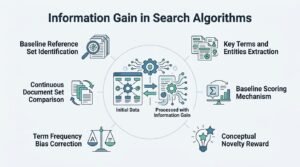
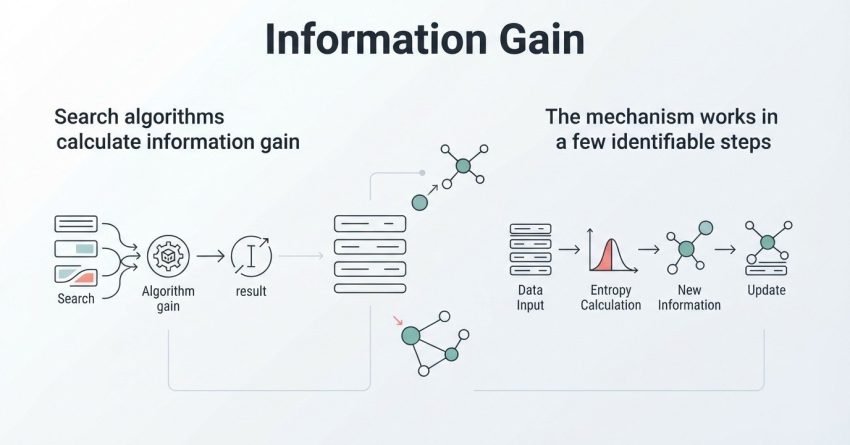
Search algorithms calculate information gain by comparing the terms, phrases, and concepts in a candidate document against a reference set of already-ranked documents for the same query. The process draws from a patent Google filed describing “systems and methods for determining an information gain of a document.”
The mechanism works in a few identifiable steps:
- The algorithm identifies the top-ranking documents for a given query as the baseline reference set
- It extracts the key terms, entities, and topics covered across that baseline set
- It scores a new or existing document against that baseline to see what it adds
- Documents introducing genuinely new terms, data, or angles receive a higher information gain score
- Documents that largely restate the reference set receive a lower score, regardless of how well-written they are
Term frequency bias plays a role here too, because older ranking models leaned heavily on how often a keyword appeared. Information gain corrects for that bias by rewarding conceptual novelty over repetition.
Search engines compare document sets continuously, not just once at indexing. This means a page’s information gain score can shift over time as competitors publish new content and the reference set itself changes.
Information Gain vs. TF-IDF: What’s the Difference?
Information gain measures conceptual novelty relative to competing documents, while TF-IDF measures how important a term is within a single document relative to a broader corpus. They solve different problems, even though both are used to evaluate content relevance.
| Factor | TF-IDF | Information Gain |
| What it measures | Term importance within a document vs. a corpus | Novel information vs. a reference set of top-ranked pages |
| Focus | Keyword frequency and rarity | Conceptual and topical novelty |
| Rewards | Strategic keyword usage | Original data, angles, and depth |
| Weakness it addresses | None – pure statistical weighting | Corrects for repetitive, derivative content |
| Era of dominance | Early-to-mid 2010s SEO | Post-2018 semantic search era |
I still use TF-IDF-style keyword analysis when I’m auditing on-page coverage, but it tells me nothing about whether my content actually adds value to the conversation already happening in the SERP.
Why Does Information Gain Matter for SEO Rankings?
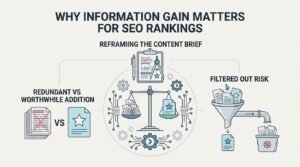
Information gain matters for SEO rankings because it directly influences whether Google views a page as redundant or as a worthwhile addition to the search results. Pages with low information gain risk being filtered out even when they’re technically well-optimized.
This shift explains why some technically flawless pages still underperform against thinner, less polished competitors. The competitor said something new, and mine didn’t.
For any business owner investing in content, this reframes the entire content brief. Word count and keyword placement stopped being the finish line a while ago.
What Is the Information Gain Score Patent?
The information gain score patent is a Google-filed patent describing a method for scoring documents based on the new information they contribute relative to a set of previously retrieved documents for a query. Patent analysts and SEO researchers have studied it extensively since it surfaced publicly.
The patent doesn’t confirm information gain as a live, weighted ranking factor exactly as described; Google rarely confirms specific patent implementations. But the patent’s existence, combined with observable ranking behavior, gives SEO practitioners a credible framework for why redundant content underperforms.
I treat it the way I treat most patents: directional evidence, not gospel. It tells me what Google’s engineers were thinking about solving, even if the live system has evolved since filing.
How Do Search Engines Identify Duplicate or Redundant Content?
Search engines identify duplicate or redundant content by comparing the semantic similarity of a page’s core concepts against already-indexed pages covering the same topic. This goes beyond exact-match duplicate content checks.
Two articles can use completely different words and sentence structures while still scoring low on information gain, because they cover the identical set of subtopics in the identical order with no new data or angle. Redundancy, in this context, is conceptual rather than textual.
I run competitor content through a topic-gap lens before writing anything new, specifically to find what’s missing from the existing conversation rather than just what’s already been said well.
What Are the Key Signals That Increase Information Gain?

The key signals that increase information gain include original data, unique expert perspectives, and coverage depth that exceeds what competing pages currently offer. A handful of content decisions consistently move this needle.
Unique data and original research stand out as the strongest signal, because a proprietary statistic or study simply cannot exist on a competitor’s page. I prioritize original surveys, internal data pulls, and case study numbers whenever a client has them available.
Novel angles and perspectives matter almost as much. Reframing a well-covered topic around a specific audience, industry, or use case that competitors ignored creates genuine gain even without new data.
Depth beyond competitor coverage rounds this out by deliberately answering the follow-up questions competitor content leaves unaddressed, rather than stopping where they stopped.
How Do You Measure Information Gain in Your Content?
You measure information gain in your content by comparing your published page’s topic coverage, terminology, and unique data points against the current top-ranking pages for your target query. There’s no single free tool that outputs an “information gain score” the way Google’s internal systems calculate it.
The practical approach involves manually mapping the subtopics, questions, and data points covered by the top five ranking pages, then auditing your own content against that map to find gaps and overlaps. Several SEO content-scoring platforms now build approximations of this into their content grading tools.
I do this exercise before writing, not after; it’s far cheaper to build gain into a first draft than to retrofit it into a published page.
What Is a Query-Document Information Gain Score?
A query-document information gain score is a value assigned to a specific page relative to a specific search query, reflecting how much unique information that page contributes for that particular query intent. It isn’t a fixed, page-level score like a domain rating.
This distinction trips people up. A page might carry high information gain for one query and near-zero gain for a closely related query, depending entirely on what the competing document set looks like for each search term.
That’s why content built for one exact query rarely transfers its “gain” advantage to a slightly different variation without deliberate optimization for that specific intent.
How Does Information Gain Affect Content Strategy?

Information gain affects content strategy by shifting the planning focus from keyword coverage toward genuine topic differentiation and originality. Content briefs built purely around competitor outlines now risk producing exactly the redundant content this scoring method penalizes.
Content differentiation approaches I use include commissioning original data, interviewing subject-matter experts, and structuring content around underserved subtopics competitors skipped entirely.
Avoiding content cannibalization through gain matters at the site level too; publishing five articles that all say the same thing in different words dilutes topical authority instead of building it, since none of those pages contribute meaningfully against each other.
What Are Common Misconceptions About Information Gain?
A common misconception about information gain is that longer content automatically scores higher, when in reality length has no direct relationship to novelty. A 3,000-word article that restates competitor coverage scores lower than an 800-word article introducing genuinely new data.
Another misconception treats information gain as a single, isolated ranking factor that can be optimized in isolation. It works alongside relevance, E-E-A-T, and technical SEO factors rather than replacing any of them.
I also hear it confused with “keyword gap analysis,” which identifies missing keywords rather than missing concepts or unique value. They’re related exercises but not the same thing.
How Does Information Gain Relate to E-E-A-T?
Information gain relates to E-E-A-T because both concepts reward content built on genuine, first-hand expertise rather than aggregated or paraphrased information. Original data and unique perspectives are core drivers of information gain are also the clearest demonstrations of real experience and expertise.
A page written by someone who has actually done the work described tends to naturally introduce details that paraphrased competitor content can’t replicate. That overlap isn’t a coincidence; both systems are trying to solve the same underlying problem of separating authentic value from recycled content.
I treat E-E-A-T and information gain as two lenses pointed at the same target rather than two separate checklists to satisfy.
How Does Information Gain Impact AI Overviews and AI Search?
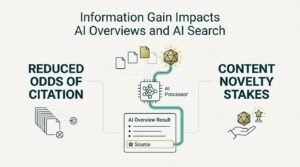
Information gain impacts AI Overviews and AI search because these systems tend to select and cite sources that contribute distinct, extractable information rather than sources that duplicate a common consensus answer. When multiple pages say the same thing, AI systems typically pick one representative source rather than citing all of them.
This raises the stakes for content novelty even further, since being one of ten near-identical pages on a topic reduces the odds of citation to roughly one in ten, regardless of how well-written each individual page is.
I’ve started treating “would an AI system quote this exact sentence” as an informal test during editing, and it usually surfaces the same weak spots that a formal information gain audit would.
How Can You Improve Information Gain on Existing Content?
You can improve information gain on existing content by auditing it against current top-ranking competitors and adding data, angles, or depth that those pages still lack. This works better as an ongoing content refresh habit than a one-time fix.
Start with pages that rank on page two or the bottom of page one, since they’re often close to a breakthrough and just need a genuine value addition rather than a full rewrite. Adding an original data point, a practitioner’s perspective, or a subtopic competitors overlooked frequently moves these pages meaningfully.
I run this audit quarterly on any client’s priority pages, because the competitive reference set Google compares against keeps shifting as new content gets published.
Conclusion
Information gain measures whether your content adds real value beyond what’s already ranking, tying directly into relevance, E-E-A-T, and AI search visibility. As search evolves toward rewarding originality over repetition, this concept will only grow more central to sustainable rankings. We help businesses build genuinely differentiated content strategies. Reach out to White Label SEO Service to start closing your information gaps.
Frequently Asked Questions
Is information gain a confirmed Google ranking factor?
Google has not officially confirmed information gain as a named, weighted ranking factor. The underlying patent and observable ranking behavior strongly suggest it influences how content is evaluated.
How is information gain different from keyword density?
Keyword density measures how often a term appears in a document, while information gain measures whether the document contributes new concepts beyond competing pages. A page can have ideal keyword density and still score low on information gain.
Can duplicate content ever have high information gain?
No, duplicate content cannot have high information gain by definition, since information gain specifically measures novelty relative to existing documents. Duplicate or near-duplicate content contributes nothing new to the reference set.
Does information gain apply to every type of query?
Information gain applies most strongly to informational queries where multiple pages compete to explain the same topic. It matters less for highly transactional or navigational queries where searchers want a specific destination, not new information.
How long does it take to see ranking improvements from information gain?
Ranking improvements from information gain updates typically take several weeks to a few months to materialize after publishing or updating content. Timelines vary based on crawl frequency, competition, and how significantly the content’s novelty improved.
Do AI Overviews use information gain to select sources?
AI Overviews appear to favor sources offering distinct, non-redundant information when selecting citations, which aligns closely with information gain principles. This isn’t officially confirmed as the exact mechanism, but the pattern is consistent with it.
What tools can help measure information gain?
No dedicated free tool directly outputs a Google-equivalent information gain score. Content optimization platforms and manual competitor gap analysis remain the most practical ways to approximate it.