An SEO service level agreement is a written document that defines the deliverables, performance metrics, timelines, reporting cadence, and remedies governing an SEO engagement between a provider and a client. It converts vague promises into measurable, enforceable commitments that both sides can point to when expectations drift.
I have watched more SEO relationships collapse over undefined scope than over poor results, because nobody wrote down what success actually looked like at the start.
This guide covers what an SEO SLA is and why agreements fail without one, how to define deliverables, scope boundaries, and the KPIs worth committing to, how timelines, reporting, communication, and responsibilities get structured, the commercial layer of pricing, remedies, compliance, and exit terms, and how to review any agreement before signing it.
What an SEO Service Level Agreement Actually Is
An SEO service level agreement is a contractual document that specifies the measurable standards an SEO provider commits to, including deliverable volume, response times, reporting frequency, and the metrics used to judge performance. It sits alongside the commercial contract rather than replacing it.
I treat the SLA as the operational spine of the engagement. The master services agreement handles liability, jurisdiction, and payment law. The SLA handles what happens on a Tuesday when a client asks why the audit is late.
Most disputes I have been called into were not legal disputes at all. They were definitional ones, where two parties held different mental models of the same word.
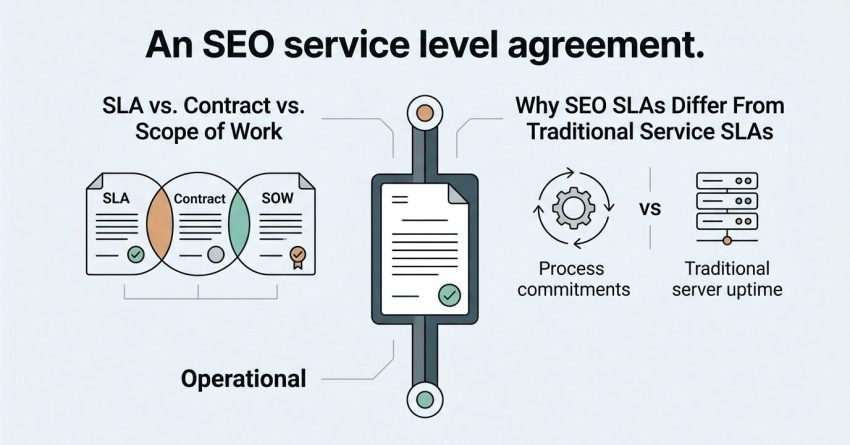
SLA vs. Contract vs. Scope of Work
A scope of work lists what will be done, a contract governs the legal relationship, and the SLA defines the standard those things must meet. All three overlap, and in smaller engagements they often live in one document.
The distinction matters when something goes wrong. A scope of work tells you a technical SEO audit was promised, while the SLA tells you it was due within fifteen business days and had to cover crawl, indexation, and Core Web Vitals.
I keep them separate on retainers above a certain size, because scope changes constantly and I do not want to reopen the legal contract every quarter.
Why SEO SLAs Differ From Traditional Service SLAs
Traditional service SLAs commit to outcomes the provider fully controls, such as 99.9% server uptime, whereas SEO outcomes depend on a third-party algorithm nobody involved in the agreement owns. That single fact reshapes the entire document.
A hosting company can promise uptime because it owns the servers. No SEO provider owns Google’s ranking systems, competitor behaviour, or your industry’s search demand curve.
So the commitments shift from results to process. We guarantee the work, the rigour, the cadence, and the transparency. We do not guarantee position three for a head term, and any provider who does is selling something other than SEO.
Why SEO Agreements Fail Without a Defined SLA
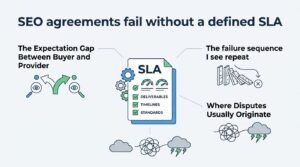
SEO agreements fail without a defined SLA because unwritten expectations diverge over time, and by month four the client and provider are measuring the same engagement against two incompatible scorecards. The gap is almost always discovered during a bad month, not a good one.
Here is the failure sequence I see repeat:
- Sales conversation sets an implied expectation about results
- Onboarding never converts that expectation into a written standard
- Early months produce work but few visible rankings
- The client benchmarks against the sales conversation
- The provider benchmarks against the work delivered
- Neither party has a document to arbitrate the difference
The Expectation Gap Between Buyer and Provider
The expectation gap is the difference between what a client believes they purchased and what the provider believes they sold, and it widens fastest in the first ninety days of an engagement. Written standards close it before it opens.
Buyers usually purchase an outcome in their head. Traffic, leads, revenue, a specific phrase ranking. Providers usually sell a process, because process is what they control.
I close this gap by writing both into the document. The process commitments become binding, and the outcome expectations become forecasts with explicit assumptions attached.
Where Disputes Usually Originate
Most SEO disputes originate in four places: undefined deliverable volume, unstated timelines, missing reporting standards, and unclear responsibility for client-side blockers. Each one is preventable with a single paragraph.
Deliverable volume is the most common. A client hears “content” and pictures eight articles a month, while the provider priced for two.
Client-side blockers are the most bitter. Development queues stall technical recommendations for months, then the provider is blamed for flat performance on work that was never implemented.
Deliverables: Defining What Actually Gets Produced
SEO deliverables in an SLA are the specific, countable outputs a provider commits to producing within a defined period, such as audits, optimised pages, published articles, or acquired links. Every deliverable needs a quantity, a cadence, and a definition of done.
Vague deliverable language is the single biggest cause of retainer churn I encounter. “Ongoing content optimisation” means nothing that can be audited at month six.
This table shows how to convert a typical retainer’s deliverables into SLA-ready language:
| Deliverable | Quantity | Cadence | Definition of Done |
| Technical audit | 1 full, 1 delta | Initial + quarterly | Crawl, index, CWV, schema documented with priority ranking |
| On-page optimisation | 8 URLs | Monthly | Title, meta, headings, internal links, schema updated and deployed |
| New content | 4 articles | Monthly | Briefed, written, edited, published, indexed |
| Link acquisition | 6 referring domains | Monthly | Live, followed, DR 30+, topically relevant |
| Performance report | 1 | Monthly | GSC + GA4 data, commentary, next-month plan |
| Strategy call | 1 | Monthly | 45 minutes, agenda circulated 24h prior |
Technical SEO Deliverables
Technical SEO deliverables cover crawlability, indexation, site architecture, page performance, and structured data, and they should be split between audit work and implementation work in the SLA. Auditing and fixing are two separate commitments with two separate owners.
I always specify who implements. A technical SEO audit that lands in a developer backlog for five months is not a deliverable; it is a document.
Where the provider implements directly, the SLA should name the access required and the deployment window. Where the client implements, the SLA should record that dependency explicitly so timelines flex accordingly.
Content Deliverables
Content deliverables should specify word count ranges, the briefing process, revision rounds included, approval windows, and who publishes. Each of those five variables causes disputes when left open.
Revision rounds matter more than people expect. Two rounds included, additional rounds billed, is a clean and defensible standard.
Approval windows protect the provider. If a client sits on a draft for three weeks, that delay belongs to them, and the SLA should say so in plain language.
Link Acquisition Deliverables
Link acquisition deliverables must define quality thresholds, not just volume, because six links from irrelevant low-authority domains actively damage a profile. Quality criteria belong in the document, not in a verbal assurance.
I specify minimum domain rating, topical relevance, traffic thresholds, and an explicit ban on paid link networks. That last clause protects both parties during algorithm updates.
Volume commitments should also carry a variance allowance. Outreach is a probabilistic activity, and a rigid monthly number encourages providers to buy low-quality placements to hit the count.
Quantity vs. Outcome Framing
Quantity framing commits to units produced, while outcome framing commits to results achieved, and SEO SLAs should use quantity framing for deliverables and forecast framing for outcomes. Mixing the two creates unenforceable promises.
“Four articles per month” is auditable. “Improved content performance” is not.
The forecast sits separately, with stated assumptions. That structure gives the client something to hold the provider to without asking the provider to guarantee an algorithm.
Scope Boundaries and Exclusions
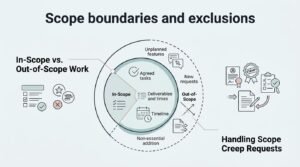
Scope boundaries define the outer edge of what the retainer covers, and exclusions name the work that will trigger a separate quote. An SLA without an exclusions list is an invitation to unbilled work.
Most providers write an inclusions list and stop there. The absence of a task from an inclusions list is rarely treated as a refusal by a client who needs it done.
In-Scope vs. Out-of-Scope Work
In-scope work is everything the retainer fee covers at the agreed cadence, and out-of-scope work is related activity that requires separate authorisation and budget. Both lists should appear in the same section, side by side.
Common out-of-scope items I name explicitly include site migrations, full redesign consultation, paid media management, CRO testing, email marketing, international or hreflang rollouts, and development work beyond specified implementation hours.
Naming them is not restrictive. It signals that the provider can do them, and prices them honestly rather than absorbing them silently until the retainer stops being viable.
Handling Scope Creep Requests
Scope creep is handled by a written change order process that logs the request, quotes the additional effort, and requires client approval before work begins. The process should take minutes, not days.
I keep the threshold low and the friction lower. Anything above two hours of unplanned work gets a short written note and a yes or no.
Without that mechanism, small requests accumulate until the provider is delivering a materially different engagement than the one being paid for, and quality drops across every committed deliverable.
Performance Metrics and KPIs Worth Committing To
Performance metrics belong in an SEO SLA when the provider can meaningfully influence them, and both parties can verify them from a shared data source. Metrics failing either test create conflict rather than accountability.
An Ahrefs study of two million keywords found only 5.7% of pages reach the top ten for any keyword within a year of publication, which is exactly why rank position makes a poor contractual guarantee.
Leading vs. Lagging Indicators
Leading indicators are early signals that predict future performance, such as indexation rate, crawl efficiency, and impression growth, while lagging indicators are downstream business outcomes like organic revenue. SLAs should track both but commit differently to each.
Leading indicators move within weeks. Lagging indicators move within quarters.
I use leading indicators for month-to-month accountability and lagging indicators for quarterly strategic review. That split keeps early conversations productive instead of prematurely alarming.
Metrics That Belong in an SLA
This table separates the metrics I commit to contractually from the metrics I report but never guarantee:
| Metric | Commit in SLA? | Reason |
| Deliverables completed | Yes | Fully provider-controlled |
| Report delivery date | Yes | Fully provider-controlled |
| Response time to queries | Yes | Fully provider-controlled |
| Indexation coverage | Yes, with caveats | Largely controllable, verifiable in GSC |
| Core Web Vitals thresholds | Yes, if implementing | Measurable and controllable with access |
| Keyword tracking coverage | Yes | Reporting commitment, not ranking commitment |
| Rank position for a term | No | Algorithm-dependent |
| Organic traffic volume | No, forecast only | Demand and algorithm-dependent |
| Conversions or revenue | No, forecast only | Depends on offer, pricing, sales process |
Metrics That Should Never Be Guaranteed
Rankings, traffic volume, conversion counts, and revenue should never be guaranteed in an SEO SLA because each depends on factors outside the provider’s control. Guaranteeing them signals either inexperience or intentional misrepresentation.
Google’s own Search Essentials documentation states that no one can guarantee a number one ranking, and that language exists precisely because guarantee claims are a recognised industry warning sign.
Forecasts are different from guarantees. A forecast with stated assumptions, a range rather than a point, and a documented methodology is honest and useful.
Timelines, Milestones, and Realistic Ramp Periods
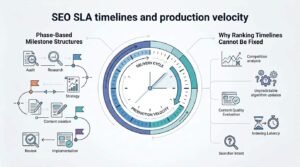
SEO SLA timelines commit to delivery dates for work products, not to dates for ranking outcomes, because the provider controls production schedules and does not control indexing or algorithmic evaluation. Every timeline clause should make that distinction explicit.
Most SEO engagements produce meaningful organic traffic movement between four and twelve months, depending on domain authority, competition, technical starting point, and content velocity.
Phase-Based Milestone Structures
A phase-based milestone structure breaks the engagement into defined stages with deliverable-based completion criteria rather than result-based ones. Each phase has an entry condition, a set of outputs, and an exit review.
A typical structure runs like this:
- Days 1–14: access provisioning, baseline capture, stakeholder alignment
- Days 15–45: technical audit, keyword research, content and architecture strategy
- Days 46–90: priority technical fixes, first on-page batch, content production begins
- Months 4–6: sustained content and link cadence, first measurable leading indicators
- Months 7–12: compounding output, lagging indicator review, strategy recalibration
Why Ranking Timelines Cannot Be Fixed
Ranking timelines cannot be fixed because Google evaluates pages against a continually shifting competitive set using systems that reweight signals without notice. A fixed ranking date is a promise about a third party’s behaviour.
Competitor activity alone can invalidate a timeline. A well-resourced rival publishing aggressively in your space changes the bar you are clearing, and no clause in your agreement constrains them.
What an SLA can fix is production velocity. Commit to the inputs at a defined pace, report honestly on the outputs, and recalibrate quarterly.
Reporting Cadence and Data Transparency
Reporting cadence in an SEO SLA specifies how often reports are delivered, what data sources they draw from, what commentary accompanies them, and how many business days after period-end they arrive. Vague reporting clauses produce vague reports.
I commit to a delivery date, not a delivery month. “Within five business days of month-end” is enforceable; “monthly reporting” is not.
Report Frequency and Format
Report frequency should match decision-making cadence, which for most retainers means monthly performance reporting with quarterly strategic review. Weekly reporting rarely changes decisions and consumes budget better spent on work.
The format section should name the specific views included: organic sessions, impressions, clicks, average position for tracked terms, indexation status, conversions where tracking exists, and deliverables completed against commitment.
Commentary is the part clients actually read. I require written interpretation, not a dashboard link, because a dashboard without analysis transfers the analytical work back to the client.
Data Source Attribution
Every figure in an SEO report should name its source, because Google Search Console, Google Analytics 4, and third-party rank trackers measure different things and will never agree. Undeclared sources create false discrepancies.
GSC reports impressions and clicks from Google’s own logs. GA4 reports sessions after cookie consent and tag firing. Third-party trackers sample rankings from a chosen location and device.
The SLA should name the system of record for each metric and lock it for the engagement. Switching sources mid-engagement to flatter a trend is a practice worth contractually prohibiting.
Communication Standards and Response Times
Communication standards define the channels, response windows, and escalation routes for the engagement, and they are the clauses clients feel most acutely day to day. Slow responses erode trust faster than slow rankings.
This table shows a workable response tier structure:
| Request type | Channel | Response window |
| Routine question | Email/shared channel | 1 business day |
| Deliverable feedback | Email/project tool | 2 business days |
| Urgent site issue | Phone/priority channel | 4 business hours |
| Crisis (deindexation, penalty, outage) | Phone | 2 business hours |
| Strategy discussion | Scheduled call | Within agreed cadence |
Response Time Tiers
Response time tiers separate acknowledgement from resolution, because a provider can confirm receipt in an hour while a technical diagnosis legitimately takes days. Conflating the two sets everyone up to fail.
I commit to acknowledgement windows contractually and resolution windows as best-effort with a status update requirement. That structure is honest and still gives the client certainty.
Escalation Paths
An escalation path names the individuals a client contacts when the primary point of contact is unresponsive or a disagreement is unresolved at the working level. Two named tiers above the account manager is usually sufficient.
The clause should include contact details and a stated response commitment at each tier. An escalation path without names is decoration.
Roles, Responsibilities, and Client Dependencies
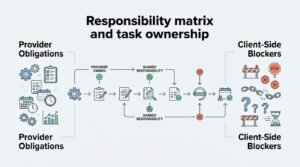
A responsibility matrix assigns every task in the engagement to either the provider, the client, or both, which prevents work stalling in the gap between two parties who each assumed the other owned it. This is the clause that saves the most time.
| Task | Provider | Client |
| Technical audit | Owns | Provides access |
| Technical implementation | Owns or advises | Owns if in-house dev |
| Content briefing | Owns | Approves |
| Content approval | Submits | Owns, within agreed window |
| CMS publishing | Owns or advises | Owns if restricted access |
| Link outreach | Owns | Approves target list |
| Analytics configuration | Owns | Provides access |
| Brand and legal sign-off | Requests | Owns |
Provider Obligations
Provider obligations cover producing committed deliverables on schedule, maintaining data accuracy, flagging risks proactively, and documenting recommendations in an implementable form. Documentation quality is an obligation worth naming explicitly.
I also commit to proactive risk flagging. If a core update lands or an indexation drop appears, the client hears it from me before they notice it themselves.
Client-Side Blockers
Client-side blockers are dependencies the provider cannot resolve alone, such as development resources, content approval, credential access, or legal review, and the SLA should state that committed timelines pause when a blocker exceeds a defined window. Five business days is a reasonable trigger.
The clause is not adversarial. It documents reality and prevents the provider from absorbing blame for delays caused entirely upstream.
I log blockers in the monthly report with the date raised and date resolved. That record ends most retrospective disputes in a single screenshot.
Access, Credentials, and Data Ownership
Access clauses specify exactly which systems the provider requires, at what permission level, and by when, because missing access is the most common cause of a stalled first month. Every day without access is a day of the retainer producing nothing.
The typical access inventory includes:
- Google Search Console (full or owner)
- Google Analytics 4 (editor)
- Google Tag Manager (publish)
- CMS or staging environment (editor or admin)
- Server or hosting panel (read, for log files)
- Existing rank tracking and SEO tooling
- Google Business Profile, where local visibility matters
Required Access Inventory
The access inventory should be attached to the SLA as an appendix with a target provisioning date, because listing it inside dense contract prose guarantees it gets missed. An appendix can be worked through as a checklist.
I set a provisioning deadline and state that the engagement start date shifts if it is missed. That single sentence has saved more first months than any other clause I use.
Ownership on Termination
Data ownership clauses should confirm the client owns all deliverables, accounts, content, and acquired links produced during the engagement, and that access is transferred rather than revoked at termination. Anything less creates hostage dynamics.
Tooling is the exception worth naming. Provider-licensed software does not transfer, and the SLA should say which analyses depend on it so the client can plan continuity.
I also commit to a defined handover window, typically fourteen to thirty days, covering credential transfer, documentation delivery, and a transition call.
Pricing Structure, Payment Terms, and Scope Changes
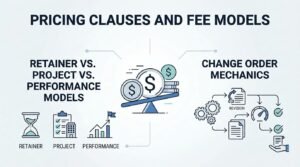
Pricing clauses define the fee model, billing cycle, payment terms, late payment consequences, and the mechanism for adjusting fees when scope changes. Ambiguity in any of these becomes a relationship problem, not just an accounting one.
| Model | Best suited to | SLA implication |
| Monthly retainer | Ongoing programmes | Commit to deliverable volume per month |
| Project fee | Audits, migrations, one-off builds | Commit to scope and delivery date |
| Hourly | Advisory, overflow support | Commit to response time and reporting of hours |
| Hybrid retainer + project | Mature programmes | Separate SLAs per component |
| Performance-based | Rarely appropriate | Requires airtight attribution and shared risk terms |
Retainer vs. Project vs. Performance Models
Retainer models suit continuous SEO work because the discipline compounds, project models suit bounded deliverables with a clear endpoint, and performance models introduce attribution disputes that usually outweigh their appeal. The model choice shapes every other clause.
Performance pricing sounds aligned and rarely is. It incentivises short-term tactics, breaks down when brand or paid activity moves the same metrics, and collapses when a core update lands.
Change Order Mechanics
A change order clause specifies who can authorise additional work, what form the authorisation takes, and how the additional fee is calculated. Written approval by a named individual is the minimum standard.
I keep a fixed hourly or day rate in the SLA for out-of-scope work so nothing needs renegotiating mid-request. The client knows the cost before they ask.
Remedies, Penalties, and Service Credits
A remedy clause defines what the client receives when the provider misses a committed standard, typically in the form of service credits, additional deliverables, or a right to terminate without penalty. Remedies should attach only to provider-controlled commitments.
This is the clause most SEO SLAs omit entirely, which is precisely why so many agreements have no teeth.
What a Fair Remedy Looks Like
A fair remedy is proportionate, automatic, and tied to a specific missed commitment, such as a pro-rata credit when reports arrive late, or deliverables fall short of the committed count. Automatic application matters more than size.
I structure it simply. Missed deliverables are made up in the following period or credited at the stated rate, and repeated misses across consecutive months unlock a termination right.
Termination rights are the most meaningful remedy in practice. A client who can leave cleanly has real leverage and rarely needs to use it.
Why Ranking Penalties Backfire
Ranking-based penalties backfire because they push providers toward high-risk tactics that produce short-term movement and long-term damage. A penalty clause tied to position creates exactly the wrong incentive.
When revenue depends on hitting a rank by a date, buying links and thin-content scaling start to look rational to a provider under pressure. The client inherits that risk when the next spam update runs.
Tie penalties to process failures instead. Late reports, missed deliverables, and unresponsive communication are all fair game and fully within the provider’s control.
Compliance, Ethics, and Algorithmic Risk Clauses
Compliance clauses commit the provider to search engine guidelines and prohibit specific manipulative tactics, protecting the client from practices that carry algorithmic or manual action risk. They should name tactics, not just reference “best practice.”
Google’s spam policies define link schemes, scaled content abuse, and cloaking as violations, and those definitions give an SLA concrete language to reference.
Prohibited Tactics Language
Prohibited tactics should be listed explicitly rather than referenced generally, because a general clause gives a provider room to argue a grey-hat practice was never specifically excluded. Specificity removes that argument.
The list I use covers paid link schemes and PBNs, automated or scaled low-quality content, cloaking and doorway pages, hidden text, expired domain abuse, and undisclosed automated generation of published content.
I pair it with a disclosure obligation. Any tactic not explicitly listed but potentially contentious must be raised in writing before deployment.
Algorithm Update Provisions
An algorithm update provision states how the parties respond when a core or spam update materially affects performance, including a diagnostic window, a remediation plan requirement, and a review point before any termination decision. Updates are inevitable, so plan for them contractually.
Google has confirmed that core update recovery can take multiple update cycles, meaning a thirty-day judgment window after a volatility event is unrealistic. I build in ninety days with mandatory interim reporting.
The clause should also prevent either party from treating a general industry-wide volatility event as automatic evidence of provider failure.
Term Length, Renewal, and Exit Conditions
Term clauses set the minimum commitment, the renewal mechanism, and the notice period for termination, and for SEO they should reflect the genuine ramp period rather than a convenient billing cycle. Most substantive SEO programmes need six to twelve months to demonstrate compounding effects.
Short terms attract clients and frustrate them, because a three-month engagement ends before leading indicators translate into anything visible.
Minimum Commitment Periods
A minimum commitment period of six months is a defensible floor for most SEO retainers, with twelve months typical for competitive verticals or sites requiring substantial technical remediation before content work can perform. The period should be justified in the document, not simply asserted.
I explain the reasoning in a short paragraph inside the SLA. A client who understands why the term exists renews far more often than one who feels locked in.
Offboarding and Transition
Offboarding clauses define the notice period, the handover deliverables, the access transfer process, and any final reporting obligation. Thirty days’ written notice with a documented handover is standard and fair.
Handover deliverables should include the full documentation set, keyword and content plans, technical recommendation status, link acquisition records, and analytics configuration notes.
A clean exit clause is a commercial advantage. Clients sign faster when leaving is not frightening.
White Label and Subcontracted SEO SLA Considerations
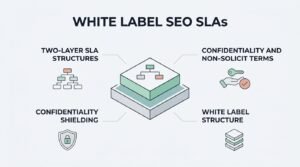
White label SEO SLAs operate across two layers: one between the end client and the reseller, and one between the reseller and the delivery provider, and the two documents must not contradict each other. Mismatched commitments between layers create liability with no way to fulfil it.
The most common failure is a reseller promising an end client a response time or deliverable volume the delivery partner never agreed to.
Two-Layer SLA Structures
A two-layer structure requires the back-end SLA to meet or exceed every commitment made in the front-end SLA, with buffer built into response windows and delivery dates. The reseller absorbs the buffer, not the end client.
I build in one business day of buffer on every response tier and three business days on every deliverable date. That margin lets the reseller manage the relationship without constantly escalating.
Reporting should be white-label ready by default, with the delivery provider’s branding, tool names, and internal terminology removed at source rather than manually stripped each month.
Confidentiality and Non-Solicit Terms
Confidentiality and non-solicit clauses protect the reseller from direct client poaching and protect the delivery provider from having its methodology redistributed. Both directions need covering.
The non-solicit should have a defined duration, typically twelve to twenty-four months post-engagement, and cover the named end client rather than an entire industry.
Confidentiality should extend to process documentation, pricing, and the existence of the subcontracting relationship itself where the reseller requires it.
How to Review an SEO SLA Before You Sign
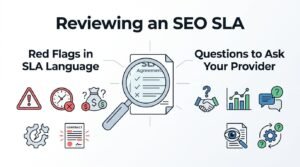
Reviewing an SEO SLA means checking that every commitment is specific, measurable, attributable to a named party, and backed by a remedy, because clauses failing any of those four tests will not survive a disagreement. Read it assuming the relationship will eventually be tested.
I run the same pass every time: quantify the deliverables, locate the exclusions, find the response times, check who owns the data, and confirm there is a clean way out.
Red Flags in SLA Language
Certain phrases signal an agreement that will not protect the buyer. Watch for these:
- Guaranteed rankings or guaranteed positions
- “Ongoing optimisation” with no quantity attached
- No exclusions list of any kind
- Reporting described only as “regular” or “monthly” with no date
- Automatic renewal with a notice period longer than thirty days
- No data ownership or access transfer clause
- Remedies that exist only in the provider’s favour
- Vague link-building language with no quality thresholds
- Response times absent entirely
Questions to Ask Your Provider
The right questions surface gaps faster than reading the document a second time. I would ask a prospective provider these directly:
- What exactly do I receive each month, in countable units?
- What is explicitly excluded from this fee?
- What happens if a deliverable is late or missed?
- Which metrics are you committing to, and which are forecasts?
- Who owns the content, links, and accounts if we part ways?
- What do you need from my team, and what happens if we are slow?
- How do you respond if a core update hits our performance?
- What is your notice period, and what does handover include?
A provider who answers all eight clearly is showing you the operating system behind the sales pitch.
Conclusion
An SEO SLA turns deliverables, metrics, timelines, responsibilities, reporting, and exit terms into written standards both parties can measure the engagement against.
The strongest agreements commit hard to process and honestly to outcomes, because that structure survives algorithm updates, competitor moves, and difficult quarters intact.
We build agreements that hold up under scrutiny. Talk to White Label SEO Service about structuring an SLA your clients will actually trust.
Frequently Asked Questions
What should an SEO SLA include at minimum?
An SEO SLA should include deliverables with quantities, scope exclusions, reporting cadence, response times, responsibility assignments, data ownership, term length, and remedies for missed commitments.
Can an SEO agency guarantee rankings in an SLA?
No reputable agency guarantees rankings, because ranking positions depend on algorithms and competitors nobody in the agreement controls. Guarantee language is a recognised warning sign.
How long should an SEO contract term be?
Six months is a defensible minimum for most SEO retainers, with twelve months typical in competitive verticals or where significant technical remediation precedes content work.
What metrics belong in an SEO SLA?
Provider-controlled metrics belong in an SLA: deliverables completed, report delivery dates, response times, and indexation coverage. Traffic and revenue belong in forecasts instead.
Who owns SEO work after the contract ends?
The client should own all content, deliverables, acquired links, and analytics accounts, with access transferred rather than revoked. Provider-licensed tooling is the standard exception.
What are service credits in an SEO SLA?
Service credits are automatic compensation applied when a provider misses a committed standard, usually a pro-rata fee reduction or additional deliverables in the following period.
How does a white label SEO SLA differ?
A white label SEO SLA operates in two layers, with the back-end agreement needing to meet or exceed every commitment the reseller makes to the end client.