Local SEO builds long-term visibility in organic search results and Google’s Local Map Pack, while local advertising buys immediate visibility through paid placements on search, social, and display platforms. Both strategies aim to put a business in front of nearby customers, but they work through different mechanisms, timelines, and cost structures. Business owners choosing between them need to understand how each one actually drives foot traffic, calls, and revenue before committing budget.
Getting this decision wrong wastes months of budget and delays real growth. Every local business faces this tradeoff eventually, whether launching a new location or fixing stalled lead flow.
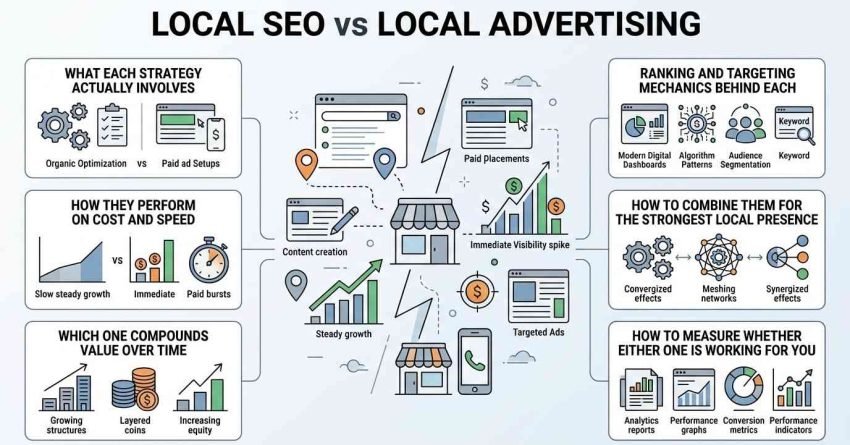
This guide covers what each strategy actually involves, how they perform on cost and speed, which one compounds value over time, and how to combine them for the strongest local presence. I’ll also cover the ranking and targeting mechanics behind each, plus how to measure whether either one is working for you.
What Local SEO and Local Advertising Actually Mean
Local SEO is the process of optimizing a business’s online presence so it appears in organic search results and map listings for geographically relevant searches. Local advertising is the practice of paying for placement in search results, social feeds, or display networks to reach nearby customers immediately.
I think of local SEO as earned visibility and local advertising as rented visibility. One builds equity over months; the other delivers exposure only while the budget keeps flowing.
Local search intent drives a huge share of consumer behavior. Google’s own data shows that “near me” searches have grown significantly over the past several years, and most of that volume touches both organic and paid results on the same search results page.
What Local SEO Includes
Local SEO includes Google Business Profile optimization, on-page content targeting local keywords, citation consistency across directories, and localized link building. Each element feeds into how search engines assess a business’s relevance to a specific geographic area.
I treat these as a stack rather than isolated tactics. Weak citations undercut a strong profile, and a strong profile without content backing it rarely holds a competitive map pack position.
What Local Advertising Includes
Local advertising includes paid search ads with location targeting, geo-fenced social ads, local service ads, and display or video campaigns aimed at a defined radius. Each format lets a business buy placement rather than earn it.
Platforms vary in how granular that targeting gets. Some let you target down to a zip code or a radius around a single storefront.
How Local SEO Works to Attract Nearby Customers
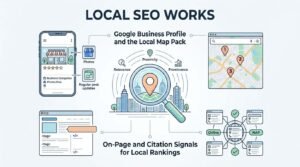
Local SEO works by signaling relevance, proximity, and prominence to search engines, which then determine map pack rankings and organic local results. Google evaluates dozens of factors before deciding which businesses deserve the top three map pack spots for any given search.
I’ve watched businesses jump into the map pack within weeks purely from fixing basic profile and citation issues. Other times, competitive markets require months of sustained content and link work before movement happens.
Google Business Profile and the Local Map Pack
A Google Business Profile is the free listing that controls how a business appears in Google Search and Maps, including its map pack placement. Complete profiles with accurate categories, photos, and regularly updated posts tend to outperform sparse or outdated ones.
Reviews play a heavy role here too. Businesses with more frequent, recent, and detailed reviews generally hold stronger map pack positions than competitors with stale review profiles.
On-Page and Citation Signals for Local Rankings
On-page signals include location-specific keywords, structured data, and locally relevant content, while citations are consistent mentions of a business’s name, address, and phone number across the web. Both signal types confirm to search engines that a business genuinely operates in the area it claims.
Inconsistent NAP (name, address, phone) data across directories confuses ranking algorithms and can suppress visibility. I run citation audits before touching any other part of a local SEO campaign for exactly this reason.
How Local Advertising Works to Attract Nearby Customers
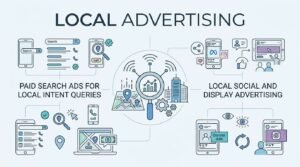
Local advertising works by using geographic targeting parameters within ad platforms to display paid placements only to users within a defined radius, city, or zip code. This lets a business control exactly who sees an ad based on location, device, and even time of day.
I like local ads for speed. A campaign can go live and start generating clicks within hours of launch, which is something local SEO simply cannot match.
Paid Search Ads for Local Intent Queries
Paid search ads for local intent queries are text-only or call-only ads that appear above organic results when someone searches a location-based term. These ads target commercial and transactional intent directly, often outperforming organic listings on click volume for high-competition terms.
Google’s Local Services Ads add another layer, showing verified badges and review scores directly in the ad unit. These tend to convert well because they front-load trust signals.
Local Social and Display Advertising
Local social and display advertising uses geo-fencing and audience targeting on platforms like Meta, Instagram, and programmatic display networks to reach nearby users based on behavior and demographics rather than search intent alone. This format works well for brand awareness and retargeting rather than immediate transactional capture.
I generally recommend social ads as a complement to search-based local ads, not a replacement, since the intent signal is weaker.
Cost Comparison: Local SEO vs Local Advertising
Local SEO typically requires a monthly investment ranging from $500 to $5,000 depending on market competitiveness and scope, while local advertising costs scale directly with click volume and impressions purchased. The fundamental cost structure differs: one is a service investment, the other is a media spend.
WordStream’s benchmark data shows average cost-per-click for local service categories can range from $2 to over $50 depending on industry, meaning ad costs can spike fast in competitive verticals like legal or home services.
Typical Local SEO Investment Ranges
Local SEO investment typically covers technical audits, content production, citation building, and ongoing optimization delivered as a recurring monthly retainer. Smaller markets with less competition often see meaningful movement at the lower end of that range.
Agencies price based on scope and competitiveness, not a flat industry rate. A single-location service business in a mid-sized city costs far less to rank than a multi-location retailer in a major metro.
Typical Local Ad Spend Ranges
Local ad spend ranges from a few hundred dollars monthly for a single small business to tens of thousands for multi-location brands running aggressive geo-targeted campaigns. Spend scales with the number of locations, competition level, and campaign objectives.
Unlike SEO, this cost never plateaus. Every additional click costs the same or more than the last one, regardless of how long the campaign has run.
Timeline to Results: How Fast Each Strategy Works
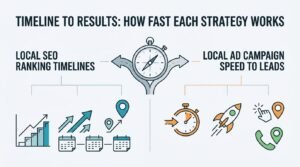
Local advertising can generate clicks and leads within hours of launch, while local SEO typically takes three to six months to show meaningful ranking movement and sustained traffic growth. This timeline gap is the single biggest factor in how businesses choose between the two.
I set expectations early with clients on this exact point because it prevents frustration when SEO doesn’t move as fast as a paid campaign.
Local SEO Ranking Timelines
Local SEO ranking timelines depend on competition, domain authority, and how much optimization work is needed before a business becomes competitive for its target terms. New businesses in low-competition markets sometimes see map pack movement within four to eight weeks.
Established competitors in dense urban markets can take six months or longer to unseat. Patience and consistency matter more than any single tactic here.
Local Ad Campaign Speed to Leads
Local ad campaign speed to leads is nearly immediate once a campaign is approved and live, often generating the first clicks and conversions within the first day. This speed comes at a cost of dependency; leads stop the moment spend stops.
I’ve seen campaigns generate qualified calls within the first 24 hours of launch, which is impossible to replicate with organic strategies.
Long-Term ROI: Which Strategy Compounds Over Time
Local SEO compounds in value over time because rankings, once earned, continue generating traffic without ongoing per-click costs, while local advertising ROI resets the moment the budget stops. This compounding effect is why most mature local businesses eventually shift more budget toward organic strategies.
A study cited by Search Engine Journal notes that organic search drives a significantly higher share of trackable website traffic than paid search across most industries over a 12-month period.
Why Local SEO Value Compounds
Local SEO value compounds because each piece of content, each earned link, and each strengthened citation continues contributing to rankings indefinitely, unlike a paid impression that disappears the second the auction ends. Businesses that invest consistently for 12 to 24 months often see traffic and lead volume that would cost far more to replicate through ads alone.
This is the core argument for treating local SEO as an asset rather than an expense.
Why Local Ad Value Resets
Local ad value resets because paid visibility exists only as long as the campaign is funded, meaning every month starts the ROI calculation from zero. There’s no residual traffic once a campaign pauses, no matter how successful it was the month before.
This makes local ads powerful for short bursts but fragile as a standalone long-term strategy.
Trust, Credibility, and Click Behavior in Local Search
Consumers click organic and map pack listings at different rates than paid ads, largely because organic placement is perceived as earned credibility rather than purchased visibility. This perception gap shapes conversion quality as much as raw click volume.
I’ve noticed local service businesses in particular benefit from this trust gap, since customers researching contractors or professionals tend to scrutinize paid ads more skeptically.
Consumer Trust in Organic vs Paid Local Listings
Consumer trust in organic listings tends to run higher than trust in paid ads because users associate top organic rankings with genuine relevance rather than budget size. Many users actively scroll past ads specifically to reach organic results they consider more trustworthy.
This bias varies by category. Urgent needs like emergency repairs often see users click ads without hesitation simply because speed matters more than source in that moment.
Click-Through Rate Differences
Click-through rate differences between organic map pack listings and paid ads vary by query type, with the map pack typically capturing a large share of clicks for “near me” searches. Paid ads often perform better for highly commercial, comparison-driven searches where users are further along the buying journey.
Testing both against the same keyword set is the only reliable way to know which performs better for a specific business.
Local SEO Ranking Factors That Influence Visibility
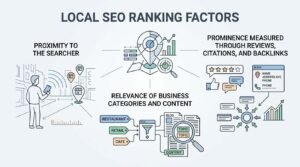
Local SEO ranking factors include proximity to the searcher, relevance of business categories and content, and prominence measured through reviews, citations, and backlinks. Google combines these three pillars to determine map pack and organic local rankings for every search.
Proximity is the one factor no amount of optimization can fully overcome, since it’s tied to the searcher’s physical location at the moment of the query. Relevance and prominence are where most competitive advantage gets built through content depth, review generation, and citation accuracy.
Local Advertising Targeting Options and Ad Formats
Local advertising targeting options include radius targeting, zip code targeting, demographic filters, and device-based targeting, while formats span search ads, display banners, social feeds, and video placements. Combining targeting layers lets advertisers narrow reach to exactly the customers most likely to convert.
Platforms differ significantly in targeting precision. Search ads rely heavily on keyword intent, while social platforms lean on behavioral and interest-based data to define local audiences.
When Local SEO Is the Better Strategy
Local SEO tends to be the better strategy for businesses with a realistic runway to invest months before expecting significant returns and a goal of building sustainable, low-marginal-cost traffic. Established businesses looking to reduce long-term customer acquisition costs typically benefit most from this approach.
Businesses in less competitive local markets also see local SEO pay off faster, since fewer competitors are actively optimizing for the same terms.
When Local Advertising Is the Better Strategy
Local advertising tends to be the better strategy for businesses needing immediate leads, launching a new location, or testing demand in a market before committing to long-term organic investment. Seasonal businesses also benefit from the ability to turn spend on and off around demand cycles.
New businesses with no existing online presence often need paid visibility just to generate initial reviews and traffic while local SEO foundations get built in parallel.
Combining Local SEO and Local Advertising for Maximum Reach
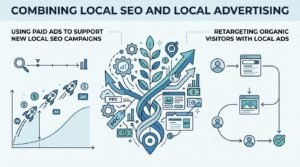
Combining local SEO and local advertising creates a layered strategy where paid ads generate immediate visibility while organic efforts build toward long-term, lower-cost traffic. Most mature local marketing strategies use both channels simultaneously rather than choosing one exclusively.
I recommend this hybrid approach to almost every client with adequate budget, because it hedges against the weaknesses of relying on a single channel.
Using Paid Ads to Support New Local SEO Campaigns
Using paid ads to support new local SEO campaigns fills the visibility gap during the months before organic rankings mature, keeping lead flow steady while long-term optimization work takes effect. This bridge strategy prevents revenue dips during the SEO ramp-up period.
Once organic rankings stabilize, ad spend can often be reduced without a corresponding drop in total lead volume.
Retargeting Organic Visitors with Local Ads
Retargeting organic visitors with local ads uses display or social campaigns to re-engage users who found a business through organic search but didn’t convert on their first visit. This keeps the business visible across multiple touchpoints without requiring a second organic search.
Retargeting tends to produce strong conversion rates because it targets users who’ve already shown intent once.
How to Measure Success in Local SEO vs Local Advertising
Measuring local SEO success involves tracking organic rankings, map pack visibility, and organic traffic through tools like Google Search Console and Google Analytics, while local advertising success is measured through cost-per-click, conversion rate, and return on ad spend. Both require distinct tracking setups since the underlying metrics don’t overlap cleanly.
I set up call tracking and conversion tracking separately for each channel specifically because blended attribution tends to overstate whichever channel gets measured last in the customer journey.
Common Mistakes Businesses Make Choosing Between the Two
Common mistakes include expecting local SEO to perform like ads within weeks, cutting ad spend the moment organic rankings improve slightly, and ignoring citation consistency while chasing more advanced tactics. These missteps usually come from treating the two strategies as interchangeable rather than complementary.
Another frequent mistake is measuring both channels with the same short-term ROI expectations, when their underlying timelines and value structures are fundamentally different.
Conclusion
Local SEO and local advertising both drive local customer acquisition, but through different mechanisms, timelines, and cost structures entirely. Understanding proximity, relevance, prominence, and paid targeting helps clarify which approach fits your situation.
Most sustainable local growth strategies eventually blend both channels rather than relying on either one exclusively long-term.
We help businesses build sustainable organic growth through strategic SEO. Contact White Label SEO Service to build your local visibility strategy today.
Frequently Asked Questions
Is local SEO better than local advertising for small businesses?
Local SEO is generally better for small businesses seeking long-term, cost-efficient growth. Local advertising works better when immediate leads are the priority and budget allows for ongoing spend.
How long does local SEO take to show results compared to ads?
Local SEO typically takes three to six months to show meaningful results, while local advertising can generate leads within hours of launch. The tradeoff is speed versus long-term cost efficiency.
How much should I budget for local SEO vs local ads?
Local SEO typically costs $500 to $5,000 monthly depending on market competition. Local ad spend varies widely based on click costs and campaign scale, often starting lower but scaling indefinitely with volume.
Can local advertising improve my local SEO rankings?
Local advertising does not directly improve organic rankings, since paid and organic algorithms operate independently. Increased brand visibility from ads can indirectly boost searches and engagement signals that support SEO.
Do I need both local SEO and local advertising?
Most established local businesses benefit from running both simultaneously to balance immediate lead flow with long-term organic growth. Budget and business stage determine the right mix between the two.
What happens to my visibility if I stop paying for local ads?
Visibility from local ads disappears almost immediately once spend stops, since paid placements only exist while campaigns are active. This is why local SEO remains valuable as a lasting foundation.
Which platforms matter most for local SEO vs local advertising?
Google Business Profile and Google Search matter most for local SEO, while Google Ads, Meta, and Local Services Ads dominate local advertising. Platform choice depends on where your target customers search and browse.