AI search engines are systems that retrieve relevant content from an index, rank it by relevance and trust signals, then generate a synthesized answer instead of a simple list of links. I’ve watched this shift reshape how visibility gets measured almost overnight. Google’s AI Overviews, ChatGPT Search, and Perplexity all run some version of this same pipeline.
Business owners can’t afford to guess anymore. Ranking rules have changed, and expectations need to catch up now.
This guide covers what AI search engines actually are and how they differ from traditional search, the three-stage retrieval-ranking-generation pipeline that powers them, what makes content extractable and citable in AI answers, and how to measure visibility and prepare your strategy for this new landscape.
What Is an AI Search Engine?
An AI search engine is a system that uses machine learning models to interpret a query, retrieve relevant information, and generate a direct answer rather than just a ranked list of pages. I think of it less like a librarian pointing to a shelf and more like a research assistant who reads the shelf for you.
Traditional search engines matched keywords and returned links for the user to click through. AI search adds a reasoning layer on top of retrieval, and that layer decides what to say, not just what to show.
Several systems now define this category: Google’s AI Overviews, OpenAI’s ChatGPT Search, Perplexity, and Microsoft Copilot all sit under this umbrella. Each pulls from a different mix of live web data and pre-trained knowledge, and each has its own quirks in how it selects sources.
The Three-Stage Process: Retrieval, Ranking & Generation Overview
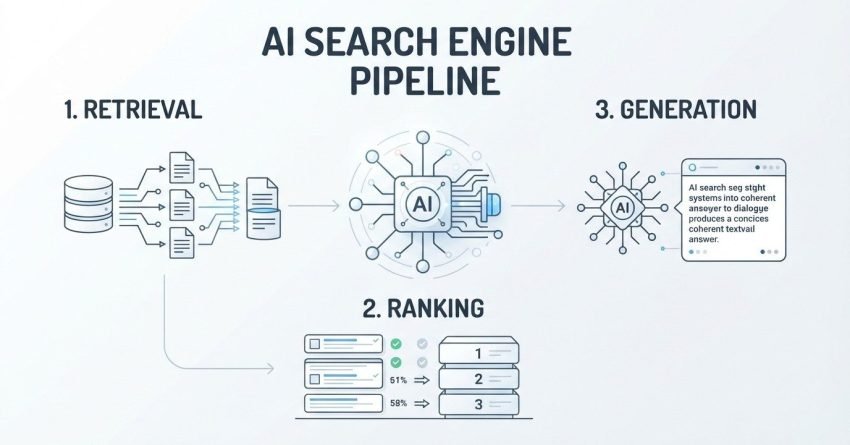
AI search engines work through three sequential stages: retrieval, where relevant documents are pulled from an index; ranking, where those documents are scored and ordered by relevance and trust; and generation, where a language model synthesizes an answer from the top-ranked content. I break this down constantly for clients who assume “ranking” still means one thing.
This pipeline replaces the old “ten blue links” model because the AI system does the reading for the user. A page no longer just needs to rank; it needs to survive being read, scored, and quoted by a model that decides what’s worth repeating.
The three stages don’t run in isolation. Retrieval quality limits what ranking can work with, and ranking quality limits what generation can accurately summarize. Weakness at any single stage weakens the final answer the user sees.
How Retrieval Works in AI Search
Retrieval is the process by which an AI search system pulls a shortlist of candidate documents from its index based on how closely they match the meaning of a query. This stage decides the raw material available to every step that follows.
Crawling and indexing still function as the foundation here. Search engines still crawl the web with bots, parse HTML, and build an index of pages, and AI systems draw on that same underlying infrastructure, just processed differently once inside the model.
Vector embeddings are the real technical shift. A vector embedding represents a chunk of text as a set of numbers that captures its meaning rather than its exact wording, which lets systems match a query to content that never shares an exact keyword. This is why a page can rank for a phrase it never literally used.
Retrieval-Augmented Generation, or RAG, is the architecture that ties this together. RAG is a method where a model retrieves relevant external documents at query time and feeds them into the generation step, rather than relying purely on what it memorized during training. Google’s own research on RAG-style architectures describes this as grounding generated answers in retrieved evidence to reduce factual errors.
How Ranking Works in AI Search
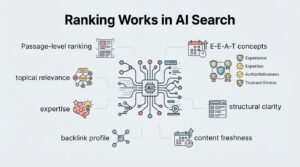
Ranking is the stage where retrieved documents get scored and ordered based on relevance, authority, and trustworthiness before any answer gets generated. This is the part most SEOs already understand, just applied to a new output format.
Passage-level ranking matters more here than page-level ranking ever did. Instead of scoring a whole page, many AI systems break content into smaller passages or chunks and rank each one independently, which means one strong paragraph can get cited even if the rest of the page is average.
Several signals drive this scoring: topical relevance to the query, the source’s demonstrated expertise, backlink profile, content freshness, and structural clarity all factor in. None of these signals are new individually, but the weighting shifts toward whichever passage most directly answers the question.
E-E-A-T concepts (experience, expertise, authoritativeness, trust) carry real weight in this scoring layer. A Princeton/Georgia Tech study on generative engine optimization found that adding citations and authoritative statistics to content improved visibility in AI-generated answers by as much as 40%.
How Generation Works: From Retrieved Content to AI Answers
Generation is the final stage, where a large language model synthesizes the top-ranked passages into a coherent, direct answer for the user. I think this is the stage people misunderstand most, assuming it’s pure invention rather than synthesis.
Large language models don’t just paraphrase one source. They blend information across several ranked passages, resolve contradictions where they can, and produce a single narrative that reads as one voice even though it draws from many.
Source citation and attribution logic vary a lot by platform. Perplexity and Google’s AI Overviews typically show inline citations linking back to source pages, while other assistants summarize without direct attribution, which makes the underlying ranking stage invisible to the reader.
AI Overviews vs. Traditional Google Search Results
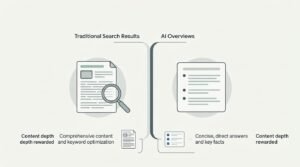
AI Overviews differ from traditional Google results because they generate a synthesized answer at the top of the page instead of relying solely on ranked links for the user to evaluate. The core index behind both is largely shared, but the output format changes everything about how visibility gets earned.
| Factor | Traditional Search Results | AI Overviews |
| Output format | Ranked list of links | Synthesized answer + citations |
| Click behavior | User clicks to read | User may not click at all |
| Ranking unit | Whole page | Passage or chunk |
| Visibility signal | Position 1–10 | Cited or not cited |
| Content depth rewarded | Comprehensive pages | Extractable, self-contained sentences |
This table shows why “ranking #1” and “being cited in the AI Overview” are now two different, sometimes unrelated, goals.
How ChatGPT Search, Perplexity & Other AI Engines Differ From Google
ChatGPT Search, Perplexity, and Google’s AI Overviews differ mainly in how much they rely on live web retrieval versus pre-trained knowledge, and how transparently they cite their sources. I test all three regularly, and their citation behavior alone tells a lot about their retrieval architecture.
Perplexity leans heavily on real-time retrieval and shows its sources prominently, almost like an annotated bibliography. ChatGPT Search blends retrieved web results with the model’s trained knowledge base, which sometimes produces answers that reference older information than what’s currently ranking on Google.
Google’s AI Overviews draw directly from its existing web index and ranking systems, which means classic SEO fundamentals still apply, just filtered through an extra synthesis layer before the reader ever sees a link.
What Makes Content Extractable by AI Search Engines
Extractable content is text written so that a single sentence or passage can be lifted out of a page and quoted accurately without needing the surrounding context. This is the writing skill that separates cited pages from ignored ones.
Answer-first structure drives most of this. Content that states the direct answer in the first sentence under a heading, before adding context or nuance, gives retrieval systems a clean, quotable unit to select.
Structured data plays a supporting role here too. Schema markup doesn’t guarantee citation, but it does help AI crawlers parse entities, relationships, and page structure faster, which Schema.org’s documentation confirms is designed specifically to make content machine-readable.
Key Ranking Factors for AI Search Visibility
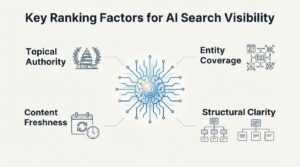
The key ranking factors for AI search visibility include topical authority, entity coverage, content freshness, and structural clarity, weighted through the same retrieval-and-ranking lens described earlier in this guide. These factors overlap heavily with traditional SEO but get applied at the passage level now.
Topical authority and entity coverage matter because AI systems cross-reference how many related concepts a page or domain covers, not just whether one keyword appears. A site that names related entities clearly gets treated as a more reliable source on the topic.
Freshness signals also carry more weight for time-sensitive queries. A BrightEdge study on AI search behavior found that pages updated within the last six months were cited noticeably more often in AI-generated answers for fast-moving topics like pricing and statistics.
How AI Search Engines Handle Trust and Misinformation
AI search engines handle trust primarily by weighting sources with established authority signals more heavily and by cross-referencing claims across multiple retrieved documents before generating an answer. No system does this perfectly, and errors still happen regularly.
Cross-referencing helps catch outright contradictions, but it doesn’t verify nuance well. A claim repeated across many low-quality sources can still get surfaced with confidence, which is why source diversity in an AI system’s index matters as much as source authority.
This is also why unattributed statistics or unverifiable claims tend to get filtered out during ranking. Systems trained to reduce hallucination lean toward sources that already cite their own data properly.
Measuring Visibility in AI Search (Metrics That Matter)
Measuring AI search visibility requires tracking citation frequency in AI-generated answers, not just traditional keyword rankings, since a page can be cited without ever appearing in a standard organic position. I’ve had to rebuild entire reporting frameworks around this shift.
A few metrics matter most in practice: how often a brand or domain gets cited across AI Overviews and assistant answers, share of voice against competitors within those citations, and referral traffic patterns from AI platforms inside Google Analytics.
Tools are catching up quickly. Several platforms now track AI Overview appearances the same way rank trackers monitor position one, giving marketers a comparable, if still evolving, visibility metric.
Common Misconceptions About AI Search Engines
A common misconception is that AI search engines replace traditional SEO entirely, when in practice most AI systems still rely on the same crawling, indexing, and ranking infrastructure underneath. The fundamentals didn’t disappear; the output layer changed.
Another misconception treats AI Overviews as random or unpredictable. Citation patterns actually follow identifiable ranking logic tied to relevance, authority, and extractability, even though the exact weighting isn’t published.
A third misconception assumes zero-click results mean zero value. Being cited by name in an AI answer still builds brand recognition and trust, even on the searches where the user never clicks through.
How Businesses Can Prepare for an AI-Driven Search Landscape
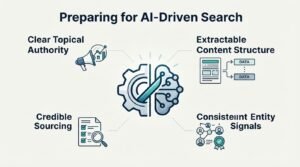
Businesses prepare for AI-driven search by strengthening the same fundamentals AI systems reward: clear topical authority, extractable content structure, credible sourcing, and consistent entity signals across the web. Nothing about this requires abandoning existing SEO investment.
We see the strongest results from clients who treat AI search visibility as an extension of their existing content strategy, not a separate discipline. Structuring answers clearly, citing real data, and covering topics comprehensively serves both traditional rankings and AI citations at once.
We help businesses build that foundation through structured, data-backed SEO built for how search actually works today. White Label SEO Service turns this shift into a measurable growth advantage for the brands we support.
Conclusion
AI search engines run on retrieval, ranking, and generation working together, not one isolated ranking factor anymore. Traditional SEO fundamentals still matter, layered beneath new extractability and citation demands.
This landscape keeps evolving as AI Overviews, ChatGPT Search, and Perplexity mature alongside deeper cluster resources worth exploring further. We build strategies around where search is actually heading.
We help businesses adapt their SEO strategy for this new reality. Partner with White Label SEO Service to build lasting AI search visibility.
Frequently Asked Questions
Do AI search engines still use traditional SEO ranking factors?
Yes, AI search engines still rely on crawling, indexing, and core ranking signals like relevance and authority. They add a generation layer on top rather than replacing the underlying system.
Can a page be cited in an AI Overview without ranking on page one?
Yes, this happens regularly since AI systems often rank at the passage level. A single well-structured paragraph can get cited even if the full page ranks lower organically.
How is AI search different from traditional keyword-based search?
AI search adds retrieval and generation layers that synthesize an answer instead of just listing matching pages. Traditional search matches keywords and ranks whole pages by relevance alone.
What is Retrieval-Augmented Generation in simple terms?
Retrieval-Augmented Generation, or RAG, is when a model pulls real documents at query time before writing its answer. This grounds the response in actual retrieved evidence instead of pure memorized training data.
Why do some AI search tools show citations and others don’t?
Citation behavior depends on each platform’s architecture and design choices. Perplexity and Google’s AI Overviews typically cite sources inline, while some assistants summarize without direct attribution.
How often should content be updated to stay visible in AI search?
Update frequency should match how time-sensitive the topic is, with fast-moving subjects like pricing needing refreshes every few months. Evergreen topics can go longer between updates without losing visibility.
What’s the biggest mistake businesses make with AI search optimization?
The biggest mistake is assuming AI search requires an entirely separate strategy from existing SEO. Most gains come from strengthening the same authority and structure fundamentals that already drive organic rankings.