Google AI Overviews are AI-generated summaries that appear above traditional organic results, pulling answers directly from indexed web content to answer a searcher’s query instantly. I’ve watched these overviews reshape how visibility works over the past two years, and they’re not going anywhere. For any business relying on organic search, understanding how they work is no longer optional.
Ignoring AI Overviews now means losing visibility at the exact moment buyers start researching. The gap between sites that adapt and sites that don’t is widening fast.
This guide covers what AI Overviews are and how Google builds them, the technical and on-page foundations that earn citations, how to measure performance in a zero-click environment, and what realistic timelines look like for results. We’ll connect each piece back to your broader SEO strategy.
What Are Google AI Overviews and How Do They Work?
Google AI Overviews are AI-generated summaries placed at the top of search results that synthesize information from multiple web sources into a direct answer. I think of them as Google’s attempt to answer the query before the user even scrolls to a single blue link.
These summaries pull from Google’s index in real time, selecting passages, not entire pages, that best match the semantic intent behind a query. A page doesn’t need to rank #1 to be cited; it needs a passage that answers the question cleanly.
How AI Overviews Differ From Traditional Snippets
A featured snippet pulls one passage from one source and displays it as-is. AI Overviews synthesize passages from several sources into a single generated response, often citing three to five pages at once.
This distinction matters because a page can support an AI Overview without being the single “best” answer. I’ve seen mid-ranking pages get cited simply because their content structure matched the extraction pattern Google needed.
How Google Generates AI Overview Content
Google’s generative system identifies the query’s core intent, retrieves relevant passages from indexed pages, and stitches them into a coherent answer. The system favors content that is already structured like an answer.
Content that buries its point under long introductions rarely gets pulled, no matter how authoritative the domain. Structure often outweighs raw domain authority for AI Overview inclusion.
Why AI Overviews Matter for Organic Search Visibility
AI Overviews matter because they now appear on a large share of informational queries, absorbing clicks that used to flow to organic listings below them. An Ahrefs study of AI Overview prevalence found AI Overviews appear on roughly 13% of all Google searches, concentrated heavily in informational queries.
I’ve watched click-through rates on page-one rankings drop for clients the moment an AI Overview appeared above them. The traffic doesn’t disappear entirely, but it shifts toward whichever sources get cited inside the overview itself.
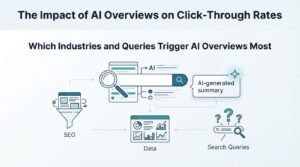
The Impact of AI Overviews on Click-Through Rates
Organic click-through rates drop significantly when an AI Overview occupies the top of the results page, even for a site ranking in position one below it. Being cited inside the overview itself has become the new top position worth competing for.
This shift changes what “ranking well” even means. A page can rank #1 organically and still lose most of its expected traffic if it’s absent from the overview above it.
Which Industries and Queries Trigger AI Overviews Most
Informational and how-to queries trigger AI Overviews far more often than transactional or highly localized searches. Health, finance, technology, and how-to content see the heaviest AI Overview presence right now.
Purely commercial queries with strong purchase intent trigger overviews less consistently. I tell clients to prioritize AI Overview optimization on their educational and top-of-funnel content first.
How Google Selects Sources for AI Overviews
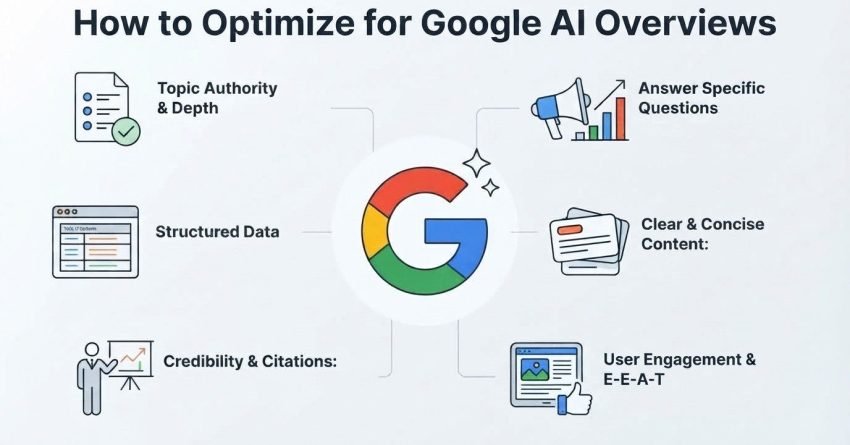
Google selects AI Overview sources based on passage-level relevance, page authority signals, and how cleanly the content answers the underlying query. The process isn’t a simple ranking pull; it’s a separate retrieval layer built on top of the existing index.
Four factors consistently show up across the pages that get cited:
- The page contains a passage that directly and completely answers the query
- The site demonstrates topical authority around the subject
- The content includes clear entity definitions and structured data
- The page loads cleanly and is fully crawlable and indexable
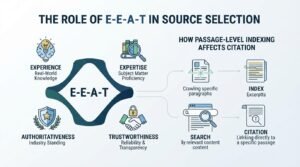
The Role of E-E-A-T in Source Selection
Experience, expertise, authoritativeness, and trustworthiness function as a filter before content ever reaches the extraction stage. Google is far less likely to surface a passage from a page with no clear authorship or credibility signals, regardless of how well-structured the sentence is.
I’ve seen well-written pages get skipped over in favor of less polished competitors simply because the competitor had stronger topical depth across their site. E-E-A-T operates at the site level as much as the page level.
How Passage-Level Indexing Affects Citation
Passage-level indexing lets Google evaluate individual sections of a page independently of the page’s overall ranking. A single paragraph buried deep in a long article can get cited even if the page itself doesn’t rank in the top 10 organically.
This is why answer-first writing at the section level matters more now than it did five years ago. Every section is competing for extraction on its own merit.
Content Structure Requirements for AI Overview Extraction
Content earns AI Overview extraction when each section opens with a direct, self-contained answer before adding supporting context. I structure every client page so the first sentence under a heading could be lifted out and still make complete sense on its own.
The requirements break down into a few concrete patterns:
- Answer the heading’s implied question in the first sentence
- Keep that sentence between 40 and 55 words for maximum extractability
- Name the subject explicitly rather than using “it” or “this”
- Follow with supporting detail, examples, or data
- Use tables for comparisons and numbered lists for processes
Answer-First Writing and Self-Contained Sentences
An answer-first sentence directly resolves the reader’s question without requiring any prior sentence for context. I train writers to imagine the sentence being lifted out of the page entirely and dropped into a search result if it still reads clearly, it passes.
Vague pronoun references kill extractability fast. Every claim meant for citation needs to name its own subject plainly.
Using Definitions, Lists, and Tables for Extractability
Definitions in the format “[Entity] is a [type] that [attribute]” give Google a clean, quotable unit it can lift with confidence. Tables and numbered lists work the same way for comparison and process queries.
I default to a table any time a section compares two or more options side by side. It’s the single easiest format for Google to extract and represent accurately.
Technical SEO Foundations That Support AI Overview Visibility
Technical SEO foundations determine whether Google can even access and understand your content before extraction becomes possible. A page can be perfectly written and still miss out on AI Overview citation if it’s slow, blocked, or poorly structured for crawlers.
The core technical requirements include:
- Clean crawlability with no accidental blocks in robots.txt
- Fast page load speed, particularly Largest Contentful Paint
- Mobile-friendly rendering across all major device types
- Valid, error-free structured data implementation
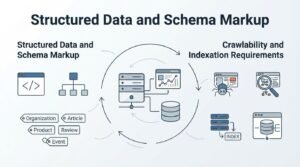
Structured Data and Schema Markup
Schema markup gives Google explicit, machine-readable context about entities, definitions, and relationships on a page. FAQ schema, Article schema, and HowTo schema all increase the odds that structured content gets parsed correctly for extraction.
I don’t treat schema as optional anymore. It’s a direct signal layer that reduces ambiguity for the systems doing the extraction.
Crawlability and Indexation Requirements
A page must be fully crawlable and indexed before it can appear in any AI Overview, regardless of content quality. Checking Google Search Console for crawl errors and index coverage issues should be a baseline step before any content optimization begins.
Orphaned pages with no internal links pointing to them often get crawled infrequently. Fixing that internal link structure tends to be a quick, high-leverage win.
Keyword and Query Research for AI Overview Targeting
Keyword research for AI Overviews shifts the focus from single keywords to full question patterns and query clusters. I look for queries phrased as questions, comparisons, or “how to” requests, since these trigger AI Overviews at a much higher rate than short transactional terms.
Practical research steps include:
- Mining “People Also Ask” boxes for question phrasing patterns
- Reviewing autocomplete suggestions for natural query variations
- Checking whether an AI Overview currently appears for target queries
- Noting which sources are already being cited for those queries
Identifying AI Overview-Triggering Query Patterns
Query patterns most likely to trigger an AI Overview include “what is,” “how does,” “why does,” and comparison phrasing like “X vs Y.” I run a manual SERP check on priority keywords before committing content resources, since overview presence changes month to month.
Not every query justifies AI Overview optimization. Highly transactional, brand-specific searches rarely show an overview at all.
Mapping Questions to Content Sections
Each identified question should map to a specific heading within your content, not get buried inside a general paragraph. I build a simple spreadsheet mapping each target question to its intended H2 or H3 before writing even starts.
This mapping keeps the content organized around genuine search demand rather than guesswork. It also makes gaps in coverage obvious before publication.
On-Page Optimization Techniques for AI Overviews
On-page optimization for AI Overviews centers on semantic heading structure, entity clarity, and topical completeness within a single page. I treat every H2 and H3 as its own mini-answer unit rather than a stepping stone to the next paragraph.
Key on-page elements to prioritize:
- Question-formatted headings where a PAA-style query applies
- Explicit entity definitions at first mention
- Consistent terminology throughout, avoiding unnecessary synonyms for core entities
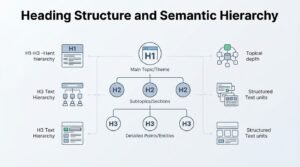
Heading Structure and Semantic Hierarchy
A clear H1 through H3 hierarchy signals topical organization to both readers and Google’s parsing systems. I never skip heading levels, since a broken hierarchy makes it harder for extraction systems to understand which content belongs to which subtopic.
Logical heading structure also improves how Google’s Search Central documentation recommends organizing content for crawlability and comprehension.
Entity Optimization and Topical Depth
Entity optimization means naming and defining the people, tools, concepts, and processes relevant to a topic clearly and consistently throughout the page. Topical depth measures how completely a page covers the surrounding concepts a reader would expect.
A page that mentions an entity once in passing rarely earns citation for that entity’s related queries. Depth beats mere mention every time.
Earning E-E-A-T Signals to Become a Cited Source
Earning E-E-A-T signals requires demonstrating real expertise, authorship transparency, and third-party validation across a site, not just on a single page. I push every client toward visible author bios, credentials, and original data as baseline requirements now.
The signals that carry the most weight include:
- Named authors with demonstrated subject-matter credentials
- Original research, data, or case studies not found elsewhere
- External citations from reputable, independent sources
- Consistent publishing history on the core topic
Building Author Expertise and Credentials
Author credentials on a page tell Google and readers who is responsible for the claims being made. A bio linking to a LinkedIn profile, published work, or professional credentials adds a trust layer that anonymous content simply can’t match.
I’ve seen thin author pages hurt otherwise strong content. It’s a small fix with outsized impact on trust signals.
Third-Party Trust Signals and Citations
Third-party citations, backlinks from reputable sites, and mentions in industry publications all reinforce that a source is trustworthy beyond its own claims. Google’s own guidance on E-E-A-T emphasizes that trust signals extend well beyond on-page content alone.
Building this kind of authority takes sustained effort across content, PR, and outreach. There’s no single technical fix that replaces genuine external validation.
Measuring and Tracking AI Overview Performance
Measuring AI Overview performance requires tracking citation presence directly, since traditional rank tracking tools don’t capture it by default. I use a combination of manual SERP checks and specialized tools that flag AI Overview appearances for tracked keywords.
| Tool | What It Tracks | Best For |
| Google Search Console | Impressions, clicks, query data | Baseline traffic shifts |
| Semrush AI Overview tracking | Citation presence by keyword | Competitive monitoring |
| Ahrefs | SERP feature tracking | Historical trend analysis |
| Manual SERP audits | Exact citation wording | Content gap analysis |
Tools for Monitoring AI Overview Appearances
Dedicated SERP tracking tools now flag when a tracked keyword shows an AI Overview and whether your domain appears among the cited sources. I check this weekly for priority keywords rather than relying on monthly reporting cycles.
Manual spot-checks still matter. Automated tools sometimes miss overview variations that render differently by location or device.
Key Metrics Beyond Traditional Rankings
Impressions and click-through rate become more important than raw ranking position in a world where AI Overviews absorb top-of-page real estate. I watch for impression growth paired with declining clicks, which usually signals overview cannibalization rather than a ranking drop.
Brand search volume also matters more now. Being cited in an overview without a click still builds awareness that shows up later as direct or branded search.
Common Mistakes That Prevent AI Overview Inclusion
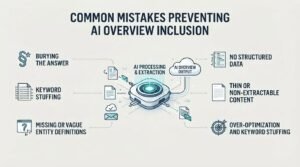
Common mistakes preventing AI Overview inclusion include vague introductions, keyword stuffing, and content that never directly answers its own heading. I see the same handful of errors repeatedly across audits, and they’re almost all fixable without a full rewrite.
The most frequent issues are:
- Burying the answer three paragraphs after the heading
- Keyword stuffing that reads unnaturally to both users and extraction systems
- Missing or vague entity definitions
- No structured data supporting the content
- Thin sections that never fully resolve the implied question
Over-Optimization and Keyword Stuffing
Keyword stuffing disrupts the natural sentence structure that extraction systems rely on to identify clean, quotable passages. I’ve reversed AI Overview losses simply by rewriting stuffed paragraphs into natural, direct language.
Google’s systems increasingly favor clarity over keyword density. Writing for the reader first tends to serve extraction goals automatically.
Thin or Non-Extractable Content
Thin content that skims a topic without fully answering the implied question rarely gets selected for citation, no matter how well it’s formatted. A single well-developed paragraph outperforms three shallow ones every time.
I audit for this by asking whether each section could stand alone as a complete answer. If it can’t, it gets expanded or rewritten.
How AI Overviews Affect Traffic, Leads, and SEO Strategy
AI Overviews affect traffic by reducing click-through rates on ranked pages while creating a new visibility channel through citation itself. Businesses need to treat overview citation as a KPI alongside traditional rankings, not a replacement metric to ignore.
This shift forces a broader rethink of what success looks like in organic search. Clicks alone no longer tell the full visibility story.
Adjusting KPIs for a Zero-Click Search Environment
A zero-click search environment requires tracking brand awareness, impression share, and citation frequency alongside conventional traffic metrics. I now build client reporting dashboards that separate “visibility” from “clicks” as two distinct success measures.
This adjustment prevents teams from panicking over traffic dips that are actually visibility gains in disguise. Context matters more than a single metric ever will.
Balancing AI Overview Optimization With Traditional Rankings
Balancing both priorities means content still needs to rank well organically while also being structured for extraction. I’ve never seen a case where optimizing for AI Overviews hurt traditional rankings when done correctly the two goals reinforce each other.
Structured, answer-first content tends to perform better across both surfaces simultaneously. There’s no meaningful tradeoff once the fundamentals are solid.
Realistic Timelines for AI Overview Optimization Results
Realistic timelines for AI Overview optimization typically run three to six months for initial citation gains, with sustained authority-building extending well beyond a year. I set this expectation upfront with every client, since overnight results simply aren’t how this works.
Google needs time to re-crawl, re-index, and re-evaluate restructured content before extraction patterns shift. Patience paired with consistent execution beats any shortcut I’ve tested.
What to Expect in the First 90 Days
The first 90 days typically involve technical fixes, content restructuring, and initial re-indexing, with early citation signals sometimes appearing by month two or three. I tell clients not to expect dramatic shifts before this window closes.
Early wins usually show up as impression increases in Search Console before any citation confirmation. That’s a legitimate leading indicator worth tracking.
Long-Term Authority Building Timelines
Long-term authority building, including E-E-A-T signal accumulation and backlink growth, typically takes six to eighteen months to fully mature. This mirrors broader SEO timeline research showing most competitive keywords need sustained months of consistent effort before stabilizing in top positions.
I treat AI Overview optimization as an extension of core SEO strategy, not a separate sprint. The timelines run in parallel, not in sequence.
Building a Long-Term AI Search Optimization Strategy
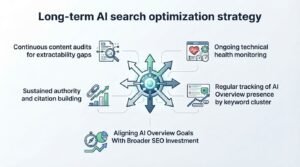
A long-term AI search optimization strategy integrates technical SEO, content structure, and authority building into one continuous program rather than a one-time project. I build this around quarterly content audits, ongoing schema updates, and ongoing E-E-A-T investment.
The core components of a sustainable approach include:
- Continuous content audits for extractability gaps
- Ongoing technical health monitoring
- Sustained authority and citation building
- Regular tracking of AI Overview presence by keyword cluster
Aligning AI Overview Goals With Broader SEO Investment
Aligning these goals means AI Overview optimization shouldn’t compete with your broader SEO budget; it should be built into it from the start. I’ve found the businesses that succeed here are the ones treating this as one unified strategy rather than a separate line item.
Conclusion
AI Overviews now shape how search visibility, authority, and clicks connect across the entire organic ecosystem. Understanding source selection, extraction, and E-E-A-T changes how you plan content.
Mastering this connects directly to your broader SEO strategy, technical health, and long-term authority building across your site. The landscape keeps shifting with each algorithm update.
We help businesses build the technical foundation and content strategy needed to earn AI Overview citations. Talk to White Label SEO Service about a sustainable growth plan today.
Frequently Asked Questions
What are Google AI Overviews?
Google AI Overviews are AI-generated summaries appearing above organic search results that synthesize answers from multiple indexed sources. They aim to answer a searcher’s query directly without requiring a click.
How do I optimize content for AI Overviews?
Optimizing for AI Overviews requires answer-first writing, clear entity definitions, and clean technical SEO foundations. Structure each section to answer its heading directly within the first sentence.
Do AI Overviews reduce website traffic?
AI Overviews can reduce click-through rates on traditionally ranked pages by answering queries directly on the results page. Traffic often shifts toward cited sources instead of disappearing entirely.
How long does it take to appear in an AI Overview?
Initial citation gains typically take three to six months after implementing technical and content changes. Full authority-building results often take six to eighteen months to mature.
Does schema markup help with AI Overviews?
Schema markup helps by giving Google explicit, machine-readable context about entities and content structure. It increases the likelihood that structured content gets parsed and extracted accurately.
Can small businesses compete for AI Overview visibility?
Small businesses can compete for AI Overview visibility since citation depends on content structure and relevance, not domain size alone. Well-structured, authoritative content from smaller sites gets cited regularly.
How do I track AI Overview performance?
Tracking AI Overview performance requires monitoring impressions and citation presence through tools like Google Search Console alongside specialized SERP tracking software. Manual spot-checks help confirm exact citation wording.