Link building pricing refers to what agencies and freelancers charge to acquire backlinks for a website, and rates typically range from $150 to over $2,000 per link depending on domain authority, niche, and placement type. SMEs and startups often overpay for weak links or underpay for links that carry penalty risk. This guide covers how pricing models work, what drives cost up or down, average rates by link quality, agency-type comparisons, red flags to avoid, and how to budget link building against your actual growth goals.
How Much Does Link Building Cost in 2025?
Most businesses pay between $200 and $800 per high-quality backlink in 2025, with enterprise campaigns often exceeding $1,500 per link for premium editorial placements. According to Ahrefs’ 2024 link building survey, the median price for a single backlink from a site with real traffic sits close to $361. Budget links under $100 usually come from low-authority or automated placements that carry little ranking value.
Monthly retainers for ongoing link building campaigns generally run $1,500 to $10,000+, scaled to the number of links, content requirements, and outreach volume involved. Freelancers price lower than agencies, but agencies bring outreach infrastructure and vetted publisher relationships that individual freelancers rarely match at scale.
The Main Link Building Pricing Models Agencies Use
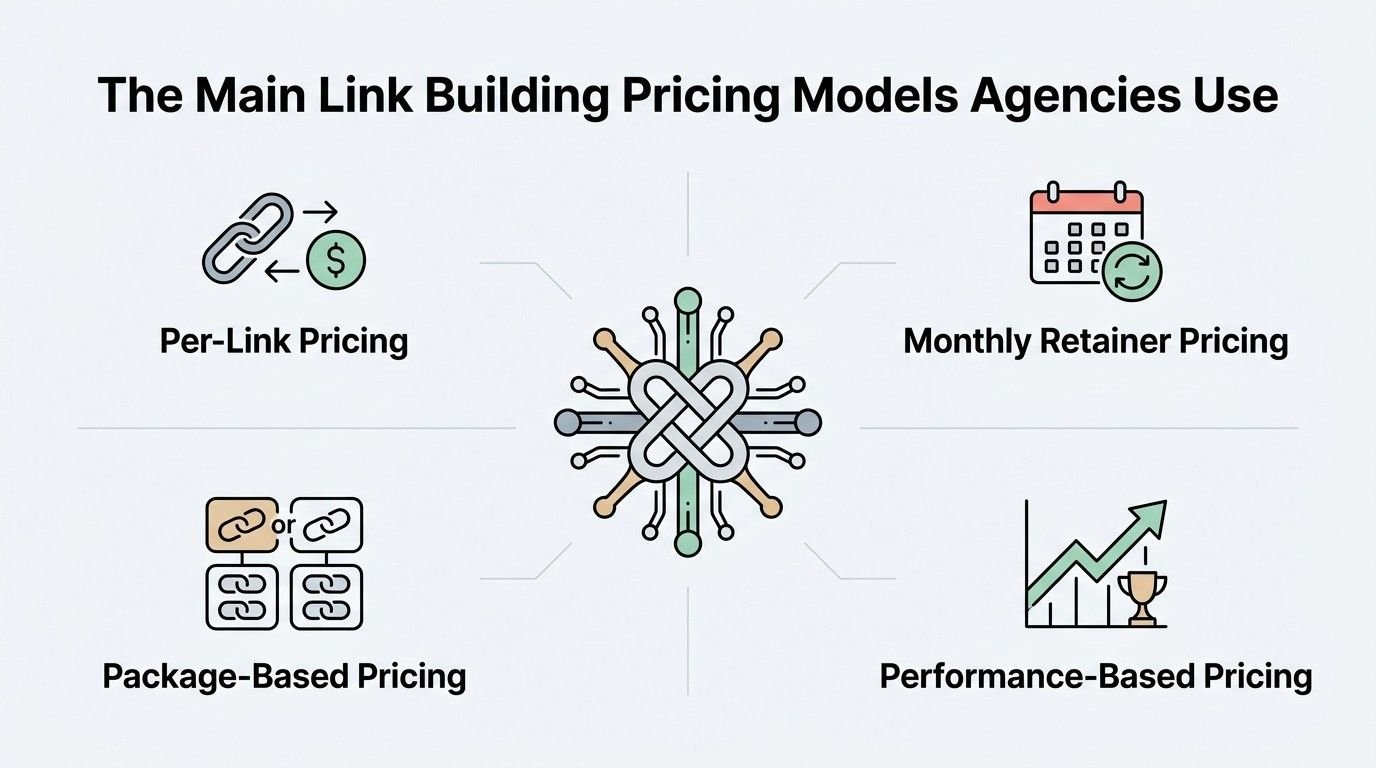
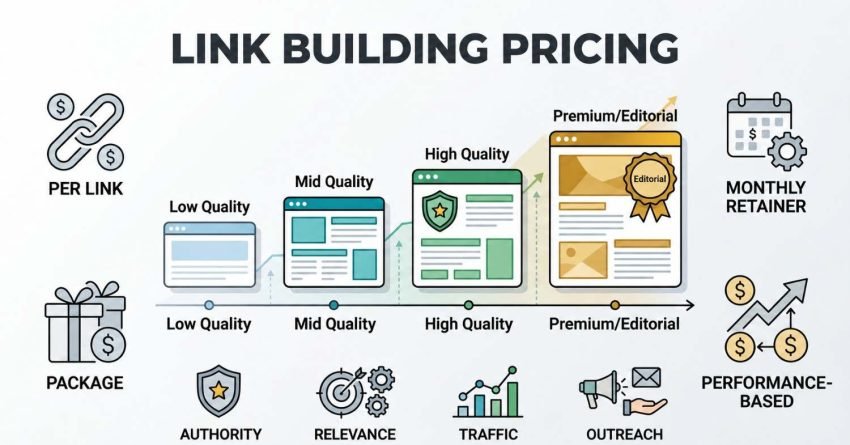
Agencies price link building using one of four dominant models, and each one shifts risk between the client and the provider differently. Per-link pricing is the most transparent model since you know the exact cost before a single placement happens.
Per-Link Pricing
Per-link pricing charges a flat fee for each individual backlink delivered, typically ranging from $100 to $1,000+ depending on the target site’s authority. This model works well for businesses that want predictable, itemized costs tied directly to deliverables.
Monthly Retainer Pricing
Monthly retainer pricing bundles a set volume of links, outreach, and reporting into a recurring fee, usually $2,000 to $8,000 per month for mid-sized campaigns. Retainers suit businesses running continuous link acquisition rather than one-off campaigns.
Package-Based Pricing
Package-based pricing groups a fixed number of links, often tiered by domain authority, into pre-built bundles sold at a set price point. These packages simplify decision-making but can obscure the actual per-link cost if the mix of link quality isn’t disclosed upfront.
Performance-Based Pricing
Performance-based pricing ties payment to ranking improvements or traffic gains rather than link volume delivered. This model shifts risk toward the agency, but it’s rare in link building specifically because rankings depend on many factors beyond backlinks alone.
What Factors Influence Link Building Costs?
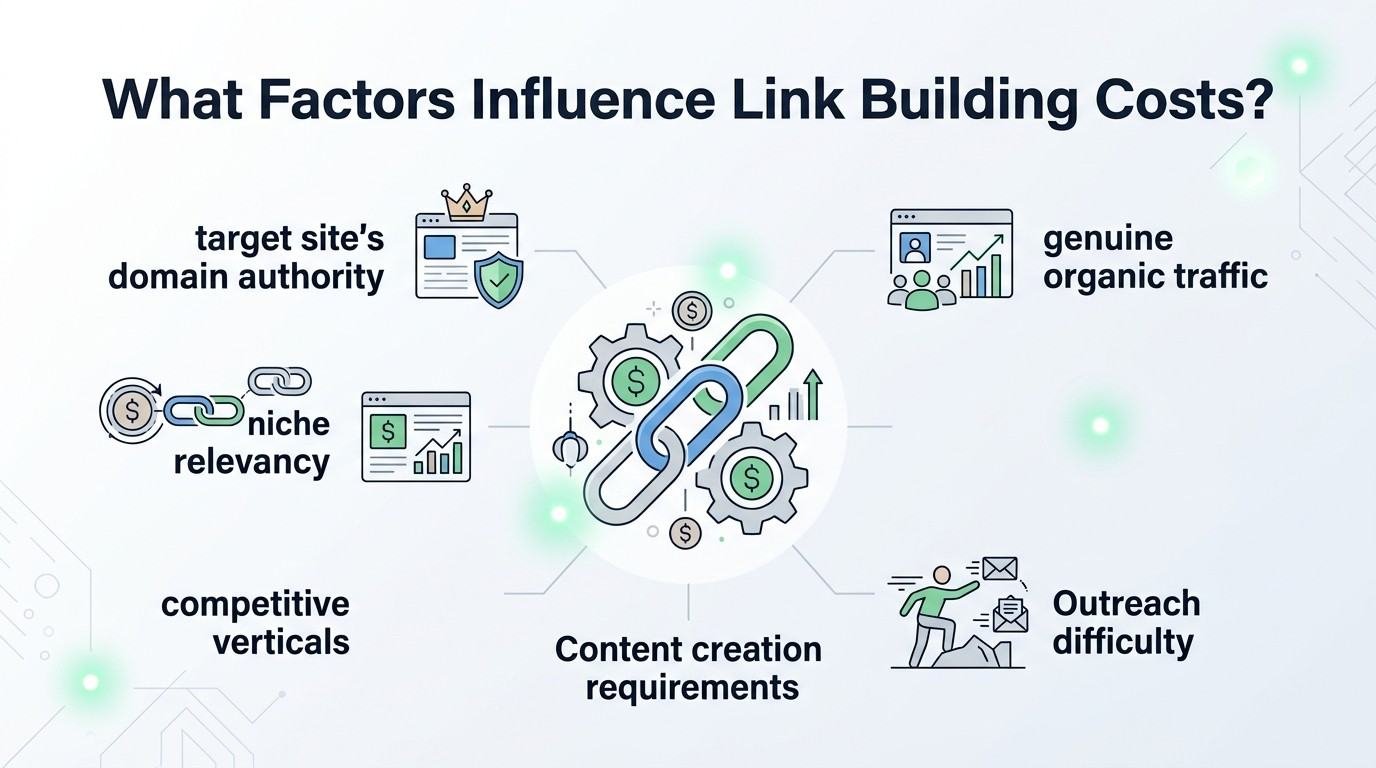
Link building costs are driven primarily by the target site’s domain authority, niche relevancy, and the outreach effort required to secure a placement. A backlink from a site with genuine organic traffic and topical relevance to your industry costs significantly more than one from an unrelated, low-traffic domain.
Niche relevancy compounds cost fastest in competitive verticals like finance, legal, and health, where publishers know their backlink value and price accordingly. Content creation requirements also add cost when a guest post or sponsored article must be written specifically to earn the placement, since that adds a writer’s fee on top of the placement fee itself.
Outreach difficulty matters just as much as the link itself. A publisher who rarely accepts external contributors takes far more relationship-building and follow-up than one running an open guest-posting program, and agencies price that time into the quote.
Average Cost Per Link by Quality Tier
The table below shows how link building costs scale directly with the target site’s domain rating and traffic profile.
| Quality Tier | Domain Rating (DR) | Typical Cost Per Link |
| Low Quality | DR 0–20 | $50–$150 |
| Mid Quality | DR 20–50 | $150–$400 |
| High Quality | DR 50–70 | $400–$800 |
| Premium/Editorial | DR 70+ | $800–$2,000+ |
Editorial links from DR 70+ publishers command the highest prices because they combine strong authority signals with genuine referral traffic, making them the hardest tier to acquire through outreach alone.
Link Building Pricing by Agency Type
Pricing varies substantially depending on whether you’re hiring a freelancer, a boutique link building agency, or a full-service SEO firm. Freelancers typically charge the least per link since they carry lower overhead, but they often have narrower publisher networks than agencies with dedicated outreach teams.
Boutique link building agencies specialize exclusively in acquisition and typically price mid-range, trading some flexibility for deeper publisher relationships built over years of consistent outreach. Full-service SEO firms fold link building into a broader retainer alongside technical SEO and content, which can offer better strategic alignment but sometimes at a premium price point.
Enterprise SEO firms serving large brands command the highest rates industry-wide, often justified by dedicated account teams, custom reporting, and access to top-tier publications that smaller providers simply can’t reach.
What’s Included in a Link Building Package?
A typical link building package includes prospecting, outreach, content creation, placement, and monthly reporting rolled into one price. Prospecting identifies relevant target sites, while outreach covers the actual pitching and relationship management needed to secure the placement.
Reporting closes the loop by documenting which links went live, their authority metrics, and anchor text used, giving you a paper trail for auditing campaign quality over time. Some packages exclude content creation and charge separately for guest post writing, which is worth clarifying before comparing quotes across providers.
Guest Posting Costs Explained
Guest posting costs cover both the content creation fee and the placement fee charged by the hosting site, and together these commonly range from $150 to $500 per published post on a mid-authority blog. The placement fee alone can vary widely since some publishers charge a flat rate regardless of the article’s length or complexity.
Higher-authority guest post opportunities on niche-relevant publications with genuine editorial standards can cost several times more than a generic mid-tier blog, since fewer publishers in that tier accept paid or contributed content at all.
Niche Edits and Link Insertions Pricing
Niche edits, also called link insertions, involve adding a link into an already-published article rather than creating new content, and this typically costs $100 to $400 per insertion. This model is cheaper than guest posting because it skips the content creation step entirely, relying instead on the existing article’s authority.
Pricing for niche edits climbs quickly on aged, high-authority articles that already rank well, since the link inherits both the page’s existing link equity and its topical context.
HARO and Digital PR Link Building Costs
Digital PR and HARO-style link building, where journalists source expert quotes for articles, typically costs $1,000 to $5,000+ per month as a retainer rather than a per-link fee. This pricing reflects the unpredictable nature of the tactic, since coverage depends on journalist demand and story timing rather than a guaranteed placement.
Digital PR campaigns often generate a smaller number of links than traditional outreach, but the links tend to come from major news and media domains that carry substantial authority and referral value.
Cheap Link Building vs Premium Link Building: What’s the Difference?
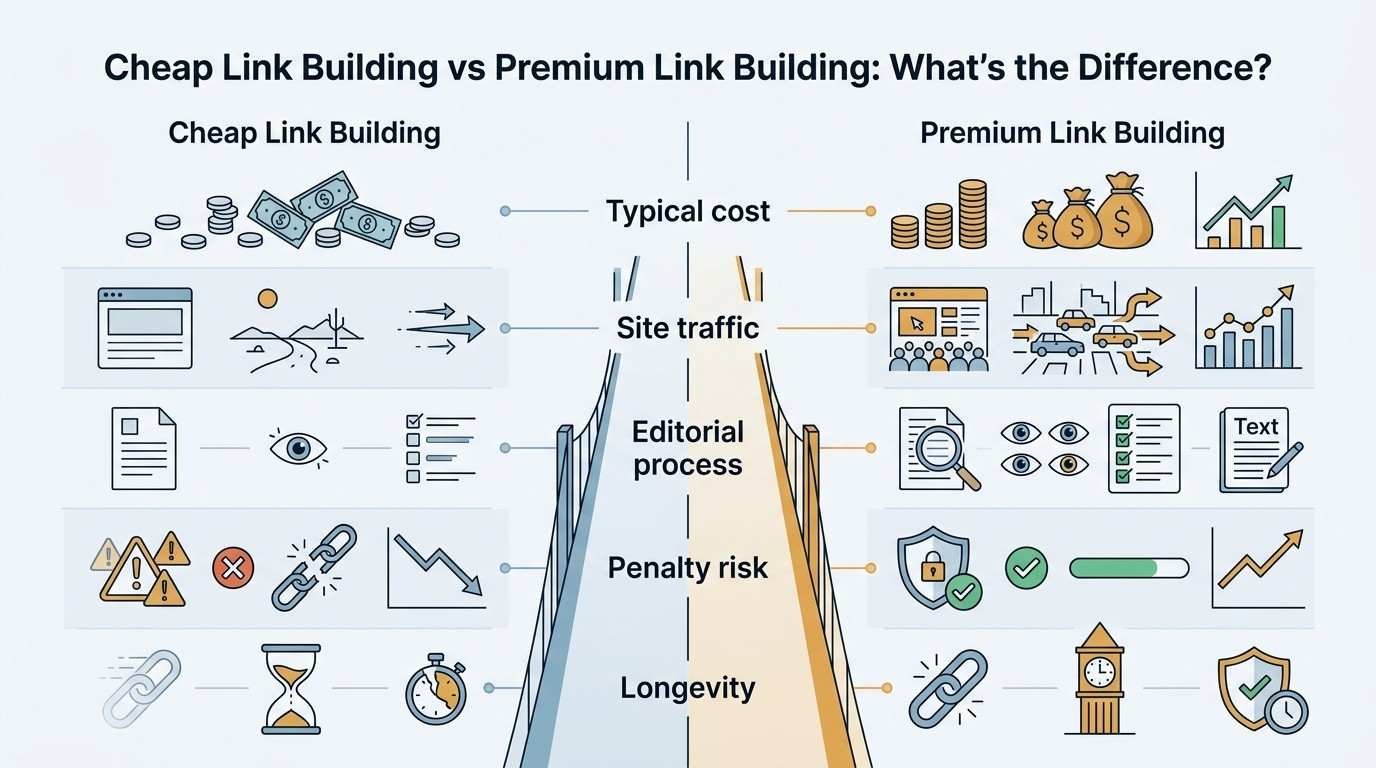
Cheap link building and premium link building differ mainly in the traffic quality, editorial standards, and risk profile of the sites involved. The comparison below breaks down what separates the two approaches in practice.
| Factor | Cheap Link Building | Premium Link Building |
| Typical cost | $20–$100/link | $400–$2,000+/link |
| Site traffic | Little to none | Genuine organic traffic |
| Editorial process | Minimal or none | Real editorial review |
| Penalty risk | Higher | Low |
| Longevity | Often removed quickly | Stays live long-term |
Cheap links often come from sites built primarily to sell links rather than serve real readers, which is exactly the pattern search engines have gotten better at detecting over time.
Red Flags: Link Building Pricing That Signals Risk
Certain pricing patterns signal that a link building offer carries real penalty risk rather than genuine value. Prices far below the market average, such as bulk packages offering 50 links for under $200, almost always indicate PBN networks or automated placements rather than editorial links.
An unnatural ratio of exact-match anchor text across a cheap package is another warning sign, since natural link profiles rarely contain that much keyword-matched anchor text. Guaranteed rankings tied to a specific link package is a similar red flag, since no reputable provider can guarantee where content ranks.
How to Budget for Link Building Based on Your Goals
Link building budgets should scale with your competitive landscape rather than following a flat industry rule. A local service business competing in a low-competition market can often see results from $500 to $1,500 per month, while a SaaS company in a crowded vertical may need $3,000 to $10,000 per month to compete for the same keyword difficulty.
Enterprise brands operating across multiple markets typically budget $10,000 to $50,000+ per month once link building runs alongside content and digital PR at scale. Matching budget to competition level prevents both overspending in easy niches and underspending in difficult ones.
DIY Link Building vs Hiring an Agency: Cost Comparison
DIY link building trades cash cost for time cost, since outreach, prospecting, and relationship management take substantial hours to do well. A business owner doing outreach personally might spend 10–20 hours per month securing just a handful of links, time that carries its own opportunity cost against running the business.
Hiring an agency converts that time cost into a direct dollar cost, typically $1,500 to $8,000 per month, but adds established publisher relationships and outreach infrastructure that take years to build independently. The comparison ultimately depends on whether your time or your budget is the scarcer resource.
How to Evaluate a Link Building Quote
Evaluating a link building quote means checking the specific metrics behind each promised link rather than trusting a headline price alone. A quote listing “50 DR40+ links for $1,000” sounds reasonable until you check whether those DR40 sites carry real organic traffic or exist purely to sell links.
Ask for sample placements, average traffic figures for target sites, and a clear anchor text policy before signing any contract. A provider unwilling to share past placement examples is generally a sign to keep looking.
What Kind of ROI Should You Expect from Link Building Spend?
Link building ROI shows up as improved rankings, increased organic traffic, and eventually leads or revenue, though the timeline varies by competition level and starting authority. Most businesses see measurable ranking movement within 3 to 6 months of consistent link acquisition, with compounding traffic gains building over 12 months or more.
ROI tracking should tie link acquisition directly to ranking position changes and organic traffic growth in tools like Google Search Console, rather than judging success by link count alone.
Conclusion
Link building pricing spans per-link fees, retainers, and packages, each shaped by domain authority, niche, and outreach difficulty. Understanding these models helps you budget realistically and spot red flags before they cost you rankings. We build transparent, ROI-tracked link campaigns at White Label SEO Service. Let’s map out a budget that fits your growth goals.
Frequently Asked Questions
How much should I pay for a single backlink?
Most businesses should expect to pay $150 to $800 per backlink depending on domain authority and niche relevancy. Prices below $50 usually signal low-quality or automated placements that carry penalty risk.
Is cheap link building worth the risk?
Cheap link building generally isn’t worth the risk since low-cost links often come from low-traffic sites with penalty exposure. The short-term savings rarely offset the long-term cost of disavowing or losing rankings later.
Why do link building agencies charge so differently?
Agencies charge differently based on their publisher network quality, outreach effort required, and whether content creation is included in the price. A boutique agency with strong relationships in your niche can charge more while delivering better placements than a lower-cost generalist.
How many backlinks do I need per month?
Most small to mid-sized businesses see solid progress with 4 to 10 quality backlinks per month, though competitive niches often require more. Volume matters less than consistency and relevance to your target audience.
Does more expensive always mean better link quality?
Higher price generally correlates with better link quality, but it isn’t guaranteed since some providers overcharge for mediocre placements. Checking actual site traffic and editorial standards matters more than price alone.
Can I negotiate link building pricing with an agency?
Yes, many agencies adjust pricing for longer-term contracts or higher monthly link volume commitments. Asking for a trial month before committing to a long retainer is a reasonable way to test quality first.
What’s a realistic monthly link building budget for a small business?
A realistic starting budget for a small business is $1,000 to $2,500 per month, scaled up as competition or growth goals increase. This typically covers 4–8 quality links depending on the pricing model used.