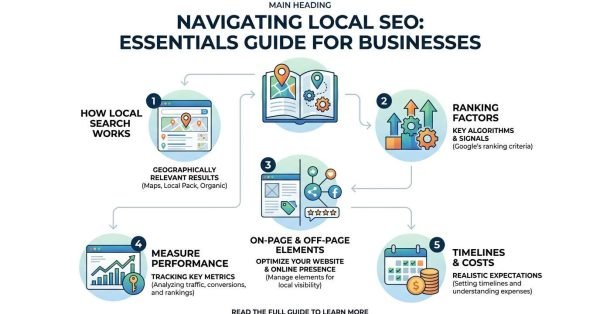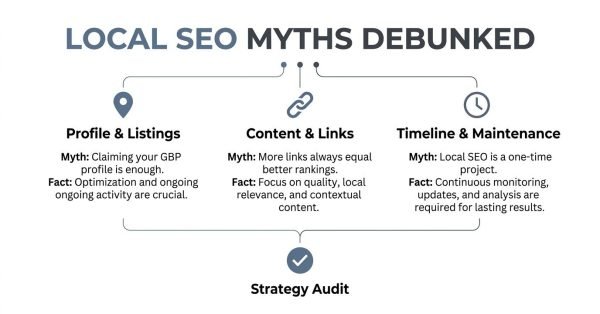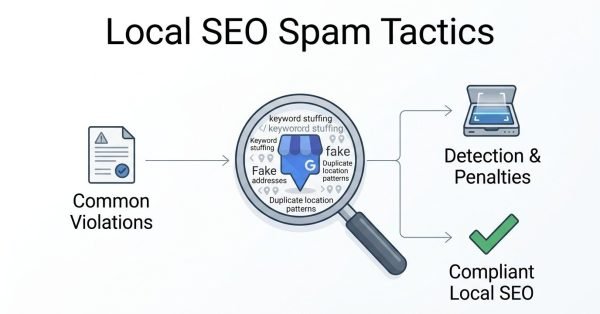
Local SEO is the process of optimizing a business’s online presence to rank higher in geographically relevant search results, including Google’s map pack and local organic listings. I’ve watched business owners expect overnight rankings, and it never works that way. Real local SEO results build in layers, starting with technical fixes and ending in compounding organic visibility that keeps paying off long after the work is done.
Most businesses see initial movement within three months, but meaningful revenue impact takes six to twelve months to fully compound.
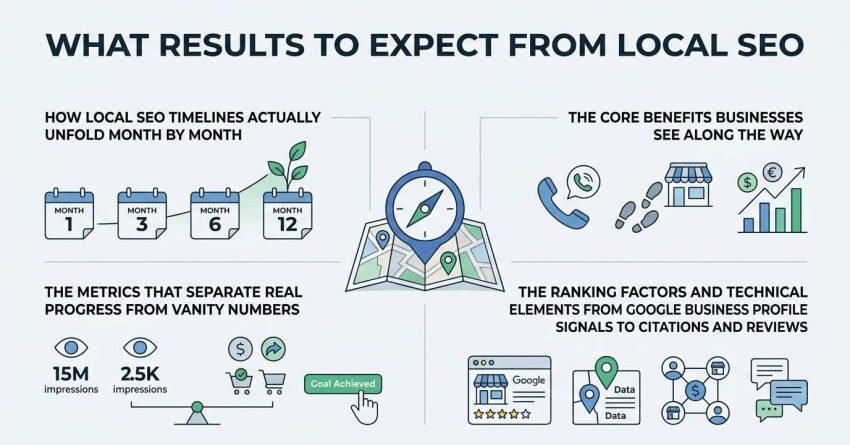
This guide covers how local SEO timelines actually unfold month by month, the core benefits businesses see along the way, the metrics that separate real progress from vanity numbers, and the ranking factors and technical elements from Google Business Profile signals to citations and reviews that shape how fast and how far your results go.
What Is Local SEO and Why Results Take Time to Materialize
Local SEO is a specialized branch of search optimization that helps businesses rank in location-based searches, such as “plumber near me” or “best bakery in Austin.” I think of it as the intersection of technical SEO, content relevance, and trust signals like reviews and citations working together.
Results take time because Google needs to build confidence in a business’s relevance and legitimacy before ranking it prominently. This confidence builds through consistent signals across Google Business Profile optimization, website content, and third-party validation like reviews and backlinks.
A new business with no history behaves differently than an established one with years of consistent local signals. I always tell clients that patience here isn’t optional; it’s structural.
The Local SEO Timeline: What Happens Month by Month
Local SEO typically follows a three-stage timeline: foundational technical work in months one through three, early ranking movement in months four through six, and compounding visibility gains from month seven onward. Each stage builds on the last, and skipping ahead rarely works.
Months 1-3: Foundation and Technical Fixes
The first three months focus on fixing technical issues, claiming and optimizing the Google Business Profile, and building out core location pages. I spend this window auditing site speed, mobile usability, and schema markup because these fixes remove barriers before any content or authority work can gain traction.
Citation building and NAP consistency work also happens here, since inconsistent business information across directories confuses search engines and delays trust-building.
Months 4-6: Early Ranking Movement
By month four, most businesses start seeing initial ranking movement for lower-competition keywords and long-tail local phrases. This is where Google’s local ranking factors <egin to respond to the technical and content work done earlier.
Review velocity also starts to matter more in this window. A steady flow of new reviews signals ongoing customer engagement, which reinforces prominence in Google’s local algorithm.
Months 7-12: Compounding Visibility Gains
After month six, results tend to compound rather than grow linearly. Ahrefs’ 2024 local search study found that local rankings for competitive keywords typically require 7 to 12 months of sustained optimization before reaching page-one visibility.
Traffic, calls, and direction requests grow together during this phase because map pack rankings, organic rankings, and review signals reinforce each other. I’ve seen this compounding effect turn a slow first quarter into a strong second half.
Key Benefits of Local SEO for Small and Mid-Sized Businesses
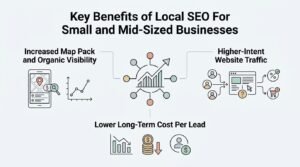
Local SEO delivers three measurable benefits: increased visibility in map pack and organic results, higher-intent website traffic, and a lower long-term cost per lead compared to paid advertising. These benefits build cumulatively rather than appearing all at once.
Increased Map Pack and Organic Visibility
Ranking in the map pack puts a business directly in front of users actively searching nearby, often above traditional organic results. This visibility compounds since map pack clicks tend to convert into calls and visits at higher rates than standard organic listings.
Higher-Intent Website Traffic
Local search traffic tends to convert better because searchers are already looking for a nearby solution, not just researching. I consistently see local organic traffic outperform broader national campaigns on conversion rate, even with lower total volume.
Lower Long-Term Cost Per Lead
Once rankings stabilize, the marginal cost of each additional lead drops significantly compared to paid channels that require ongoing spend. BrightLocal’s 2024 consumer survey found that 87% of consumers used Google to evaluate local businesses in the past year, which reinforces why organic local visibility pays off longer than a single ad campaign.
Local SEO Metrics That Actually Matter
The metrics that matter most in local SEO fall into three categories: visibility metrics, traffic metrics, and conversion metrics. Tracking all three together paints a complete picture, since visibility alone doesn’t guarantee revenue.
| Metric Category | Key Metrics | What It Shows |
| Visibility | Map pack rank, organic rank, share of local search | How discoverable the business is |
| Traffic | Organic sessions, click-through rate, impressions | How many people reach the site |
| Conversion | Calls, form fills, direction requests | Whether visibility translates to business |
Visibility Metrics (Rankings, Map Pack Share)
Visibility metrics track where a business shows up for its target keywords, both in the map pack and standard organic results. I check map pack ranking positions weekly for competitive terms since these shift more often than organic positions.
Traffic Metrics (Organic Sessions, CTR)
Organic sessions and click-through rate reveal whether improved rankings are actually driving people to the site. A high ranking with low CTR often points to a weak meta title or description that needs rewriting.
Conversion Metrics (Calls, Form Fills, Direction Requests)
Conversion metrics are the numbers that connect SEO work to revenue, including phone calls, form submissions, and requests for directions. These are the figures I bring to every client review because they answer the only question that matters: did this turn into business?
Google Business Profile Performance and What It Signals
Google Business Profile performance is a set of engagement and accuracy signals that Google uses to gauge a local business’s relevance and trustworthiness. Profile views, search queries, and photo engagement all feed into this signal set.
A profile with outdated hours, missing categories, or stale photos sends a weaker trust signal than one updated consistently. I treat GBP maintenance as an ongoing task, not a one-time setup, because Google rewards active profiles over dormant ones.
How Google Ranks Local Businesses (Core Ranking Factors)
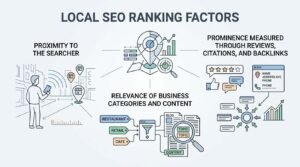
Google ranks local businesses using three core factors: proximity to the searcher, relevance to the search query, and prominence based on reviews, links, and citations. These three factors interact, so strength in one can partially offset weakness in another.
Proximity, Relevance, and Prominence
Proximity is largely outside a business’s control since it depends on the searcher’s physical location. Relevance and prominence, however, respond directly to optimization work like keyword-optimized content and consistent citation building.
I’ve seen businesses with weaker proximity outrank closer competitors purely on stronger prominence signals, which is why review volume and backlink quality matter so much.
Why Local SEO Results Vary by Industry and Competition Level
Local SEO results vary significantly by industry because competition density and search volume differ widely between sectors. A dentist in a small town faces far less competition than a personal injury attorney in a major metro area.
Highly competitive industries like legal services or home services in dense urban markets often need six months longer than the typical timeline to see comparable results. I always set expectations based on the specific competitive landscape, not a generic average.
Local Citations and NAP Consistency: Impact on Results
NAP consistency refers to keeping a business’s name, address, and phone number identical across every online directory and platform. Inconsistent NAP data confuses search engines and can slow down trust-building significantly.
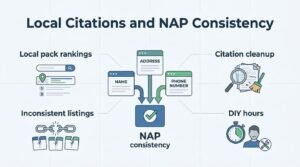
I run citation audits early in any engagement because fixing scattered, outdated listings often produces some of the fastest visible ranking improvements available.
The Role of Reviews in Local SEO Performance
Reviews influence local rankings both directly, as a prominence signal, and indirectly, by improving click-through rates on search results. Moz’s 2024 local ranking factors survey found that review signals account for roughly 17% of local pack ranking factors, making them one of the more influential elements businesses can actively control.
Response rate matters here too. I encourage clients to respond to every review, since engagement signals reinforce the sense that a business is active and attentive.
Content and On-Page Local SEO: What Moves the Needle
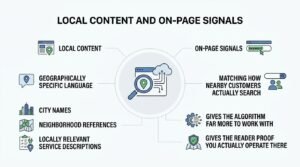
On-page local SEO involves optimizing website content, title tags, and location-specific pages to match what local searchers are actually looking for. Location pages that read like templates rarely perform, while ones with genuine local detail tend to rank and convert better.
I write location content around specific neighborhoods, landmarks, and service areas rather than generic city names, because that specificity mirrors how real searchers phrase their queries.
Local Link Building and Its Effect on Authority
Local link building is the process of earning backlinks from geographically or topically relevant websites to strengthen a business’s domain authority and local relevance.
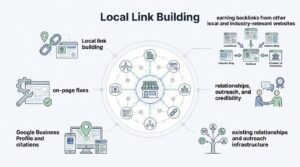
Links from local chambers of commerce, news outlets, and industry associations carry particular weight.
I prioritize quality over volume here, since a handful of relevant local links tends to move rankings faster than dozens of generic, low-authority ones.
How to Track and Report Local SEO ROI
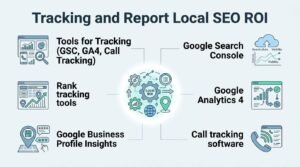
Tracking local SEO ROI requires connecting visibility and traffic data to actual business outcomes like calls, leads, and revenue. This connection is what separates a defensible SEO investment from a guessing game.
Tools for Tracking (GSC, GA4, Call Tracking)
- Google Search Console shows impressions, clicks, and average position for target keywords.
- Google Analytics 4 tracks user behavior, conversion events, and traffic sources.
- Call tracking software attributes phone calls to specific campaigns or keywords.
- Google Business Profile Insights reports profile views, direction requests, and customer actions.
- Rank tracking tools monitor daily position changes for map pack and organic rankings.
I pull these into one dashboard for clients so the full picture is visible in a single view rather than scattered across five logins.
Common Reasons Local SEO Results Are Delayed
Local SEO results most often stall due to inconsistent citations, thin or duplicate content across location pages, and a lack of review generation strategy. Technical issues like slow site speed or broken schema markup also quietly suppress otherwise solid work.
I’ve diagnosed delayed results that traced back to a single inconsistent address listing on a major directory. Small technical debts compound just as much as small wins do.
Setting Realistic Expectations With an SEO Provider
A trustworthy SEO provider sets expectations around realistic timelines, transparent reporting, and measurable milestones rather than promising guaranteed rankings. Guarantees of a specific ranking position within a set timeframe are a signal to walk away.
I believe the right provider relationship feels more like a long-term partnership built on shared data than a vendor transaction.
Conclusion
Local SEO results build through technical groundwork, review signals, citations, and content working together over time. Understanding this timeline and these metrics helps separate real, sustainable growth from short-term tactics that fade.
The deeper resources in this cluster covering Google Business Profile optimization, ranking factors, and ROI tracking go further into each piece of this puzzle.
We built White Label SEO Service to guide businesses through exactly this process. Let’s build your sustainable organic growth strategy together.
Frequently Asked Questions
How long does local SEO take to show results?
Most businesses see initial ranking movement within three to six months, with significant traffic and lead growth typically appearing between months six and twelve.
What’s a realistic local SEO timeline for a new business?
New businesses should expect nine to twelve months for strong local visibility, since they lack the historical trust signals established businesses already have.
What local SEO metrics should I track monthly?
Track map pack rankings, organic sessions, click-through rate, and conversion metrics like calls and form fills monthly to see the full performance picture.
Does local SEO work for every industry?
Local SEO works across nearly every industry, but timelines and difficulty vary based on competition density and search volume in that specific market.
How much do reviews impact local search rankings?
Reviews significantly impact rankings, contributing to prominence signals and influencing click-through rates, making them one of the most controllable ranking factors available.
What’s the difference between local SEO and traditional SEO results?
Local SEO results center on map pack visibility and geographically-bound searches, while traditional SEO focuses on broader national or topic-based organic rankings.
How do I know if my local SEO strategy is working?
A working strategy shows steady improvement across rankings, organic traffic, and conversion metrics like calls and form fills over consecutive months, not just isolated spikes.