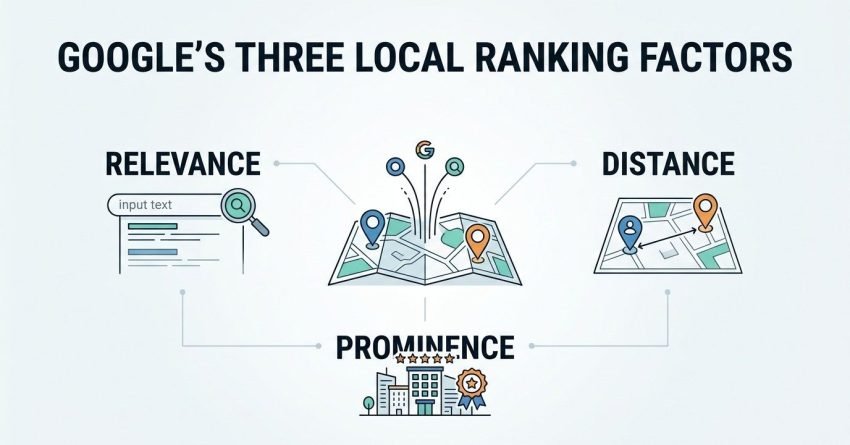
Google ranks local businesses using three core factors: relevance, distance, and prominence, which together determine which listings appear in the Local Pack and Google Maps for a given search. Relevance measures how well a business profile matches what someone typed. Distance measures how close a business is to the searcher or the searched location. Prominence measures how well-known and trusted a business is, both online and offline.
Getting these three factors wrong costs businesses visibility they cannot easily win back once competitors establish stronger signals. I have watched well-run businesses stay invisible on Maps for years over fixable profile gaps.
This guide covers what each ranking factor means and how Google calculates it, the practical levers that influence all three profile optimization, reviews, citations, on-page signals, and backlinks plus the mistakes that suppress rankings and realistic timelines for improvement.
What Are Google’s Local Ranking Factors?
Google’s local ranking factors are the three signal categories: relevance, distance, and prominence that the local algorithm uses to decide which businesses appear for a given local search. Google combines all three simultaneously rather than weighting one factor above the others in a fixed way. A business with strong prominence but weak relevance can still lose a ranking spot to a closer, better-matched competitor.
I think of these three factors as a triangle rather than a checklist. Move one point, and the other two shift the outcome too. Understanding how Google’s local algorithm evaluates relevance is usually the fastest starting point, because relevance failures are the easiest to fix and the most common reason a business never shows up at all.
How Google’s Local Algorithm Evaluates Relevance
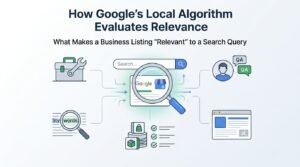
Relevance is how well a local business profile matches the words and intent behind a searcher’s query, based on the business category, the description, and the content Google can associate with that listing. A plumbing company searching “emergency plumber” needs that exact service reflected in its Google Business Profile category and description, not implied through vague wording.
What Makes a Business Listing “Relevant” to a Search Query
Google pulls relevance signals from several places at once, and I have seen businesses miss rankings simply because their primary category was slightly wrong.
- Primary and secondary Google Business Profile categories
- Business description keyword alignment with search terms
- Products and services listed directly on the profile
- Website content that matches the same service language
- Q&A section answers on the profile itself
A mismatched category is the single most common relevance failure I encounter, and it often silently caps a business out of rankings it should easily win.
How Distance Affects Local Search Rankings
Distance is the physical proximity between the searcher’s location (or the location typed into the query) and the business address Google has on file. Google shortens the geographic radius it considers for dense urban queries and widens it for rural or niche searches where fewer competitors exist.
How Google Calculates Distance When You Don’t Share Your Location
Google defaults to the geographic center of the searched city or area whenever a user has not shared their device location, then measures every candidate business against that center point. This is why a business three miles from downtown often outranks one sitting exactly at the city’s edge for a citywide search. Distance cannot be manipulated the way relevance and prominence can, which makes it the most rigid of the three factors.
How Prominence Signals Build Local Authority
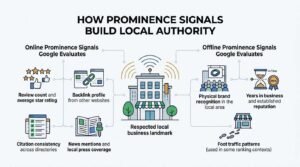
Prominence is a measure of how well-known, trusted, and established a business is, drawn from both online signals and real-world reputation indicators that predate the internet, such as being a well-known local landmark. A business with 500 reviews and consistent press mentions carries far more prominence weight than a new listing with none.
Online Prominence Signals Google Evaluates
- Review count and average star rating
- Backlink profile from other websites
- Citation consistency across directories
- News mentions and local press coverage
Offline Prominence Signals Google Evaluates
- Physical brand recognition in the local area
- Years in business and established reputation
- Foot traffic patterns (used in some ranking contexts)
| Signal Type | Examples | Controllable? |
| Online | Reviews, backlinks, citations, press | Yes, over time |
| Offline | Brand recognition, longevity, foot traffic | Partially |
This table shows how prominence splits into signals a business can actively build versus signals that accumulate mostly through time and reputation.
Relevance vs. Distance vs. Prominence: How They Work Together
These three factors never operate in isolation, and every local ranking result reflects some blend of all three rather than a single dominant signal. A business can compensate for weaker distance with stronger relevance and prominence, and vice versa.
| Factor | What It Measures | Can Be Improved Directly? |
| Relevance | Match between query and business profile | Yes: category, description, content |
| Distance | Physical proximity to searcher/location | No, fixed by business address |
| Prominence | Overall trust and authority signals | Yes: reviews, citations, backlinks, press |
This comparison shows why most local SEO strategy work concentrates on relevance and prominence, since distance sits outside a business owner’s direct control.
Google Business Profile Optimization and Local Ranking Factors
Google Business Profile optimization is the practice of completing and refining every field on a business’s Google listing so the algorithm has maximum relevant data to match against searches.
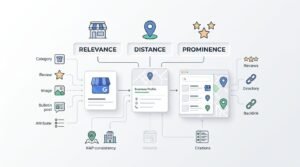
A fully optimized profile touches all three ranking factors at once, which makes it the highest-leverage single action available to most businesses.
- Select the most specific accurate primary category available
- Add all applicable secondary categories
- Write a keyword-aligned business description
- Upload and regularly update photos
- Keep hours, services, and attributes current
- Respond to every review, positive or negative
I treat Google Business Profile optimization as the foundation everything else builds on, because a weak profile undermines even strong review counts and backlink profiles.
Online Reviews and Their Role in Local Rankings
Online reviews function as a direct prominence signal and an indirect relevance signal, since Google can read review text for keyword and service matches in addition to counting star ratings. A Moz local search ranking factors study found review signals account for a meaningful share of local pack ranking weight alongside GBP and link signals.
Businesses with a steady flow of new reviews tend to outperform businesses with a large but stagnant review count. Review recency matters as much as review volume in most cases I have tracked.
NAP Consistency and Local Citations Explained
NAP consistency is the practice of keeping a business’s name, address, and phone number identical across every online directory, citation source, and website mention. Inconsistent NAP data confuses Google’s ability to confirm a business’s legitimate location, which directly weakens prominence and indirectly weakens distance accuracy.
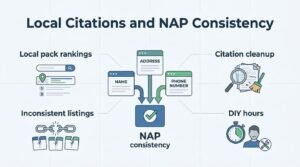
A citation is any online mention of a business’s NAP data, whether or not it includes a link back to the website. Data aggregators, industry directories, and chamber of commerce listings all count as citation sources Google references when validating a business.
On-Page and Technical SEO Signals That Influence Local Rankings
On-page SEO signals for local search include location-specific keywords in title tags, schema markup identifying the business as a LocalBusiness entity, and dedicated location pages for multi-location businesses. These signals help Google confirm the relevance match between a website and the local queries it should rank for.
- LocalBusiness schema markup on the website
- City and service keywords in page titles and headers
- Location-specific landing pages for multi-location businesses
- Mobile page speed, since most local searches happen on mobile devices
Technical SEO signals rarely move rankings alone, but they reinforce the relevance signals already established through the Google Business Profile.
Backlinks and Local Search Authority
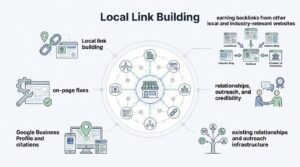
A backlink is a link from another website pointing to a business’s own site, and it functions as a trust and prominence signal in Google’s local algorithm the same way it does in organic web rankings. Local backlinks from chambers of commerce, local news sites, and industry associations carry disproportionate weight compared to generic directory links.
An Ahrefs analysis of ranking correlations found that businesses ranking in the top three local pack positions tend to have significantly stronger backlink profiles than those ranking lower. Backlinks take longer to build than review counts or profile edits, which makes them a longer-term prominence investment.
Common Local Ranking Factor Mistakes That Hurt Visibility
Most businesses that fail to rank locally are making one or more identifiable mistakes rather than facing an unsolvable competitive gap. I see these same errors repeatedly across industries and markets.
- Choosing the wrong primary Google Business Profile category
- Inconsistent NAP data across directories and citation sources
- Ignoring or delaying responses to customer reviews
- Using a virtual office or PO box address where prohibited
- Neglecting to update profile hours, photos, and services
- Duplicate Google Business Profile listings competing against each other
Duplicate listings are the most damaging mistake on this list because they split prominence signals across two profiles instead of consolidating them into one.
How to Track and Measure Your Local Ranking Performance
Tracking local ranking performance means monitoring position changes across the specific keywords and geographic points that matter to a business, since local rankings vary by the searcher’s physical location. Standard rank trackers built for organic web rankings often miss this geographic variability entirely.
- Use a local rank tracker that supports geo-grid reporting
- Monitor Google Business Profile Insights for search and view data
- Track click-to-call and direction request metrics monthly
- Compare ranking data across multiple points within the service area
- Review Google Search Console for location-based query trends
Geo-grid tracking matters because a business can rank first near its own address and fall to page two just a few miles away.
How Long It Takes to Improve Local Rankings
Most businesses see measurable local ranking improvement within three to six months of consistent optimization work, though competitive urban markets can take longer. Profile optimization changes often show impact within two to four weeks, while prominence-building activities like backlinks and sustained review growth take three months or more to fully register.
Rankings rarely move in a straight line, and I have seen positions fluctuate weekly even during genuine upward trends. Patience paired with consistent execution outperforms sporadic bursts of activity every time.
Conclusion
Relevance, distance, and prominence work together, not separately, to decide local rankings. Distance stays fixed, but relevance and prominence respond directly to profile optimization, reviews, citations, and backlinks.
Local search keeps evolving as Google refines how it weighs these signals. Sustainable visibility comes from steady, consistent work across all three factors, not shortcuts.
We build local ranking strategies around all three factors at once. Talk to White Label SEO Service to strengthen your local visibility today.
Frequently Asked Questions
Is relevance, distance, or prominence more important?
No single factor dominates; Google blends all three simultaneously for every search. Relevance and prominence are the two factors businesses can actively improve, since distance is fixed by location.
Can a business rank locally without a physical address?
Service-area businesses can rank without a public address if they hide it correctly in Google Business Profile settings. They still need a verified location on file for distance calculations to work.
Does Google use my exact location to determine distance?
Google uses a searcher’s device location when shared, and defaults to the searched city’s center point when it is not. This default explains why rankings can differ significantly by neighborhood.
How often does Google update its local ranking algorithm?
Google updates local ranking signals continuously, with major confirmed algorithm changes occurring several times per year. Most updates are unannounced, which is why ranking fluctuations happen without a clear cause.
Can paid ads improve local organic rankings?
No, running Google Ads has no direct effect on organic local pack rankings. The two systems are evaluated independently, though ads can increase visibility while organic rankings improve.
What is the difference between local SEO and organic SEO?
Local SEO targets map-based and geographically relevant search results tied to a physical location or service area. Organic SEO targets standard web search rankings without a required geographic component.
Do local ranking factors apply to service-area businesses?
Yes, service-area businesses are evaluated using the same three factors, though distance calculations use the service area boundaries instead of a public storefront address. Relevance and prominence work identically to location-based businesses.