Entity optimization is the process of helping search engines recognize, verify, and connect a business, person, or brand as a distinct entity rather than a string of keywords. I think about it as giving Google a clear identity to attach trust to, instead of just text to rank. For any business trying to build lasting visibility, this shift matters more than most SEO conversations acknowledge.
Search engines stopped matching keywords years ago. They now build meaning around entities, relationships, and verified facts, and that changes what actually earns rankings today.
This guide covers what entities and knowledge graphs actually are, how Google identifies and verifies them, the core building blocks of entity SEO like schema and citations, how AI search systems use entity data, and how to measure and strengthen your own entity presence over time.
What Is Entity Optimization?
Entity optimization is the practice of structuring a brand’s digital footprint so search engines can identify it as a specific, verifiable entity with defined attributes and relationships. I use this definition constantly with clients because it separates entity work from plain keyword targeting immediately.
An entity, in Google’s framework, is a thing that can be uniquely identified: a person, place, organization, product, or concept distinct from the words used to describe it. This distinction matters because two businesses can share a name, but only one connects to the correct address, founder, and service history in Google’s data.
How Entities Differ From Keywords
A keyword is a string of text; an entity is a real-world thing with defined attributes and relationships. I’ve watched teams spend years optimizing for keyword variations while ignoring the entity signals that actually anchor those rankings.
Keywords tell Google what a page says. Entities tell Google what a business is, who runs it, and how it connects to other verified things. That second layer carries far more long-term weight.
Why Search Engines Think in Entities, Not Strings
Google’s shift toward “things, not strings” started with the original Knowledge Graph announcement in 2012, which explicitly framed search as understanding real-world entities rather than matching text. I still reference that framing when explaining this to clients who assume SEO is purely about keyword density.
This approach lets Google disambiguate between similarly named entities and serve more precise answers. It also means a business’s authority now depends on how well-connected and verified its entity profile is, not just how often a keyword appears on its site.
What Is a Knowledge Graph and How Does It Work?
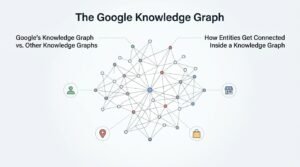
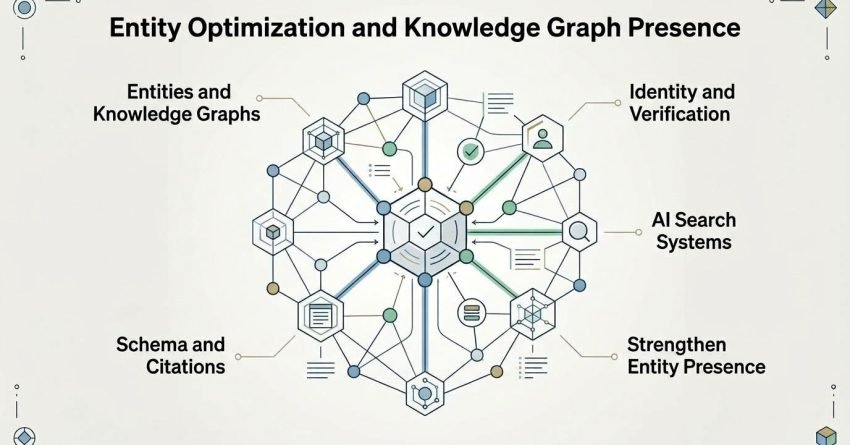
A knowledge graph is a structured database that stores entities and the verified relationships between them, allowing a search engine to answer questions using facts rather than page rankings alone. I think of it as Google’s internal map of everything it considers real and connected.
Google’s Knowledge Graph reportedly contains over 500 billion facts about 5 billion entities, spanning people, places, organizations, and concepts. That scale is why a single verified data point about your business can ripple across dozens of surfaces at once.
Google’s Knowledge Graph vs. Other Knowledge Graphs
Google’s Knowledge Graph is proprietary, but it draws from and cross-references public knowledge graphs like Wikidata, which anyone can edit and verify. I always tell clients that Wikidata is one of the few entity signals they can influence directly, rather than waiting for Google to notice them.
Other knowledge graphs — Microsoft’s, Amazon’s, and various industry-specific ones serve their own ecosystems, but they often pull from the same underlying open data sources. Consistency across all of them compounds trust rather than existing in isolation.
How Entities Get Connected Inside a Knowledge Graph
Entities connect through verified relationships: a person works for an organization, an organization is located in a place, a product belongs to a brand. I’ve found that the strength of these connections often matters more than the sheer volume of mentions a business has.
Each relationship acts like a vote of confirmation from one verified data point to another. The more consistent and cross-referenced these relationships are, the more confidently a search engine treats the entity as real and stable.
How Google Identifies and Verifies Entities
Google identifies entities through a combination of named entity recognition, disambiguation algorithms, and cross-referencing against existing verified data sources. The first sentence in that process usually decides everything else that follows for a brand’s visibility.
This isn’t a one-time check. Google continuously re-evaluates entity signals as new mentions, citations, and structured data appear across the web.
Entity Recognition and Disambiguation
Entity recognition is the process by which Google’s systems scan text to detect known or potential entities, then disambiguation resolves which specific entity is being referenced when names overlap. I see this trip up businesses with common names constantly, since they compete against unrelated entities sharing the same term.
Disambiguation relies heavily on context: co-occurring terms, linked data, and structured markup all help Google decide which “Smith Consulting” it’s looking at. Weak or inconsistent context makes a business invisible even when it technically has a web presence.
The Role of Confidence Scores
Google assigns internal confidence scores to entity associations based on how consistently and how often a claim appears across trusted sources. A single unverified mention rarely moves this score; repeated, cross-referenced confirmation does.
I think of confidence scoring as compound interest. Each additional consistent citation a directory listing, a press mention, a structured data match adds a small amount of trust that accumulates over time rather than all at once.
Why Entity Optimization Matters for Modern SEO
Entity optimization matters because search engines now rank based on established trust and topical authority tied to a verified entity, not just on-page keyword signals. I’ve watched this shift directly affect which sites survive algorithm updates and which don’t.
Sites with strong entity signals tend to recover faster from volatility because their authority isn’t solely dependent on any single page’s optimization. The entity itself carries weight across the whole domain.
From Keyword Rankings to Entity Authority
Ranking for a keyword used to be the finish line; now it’s often just a symptom of stronger entity authority working in the background. I explain this to clients as the difference between chasing individual results and building a reputation search engines already trust.
This shift also explains why some newer sites with strong founder entities and citations outrank older sites with weaker entity signals. Authority increasingly travels with the entity, not just the domain age.
Core Components of Entity SEO
Entity SEO rests on three pillars: structured data implementation, consistent identity signals across the web, and authoritative third-party verification. Each pillar reinforces the other two, which is why partial implementation rarely produces strong results.
Skipping any one of these tends to cap how far entity recognition can go, regardless of how strong the other two are.
Structured Data and Schema Markup
Structured data and schema markup give search engines explicit, machine-readable declarations of who an entity is and how its parts relate. This is the clearest technical lever a business controls directly in entity optimization.
Schema doesn’t guarantee recognition on its own, but it removes ambiguity that would otherwise force Google to guess. I treat it as the foundation layer that every other entity signal builds on top of.
Consistent NAP and Brand Signals
NAP consistency name, address, and phone number matching exactly across every listing remains one of the most overlooked entity trust signals. Inconsistent formatting across directories can quietly fracture what should be one unified entity into several weaker fragments in Google’s eyes.
Brand signals extend beyond NAP to consistent logos, descriptions, and social profiles. I’ve seen businesses fix ranking plateaus simply by auditing and unifying these details across twenty or thirty listings.
Wikidata, Wikipedia, and Authoritative Citations
Wikidata and Wikipedia function as some of the highest-trust sources feeding Google’s Knowledge Graph, and a well-sourced Wikidata entry can directly influence Knowledge Panel accuracy. These platforms reward genuine notability and verifiable third-party sourcing, not self-promotion.
Authoritative citations press coverage, industry recognition, academic references carry similar weight because they represent independent confirmation. I generally advise clients to earn these citations through real coverage rather than attempting shortcuts, which tend to get flagged or ignored.
How to Get Your Business Recognized as an Entity
Getting recognized as an entity starts with claiming and verifying every controllable profile, then building consistent, cross-referenced signals that confirm those details externally. This groundwork typically takes months, not days, to solidify.
I always tell clients this is a compounding process. Early consistency work makes every later signal land with more impact.
Establishing a Google Knowledge Panel
A Knowledge Panel is Google’s visual confirmation that it recognizes an entity with enough confidence to summarize it directly in search results. Businesses can request panel claims through Google’s system once enough verified data exists to support one.
Getting there usually requires a foundation of structured data, a Wikidata entry, consistent citations, and enough independent coverage for Google to feel confident displaying a summary. Rushing this before the underlying signals exist rarely works.
Building Entity Associations Across the Web
Entity associations form when a business’s name consistently appears alongside the same verified attributes across independent, authoritative platforms. Directory listings, industry associations, and press coverage all contribute to this web of association.
I approach this as deliberate reinforcement rather than volume for its own sake. Ten consistent, high-trust associations outperform a hundred scattered, low-quality mentions.
Schema Markup and Structured Data for Entity Optimization
Schema markup translates entity information into a format search engines can parse without ambiguity, using vocabulary defined by Schema.org. This section focuses specifically on the technical implementation layer of entity signals.
Getting schema right is less about volume of markup and more about accuracy and completeness of the entity data being declared.
Organization and Person Schema
Organization schema declares core business attributes: name, logo, address, founding date, and social profiles in structured, machine-readable form. Person schema does the same for individual founders, authors, or key figures tied to the brand.
I treat these two schema types as the backbone of any entity SEO implementation. Getting them right early prevents rework later when more advanced markup gets layered on top.
SameAs Properties and Entity Linking
The sameAs property explicitly tells search engines that separate profiles a Wikidata page, a LinkedIn profile, a Crunchbase listing all refer to the same entity. This single property does more disambiguation work than almost any other schema attribute available.
Without sameAs links, Google has to infer these connections probabilistically, which introduces risk of misattribution. I treat this property as close to mandatory for any business serious about entity clarity.
Topical Authority and Its Relationship to Entities
Topical authority describes how comprehensively and consistently a domain covers a specific subject area, and it functions as a direct reinforcement mechanism for entity trust. A domain recognized as an authority on a topic strengthens the entity behind it simultaneously.
These two concepts reinforce each other in a loop: stronger entity signals help content rank, and comprehensive content strengthens the entity’s perceived expertise.
Content Clusters as Entity Reinforcement
Content clusters, a pillar page supported by focused subtopic pages, signal depth of expertise that search engines associate directly with the underlying entity. Each supporting page adds another data point confirming the entity’s authority in that specific domain.
I build these clusters deliberately around the entities a business wants recognized for, rather than around keywords alone. The distinction changes which pages get prioritized first.
E-E-A-T and Entity-Based Trust Signals
E-E-A-T experience, expertise, authoritativeness, and trustworthiness functions as Google’s qualitative framework for evaluating entity credibility, and it’s described directly in Google’s Search Quality Rater Guidelines. Entities with weak E-E-A-T signals tend to struggle even with strong technical optimization elsewhere.
I treat E-E-A-T less as a ranking factor and more as a lens Google uses to interpret every other signal, including entity data.
Author Entities and Expertise Signals
Author entities are sare real people with verifiable credentials, publication history, and consistent bylines that increasingly carry their own trust signals independent of the brand they write for. Google can now trace an author’s expertise across multiple domains and factor that into content trust.
I encourage clients to treat their authors as entities worth optimizing directly, complete with schema, bios, and consistent external profiles, rather than anonymous contributors.
Entity Optimization for Local and Multi-Location Businesses
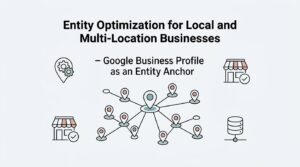
Local and multi-location businesses face a unique entity challenge: each location can be perceived as its own entity or as a branch of one larger entity, depending on how consistently the data is structured. Getting this distinction wrong often fragments authority across locations instead of consolidating it.
I typically recommend a clear parent-child entity structure, where each location schema explicitly references the parent organization.
Google Business Profile as an Entity Anchor
Google Business Profile functions as one of the strongest direct entity anchors available to local businesses, feeding verified location, category, and attribute data straight into Google’s systems. An incomplete or inconsistent profile weakens the entity signal for every location tied to it.
I treat this profile as non-negotiable groundwork, since it’s one of the few entity signals a business controls with near-immediate update speed.
How AI Search and Generative Engines Use Entities
AI search systems and generative engines rely on entity data even more heavily than traditional search, because they need verified facts to generate accurate, citable answers. A business with weak entity signals is far less likely to appear as a source in an AI-generated response.
This shift raises the stakes on entity work considerably, since visibility now extends beyond ranked links into synthesized answers.
Entities in AI Overviews and AI Assistant Answers
AI Overviews and assistant-style answers pull from entities with strong, cross-verified data rather than pages with strong keyword optimization alone. I’ve noticed these systems favor sources that already carry Knowledge Graph confirmation or structured data backing their claims.
This means the same entity groundwork that earns a Knowledge Panel also improves the odds of being cited inside an AI-generated answer.
Becoming a Cited Source in AI-Generated Answers
Becoming a cited source requires content that states facts in clear, extractable, self-contained sentences tied to a verified entity behind the claim. Vague or unattributed claims rarely get pulled into these answers, no matter how well the page ranks traditionally.
I write every client’s core claims with this extraction requirement in mind now, since it’s become as important as traditional on-page optimization.
Common Entity Optimization Mistakes to Avoid
The most common mistake I see is inconsistent business information scattered across directories, which fragments entity confidence instead of building it. A second common mistake is treating schema markup as a one-time technical task rather than an ongoing maintenance requirement.
Businesses also frequently chase Knowledge Panels before the underlying citation and structured data foundation exists, which typically results in rejected or incomplete panels.
How to Measure Entity Optimization Success
Measuring entity optimization success means tracking Knowledge Panel accuracy, structured data validation, and citation consistency alongside traditional organic performance metrics. These signals move slower than keyword rankings, so patience matters here more than in most SEO work.
I check these signals quarterly rather than weekly, since entity trust compounds gradually rather than shifting overnight.
Tools for Tracking Knowledge Graph Presence
Google’s Rich Results Test and Search Console both surface structured data errors that directly affect entity recognition. Google Knowledge Graph Search API access, where available, offers a more direct view into how an entity is currently represented.
I pair these technical tools with manual monitoring of Knowledge Panel changes and citation consistency across major directories.
Building an Entity Optimization Strategy
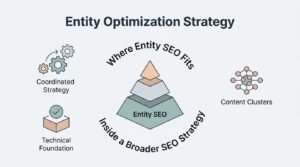
Building an entity optimization strategy means sequencing schema implementation, citation consistency, and authoritative content clusters into a coordinated plan rather than tackling them in isolation. Trying to do all three simultaneously without sequencing usually dilutes the impact of each.
I typically start with technical foundations, move to citation consistency, then layer in content clusters that reinforce the entity’s topical authority over time.
Where Entity SEO Fits Inside a Broader SEO Strategy
Entity SEO functions as the trust and identity layer underneath a broader SEO strategy that still includes technical health, content depth, and link acquisition. None of these components replace the others; they compound together.
I treat entity work as the foundation that makes every other SEO investment perform better over time, rather than a separate initiative running parallel to it.
Conclusion
Entity optimization connects structured data, verified citations, and knowledge graph presence into one coherent trust signal search engines rely on.
This foundation increasingly shapes how AI search engines and traditional rankings both evaluate credibility going forward.
We help businesses build this entity foundation deliberately; reach out to White Label SEO Service to start strengthening your search presence.
Frequently Asked Questions
What is entity optimization in SEO?
Entity optimization is the process of helping search engines recognize a business as a verified, distinct entity. It relies on structured data, consistent citations, and authoritative third-party confirmation.
How long does it take to build knowledge graph presence?
Building meaningful knowledge graph presence typically takes six to twelve months of consistent signal-building. Confidence scores accumulate gradually through repeated, cross-referenced verification rather than instantly.
Do I need a Wikipedia page to get a Knowledge Panel?
A Wikipedia page isn’t strictly required, but it significantly increases the odds of an accurate Knowledge Panel. Wikidata entries combined with strong citations can also support panel creation.
What is the difference between entity SEO and traditional keyword SEO?
Traditional keyword SEO targets specific search terms and page-level optimization. Entity SEO builds recognition and trust around the business itself as a verified, connected real-world entity.
How does schema markup help entity optimization?
Schema markup explicitly declares entity attributes and relationships in a format search engines can parse without guessing. It removes ambiguity that would otherwise weaken entity recognition.
Can small businesses build entity authority without big brand recognition?
Small businesses can absolutely build entity authority through consistent NAP data, schema markup, and genuine local citations. Recognition scales with consistency and verification, not company size alone.
How do AI search engines determine which entities to cite?
AI search engines favor entities with strong, cross-verified structured data and clear factual claims. Self-contained, attributable statements tied to a verified entity are far more likely to be cited.