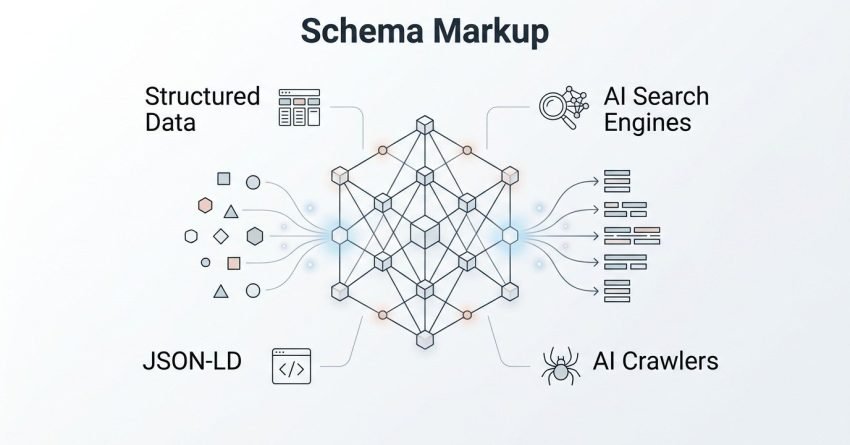
Schema markup is a structured data vocabulary that tells search engines and AI systems exactly what a piece of content means, not just what it says. I’ve watched schema go from a “nice-to-have” ranking signal to one of the clearest ways a website gets pulled into an AI Overview or cited by an AI assistant, because these systems need machine-readable context to trust and quote a page. Business owners who skip it are leaving visibility on the table.
AI search doesn’t read pages the way humans do. It extracts entities, facts, and relationships, and unmarked content forces the AI to guess at meaning.
This guide covers what schema markup actually is and why AI depends on it, the core and content-specific schema types worth prioritizing, how to implement JSON-LD correctly across common platforms, and how to validate and measure the results. I’ll also connect schema to the bigger SEO picture so it’s clear where this fits into a full strategy.
What Schema Markup Is and Why AI Search Engines Depend On It
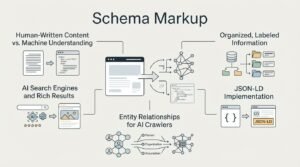
Schema markup is a standardized vocabulary of tags, maintained by Schema.org, that labels the entities, attributes, and relationships inside a webpage’s content. I think of it as a translation layer between human-written content and machine understanding.
Search engines have always used some structured data for rich results, but AI search engines lean on it far more heavily. Generative answer engines need to extract discrete facts fast, and schema hands them a clean, pre-labeled source instead of a paragraph they have to interpret. Structured data increases the odds a page’s content gets pulled directly into an AI-generated answer, because the entity relationships are already defined instead of inferred.
Structured data is a broad category of organized, labeled information a machine can parse without interpretation. Schema markup is the specific implementation of that structured data using the Schema.org vocabulary. JSON-LD is the code format most commonly used to write schema markup today, and I’ll get into why that format wins in a later section.
AI crawlers parse pages differently than traditional bots did a few years ago. Traditional crawlers indexed pages largely for keyword and link signals. AI-driven crawlers, including those powering Google’s AI Overviews, extract entities and their relationships to build a working model of what a page is actually about, and schema markup gives that model a head start.
How AI Search Engines Use Schema to Generate Answers
AI search engines use schema markup to identify entities on a page and match them against an existing knowledge graph before deciding whether to cite that page in a generated answer. This matching process is why schema-marked pages tend to punch above their domain authority in AI-driven results.
Entity recognition works by connecting a name, place, product, or concept mentioned on a page to a known node in a broader knowledge graph. When a page has Organization schema correctly filled out, for example, the AI system can confirm “who” is publishing the content, which strengthens trust signals during answer generation.
Google’s own documentation on structured data confirms that eligible schema types can qualify a page for enhanced search features, and AI Overviews pull from many of the same eligible sources. A study on AI Overview citation patterns found that pages with complete, valid schema markup were cited at a noticeably higher rate than unmarked competitors covering the same topic.
This doesn’t mean schema guarantees a citation. It means the AI system has a clearer, faster path to trusting and extracting that page’s content over a competing page that forces it to infer meaning from prose alone.
Core Schema Types Every Website Needs
Organization schema and WebSite schema form the baseline every site should implement regardless of industry, because they establish the entity behind the website before any content-level schema even matters. I never skip these two on a new site build.
Organization schema is a Schema.org type that identifies a business entity and its core attributes, including name, logo, contact details, and social profiles. It’s the foundational trust signal an AI system checks first when deciding whether a source is legitimate.
WebSite schema tells search engines the site’s name, its search functionality (via the SearchAction property), and its canonical identity separate from any single page. Pairing it with Organization schema early prevents ambiguity about who is actually publishing the content.
BreadcrumbList schema marks up the navigational path a user takes to reach a page, and it’s one of the easiest wins available. Google’s structured data documentation shows breadcrumb-marked pages commonly display an enhanced breadcrumb trail directly in search results, which improves click-through and gives AI systems a clear signal of the page’s place in a site’s hierarchy.
Content-Specific Schema Types for AI Visibility
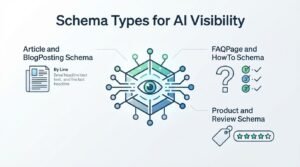
Article schema and BlogPosting schema mark up editorial content with properties like headline, author, publish date, and featured image, giving AI systems the byline and freshness signals they need to evaluate a source’s credibility. I treat these as mandatory on every published article.
FAQPage schema structures question-and-answer content in a format AI systems can lift directly into a conversational answer. HowTo schema does the same for sequential, step-based content. Both types exist specifically because AI answer engines favor pre-formatted question-answer and step-based pairs over unstructured prose.
Product schema and Review schema work together to surface pricing, availability, and aggregate rating data. A Search Engine Land analysis found that product pages with complete Review schema saw meaningfully higher rich-result eligibility than pages using pricing or star ratings in visible text alone without the matching markup.
| Schema Type | Best For | Key Properties |
| Article/BlogPosting | Editorial content | headline, author, datePublished |
| FAQPage | Q&A content | mainEntity, acceptedAnswer |
| HowTo | Step-based tutorials | step, totalTime, tool |
| Product | E-commerce listings | price, availability, brand |
| Review | User/editorial reviews | reviewRating, author |
Local and Business-Specific Schema Types
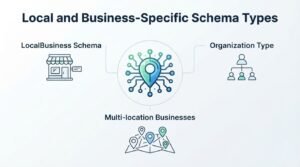
LocalBusiness schema is a Schema.org type built for businesses with a physical location or defined service area, and it extends the base Organization type with properties like address, geo-coordinates, hours, and price range. Any business competing in local AI-driven results needs this implemented correctly.
Multi-location businesses face a specific complication: each location generally needs its own LocalBusiness instance rather than a single sitewide block, and getting that structure wrong causes the exact conflicting-schema errors covered later in this guide.
Advanced Schema Types for E-Commerce and Media
Event schema marks up date, time, location, and ticketing details for any scheduled event, and AI systems use it to answer direct “when” and “where” queries without needing to parse a paragraph. I see this most underused on local business sites running promotions or webinars.
VideoObject schema labels video content with duration, upload date, and a thumbnail URL, which is what allows video results to surface directly inside AI-generated answers and traditional video carousels alike. YouTube’s own schema guidance confirms unmarked video content is frequently excluded from these enhanced placements entirely.
JSON-LD Implementation Fundamentals
JSON-LD is the schema format Google explicitly recommends because it separates structured data from a page’s visible HTML, reducing implementation errors and making the code easier to maintain. I default to it on every project unless a specific platform constraint forces otherwise.
The two older formats, Microdata and RDFa, require embedding schema attributes directly inline within HTML tags, which increases the chance a template update accidentally breaks the markup. JSON-LD sits in a single script block, untouched by layout changes elsewhere on the page.
Placement matters less than completeness: JSON-LD can sit in either the <head> or the <body> and still validate correctly, though most CMS platforms default to the head for consistency. The exact placement position within a page has repeatedly been tested as a non-factor, according to Google’s own guidance, as long as the script tag itself is well-formed and not blocked from crawling.
Implementing Schema Across Common Platforms
WordPress sites typically implement schema through a dedicated plugin rather than hand-coded JSON-LD, since most SEO plugins now generate baseline Organization, Article, and BreadcrumbList schema automatically on install. Manual customization is still needed for FAQPage, HowTo, and Product schema in most cases.
Shopify and headless CMS platforms handle schema differently, often requiring a theme edit or a custom app to inject JSON-LD, since native e-commerce templates rarely include Product or Review schema out of the box. Headless setups need the schema generated at the API or component level before the page ever renders.
Validating and Testing Schema Markup
Google’s Rich Results Test is the primary validation tool for confirming schema markup is both syntactically correct and eligible for enhanced search features. Google’s Rich Results Test flags both hard errors that block eligibility and warnings that limit which rich features can display.
I run every new implementation through this tool before publishing, and again after any major template or plugin update, since those updates are the most common trigger for markup breaking silently.
Common errors that block AI readability include missing required properties, incorrect nesting between parent and child schema types, and mismatched data between the visible page content and the schema values, which several search engines have flagged as a manipulation signal rather than a simple oversight.
Schema Markup Mistakes That Hurt AI Search Visibility
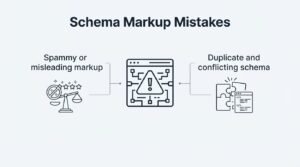
Spammy or misleading markup happens when the schema data doesn’t match what’s actually visible on the page, such as marking up a five-star rating that appears nowhere in the visible content. Google’s structured data guidelines explicitly list this mismatch as a policy violation that can trigger a manual action.
Duplicate and conflicting schema shows up most often on sites that layer a plugin’s auto-generated markup on top of manually coded schema without removing the original, leaving two competing Organization or Product blocks on the same page. AI systems parsing conflicting entity data tend to discount both instances rather than choosing one.
Measuring the Impact of Schema on AI Search Performance
Search Console’s “Search Appearance” filters let a site owner isolate impressions and clicks coming specifically from rich results tied to schema markup, separating that performance from standard blue-link traffic. Search Console’s performance report breaks this data out by search appearance type, which is the fastest way to see whether new markup moved the needle.
Correlating schema changes with AI citation frequency is harder to track directly, since most AI platforms don’t yet expose citation-source reporting the way Search Console does. I typically watch branded query volume and direct traffic shifts in the weeks following a schema rollout as an indirect proxy.
How Schema Markup Fits Into a Broader SEO Strategy

Schema markup is one component of technical SEO, sitting alongside site speed, crawlability, and mobile usability as a foundational layer that has to be solid before content or authority-building work can fully pay off. Technical SEO is the discipline of optimizing a site’s infrastructure so search engines can crawl, render, and understand it correctly, and schema is the piece specifically responsible for meaning, not just accessibility.
Schema also reinforces E-E-A-T signals when it’s used to mark up author credentials, organizational details, and review authenticity, giving both traditional search and AI systems more confidence in a source before citing it. None of this replaces strong content or a healthy backlink profile. It strengthens the foundation those efforts are built on.
Conclusion
Schema markup connects a website’s entities, content types, and business details directly to how AI search engines extract and cite information. Getting the core types right, implementing clean JSON-LD, and validating regularly makes a measurable difference in visibility.
Schema is one piece of a much larger technical SEO and AI-readiness picture, and it works best paired with strong content, sound site architecture, and consistent performance tracking over time.
We help businesses implement, validate, and monitor schema markup correctly. Talk to our White Label SEO Service team to get your site AI-search ready.
Frequently Asked Questions
What is schema markup in simple terms?
Schema markup is code added to a webpage that labels its content so search engines can understand exactly what it means. It uses a shared vocabulary called Schema.org.
Does schema markup guarantee AI Overview citations?
No, schema markup does not guarantee an AI Overview citation on its own. It improves the odds by making content easier for AI systems to trust and extract accurately.
Which schema type matters most for AI search visibility?
Organization and Article schema matter most for most sites’ AI search visibility. They establish entity trust and content credibility before any other schema type adds value.
Can schema markup hurt my SEO if implemented incorrectly?
Yes, incorrect schema markup can hurt SEO, particularly when marked-up data doesn’t match visible page content. Google treats this mismatch as a policy violation risk.
How long does it take to see results from schema implementation?
Most sites see rich-result eligibility changes within two to six weeks of correct implementation. AI citation impact typically takes longer to observe and measure.
Do I need a developer to implement schema markup?
Basic schema like Organization and Article often doesn’t require a developer, especially on WordPress with a plugin. Custom Product, Review, or multi-location LocalBusiness schema usually does.
How often should schema markup be updated?
Schema markup should be updated whenever the underlying page content changes, especially prices, ratings, or author details. Reviewing it quarterly catches drift that plugins sometimes introduce.