AI search engines select and rank sources by evaluating content relevance, source credibility, structural extractability, and freshness, then pulling the highest-matching passages into a generated answer. I’ve watched this shift reshape how visibility works over the past two years, and it’s not the same game as traditional blue-link SEO. We built this guide to walk through exactly what’s happening behind the scenes.
Search used to mean ten blue links and a click. Now an AI model reads dozens of pages, picks the best pieces, and writes the answer itself. That changes everything about how you earn visibility.
This guide covers what AI search engines actually are and how they differ from traditional search, how they crawl and retrieve content in real time, the ranking signals they weigh most heavily, and how content structure and source authority influence whether you get cited. We’ll also cover how to measure your AI visibility and avoid the mistakes that keep pages invisible.
What Are AI Search Engines and How Do They Differ From Traditional Search?
AI search engines are systems that generate direct answers to queries by retrieving and synthesizing information from multiple web sources rather than simply listing links. I think of them as research assistants that read the web on your behalf and hand you a summary instead of a stack of tabs.
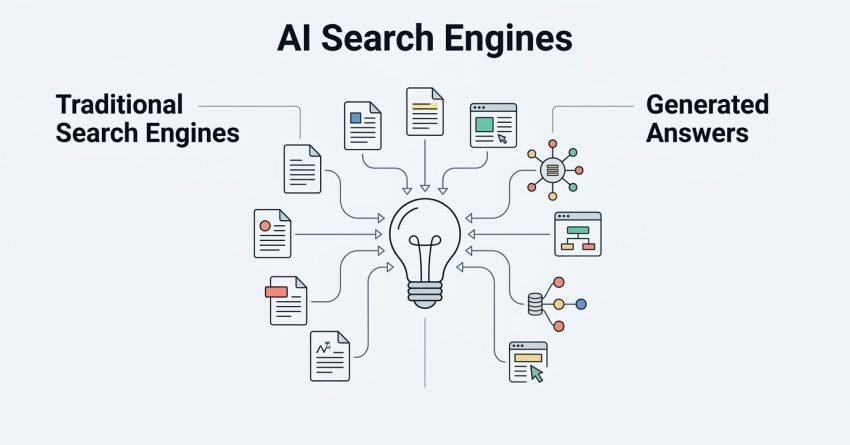
Traditional search engines like classic Google return a ranked list of pages and leave the reading to you. AI search engines, including ChatGPT, Perplexity, Google AI Overviews, and Microsoft Copilot, read multiple pages, extract the most relevant passages, and blend them into one generated answer.
AI Search Engines vs. Traditional Search Engines
The core difference comes down to output format. Traditional search ranks whole pages; AI search ranks and extracts individual passages, sentences, and data points from those pages.
| Factor | Traditional Search | AI Search |
| Output | List of ranked links | Synthesized answer |
| Unit ranked | Whole page | Passage/sentence |
| User action | Clicks through | Reads answer directly |
| Source visibility | URL shown prominently | Citation, often smaller or absent |
Key Players in AI Search
ChatGPT, Perplexity, Google AI Overviews, and Microsoft Copilot each pull from different retrieval systems, but all four share the same underlying goal: surface the most relevant, trustworthy, and extractable content for a given query. I track all four separately because their citation behavior isn’t identical. Perplexity tends to cite more sources per answer, while AI Overviews often condenses to two or three.
How Do AI Search Engines Find and Crawl Content?
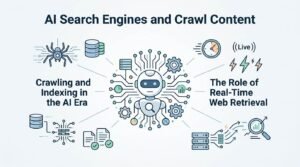
AI search engines find content the same way traditional crawlers do at the base layer, using bots that request pages, follow links, and index text, but many AI systems add a real-time retrieval layer on top of that stored index. This matters because a page can be indexed and still miss out on citation if it isn’t retrievable at the moment of the query.
Crawling and Indexing in the AI Era
Search engine crawlers still visit your site the traditional way. What’s changed is what happens after: instead of just storing the page for ranked link display, AI systems break it into chunks that get matched against queries semantically.
The crawling process generally works in this order:
- A bot requests the page and renders the HTML
- Text is extracted and split into semantic chunks
- Each chunk is converted into a vector embedding
- Embeddings are stored for similarity matching against future queries
- At query time, the closest-matching chunks are retrieved
- Retrieved chunks are ranked by relevance and credibility
- The top chunks feed into the generated answer
The Role of Real-Time Web Retrieval
Some AI systems don’t rely only on a pre-built index. Perplexity and Google AI Overviews perform live retrieval at the moment of the query, pulling fresh results rather than relying solely on a cached snapshot from weeks earlier.
What Is Retrieval-Augmented Generation (RAG) and Why Does It Matter?
Retrieval-augmented generation is a technique that combines a search retrieval step with a language model’s generation step, so the model answers using retrieved documents instead of only its training data. This is the architecture behind most AI search tools today, and understanding it explains almost every ranking behavior that follows.
How RAG Connects Search Retrieval to AI Answers
Without RAG, a language model can only answer from what it learned during training, which goes stale fast. With RAG, the model retrieves current documents at query time, then generates an answer grounded in those specific passages. This is why a page published yesterday can still get cited in an answer today; retrieval happens live, and generation happens on top of it.
What Ranking Signals Do AI Search Engines Prioritize?
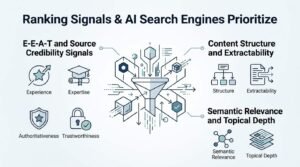
AI search engines prioritize semantic relevance, source credibility, content structure, and freshness when selecting which passages to surface in a generated answer. These four signal groups explain almost every visibility difference I see between pages targeting the same query.
| Signal Group | What It Measures | Why It Matters |
| Semantic Relevance | How closely content matches query meaning | Determines retrieval eligibility |
| Source Credibility | Author expertise, domain trust, citations | Determines whether retrieved content gets used |
| Content Structure | Extractability of individual sentences | Determines whether a passage can be lifted cleanly |
| Freshness | Recency of publication or update | Determines priority among similar-quality sources |
E-E-A-T and Source Credibility Signals
Experience, expertise, authoritativeness, and trustworthiness function as a credibility filter that AI systems apply before trusting a retrieved passage enough to cite it. A technically accurate paragraph on an anonymous, unsourced page competes at a real disadvantage against the same claim published with a named author and supporting citations.
Content Structure and Extractability
Extractability describes how easily a single sentence or paragraph can be lifted out of a page and quoted without losing meaning. Pages that answer questions directly in the first sentence of each section consistently outperform pages that bury the answer under three paragraphs of preamble.
Semantic Relevance and Topical Depth
Semantic relevance measures how closely the meaning of your content, not just its keywords, matches the intent behind a query. A page covering a topic from multiple angles, using the vocabulary a real expert would use, tends to match a broader range of query phrasings than a page optimized around one exact keyword.
How Does Source Authority Influence AI Citations?
Source authority influences AI citations by acting as a trust multiplier, meaning content from a well-established, well-linked domain gets weighted higher than identical content from an unknown domain during the source selection stage. I’ve seen near-identical paragraphs get cited from one domain and skipped entirely from another, and authority signals are usually the reason.
Domain Authority and Backlink Signals
Backlinks still matter in AI search, functioning as a trust signal that tells the retrieval system other credible sites vouch for this domain. A Backlinko study of ranking factors found that the number of referring domains remains one of the strongest correlates with visibility across search systems, AI-driven ones included.
Brand Mentions and Third-Party Validation
Unlinked brand mentions across news sites, forums, and review platforms contribute to how AI systems assess whether a source is genuinely authoritative on a topic, separate from backlinks alone. This kind of validation builds a pattern of trust the model can recognize even without a clickable link attached.
How Does Content Structure Affect Whether AI Engines Cite a Page?
Content structure affects AI citation because a passage that cannot be understood on its own, disconnected from its surrounding paragraph, is far less likely to get extracted cleanly into a generated answer. This is the single most controllable factor in this entire guide.
Answer-First Writing and Extractable Formatting
Answer-first writing means the first sentence under every heading directly answers that heading’s implied question, with supporting context following afterward rather than before. I write every client page this way now because it consistently produces more citations than a build-up style that saves the answer for the end of the paragraph.
Structured Data and Schema Markup
Schema markup FAQ schema, HowTo schema, and Article schema helps AI crawlers parse the exact role each piece of content plays on a page, which speeds up accurate extraction. Pages with clean schema tend to get pulled into structured answer formats like lists and tables more often than pages without it.
What Role Does Freshness and Update Frequency Play in AI Source Selection?
Freshness affects AI source selection because retrieval systems weight recently updated content more heavily for time-sensitive or evolving queries, while stable, factual queries show far less sensitivity to publish date. A page updated within the last few months on a fast-moving topic will often outrank an older, more established page purely on recency for that query type.
An Ahrefs analysis of top-ranking content found that update frequency correlates strongly with sustained visibility on queries tied to trends, tools, or pricing categories where stale information actively hurts the reader.
How Do AI Search Engines Evaluate Content Quality and Accuracy?
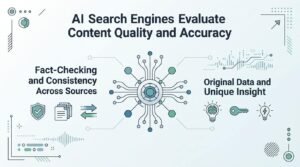
AI search engines evaluate content quality and accuracy by cross-referencing claims across multiple retrieved sources and favoring passages that align with consensus rather than outlier claims. A single unsupported statistic tends to get filtered out if no other credible source corroborates it.
Fact-Checking and Consistency Across Sources
Consistency checking means the system compares a claim found on your page against what other trusted sources say about the same topic before deciding how much weight to give it. This is part of why a claim with an in-sentence citation to a credible source tends to survive this filtering step better than an unsupported claim.
Original Data and Unique Insight
Original research and proprietary data give AI systems a reason to cite your specific page rather than paraphrasing a generic version of the same claim available elsewhere. A unique statistic, survey result, or case study functions as a citation magnet precisely because it can’t be sourced from ten other pages instead.
How Do AI Overviews and Featured Snippets Select Their Source?
AI Overviews and featured snippets select their source by identifying the passage that most directly and completely answers the query in the fewest words, then verifying that passage against the credibility and freshness signals covered earlier. The winning passage is rarely the most detailed one; it’s the most self-contained one.
Featured snippets and AI Overviews often pull from different pages than the ones ranking first organically, because raw ranking position and extractability are measured separately even though they’re correlated.
What Is the Role of User Intent in AI Source Ranking?
User intent shapes AI source ranking by determining which passage type the system looks for, whether that’s a definition, a comparison, a step-by-step process, or a number, before it even starts evaluating credibility or freshness. A page that matches the query’s words but answers the wrong intent type gets passed over regardless of how authoritative it is.
Query phrasing gives away intent directly in most cases. A “what is” query wants a definition-shaped answer, while a “vs” query wants a comparison table, and a system that fails to distinguish between the two will retrieve poorly no matter how good its index is.
How Do AI Search Engines Handle Multiple Sources for the Same Query?
AI search engines handle multiple sources for the same query by blending several retrieved passages into one answer and attributing different claims to different citations rather than relying on a single page. This is why a generated answer often cites three or four sources rather than one.
Source Diversity and Cross-Referencing
Cross-referencing means the system deliberately pulls from more than one domain to reduce the risk of amplifying a single source’s errors or bias. I see this play out most clearly on comparison and “best of” queries, where the answer visibly stitches together claims from several competing pages.
What Is Generative Engine Optimization (GEO) and How Does It Differ From SEO?
Generative engine optimization is the practice of structuring and writing content specifically to be retrieved, understood, and cited by AI-driven answer engines rather than only ranked in a traditional results list. It shares a foundation with SEO but shifts the finish line from a ranking position to a citation.
| Factor | Traditional SEO | GEO |
| Success metric | Ranking position, clicks | Citation frequency, answer inclusion |
| Content unit | Whole page | Passage/sentence |
| Primary lever | Keywords, backlinks | Extractability, credibility, structure |
| Measurement tools | Rank trackers | AI answer monitoring tools |
How Can Businesses Optimize Content to Be Selected by AI Search Engines?
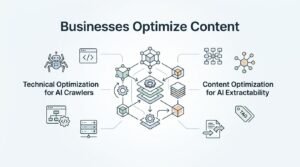
Businesses can optimize content for AI search by combining technical accessibility with answer-first writing, since a page that AI crawlers can’t parse cleanly never reaches the stage where writing quality even matters. I always start with the technical layer before touching a single sentence of copy.
Technical Optimization for AI Crawlers
Technical optimization means confirming that AI crawlers Google-Extended, PerplexityBot, and GPTBot, among them aren’t blocked in robots.txt, and that pages render cleanly without heavy client-side JavaScript hiding the core content. A page blocked from these crawlers simply cannot be retrieved, regardless of content quality.
Content Optimization for AI Extractability
Content optimization for extractability means restructuring paragraphs so each one answers its heading directly in the first sentence, defines key entities plainly, and attributes statistics inline rather than in a separate footnote. This single change tends to produce the fastest visible improvement in citation frequency.
How Do You Measure Visibility in AI Search Results?
Measuring AI search visibility means tracking how often your brand or pages get cited in AI-generated answers, which requires different tools than traditional rank tracking since there’s no fixed SERP position to monitor. I run this as a separate reporting line from standard organic tracking now.
Practical tracking methods include:
- Manually querying target questions across ChatGPT, Perplexity, and Google AI Overviews on a set schedule
- Using emerging AI-visibility tracking platforms that monitor citation frequency
- Reviewing referral traffic patterns from AI platforms in Google Analytics
- Monitoring branded query volume as an indirect signal of AI-driven exposure
What Are Common Mistakes That Prevent AI Search Engines From Citing a Source?
The most common mistake that prevents AI citation is burying the direct answer under introductory paragraphs instead of stating it in the first sentence of a section. This alone accounts for more missed citations than any technical issue I’ve diagnosed.
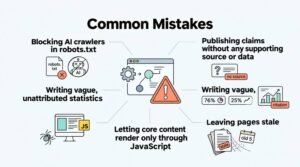
Other frequent issues include:
- Blocking AI crawlers in robots.txt without realizing it
- Publishing claims without any supporting source or data
- Writing vague, unattributed statistics that can’t survive a fact-check pass
- Letting core content render only through JavaScript that crawlers can’t parse
- Leaving pages stale on topics that move quickly
Conclusion
AI search engines rank sources by blending semantic relevance, credibility, structure, and freshness into one retrieval decision. Understanding retrieval, ranking signals, and extractability turns visibility from guesswork into a repeatable process.
Generative engine optimization builds directly on SEO fundamentals rather than replacing them, and the two disciplines will keep converging as AI answers become a bigger share of search.
We help businesses structure and optimize content so AI search engines can find, trust, and cite it. Talk to White Label SEO Service about building your AI-ready search visibility strategy today.
Frequently Asked Questions
Do AI search engines use the same ranking factors as Google?
AI search engines share some ranking factors with Google, like authority and relevance, but add extractability and passage-level structure as additional requirements. Traditional rankings alone don’t guarantee AI citation.
Can a low-authority website still get cited by AI search engines?
Yes, a low-authority website can get cited if it offers unique data or a clearly extractable answer that higher-authority pages lack. Originality and structure can offset some authority gaps.
How often do AI search engines update their sources?
AI search engines with real-time retrieval, like Perplexity and Google AI Overviews, can pull newly published content within hours. Systems without live retrieval depend on their last indexing cycle.
Does having schema markup guarantee AI citation?
No, schema markup does not guarantee citation, but it helps AI crawlers parse content structure faster and more accurately. It increases the odds of clean extraction rather than ensuring it outright.
Why does my page rank on Google but never get cited by AI search?
This usually happens when the page ranks on authority and backlinks, but buries answers in long introductions instead of stating them directly. Extractability, not just ranking position, drives AI citation.
Do AI search engines prefer citing multiple sources over one?
Yes, AI search engines often cite multiple sources for a single answer to cross-reference claims and reduce reliance on any one page. This is especially common for comparison and listicle-style queries.
How is generative engine optimization different from traditional SEO?
Generative engine optimization focuses on getting individual passages cited inside AI-generated answers, while traditional SEO focuses on ranking whole pages in a results list. GEO builds on SEO rather than replacing it.