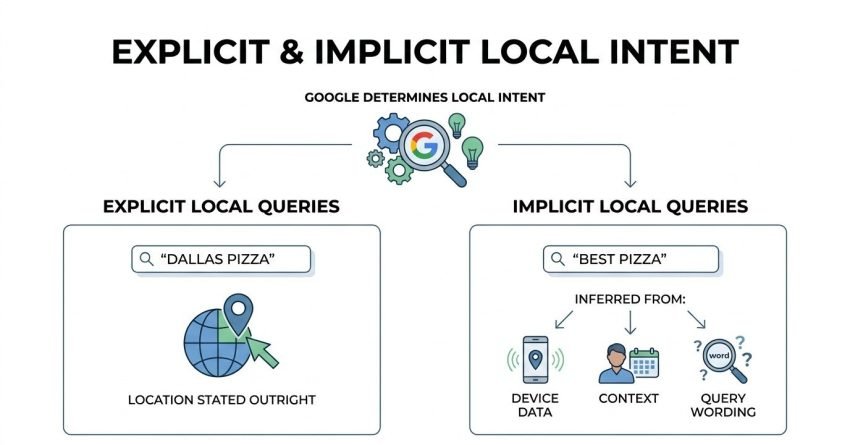
Local intent is the signal Google extracts from a search query to determine whether a user wants results tied to a specific geographic area. I look at this signal on every SEO account I run, because misreading it means optimizing content for the wrong SERP behavior entirely. Google splits local intent into two categories: explicit, where the location is stated outright, and implicit, where the location is inferred from context, device data, or query wording.
Getting this classification wrong costs businesses visibility in the exact moments buyers are ready to convert. We see it constantly in audits.
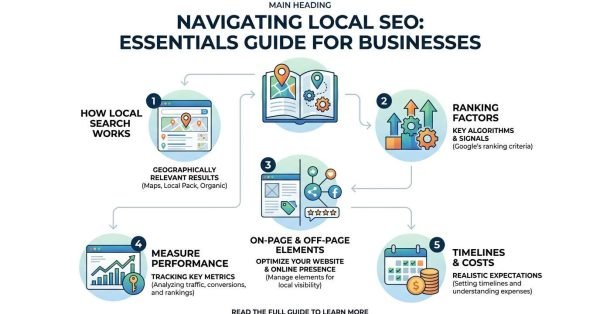
This guide covers how Google defines local intent, what separates explicit from implicit queries, the signals search engines use to classify them, how the local pack responds to each type, and how to build a content and optimization strategy that covers both.
What Local Search Intent Means to Google
Local search intent is Google’s determination that a query requires results anchored to a physical location rather than general web results. I’ve watched this classification decide whether a page shows up in the local pack, the organic results, or not at all.
Google doesn’t treat “local” as a single flag. It runs a layered assessment, checking the query text itself, the user’s device location, their search history, and even the time of day before deciding how much weight location should carry in the results it returns.
How Google Defines “Local” in a Query
Google defines a query as local when its ranking systems detect a strong likelihood the user wants a business, service, or result tied to a specific place. This can come from an explicit place name or from behavioral and contextual clues.
I think about this less as a binary switch and more as a confidence score. A query like “plumber” from a phone with location services on scores high for local intent even without a city name attached.
Why Intent Classification Matters for Rankings
Intent classification matters for rankings because it determines which ranking system Google applies: the local pack algorithm, which weighs proximity and business signals heavily, or the standard organic algorithm, which weighs content and authority.
Get the classification wrong on your end, and you’re optimizing content for a ranking system that was never going to serve your page in the first place. That’s the practical stakes here.
What Are Explicit Local Queries
An explicit local query is a search that directly states a location, either as a city, neighborhood, zip code, or landmark name. “Coffee shop in Austin” and “HVAC repair 60614” are both explicit; the location requirement is written into the words themselves.
![Infographic titled EXPLICIT LOCAL QUERIES showing a search bar where search directly states location, branching into three query structures: [SERVICE] + [CITY] with 'Dentist in Brooklyn', [BUSINESS TYPE] + [ZIP CODE] with 'Moving Company 90210', and [SERVICE] + [NEIGHBORHOOD NAME] with '24 hour pharmacy downtown Denver'.](https://whitelabelseoservice.com/wp-content/uploads/2026/09/What-Are-Explicit-Local-Queries-300x167.jpeg)
I find these the easiest to optimize for because Google doesn’t have to infer anything. The location signal is unambiguous, which means your on-page targeting can mirror the query almost directly.
Common Patterns in Explicit Local Queries
Explicit local queries tend to follow a handful of recurring structures: [service] + [city], [service] + “near” + [landmark], [business type] + [zip code], and [service] + [neighborhood name].
These patterns show up consistently across autocomplete data and in Google’s People Also Ask panels for local categories.
Examples of Explicit Local Query Structures
A few real-world shapes of explicit queries: “dentist in Brooklyn,” “24 hour pharmacy downtown Denver,” “moving company 90210,” and “best tacos Highland Park.”
Each one names the geography outright, which is what separates this category from implicit queries entirely.
What Are Implicit Local Queries
An implicit local query is a search where no location is stated in the text, but Google infers local intent from signals outside the query itself. “Pizza near me” is the classic example, but plenty of implicit queries don’t even include “near me.”
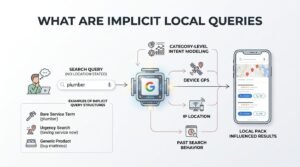
A search for “emergency electrician” carries implicit local intent because Google’s systems recognize that almost nobody searching that phrase wants a national brand’s homepage; they want someone who can show up at their house.
How Google Detects Hidden Local Intent
Google detects hidden local intent primarily through category-level intent modeling; its systems have learned, across billions of past searches, which query categories reliably correlate with local need even without a stated place name.
Device GPS, IP-based location, and past search behavior all feed into this same detection layer, reinforcing or overriding the category-level assumption depending on signal strength.
Examples of Implicit Local Query Structures
Common implicit patterns include bare service terms (“plumber,” “nail salon”), urgency-driven searches (“towing service now”), and generic product searches with local purchase intent (“buy mattress”).
None of these name a place, yet Google still routes most of them into local-pack-influenced results.
The Signals Google Uses to Classify Local Intent
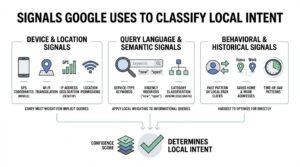
Google classifies local intent using a combination of device signals, semantic query analysis, and behavioral history layered together into a single confidence score. A 2023 Google Search Central documentation update on local search ranking factors confirmed relevance, distance, and prominence remain the three core local ranking pillars, all of which depend on accurate intent classification first.
I treat these signal categories as a checklist when I’m diagnosing why a page isn’t appearing where a client expects it to.
Device and Location Signals
Device and location signals include GPS coordinates on mobile, Wi-Fi triangulation, IP address geolocation on desktop, and location permissions granted to the Google app or Chrome.
These signals carry the most weight for implicit queries since there’s no text-based location to fall back on.
Query Language and Semantic Signals
Query language signals include the presence of service-type keywords Google has historically associated with local intent, urgency modifiers like “now” or “open,” and category classification drawn from the Knowledge Graph.
Semantic analysis of business category terms lets Google apply local weighting even to queries that look purely informational on the surface.
Behavioral and Historical Signals
Behavioral signals include a user’s past pattern of clicking local pack results for similar queries, their saved home and work addresses, and time-of-day patterns that correlate with local errands versus research browsing.
This is the layer most businesses have zero visibility into, and it’s also the hardest one to optimize for directly.
The Role of the Local Pack and Map Results in Intent Classification
The local pack is the three-result map-based block Google shows when it classifies a query as carrying strong local intent, and its appearance is itself a signal of how Google scored that query.
I use local pack presence as a diagnostic tool constantly; if a target keyword triggers the pack, I know Google has classified it as local-first, and my content strategy needs to prioritize Google Business Profile signals alongside on-page SEO.
How Google’s Algorithms Interpret Proximity and Location
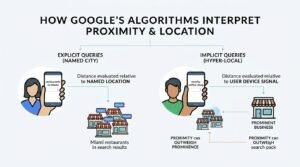
Google’s algorithms interpret proximity as the physical or inferred distance between the searcher and a candidate business location, and this factor carries different weight depending on query classification.
For explicit queries naming a city, proximity gets measured against the named location rather than the user’s actual position, which is why a search for “restaurants in Miami” from someone in Chicago still returns Miami results.
Proximity as a Ranking Factor
Proximity functions as one of the three core local ranking factors alongside relevance and prominence, and Google has stated distance is evaluated relative to whichever location signal the query provides, whether that’s the user’s device or a named place in the search terms.
I’ve seen proximity outweigh prominence entirely for hyper-local implicit searches, which is why nearby smaller businesses often beat larger competitors in the pack.
Implicit vs Explicit Queries: Key Differences Compared
The table below shows how implicit and explicit local queries differ across the signals Google relies on and the SERP behavior each one triggers.
| Attribute | Explicit Query | Implicit Query |
| Location stated in text | Yes | No |
| Primary signal used | Query text | Device/behavioral data |
| Example | “plumber in Dallas” | “plumber” |
| Local pack trigger likelihood | High, consistent | High, but device-dependent |
| Optimization focus | Location pages, geo-keywords | GBP signals, category relevance |
| Ranking sensitivity to user location | Low | High |
How Businesses Should Optimize for Both Query Types
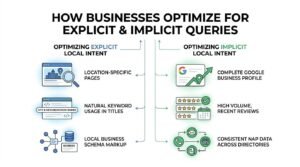
Businesses need separate optimization tactics for explicit and implicit queries because each one relies on a different primary signal to trigger local ranking.
I build most local SEO strategies around covering both simultaneously rather than picking one, since most target customers use a mix of both phrasing styles across a single buying journey.
Optimizing for Explicit Local Intent
Optimizing for explicit intent means building dedicated location pages, using city and neighborhood names naturally in titles and headers, and structuring local business schema markup with accurate address data.
This is largely a content and technical SEO exercise; the location keyword needs to exist cleanly on the page Google is meant to rank.
Optimizing for Implicit Local Intent
Optimizing for implicit intent centers on Google Business Profile completeness, category accuracy, review volume and recency, and consistent NAP (name, address, phone) data across directories.
None of this lives on your website directly, which is exactly why so many businesses under-invest here relative to on-page work.
Common Mistakes Businesses Make With Local Intent Targeting
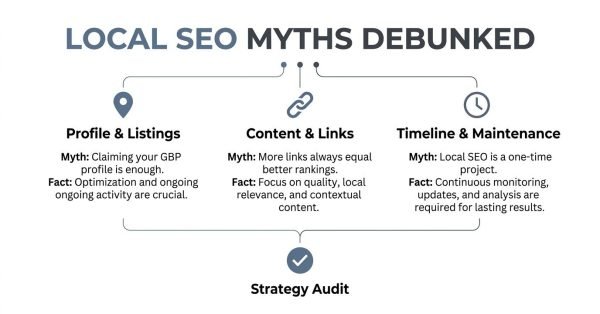
The most common mistake is treating every local query as explicit and building city-name landing pages while ignoring Google Business Profile optimization entirely.
I also see the reverse mistake often: businesses that nail their GBP setup but never build location-specific content, missing the explicit-query traffic entirely because there’s no page for Google to rank.
How Local Intent Classification Affects SEO Strategy and Content Planning
Local intent classification affects content planning because it determines whether a keyword needs a dedicated page, a section within a broader service page, or no dedicated content at all.
Keyword research that ignores this distinction tends to produce bloated site architectures with duplicate-feeling location pages targeting queries that were never explicit to begin with.
Tools and Methods to Analyze Local Search Intent
Google Search Console query reports, SERP feature tracking, and manual SERP checks across devices are the primary methods I use to determine how Google is classifying a given keyword.
Checking whether the local pack appears for a keyword, and how it changes across different simulated locations, tells you more about Google’s classification than any third-party intent-labeling tool.
How AI and Google’s Algorithm Updates Are Changing Local Intent Detection
AI-driven ranking systems are making local intent detection more contextual, pulling in signals like session history and query sequences rather than scoring each search in isolation.
A 2024 analysis from Search Engine Land on AI-driven local search changes noted increasing reliance on session-based context for borderline queries that don’t clearly fall into either explicit or implicit categories.
Conclusion
Explicit and implicit local queries rely on different signals entirely, and Google’s classification determines which ranking system controls visibility.
The distinction shapes content structure, technical SEO priorities, and Google Business Profile strategy across any serious local search plan.
We help businesses build strategies covering both query types. Talk to White Label SEO Service about your local visibility today.
Frequently Asked Questions
What is the difference between implicit and explicit local search queries?
Explicit queries state a location directly in the search text, while implicit queries carry local intent without naming a place. Google infers implicit intent from device and behavioral signals instead.
Does Google always show the local pack for implicit queries?
No, the local pack appears based on confidence in local intent, not query type alone. Device location and category signals both influence whether it triggers.
How does Google determine location for a query with no stated city?
Google relies on GPS data, IP address, and saved location history to infer where the searcher is. This data substitutes for the missing location text.
Can a business rank locally without location pages?
Yes, Google Business Profile optimization can drive local pack rankings for implicit queries without dedicated location pages. Explicit queries generally still benefit from location-specific content.
Why do some searches without “near me” still trigger local results?
Google’s category-level intent modeling recognizes many service terms as inherently local, regardless of phrasing. Historical search behavior confirms this classification at scale.
Is proximity more important than relevance for local rankings?
Neither factor consistently outweighs the other; both combine with prominence in Google’s local ranking formula. Proximity typically carries more weight for implicit, device-based searches.
How can I check how Google classifies my target keyword?
Search the keyword from different simulated locations and devices, then note whether the local pack appears consistently. Google Search Console query data adds further confirmation over time.