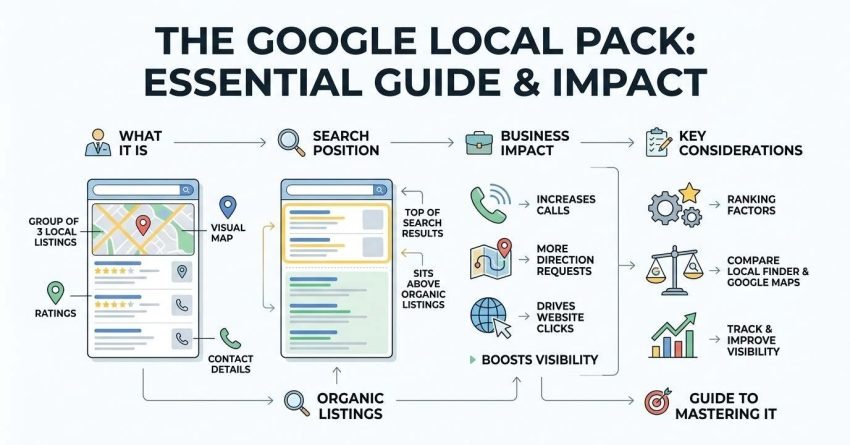
The Google Local Pack is the group of three local business listings that Google displays at the top of search results for location-based queries, complete with a map, ratings, and contact details. I see it dominate the first screen of results for anything with local intent, from “plumber near me” to “best coffee shop downtown.” It sits above the standard organic listings, and for most local searches, it’s the first thing a searcher’s eye lands on.
Ranking here changes everything for a local business’s visibility. Businesses that never appear in the pack tend to see a fraction of the calls, direction requests, and website clicks. I’ve watched this pattern hold across dozens of industries.
This guide covers what the Local Pack actually is and how it differs from organic results, the ranking factors and features that shape which businesses appear, how it compares to the Local Finder and Google Maps, and how to track and improve your own visibility inside it.
What Is the Google Local Pack?
The Google Local Pack is a set of three business listings, shown with a map, that Google surfaces for search queries with clear local intent. It appears above the organic results for searches like “italian restaurant near me” or “emergency electrician [city],” and it pulls its data primarily from Google Business Profile rather than from a website’s on-page content.
I think of the Local Pack as Google’s answer to “who’s nearby and relevant right now.” It’s distinct from the ten blue links below it because it’s built entirely around location, business data, and reviews rather than backlinks or content depth alone.
How the Local Pack Differs From Organic Results
Organic results rank web pages based on content relevance, backlinks, and technical SEO signals. The Local Pack ranks business entities based on Google Business Profile completeness, proximity to the searcher, and review signals, which means a business with a thin website can still rank in the pack if its profile is strong.
I’ve seen businesses with weak websites outrank competitors with excellent content, purely because their profile was better optimized. That’s a distinction worth understanding before investing SEO budget in the wrong place.
Where the Local Pack Appears on the SERP
The Local Pack typically appears directly below any paid ads and above the organic listings, occupying prime real estate on both desktop and mobile. On mobile, it often appears even higher, sometimes pushing organic results below the fold entirely.
This placement is why local pack visibility carries outsized value for service-area businesses. A business ranking third in organic search but first in the Local Pack still wins the click.
How Does the Google Local Pack Work?
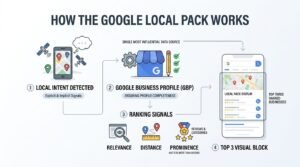
The Google Local Pack works by matching a searcher’s query and location to business profiles that best satisfy relevance, distance, and prominence signals, then displaying the top three as a ranked visual block. Google runs this matching in real time, adjusting results based on the searcher’s exact GPS location or the city named in the query.
I treat this as a live auction of sorts, except reviews, categories, and profile completeness matter more than bidding. The businesses that show up have usually done the unglamorous work of maintaining accurate, detailed profiles.
The Role of Google Business Profile
Google Business Profile is a free Google tool that lets businesses manage how their name, address, hours, and other details appear across Google Search and Maps. It’s the single most influential data source behind Local Pack rankings, more so than the business’s own website in most cases.
I always start local SEO audits by checking profile completeness, because an unclaimed or sparse profile almost guarantees exclusion from the pack, regardless of how strong the underlying business is.
How Google Matches Local Intent to Businesses
Google detects local intent through explicit signals (“near me,” a city name) and implicit signals (a searcher’s device location, search history, and query type). Once intent is confirmed, Google filters its business database by category match, then ranks by the same relevance, distance, and prominence factors used across the Local Pack.
A locksmith searching “24 hour locksmith” fifteen minutes from three shops will see different Local Pack results than a searcher three miles away, even for the identical query.
The 3-Pack vs. the Old 7-Pack
Google’s Local Pack now shows three listings, down from the seven-listing format Google phased out back in 2015. Google made the shift after data from Search Engine Land’s historical SERP tracking showed users rarely engaged with results beyond the first three positions.
I remind clients of this whenever they ask why “ranking in the local pack” feels harder than it used to. The competition for three spots is naturally steeper than it was for seven, which raises the bar for profile optimization and review volume alike.
Key Ranking Factors Behind the Local Pack
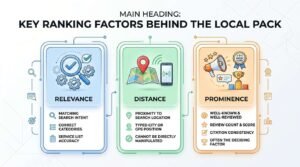
Google ranks Local Pack listings using three core factors: relevance, distance, and prominence, each carrying different weight depending on the query. Understanding how these three interact explains almost every fluctuation I’ve seen in Local Pack visibility.
Relevance
Relevance measures how well a business profile matches the intent and terms of a search query. A plumbing company categorized correctly as “Plumber” with matching services listed will outrank a generalist “Home Services” listing for a plumbing-specific search.
I treat category selection and service list accuracy as the first lever to pull, since it’s the fastest fix for a business missing from the pack entirely.
Distance
Distance measures how close a business is to the location implied in the search, whether that’s a typed city name or a device’s actual GPS position. This factor alone explains why the same search can produce completely different Local Pack results for two people standing a mile apart.
There’s no way to manipulate distance directly, which makes the other two factors, relevance and prominence, the practical places to focus effort.
Prominence
Prominence reflects how well-known and well-reviewed a business is, based on signals like review count, review score, and citation consistency across the web. A BrightLocal survey found that businesses with 40+ reviews see meaningfully higher Local Pack inclusion rates than those with fewer than 10.
I’ve watched prominence become the deciding factor between two otherwise-similar competitors more often than relevance or distance combined.
Key Features of a Local Pack Listing
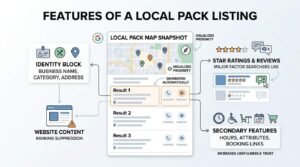
Every Local Pack listing displays a consistent set of features: business name, category, star rating, review count, hours, address, and often a direct call or website button. These elements aren’t optional; Google pulls them automatically from the Google Business Profile.
Business Name, Category, and Address
The business name, primary category, and physical address form the identity block of every Local Pack listing, and mismatches between these and the actual website content can trigger ranking suppression. I check this alignment first whenever a client’s listing seems to be underperforming for no obvious reason.
Star Ratings and Review Count
Star ratings and review counts sit directly beneath the business name and are often the single biggest factor searchers use to choose between the three listed options. A business with 4.8 stars and 200 reviews will consistently out-click a 4.2-star competitor with 20 reviews, even at a lower map position.
Hours, Attributes, and Booking Links
Hours, business attributes (like “wheelchair accessible” or “outdoor seating”), and direct booking or ordering links appear as secondary features that increase the listing’s usefulness without affecting core ranking. I still recommend filling these out completely, since incomplete listings read as lower-trust to both Google and searchers.
The Local Pack Map Snapshot
The map snapshot shows pin locations for all three businesses relative to the searcher, giving an immediate visual sense of proximity before a single listing is read. This snapshot is generated automatically and can’t be customized, but its accuracy depends entirely on correct address data in the profile.
Google Business Profile’s Role in Local Pack Rankings
Google Business Profile is the foundational account through which nearly every Local Pack ranking signal gets submitted and verified. Categories, hours, photos, posts, and Q&A responses all live inside this single account, and neglecting any of them creates gaps competitors can exploit.
I consider profile management a daily discipline rather than a one-time setup, since Google rewards profiles that show ongoing activity through fresh photos, posts, and review responses.
Why the Local Pack Matters for Local Businesses
The Local Pack matters because it occupies the highest-visibility position on local search results and captures a disproportionate share of clicks, calls, and direction requests. For any business relying on foot traffic or local service calls, absence from the pack often means invisibility to a majority of local searchers.
Click-Through and Visibility Impact
Research from Uberall found that Local Pack listings capture roughly 44% of all clicks on local search results pages, far outpacing the combined click share of every organic listing below them. That single data point explains why Local Pack inclusion has become a primary KPI for brick-and-mortar and service-area businesses alike.
Local Pack vs. Organic Traffic Value
Local Pack traffic tends to convert at a higher rate than standard organic traffic because it captures searchers already expressing high commercial or navigational intent. I generally advise clients to treat pack visibility and organic content strategy as complementary investments rather than substitutes for one another.
Local Pack vs. Local Finder vs. Google Maps Results
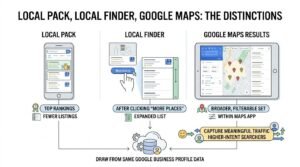
The Local Finder is the expanded list of local businesses a searcher sees after clicking “More places” beneath the Local Pack, while Google Maps results show a broader, filterable set of listings within the Maps app itself. All three surfaces draw from the same underlying Google Business Profile data, but they differ in how many listings they show and how much detail accompanies each one.
I explain this distinction to clients who obsess over pack rankings alone. A business that misses the top three can still capture meaningful traffic through Local Finder and Maps visibility, particularly for higher-intent searchers willing to scroll further.
How Reviews Influence Local Pack Visibility
Reviews influence Local Pack visibility both directly, as a prominence signal, and indirectly, by affecting click-through rate once a listing appears. Review recency also plays a measurable role, since Google appears to weight recent review activity more heavily than a large volume of old reviews.
I push clients toward a steady review-generation cadence rather than a one-time push, because a sudden spike followed by silence can look less trustworthy than a slow, consistent trickle.
Common Reasons Businesses Don’t Appear in the Local Pack
Businesses commonly miss the Local Pack due to unverified or suspended Google Business Profiles, incorrect business categories, inconsistent name-address-phone data across the web, or simply being physically too far from typical searcher locations for that keyword. Each of these causes has a distinct fix, and diagnosing which one applies is usually the fastest path to recovery.
A business with a suspended profile, for example, needs Google’s reinstatement process resolved before any other optimization matters. One with inconsistent citation data across directories needs those listings corrected and standardized before ranking signals stabilize.
How to Track and Measure Local Pack Performance
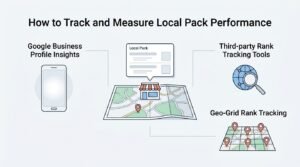
Local Pack performance is tracked primarily through Google Business Profile Insights, which reports search queries, customer actions, and view counts directly tied to pack appearances. Third-party rank tracking tools that simulate searches from specific geographic points add a layer of competitive visibility that Google’s own dashboard doesn’t provide.
I recommend pairing profile-level insights with geo-grid rank tracking for any business serious about measuring pack performance over time, since a single rank check from one location tells an incomplete story across an entire service area.
Local Pack Trends and Algorithm Changes to Watch
Google continues to weight review quality, profile engagement, and proximity more heavily each year, while historically dominant factors like raw backlink count matter less for local-specific rankings. AI-driven search features are also beginning to summarize Local Pack data directly within search results, which changes how prominently individual listings get displayed.
I keep a close eye on these shifts because local ranking factors move faster than broader organic algorithm updates, and businesses that treat their profile as “set and forget” tend to lose ground within a year.
Conclusion
The Google Local Pack rewards businesses that combine strong Google Business Profile data with consistent reviews and accurate local signals. Understanding relevance, distance, and prominence together explains most ranking shifts we see.
Local visibility keeps evolving as Google tests new formats and AI-driven summaries within search results. Businesses that maintain their profiles consistently tend to hold their pack positions longest.
We help businesses build the technical and profile foundations Local Pack rankings depend on. Partner with White Label SEO Service to strengthen your local visibility strategy today.
Frequently Asked Questions
What is the Google Local Pack?
The Google Local Pack is a set of three local business listings, shown with a map, that appears above organic results for location-based searches. It pulls data mainly from Google Business Profile rather than website content.
How many businesses appear in the Local Pack?
Exactly three businesses appear in the current Local Pack format. Google reduced this from seven listings back in 2015 based on user engagement data.
What factors determine Local Pack rankings?
Google ranks Local Pack listings using relevance, distance, and prominence. Reviews, profile completeness, and category accuracy all feed into these three core factors.
Why isn’t my business showing in the Local Pack?
Common causes include an unverified profile, incorrect business category, or inconsistent address data across the web. Physical distance from typical searchers can also prevent inclusion.
Do reviews affect Local Pack rankings?
Yes, reviews directly influence the prominence factor and indirectly affect click-through rate. Recent review activity appears to carry more weight than older reviews alone.
How is the Local Pack different from Google Maps results?
The Local Pack shows only three listings directly in search results, while Google Maps shows a broader, filterable list within the Maps app. Both draw from the same Google Business Profile data.
Can a business track its Local Pack performance?
Yes, through Google Business Profile Insights and third-party geo-grid rank tracking tools. These show query data, customer actions, and ranking visibility across different locations.