I’ve pulled up both platforms side by side more times than I can count, and here’s the direct answer: Google Maps and Apple Maps are location-based mapping services that also function as local search engines, and they differ significantly in market share, ranking mechanics, and business tools. Google Maps dominates in the US with a larger user base and more mature business features. Apple Maps has closed much of that gap since 2020, especially among iPhone-heavy demographics.
I’ve watched businesses obsess over one platform while completely ignoring the other, and that gap always costs them visibility. Every unclaimed listing is a missed customer.
This guide covers what each platform actually is and how they handle business listings, the ranking factors behind local visibility on each, data accuracy and review management differences, and how navigation, advertising, and analytics tools compare. I’ll close with a decision framework for where to focus your limited time and budget.
What Google Maps and Apple Maps Actually Are
Google Maps is a digital mapping and local search platform that Google operates as both a navigation tool and a business discovery engine. It pulls from Google’s search index, so a business’s map presence directly ties into broader local SEO performance. I treat it as an extension of the search engine itself, not a standalone app.
Apple Maps is a mapping application built into every iPhone, iPad, and Mac, and it increasingly functions as its own local search layer for iOS users. Apple has invested heavily in rebuilding its underlying map data since 2018, moving away from third-party data providers toward its own satellite and vehicle-collected imagery.
Google Maps at a Glance
Google Maps ties directly into Google Business Profile, Google Search, and Google’s broader ranking algorithm. A business’s map pin, reviews, and photos all feed into the same visibility engine that powers organic search results.
Apple Maps at a Glance
Apple Maps runs on Apple Business Connect, the free tool Apple launched in 2022 to let business owners manage their own listings directly, similar in concept to Google Business Profile but with a smaller advertising and review ecosystem attached.
How Google Maps and Apple Maps Handle Local Business Listings
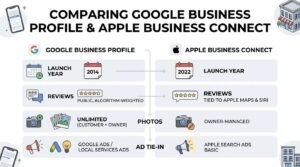
Google Business Profile and Apple Business Connect are the two primary dashboards business owners use to control how their listing appears on each respective map. Google’s version has existed since 2014 in various forms and carries far more third-party integration. Apple’s platform launched in 2022 and is still expanding its feature set.
| Feature | Google Business Profile | Apple Business Connect |
| Launch year | 2014 (as GMB) | 2022 |
| Review system | Yes, public, algorithm-weighted | Yes, tied to Apple Maps and Siri |
| Photo uploads | Unlimited, customer + owner | Owner-managed, growing library support |
| Direct messaging | Yes | Limited |
| Booking integration | Yes (third-party) | Limited, expanding |
| Ad platform tie-in | Yes (Google Ads / Local Services Ads) | Yes (Apple Search Ads Basic) |
Google Business Profile vs Apple Business Connect
Google Business Profile connects to the full Google ecosystem, including Search, Maps, and Google Assistant, which means one optimized listing improves visibility across multiple surfaces simultaneously.
Verification and Ownership Differences
Google verifies ownership through postcard, phone, email, or video methods depending on the business category. Apple typically verifies through Apple ID association and existing business documentation, and the process generally moves faster for businesses already in Apple’s developer or business ecosystem.
Search Visibility and Ranking Factors on Each Platform
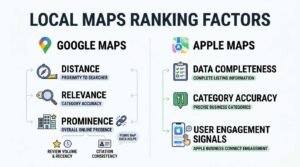
Google Maps rankings depend primarily on relevance, distance, and prominence, the same three-pillar framework Google’s own local ranking documentation confirms drives map pack placement. Prominence is largely built from review volume, review recency, and citation consistency across the web. I’ve seen businesses jump several map pack positions purely by fixing inconsistent NAP data.
Apple Maps ranking factors remain less publicly documented, but data completeness, category accuracy, and user engagement signals from Apple Business Connect appear to carry the most weight based on observed listing movement.
What Influences Google Maps Rankings
Google weighs proximity to the searcher heavily, alongside category relevance and the strength of the business’s overall online presence, including backlinks and citation consistency.
What Influences Apple Maps Rankings
Apple Maps favors listings with complete profiles, accurate hours, and active engagement through Apple Business Connect, though Apple has not published a formal ranking algorithm the way Google has.
Map Data Accuracy and Update Frequency
Google Maps updates its map data continuously through a mix of satellite imagery, Street View vehicles, and user-submitted edits, giving it the fastest average update cycle of any consumer mapping platform. Apple Maps rebuilt its entire dataset between 2018 and 2021 using its own fleet of mapping vans rather than licensed data.
Businesses that move locations or change hours frequently tend to see Google Maps reflect those changes faster, sometimes within days. Apple Maps updates have become significantly more frequent since the 2021 rebuild but still generally lag Google’s turnaround.
Reviews, Ratings, and Reputation Management Differences
Google Maps reviews carry more public weight than Apple Maps reviews because Google reviews also surface directly in standard Google Search results, not just within Maps itself. This dual visibility means a single Google review pool influences two major discovery surfaces at once.
Apple Maps reviews are visible within the Maps app and through Siri responses, but they don’t carry over into a separate Apple search engine the way Google’s do. A business with strong review velocity on Google Maps typically sees compounding SEO value that Apple Maps reviews don’t replicate.
| Aspect | Google Maps Reviews | Apple Maps Reviews |
| Surfaces in general search | Yes | No |
| Response tools for owners | Full public reply | Public reply available |
| Review request integration | Yes (link generator) | Limited |
| Influence on map ranking | High | Moderate |
User Base, Market Share, and Device Ecosystem Reach
Google Maps holds a dominant share of the US mapping market, with Statista’s 2024 mobile app data showing it as the most-used navigation app across both Android and iOS users combined. Apple Maps usage concentrates almost entirely among iPhone owners, since it comes preinstalled and defaults for Siri-based directions.
I look at this less as “which app wins” and more as “which audience segment you’re missing.” A business ignoring Apple Maps is invisible to a meaningful share of iPhone users who never open Google Maps at all.
Navigation, Directions, and Real-Time Traffic Features
Google Maps offers more granular real-time traffic data, crowd-sourced incident reporting, and public transit integration across more cities globally. Apple Maps has closed much of this gap in major metro areas but still trails in smaller markets and international transit coverage.
Both platforms support turn-by-turn voice navigation, live traffic rerouting, and estimated arrival times, so for most everyday driving purposes, the practical difference for customers finding a business is minimal.
Business Photos, Menus, and Rich Media Support
Google Maps allows unlimited photo uploads from both the business owner and customers, plus menu integration for restaurants and product catalogs for retailers. Apple Business Connect supports owner-uploaded photos and basic business details but offers a narrower media toolkit overall.
Restaurants in particular lean on Google’s menu and photo depth, since customer-submitted food photos often influence click-through more than owner-uploaded ones.
Advertising and Promoted Listings Compared
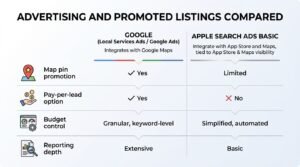
Google Local Services Ads and Google Ads both integrate directly with Google Maps, letting businesses pay for prioritized placement in map pack results and sponsored pins. Apple Search Ads Basic, launched more recently, offers a comparable but smaller-scale promotional system tied to App Store and Maps visibility.
| Ad Feature | Google (Local Services Ads / Google Ads) | Apple Search Ads Basic |
| Map pin promotion | Yes | Limited |
| Pay-per-lead option | Yes | No |
| Budget control | Granular, keyword-level | Simplified, automated |
| Reporting depth | Extensive | Basic |
Integration With Siri, Google Assistant, and Voice Search
Google Assistant pulls business information directly from Google Business Profile, so an optimized listing improves voice search answers on Android devices and smart speakers. Siri pulls from Apple Maps and Apple Business Connect data for any spoken query like “find a coffee shop near me.”
Voice search behavior increasingly shapes local visibility, since an incomplete or outdated listing on either platform means Siri or Google Assistant simply skips over the business in favor of a competitor with cleaner data.
Analytics and Performance Insights for Business Owners
Google Business Profile provides detailed performance insights, including search queries that triggered a listing view, call clicks, direction requests, and photo view counts. Apple Business Connect offers a more limited analytics dashboard, covering basic views and engagement but with less query-level detail.
Business owners tracking ROI from map visibility typically rely far more heavily on Google’s data, simply because it exposes more of the underlying search behavior driving those visits.
Local SEO Implications: Why Businesses Shouldn’t Choose Just One
Local SEO strategy benefits from claiming and optimizing listings on both Google Maps and Apple Maps, because each platform reaches a distinct and only partially overlapping audience segment. Treating this as an either-or decision leaves revenue on the table regardless of which platform “wins” on paper.
I approach both listings as part of the same broader local SEO strategy, not two separate projects. Consistent NAP data, matching categories, and synchronized hours across both platforms reduce the kind of conflicting signals that can quietly suppress rankings on either one. A dedicated local SEO strategy framework typically treats every map platform, review site, and citation source as one interconnected trust signal rather than isolated tasks. Backlink-driven authority and citation consistency, the same signals that influence Google’s map pack, tend to lift a business’s visibility across both mapping ecosystems simultaneously.
Which Platform Should Your Business Prioritize? Decision Framework
Businesses with a primarily Android or mixed-device customer base should prioritize Google Maps first, while businesses in iPhone-dense markets or demographics should give Apple Maps equal weight from day one. Neither platform should be ignored, but limited time and budget often force a sequencing decision.
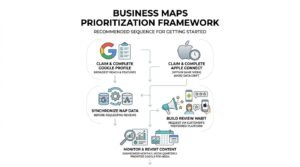
I generally recommend this sequence for businesses just getting started:
- Claim and fully complete the Google Business Profile listing first, since it carries the broadest reach and richest feature set.
- Claim and complete the Apple Business Connect listing within the same week to avoid data drift between platforms.
- Synchronize NAP data, hours, and categories across both before requesting reviews on either.
- Build a review generation habit that requests feedback through whichever platform each customer actually used.
- Monitor both dashboards monthly, since Apple’s analytics update less frequently than Google’s.
- Revisit photo and menu content quarterly, prioritizing Google given its deeper media support.
A local business ranking factors overview helps clarify which signals carry the most weight before allocating time between the two platforms.
Common Mistakes Businesses Make on Both Platforms
The most frequent mistake I see is claiming a Google Business Profile and never touching Apple Business Connect at all, leaving an entire customer segment to find outdated or missing information. Inconsistent business hours between the two platforms confuse customers and erode trust when a listing says “open,” but the door is locked.
Duplicate listings, often created accidentally through data aggregators, split review counts and confuse both platforms’ ranking systems. Ignoring negative reviews on either platform signals neglect to both future customers and the ranking algorithms weighing engagement.
Conclusion
Google Maps and Apple Maps serve overlapping but distinct audiences, each with its own listing tools, ranking factors, and review ecosystems. Understanding both strengthens visibility everywhere customers search.
Treat both platforms as part of one local search strategy rather than a single choice. The businesses that win locally show up consistently everywhere.
We build exactly this kind of multi-platform visibility for our clients. Talk to White Label SEO Service about strengthening your local search presence today.
Frequently Asked Questions
Is Apple Maps as accurate as Google Maps for businesses?
Apple Maps has significantly closed the accuracy gap since rebuilding its data between 2018 and 2021. Google Maps still updates changes faster on average, though the difference has narrowed considerably in most US metro areas.
Do I need to list my business on both Google Maps and Apple Maps?
Yes, listing on both platforms reaches distinct audience segments that don’t fully overlap. Skipping either one means missing customers who default to that specific app.
Which map app do more people use in the US?
Google Maps holds the larger overall US user base across both Android and iOS devices. Apple Maps usage concentrates heavily among iPhone owners who default to Siri-based directions.
Can I manage Google Maps and Apple Maps listings from one place?
No single native dashboard manages both simultaneously, so each requires separate access through Google Business Profile and Apple Business Connect. Some third-party listing management tools do sync updates across both.
Does Apple Maps affect local SEO rankings?
Apple Maps doesn’t directly influence Google’s search rankings, but consistent business data across platforms supports overall local SEO signal strength. Citation consistency across multiple sources remains a recognized ranking factor.
How often should I update my business information on both platforms?
Update both listings immediately whenever hours, location, or contact details change. Reviewing photos, categories, and descriptions quarterly keeps both profiles competitive.
What’s the biggest difference between Google Maps and Apple Maps for business owners?
Google Maps offers deeper analytics, wider ad integration, and a larger user base overall. Apple Maps offers simpler management through Apple Business Connect but with fewer advanced business tools.