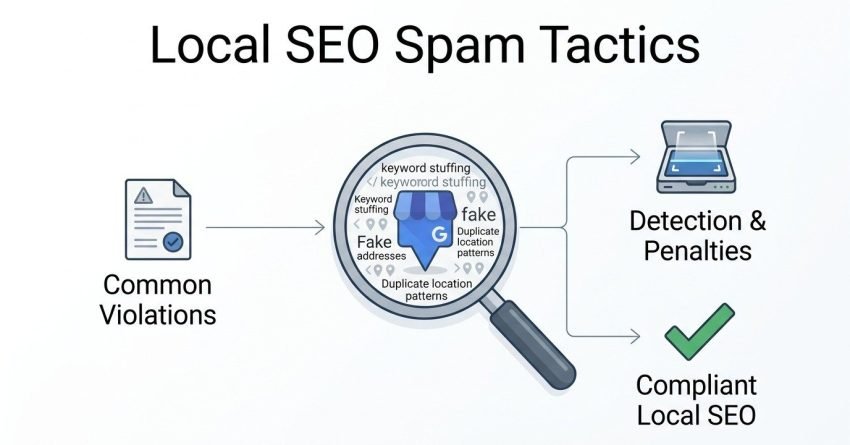
I’ve reviewed enough Google Business Profiles over the years to spot spam within seconds. Local SEO spam refers to any tactic designed to manipulate local search rankings through fake, deceptive, or policy-violating means rather than genuine relevance or quality signals, and it puts any business using it at risk of suspension or removal. Search engines have gotten aggressive about detecting these patterns, and the businesses caught using them often lose far more than they gained.
I’ve watched local businesses lose years of ranking progress overnight. A single manual action can erase a Google Business Profile that took months to build.
This guide covers what actually counts as spam versus aggressive-but-legitimate marketing, the most common violations I see in local SEO campaigns, how Google detects and penalizes them, and the exact process for reporting spam you encounter. We’ll also cover what compliant local SEO looks like instead.
What Counts as Local SEO Spam?
Local SEO spam is any technique that manipulates local search results through deception rather than genuine value, and Google’s guidelines are specific about what crosses that line. The confusion I see most often involves business owners who think aggressive marketing and spam are the same thing. They’re not.
Aggressive but legitimate tactics include things like requesting reviews from every customer or running location pages for offices you genuinely operate. Spam involves fabrication: fake addresses, fake reviews, fake content designed purely to trick ranking algorithms.
Google’s Definition of Spam vs. Aggressive Marketing
Google’s guidelines draw a clear line: aggressive marketing pushes real information hard, while spam fabricates information that doesn’t exist. A business that emails past customers asking for honest reviews is being aggressive. A business paying for five-star reviews from people who never used the service is spamming.
I use one test with clients constantly: would this tactic still work if it were completely transparent? If a business would be embarrassed for Google (or a customer) to see exactly how a ranking signal was created, that’s usually the spam line.
Fake and Misleading Google Business Profile Listings
Fake GBP listings are business profiles that misrepresent location, ownership, or service area to game local pack rankings, and they’re one of the most reported violation types Google receives. I see this constantly in competitive service-area businesses like plumbing, HVAC, and legal services.
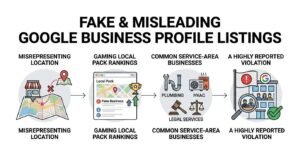
The most common version involves a business creating a listing for an address it doesn’t actually operate from, just to rank in a nearby city’s local pack. Google’s guidelines require a real, staffed location for any business claiming a physical address.
Keyword Stuffing in Business Names
Keyword stuffing in a Google Business Profile name means adding service or location terms beyond the actual registered business name. A listing named “Bob’s Plumbing – Emergency 24/7 Plumber Denver Colorado” instead of just “Bob’s Plumbing” violates Google’s naming guidelines directly.
This tactic used to work well before Google tightened enforcement. Now it’s one of the fastest ways to trigger a suspension, because the pattern is trivial for automated systems to detect.
Virtual Offices and PO Box Addresses
Virtual offices and PO boxes used as a listed business address violate Google’s requirement that the address represent a real, staffed location during business hours. I’ve seen entire industries, particularly lawyers and insurance agents, build listings around office suites they visit once a month.
Google’s Business Profile guidelines explicitly prohibit PO boxes and require the address to match a location customers can physically visit. Enforcement on this has increased significantly since 2023.
Fake Reviews and Review Gating
Fake reviews are reviews written by non-customers, incentivized reviewers, or purchased review services, and they represent one of the highest-volume categories of local SEO spam reports Google receives. The tactic remains common because reviews carry heavy ranking weight and consumer trust influence.
Review gating, the practice of only asking happy customers to leave public reviews while diverting unhappy customers elsewhere, is a related but distinct violation. Both tactics manufacture a false trust signal.
Incentivized and Purchased Reviews
Incentivized reviews involve offering money, discounts, or free products in exchange for a review, which violates the review policies of virtually every major platform. I’ve seen businesses buy review packages from overseas sellers, and the pattern is almost always detectable: reviews arrive in bursts, use generic language, and come from accounts with no other review history.
A BrightLocal survey found that 62% of consumers say they can recognize a fake review, which means the risk isn’t just algorithmic detection anymore.
Review Gating and Filtering Negative Feedback
Review gating filters customers before they leave a public review, routing unhappy ones to private feedback while pushing happy ones toward the public review page. This creates an artificially inflated rating that misrepresents actual customer sentiment.
Google explicitly prohibits this under its review solicitation guidelines. The practice also tends to backfire, since sophisticated customers notice when a business only responds publicly to positive feedback.
Duplicate and Bulk-Created GBP Listings
Duplicate listings are multiple Google Business Profiles created for the same physical location or business entity, usually to occupy more local pack real estate. I see this most in industries with high competition density, like personal injury law and home services.
Bulk-created listings go further, involving dozens or hundreds of fabricated locations, often for franchise-style lead generation operations. Both patterns violate Google’s one-listing-per-location policy and get suppressed once flagged.
Doorway Pages and Fake Location Pages
Doorway pages are website pages built for cities or service areas where the business has no genuine physical presence, created solely to rank for “near me” and city-specific searches. They typically follow an identical template with only the city name swapped.
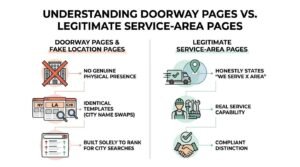
I can usually spot these within the first sentence, since the content reads as a Mad Libs version of the homepage with a location dropped in. Google’s algorithm has gotten equally good at detecting the pattern at scale.
City-Specific Pages With No Real Presence
City-specific pages built without a real office, staff, or service history in that city misrepresent the business’s actual footprint. This differs from a legitimate service-area page, which honestly states “we serve X area” without claiming a physical office there.
The distinction matters for compliance. A legitimate service-area page describes real service capability; a doorway page fabricates local presence that doesn’t exist.
Manipulative Local Link Building Schemes
Manipulative local link schemes are backlink acquisition tactics that violate Google’s link spam policies, typically through paid placements, link exchanges, or networks built solely to pass ranking authority. Local businesses fall into this trap often because “get backlinks fast” services specifically target small business budgets.
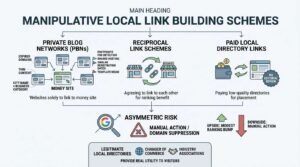
The risk with link schemes is asymmetric: the upside is a modest, often short-lived ranking bump, while the downside is a manual action that can suppress an entire domain.
Private Blog Networks (PBNs) for Local Sites
A private blog network is a group of websites created solely to link to a money site, disguised as independent, unrelated publications. Local SEO PBNs often use expired domains with existing authority, repurposed to publish thin content around a city name and business category.
Google’s spam policies classify PBN participation as a link scheme, and detection has improved through footprint analysis; shared hosting, similar registration dates, and template reuse all flag these networks.
Reciprocal and Paid Local Directory Links
Reciprocal link schemes involve businesses agreeing to link to each other purely for ranking benefit rather than genuine reader value. Paid local directory links, where a business pays a low-quality directory site for a placement with no editorial review, follow the same violation pattern.
Legitimate local directories like the Chamber of Commerce or industry associations differ because they provide real utility to visitors beyond the link itself.
Citation Spam and NAP Inconsistency Abuse
Citation spam involves creating business citations (name, address, phone listings) on low-quality or fabricated directory sites purely to inflate citation count. NAP inconsistency abuse happens when a business deliberately varies its name, address, or phone number across listings to create multiple ranking footprints for the same entity.
This tactic backfires more often than it succeeds. Inconsistent NAP data actually confuses Google’s entity matching and can suppress rankings rather than help them, which is the opposite of the intended effect.
Negative SEO and Competitor Sabotage Tactics
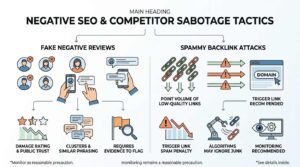
Negative SEO refers to tactics used against a competitor’s website rather than to promote one’s own, with the goal of triggering a penalty or ranking suppression on the target. Local SEO makes an easy target for this because review platforms and citation sites are publicly editable.
I’ve worked with business owners who spent months trying to identify why rankings dropped, only to discover a competitor had been running one of these campaigns for weeks.
Fake Negative Reviews Against Competitors
Fake negative reviews are reviews left by a competitor or their proxy, designed to damage a business’s rating and public trust signals. These often appear in clusters, use similar phrasing to each other, and come from accounts with no genuine purchase history.
Google allows businesses to flag suspected fake reviews for removal, though the process requires evidence and can take weeks to resolve.
Spammy Backlink Attacks
A spammy backlink attack involves pointing large volumes of low-quality or toxic links at a competitor’s domain, hoping to trigger an algorithmic link spam penalty. This tactic became more common after Google’s link spam algorithms started weighting toxic backlink profiles more heavily.
Google’s John Mueller has stated that negative SEO through bad backlinks rarely works because Google’s algorithms are generally good at ignoring or disavowing junk links automatically, though monitoring remains a reasonable precaution.
Grey-Hat Local SEO Tactics That Toe the Line
Grey-hat local SEO tactics sit between clearly compliant and clearly spammy, exploiting ambiguity in Google’s guidelines rather than violating them outright. Examples include creating multiple GBP categories that stretch relevance, or building service-area pages that are technically accurate but heavily optimized to feel like location pages.
I generally advise against grey-hat tactics even when they’re not explicitly banned, because enforcement standards shift over time and today’s tolerated grey area often becomes tomorrow’s penalty trigger.
How Google Detects and Penalizes Local SEO Spam
Google detects local SEO spam through a combination of algorithmic pattern recognition, user spam reports, and manual review team investigations. Google’s local search algorithms flag suspicious patterns like sudden review bursts, template-duplicated location pages, and address clustering that don’t match real-world business density.
Detection has become significantly faster since 2022, when Google expanded automated GBP suspension systems to catch fabricated listings before they gain ranking traction.
Manual Actions vs. Algorithmic Suppression
A manual action is a penalty applied by a human reviewer at Google after investigating a specific violation, usually visible in Google Search Console with a stated reason. Algorithmic suppression happens automatically when ranking systems detect spam patterns without human review, and it often shows no direct notification at all.
Manual actions typically come with a reconsideration request path. Algorithmic suppression requires removing the offending pattern and waiting for the next algorithm refresh, which offers no fixed timeline.
How to Report Local SEO Spam to Google
Reporting local SEO spam to Google requires using the specific reporting tool that matches the violation type, since GBP spam, review spam, and web spam each route through different systems. Every report should include the exact URL or listing, a clear description of the violation, and supporting evidence like screenshots.
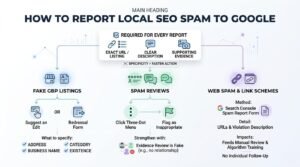
I’ve submitted dozens of these reports for clients dealing with fake competitor listings, and specificity matters enormously. Vague reports get deprioritized; detailed ones with evidence get action faster.
Reporting Fake GBP Listings
Fake GBP listings can be reported directly from the listing itself by clicking “Suggest an edit” or through Google’s dedicated redressal form for business profile spam. The report should specify exactly what’s fake: the address, the business name, the category, or the business’s existence entirely.
Google typically reviews suspicious listing flags within a few days to a few weeks, depending on report volume in that category.
Reporting Spam Reviews
Spam reviews are reported by clicking the three-dot menu next to the specific review and selecting “Flag as inappropriate,” which routes it to Google’s review moderation team. Evidence that the review is fake, such as the reviewer having no relationship to the business, strengthens the report significantly.
Google’s review policy guidelines outline the specific violation categories eligible for removal, including fake engagement, conflict of interest, and off-topic content.
Reporting Web Spam and Link Schemes
Web spam, including doorway pages and link schemes, gets reported through Google’s Search Console spam report form, which accepts URLs along with a description of the violation. This form feeds into both manual review queues and training data for future algorithm updates.
Reports don’t get individual confirmation or follow-up in most cases, but they do contribute to enforcement patterns across the wider web.
Consequences of Getting Caught Using Spam Tactics
Getting caught using spam tactics typically results in listing suspension, ranking suppression, or in severe cases, permanent removal from Google’s index. A suspended Google Business Profile can take anywhere from a few days to several months to reinstate, and reinstatement is never guaranteed.
Beyond the ranking impact, there’s reputational risk. Customers who discover fake reviews or fabricated locations tend to lose trust in a brand permanently, not just temporarily.
Building Compliant, Sustainable Local SEO Instead
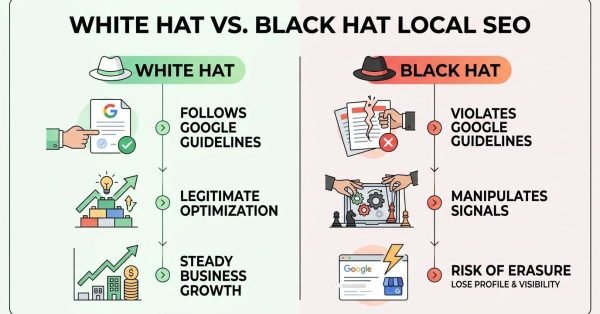
Compliant local SEO relies on genuine signals: real reviews earned through service quality, accurate business information, and content that reflects actual expertise and location presence. It takes longer to build than spam tactics, but it doesn’t carry suspension risk or the reputational damage of getting caught.
I tell every client the same thing: rankings built on real signals survive algorithm updates. Rankings built on fabrication are always one update away from collapsing.
White-Hat Alternatives to Common Spam Shortcuts
White-hat alternatives replace fabricated signals with earned ones, requesting reviews from genuine customers instead of buying them, building real service-area content instead of doorway pages, and earning citations from legitimate directories instead of spam networks. Each shortcut has a slower, compliant equivalent that produces durable results.
The tradeoff is patience. Legitimate local SEO growth typically takes three to six months to show meaningful movement, compared to the days-long (but temporary) results some spam tactics produce.
Conclusion
Local SEO spam covers fake listings, manipulated reviews, doorway pages, and manufactured links designed to trick ranking systems. Each carries detection risk and real consequences for the businesses using them.
Reporting these violations helps protect fair rankings across the broader local search ecosystem, and understanding compliant alternatives protects a business from those same penalties long-term.
We help businesses build genuinely sustainable local visibility instead of risky shortcuts. Reach out to White Label SEO Service to start growing your organic presence the right way.
Frequently Asked Questions
Is it illegal to use local SEO spam tactics?
Local SEO spam tactics violate platform guidelines rather than the law in most cases, though extreme cases involving fraud can carry legal consequences. Google enforces these violations through suspension and ranking penalties rather than legal action.
How long does it take Google to remove a fake GBP listing after reporting?
Google typically reviews reported fake listings within a few days to a few weeks. High-volume violation categories or incomplete reports can extend that timeline significantly.
Can a competitor’s fake reviews hurt my business ranking?
Fake negative reviews primarily damage reputation and conversion rate rather than directly hurting rankings. However, review count and rating do factor into local pack visibility over time.
What’s the difference between aggressive marketing and spam in local SEO?
Aggressive marketing promotes real, accurate information forcefully, while spam fabricates false information to manipulate rankings. The test is whether the tactic would still work if fully transparent.
Will using spam tactics get my whole website penalized, or just my GBP listing?
Web spam tactics like link schemes and doorway pages can trigger site-wide penalties, while GBP-specific violations usually affect only the business listing. Severe or repeated violations can affect both simultaneously.
How do I know if my SEO agency is using spam tactics on my behalf?
Warning signs include unusually fast ranking gains, review counts spiking suddenly, or an inability to explain exactly what tactics are being used. Legitimate agencies can describe their strategy transparently in specific terms.
Can I recover my rankings after a manual action for spam?
Recovery is possible through removing the violation and submitting a reconsideration request, though timelines vary from weeks to months. Some severe or repeated violations result in permanent suppression.