Link building is the process of earning hyperlinks from other websites that point back to your own, and it remains one of the top three ranking factors search engines use to evaluate a page’s authority and trustworthiness, according to Backlinko’s analysis of 11.8 million Google search results. For business owners trying to grow organic traffic, this single element often separates pages stuck on page two from pages sitting in the top three results.
Ignoring link building while competitors invest in it steadily erodes your ranking position over time. I have watched well-written content sit invisible on page four simply because nobody linked to it. This guide is for anyone starting from zero.
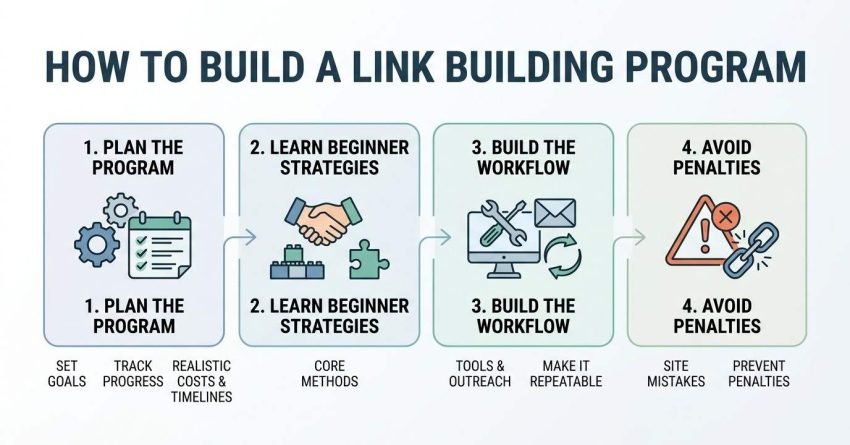
This guide covers how backlinks actually influence rankings, the core link building strategies available to beginners, how to set goals and track progress, the tools and outreach processes that make a program repeatable, and what realistic costs and timelines look like. We will also flag the mistakes that get sites penalized.
What Is Link Building and Why Does It Matter for SEO?
Link building is the ongoing practice of acquiring hyperlinks from external websites to increase a page’s authority, visibility, and ranking potential in search engines. Each link acts as a signal of trust passed from one site to another.
Search engines treat these signals similarly to citations in academic research. A page referenced by many credible sources appears more trustworthy than one referenced by none, and Google’s own documentation on how search works confirms that links remain a core relevance signal alongside content quality.
Link Building vs. Backlink Acquisition
People often use these terms interchangeably, but link building describes the strategic program, while backlink acquisition refers to the individual event of gaining one link. A program is a system; a backlink is a single outcome of that system.
Building a system matters more than chasing individual wins. One backlink rarely moves a ranking. A structured pipeline that consistently earns relevant links does.
How Links Influence Google Rankings
Google’s algorithm evaluates link authority using signals including domain relevance, referring page trust, and anchor text context to determine how much ranking value a link passes to its destination. Not every link carries equal weight.
A single link from a well-established industry publication can outweigh dozens of low-quality directory links combined. This is why link quality, not link quantity, drives the strategy throughout this guide.
How Do Backlinks Actually Work?
Backlinks work by passing a portion of a linking page’s authority, often called link equity, through a hyperlink to the destination page, influencing how search engines evaluate that destination’s trustworthiness. This transfer is not unlimited or equal across every link.
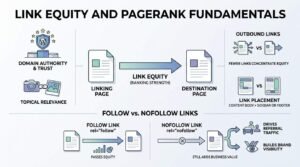
Link Equity and PageRank Fundamentals
Link equity is the value or ranking strength that one page transfers to another through a hyperlink, originally formalized through Google’s PageRank algorithm. Several factors determine how much equity gets passed:
- The authority and trust level of the linking domain
- The number of other outbound links on that same page
- The topical relevance between the linking page and destination
- The placement of the link within the content body versus a footer or sidebar
- Whether the link is followed or nofollowed
Pages with fewer outbound links concentrate more equity into each link they give. This is one reason editorial placements inside long-form articles outperform links buried in resource lists.
Follow vs. Nofollow Links
A followed link passes ranking signals to the destination page, while a nofollow link, marked with a rel=”nofollow” attribute, tells search engines not to pass that authority. Both link types still hold value.
Nofollow links drive referral traffic and build brand visibility even without direct ranking equity. I still pursue nofollow placements on high-traffic sites because the exposure alone produces business value.
What Makes a Backlink High-Quality vs. Low-Quality?
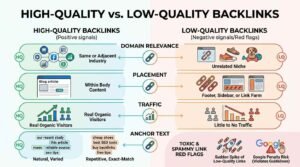
A high-quality backlink comes from a topically relevant, trustworthy domain and is placed naturally within content that a real audience reads. Quality is judged on relevance, authority, and placement context together, not any single metric alone.
Domain Authority and Relevance Signals
| Signal | High-Quality Link | Low-Quality Link |
| Domain relevance | Same or adjacent industry | Unrelated niche |
| Placement | Within body content | Footer, sidebar, or link farm |
| Traffic | Real organic visitors | Little to no traffic |
| Anchor text | Natural, varied | Repetitive, exact-match |
| Link neighborhood | Reputable surrounding sites | Spam-linked network |
This table shows why a single link from a respected trade publication routinely outperforms fifty links purchased from a private blog network.
Toxic and Spammy Link Red Flags
Toxic backlinks typically originate from link farms, expired domains repurposed for spam, or paid link networks designed purely to manipulate rankings. Google’s Search Central spam policies explicitly state that link schemes violate guidelines and can trigger manual penalties.
A sudden spike of hundreds of low-quality links pointing at one page is one of the clearest toxic-link warning signs. I flag these for disavow review the moment they appear in a backlink audit.
What Are the Main Types of Link Building Strategies?
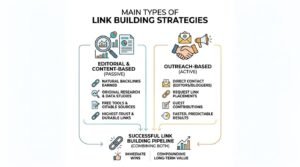
Link building strategies fall into two broad categories: earning links passively through content quality, and actively acquiring links through outreach and relationship building. Most successful programs combine both approaches.
Editorial and Content-Based Links
Editorial links are backlinks earned naturally because a piece of content, like original research, a tool, or a data study, provides enough value that other sites choose to cite it without being asked. This category produces the most durable, highest-trust links.
Original data studies and free tools consistently earn editorial links because journalists and bloggers need citable sources. Content built specifically to be linkable performs far better than generic blog posts.
Outreach-Based Links
Outreach-based links come from directly contacting site owners, editors, or bloggers to request a link placement, guest contribution, or content collaboration. This approach requires more manual effort but produces faster, more predictable results.
Combining both approaches into a single pipeline gives a beginner program both immediate wins and compounding long-term value.
How Does Guest Posting Fit Into a Link Building Program?
Guest posting is the practice of writing and publishing an article on another website in exchange for a backlink, typically placed within the author bio or body content. It remains one of the most accessible starting points for beginners.
The strongest guest posting programs target sites with genuine audience overlap rather than any site that accepts submissions. A guest post placed on an irrelevant domain rarely produces ranking or referral value, even when the link itself is followed.
Quality guest posting requires original insight, not recycled content repurposed from your own blog. Editors reject templated pitches quickly, and a rejected pitch wastes outreach time that a beginner program cannot afford to lose.
How Does Digital PR Support Link Acquisition?
Digital PR is the practice of pitching newsworthy stories, data, or expert commentary to journalists and publications in order to earn high-authority media coverage and backlinks. It scales link acquisition beyond what manual outreach alone can achieve.
A single successful digital PR campaign can generate dozens of high-authority links from one piece of coverage picked up across multiple outlets. Original survey data, proprietary research, and expert commentary tend to perform best with journalists actively searching for sources.
Digital PR requires more investment upfront than direct outreach, since it depends on genuinely newsworthy angles rather than a simple ask. The payoff comes in link authority that outreach alone rarely matches.
What Role Do Resource Pages and Directories Play?
Resource page link building targets curated pages that list helpful tools, guides, or industry resources, asking the page owner to include your content as an additional entry. These pages exist specifically to link out, making them a natural fit for beginners.
Industry-specific directories and association listings also provide legitimate link value when they are actively maintained and relevant to your niche. A directory with real traffic and editorial oversight behaves like any other quality link source.
Generic, unmoderated directories accepting any submission for a fee provide little ranking value and can trigger the toxic link red flags covered earlier. Selectivity matters more than volume in this category.
How Does Broken Link Building Work?
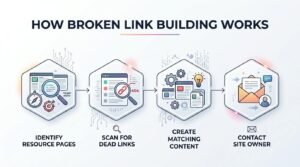
Broken link building is the process of finding dead links on other websites, then reaching out to suggest your own content as a working replacement. It works because site owners want to fix broken links but rarely have time to find replacements themselves.
The process typically follows these steps:
- Identify resource or link pages within your target niche
- Scan those pages for broken or dead outbound links using a checker tool
- Confirm the broken link’s original topic to find or create a matching replacement
- Draft a helpful outreach email flagging the broken link
- Suggest your own relevant page as the replacement
- Follow up once if there is no response within a week
This method converts a genuine favor to the site owner into a link opportunity, which tends to produce higher response rates than a cold pitch requesting a link with nothing offered in return.
How Do You Set Goals and KPIs for a Link Building Program?
Link building KPIs measure a program’s progress using metrics like referring domain growth, link velocity, and anchor text distribution rather than tracking total backlinks alone. Total link count is a misleading metric on its own.
Referring Domains vs. Total Backlinks
| Metric | What It Measures | Why It Matters More |
| Referring domains | Unique websites linking to you | Diversity signals natural growth |
| Total backlinks | Every individual link, including duplicates | One domain can inflate this artificially |
This table clarifies why ten links from ten different domains outweigh fifty links from a single site.
Tracking Link Velocity
Link velocity is the rate at which new backlinks and referring domains accumulate over a given period, typically measured monthly. A sudden unnatural spike in velocity can look manipulative to search engines, while a steady upward trend looks organic.
I set velocity targets based on competitor benchmarks rather than arbitrary numbers, since a program acquiring links faster than the entire market average raises the same red flags covered in the toxic link section above.
How Do You Build a Link Prospecting Process?
Link prospecting is the research phase of identifying which websites are realistic, relevant targets for a link before any outreach begins. Skipping this step is the single biggest reason beginner outreach campaigns fail.
A repeatable prospecting process typically includes:
- Identifying competitor backlinks using a backlink analysis tool
- Searching for industry roundups, resource pages, and guest post opportunities
- Filtering prospects by domain relevance and authority thresholds
- Checking for existing relationships or mutual connections
- Building a prioritized spreadsheet ranked by opportunity quality
Competitor backlink analysis alone often generates more qualified prospects than broad keyword searches, since it shows exactly who already links to sites like yours.
How Do You Structure Outreach Campaigns That Get Responses?
Effective outreach campaigns combine personalized messaging, a clear value proposition, and a realistic ask sent to a correctly identified contact. Generic mass-emailed templates produce response rates far below personalized, researched pitches.
A structured outreach sequence generally includes:
- An initial personalized email referencing specific content on the recipient’s site
- A clear, concise explanation of what you are offering or requesting
- A single, specific call to action
- One polite follow-up after five to seven days
- A final follow-up before closing the prospect out
A study by Backlinko analyzing 12 million cold emails found that shorter subject lines and personalized opening lines produced meaningfully higher reply rates than generic templates.
What Tools Are Needed to Run a Link Building Program?
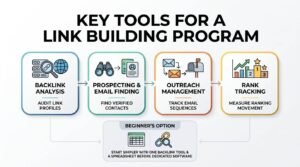
A functional link building program requires tools across four categories: backlink analysis, prospecting, outreach management, and rank tracking. Beginners do not need every tool on day one.
- Backlink analysis platforms for auditing your own and competitor link profiles
- Prospecting and email-finding tools to identify verified contact information
- Outreach management software to track email sequences and follow-ups
- Rank tracking tools to measure whether acquired links correlate with ranking movement
Most beginner programs can start with one backlink analysis tool and a simple spreadsheet before investing in dedicated outreach software.
How Much Does Link Building Cost and How Long Does It Take?
Link building typically costs businesses between $1,000 and $5,000 per month for a managed beginner-to-mid-level program, according to Ahrefs’ 2024 industry pricing survey, with measurable ranking movement generally appearing within four to six months of consistent activity.
Costs vary significantly based on whether links are earned through in-house outreach, paid guest posting, or full-service digital PR campaigns. Programs relying heavily on digital PR tend to cost more upfront but produce higher-authority links per dollar spent over time.
Timelines depend heavily on starting domain authority, competitiveness of the niche, and consistency of outreach volume. A site with almost no existing backlink profile generally takes longer to show movement than an established site adding incremental authority.
What Are Common Link Building Mistakes and Penalty Risks?
The most common link building mistakes include buying links in bulk, over-optimizing anchor text, and ignoring topical relevance in favor of raw authority metrics. Each of these behaviors risks a manual action from Google.
- Purchasing large quantities of links from private blog networks
- Using the exact same keyword-rich anchor text across dozens of links
- Chasing high domain authority scores while ignoring topical relevance
- Ignoring referring domain diversity in favor of link volume alone
- Failing to audit and disavow toxic links accumulated over time
Manual penalties tied to unnatural link schemes can remove a site from search results entirely until the issue is resolved and a reconsideration request is approved, which can take weeks even after cleanup work begins.
How Do You Build a Long-Term Link Building Roadmap?
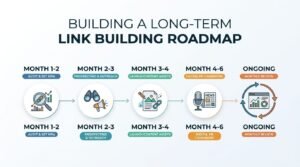
A long-term link building roadmap sequences prospecting, outreach, content creation, and performance review into a repeatable monthly cycle rather than a one-time project. Programs treated as ongoing infrastructure consistently outperform short bursts of activity.
- Month 1 to 2: audit existing backlinks and set baseline KPIs
- Month 2 to 3: build prospecting lists and begin outreach campaigns
- Month 3 to 4: launch content assets designed specifically to earn editorial links
- Month 4 to 6: layer in digital PR campaigns for authority-tier links
- Ongoing: review velocity, referring domain growth, and ranking correlation monthly
Treating this as a permanent function rather than a temporary campaign is what separates sites that keep climbing from sites that plateau after an initial push.
Conclusion
Link building combines earned editorial links, structured outreach, and consistent prospecting into one repeatable authority-building system. Domain relevance and link quality matter more than raw volume throughout this process.
Pairing this program with strong technical SEO and content foundations compounds results across your entire organic strategy over time. Sustainable growth comes from consistency, not shortcuts.
We built White Label SEO Service to help agencies and businesses execute this exact process without guesswork. Let’s build your link authority the right way, starting now.
Frequently Asked Questions
How many backlinks do I need to rank on page one?
There is no fixed number, since ranking depends on competitor link profiles and content quality, not a specific backlink count. Studying top-ranking competitors’ referring domains gives a more realistic benchmark than any generic target.
Is link building still important in 2025?
Yes, link building remains one of Google’s core ranking signals despite algorithm updates over the years. Relevance and quality now matter more than raw link volume did in earlier SEO eras.
Can I build links without outreach?
Yes, editorial links earned through original research, tools, or highly citable content require no direct outreach. This approach takes longer to scale but produces some of the most durable, natural-looking links available.
How long before link building shows ranking results?
Most sites see measurable ranking movement within four to six months of consistent link building activity. Newer domains with thin backlink profiles typically take longer than established sites.
What is a good referring domain velocity per month?
A sustainable pace generally falls within your niche’s competitive benchmark rather than a universal number. Velocity that dramatically outpaces the broader market for your niche risks appearing manipulative to search engines.
Do internal links count as link building?
No, internal links connect pages within your own site and serve a different purpose than external link building. They support site structure and crawlability but do not pass the same third-party trust signal external backlinks provide.
Should beginners hire an agency or build links in-house?
Either approach works, depending on available time, expertise, and budget for consistent outreach. Agencies typically bring established relationships and faster execution, while in-house teams retain full control over messaging and target selection.