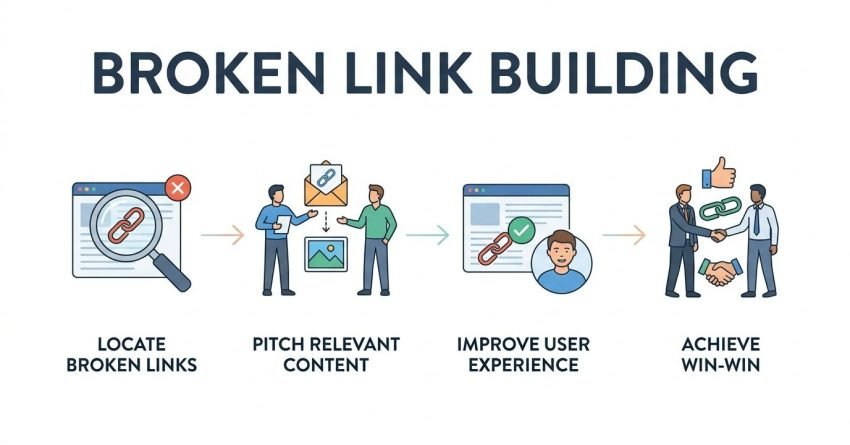
I’ve spent enough time in outreach inboxes to know that broken link building is a link acquisition method built on a simple win-win: a webmaster has a dead link hurting their user experience, and I have content that can replace it. Broken link building means finding pages that link out to resources no longer online, then pitching your own relevant content as the replacement. It works because it solves a real problem for the site owner instead of asking for a favor.
Most SEO teams treat this as a checkbox tactic. But I’ve watched it outperform guest posting campaigns when the targeting and outreach are done right, precisely thirty words in.
This guide covers what broken link building is and why it still works, the tools and step-by-step process for finding and replacing dead links, how to write outreach that gets replies, and how to measure results and avoid the mistakes that sink most campaigns.
What Is Broken Link Building?
Broken link building is an off-page SEO strategy that finds dead or 404 links on other websites and pitches replacement content from your own site to earn the backlink. The tactic sits inside the broader link acquisition discipline that any white label SEO service uses to build domain authority for clients. It works on any website that publishes outbound links to external resources.
Why Broken Link Building Works
Webmasters generally want to fix broken links because dead links hurt user experience and waste the crawl equity search engines assign to their pages. I’ve found that site owners respond faster to this kind of outreach than to a cold guest post pitch because you’re offering to solve a problem they didn’t know they had.
Broken Link Building vs. Other Link Building Methods
Broken link building differs from guest posting and skyscraper outreach in one key way: the opportunity already exists on the page before you ever reach out. Guest posting requires convincing an editor to accept new content, while skyscraper outreach asks a site to swap a working link for a better one.
Why Broken Link Building Still Works in 2026
Broken link building still works in 2026 because the volume of dead links across the web has grown alongside the total size of the internet, not shrunk. Sites redesign, migrate CMS platforms, and let domains expire constantly, and every one of those events creates a new broken link opportunity somewhere in a niche.
The Value Backlinks From Broken Link Replacement Provide
A backlink earned through broken link replacement carries the same authority value as any other earned editorial link, since it sits inside existing contextual content rather than a sidebar or footer. I treat these placements as equivalent in quality to guest post links, sometimes stronger because the linking page already ranks and has accumulated trust.
Data: How Common Broken Links Are on the Web
An Ahrefs study of over 2 billion pages found that a significant share of external links on the average website eventually break as source pages go offline or move. This scale is exactly why broken link prospecting rarely runs dry once a workflow is built.
How Search Engines Treat Broken Links (404s, 410s, Dead Pages)
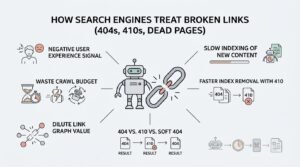
Search engines treat broken links as a negative user experience signal that can waste crawl budget and dilute the value passed through a page’s link graph. A page returning a 404 or 410 status code stops passing any authority to what used to be its destination, which is precisely the value broken link building recaptures for the replacement page.
404 vs. 410 vs. Soft 404
A 404 status tells a crawler the page is missing but might return; a 410 explicitly tells it the page is gone permanently, and a soft 404 is a page returning a 200 status while displaying “not found” content to a visitor. Google treats a confirmed 410 as a faster signal to drop the URL from its index than a 404 left unresolved.
How Broken Links Affect Crawl Budget and Rankings
Search engine crawlers spend a finite crawl budget on any given site, and repeatedly hitting dead links wastes crawl requests that could otherwise reach valuable pages. Sites with a high ratio of broken outbound or internal links can see slower indexing of new content as a downstream effect.
The Broken Link Building Process: Step-by-Step Overview
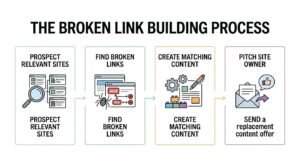
The broken link building process follows four repeatable steps: prospecting relevant sites, finding their broken links, creating matching replacement content, and pitching the site owner. Running this process at scale is what separates a one-off tactic from a genuine link acquisition channel.
- Prospect relevant sites in your niche using resource pages, competitor backlink profiles, and industry directories.
- Find broken links on those pages using a crawler or browser extension that flags dead outbound links.
- Create or identify replacement content that matches or exceeds what the dead page used to offer.
- Pitch the site owner with a short, specific email pointing out the broken link and offering your content as the fix.
Step 1: Prospecting Relevant Sites
I start every campaign by identifying resource pages, “best of” lists, and industry directories in the target niche, since these page types accumulate outbound links faster than they get maintained. These pages are the highest-yield hunting ground for dead links because they’re rarely revisited after publication.
Step 2: Finding Broken Links
Once I have a prospect list, I run each URL through a link checker to surface every dead outbound link on the page. This step converts a list of relevant sites into a list of specific, actionable opportunities.
Step 3: Creating Replacement Content
The replacement content needs to genuinely satisfy what the original dead page promised, not just approximate it. I cover this decision in more depth further in this guide, since it’s often the difference between a campaign that converts and one that gets ignored.
Step 4: Outreach and Pitching
The final step is contacting the site owner or editor with a specific, low-friction pitch that names the exact broken link and its location on the page. Generic mass outreach at this stage is the single biggest reason campaigns underperform.
Tools to Find Broken Links
Finding broken links at scale requires a mix of backlink analysis tools, site crawlers, and browser extensions, each suited to a different part of the prospecting workflow. No single tool covers every use case, so most practitioners running broken link building end up combining two or three.
| Tool | Best For | Scale |
| Ahrefs / Semrush | Competitor backlink & broken page discovery | High |
| Check My Links (extension) | Quick manual page checks | Low |
| Screaming Frog | Full site crawls for broken internal/external links | High |
| Google Search Console | Auditing your own site’s broken links | Site-specific |
Ahrefs and Semrush for Broken Link Discovery
Both platforms let you filter a competitor’s backlink profile by broken target pages, surfacing every site linking to a dead URL in their content. This turns competitor research into a direct broken link building prospect list.
Check My Links and Browser Extensions
Browser extensions like Check My Links scan a single page and highlight every broken link in seconds, which makes them ideal for manually verifying resource pages before outreach. I use these as a final check before sending a pitch, since backlink tool data can lag behind a page’s current state.
Screaming Frog for Site-Wide Crawls
Screaming Frog crawls an entire domain and reports every broken internal and external link it finds, which is essential when auditing a large resource hub for dozens of dead links at once. This tool scales the discovery process beyond what manual checking can realistically cover.
Google Search Console for Your Own Site
Search Console’s coverage report flags 404 errors search engines have already found on your own site, giving you a direct list of broken links to fix internally. This is the starting point for the internal audit covered later in this guide.
How to Find Broken Links on Competitor and Resource Pages
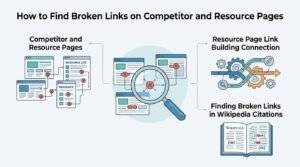
Competitor and resource pages are the fastest source of broken link prospects because they aggregate large numbers of outbound links in one concentrated location. A single outdated resource page can surface a dozen broken link opportunities in one crawl.
Resource Page Link Building Connection
Resource page link building and broken link building overlap heavily since the same “best of” and curated pages that accept new resource submissions are also the pages most likely to contain outdated dead links. Targeting the same prospect list for both tactics multiplies the return on your outreach research.
Finding Broken Links in Wikipedia Citations
Wikipedia articles cite thousands of external sources, and a portion of those citation links go dead as the cited pages disappear over time. Finding one of these broken citations and offering a comparable replacement resource is one of the highest-authority broken link opportunities available.
How to Find Broken Links on Your Own Website
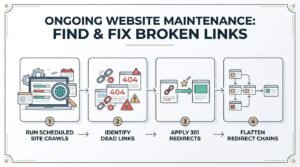
Auditing your own website for broken links protects existing rankings by identifying dead internal and outbound links before they damage user experience or waste crawl budget. This is a maintenance task, not a one-time project, since links break continuously as external sites change.
Internal Broken Link Audits
Running a full site crawl on a scheduled basis catches broken internal links before they accumulate into a larger technical SEO problem. I treat this as a quarterly minimum for any site over a few hundred pages.
Fixing Broken Links with Redirects
A 301 redirect passes the majority of the original page’s link equity to its new destination, making it the standard fix for a broken internal link that has a clear replacement page. Redirect chains longer than one hop should be flattened to avoid diluting that equity further.
Creating Content That Replaces the Dead Resource
Creating replacement content for a broken link building pitch means matching or exceeding what the original dead page covered, since the site owner is comparing your resource against their reader’s expectations. A thin or tangential replacement gets rejected even when the pitch itself is well-written.
Matching or Exceeding the Original Content
I pull the dead page from the Wayback Machine whenever possible to see exactly what it covered, then build content that closes any gap the original left along with additional depth. This step alone separates outreach that converts from outreach that gets ignored.
Content Gaps as Broken Link Building Opportunities
Sometimes the broken link points to a resource that never fully answered its topic well, which means the opportunity here is a genuinely better piece of content rather than a like-for-like replacement. Spotting these gaps turns an average broken link campaign into one with a real content marketing angle.
How to Write Outreach Emails for Broken Link Building
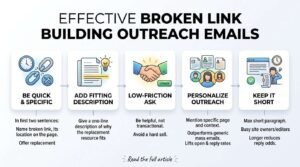
Effective broken link building outreach names the exact broken link, its location on the page, and your specific replacement in the first two sentences. Anything longer than a short paragraph reduces the odds of a reply from a busy site owner or editor.
Outreach Email Templates and Structure
A strong template opens with the specific broken link found, states the page it’s on, and offers the replacement resource with a one-line description of why it fits. Closing with a low-friction ask, rather than a hard sell, keeps the message feeling helpful rather than transactional.
Personalization and Response Rate Benchmarks
Personalized outreach mentioning the specific page and context consistently outperforms templated mass email in broken link building campaigns. Backlinko’s outreach research found that personalized subject lines and body copy can significantly lift open and reply rates compared to generic blasts.
Broken Link Building Outreach: Response Rates and Follow-Ups
Broken link building outreach typically sees single-digit reply rates on the first email, with follow-ups accounting for a large share of eventual placements. Most successful campaigns budget for two to three follow-up touches per prospect before moving on.
When and How Often to Follow Up
A single follow-up sent three to five business days after the initial email captures a meaningful share of replies that would otherwise never come. I stop after a second follow-up to avoid appearing pushy or damaging the relationship for future outreach.
Common Broken Link Building Mistakes to Avoid
The most common broken link building mistakes are poor targeting, weak or irrelevant replacement content, and generic outreach that ignores the specific page context. Any one of these mistakes can turn an otherwise sound campaign into a low-reply, low-placement effort.
Poor Targeting and Irrelevant Replacements
Pitching a replacement resource that only loosely relates to the dead link’s original topic gets rejected quickly, since the site owner is protecting their page’s relevance to readers. Relevance matters more here than domain authority of the pitching site.
Generic, Unpersonalized Outreach
Sending the same templated email to hundreds of prospects without referencing the specific broken link or page context is the fastest way to get ignored or marked as spam. The personalization step covered earlier in this guide directly addresses this failure point.
How to Measure Broken Link Building Success
Broken link building success is measured through placement rate, the number of referring domains earned, and the domain rating or authority of the sites securing your link. Tracking these metrics over a full campaign reveals whether the targeting and outreach process needs adjustment.
Key Metrics: Referring Domains, DR, Placement Rate
Placement rate divides the number of successful link placements by the total number of outreach emails sent, giving a direct efficiency measure for a campaign. A healthy broken link building campaign often lands placement rates in the low single digits to low teens depending on niche and outreach quality.
Tracking Outreach in a CRM or Spreadsheet
Logging every prospect, contact date, follow-up status, and outcome in a shared spreadsheet or CRM prevents duplicate outreach and shows exactly where a campaign’s bottleneck sits. This tracking discipline becomes essential once a campaign scales past a few dozen prospects.
Broken Link Building vs. Guest Posting vs. Skyscraper Technique
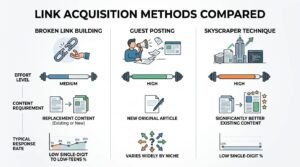
Broken link building, guest posting, and the skyscraper technique are three distinct link acquisition methods that differ in effort, scalability, and the type of relationship they require with the target site. Choosing between them depends on available content assets and outreach capacity.
| Method | Effort Level | Content Requirement | Typical Response Rate |
| Broken Link Building | Medium | Existing or new replacement page | Low-single-digit to low-teens % |
| Guest Posting | High | New original article per placement | Varies widely by niche |
| Skyscraper Technique | High | Significantly better existing content | Low-single-digit % |
Scaling Broken Link Building for Agencies and In-House Teams
Scaling broken link building requires standardized prospecting workflows, templated but personalized outreach, and a tracking system that prevents duplicate contact across multiple campaigns. Teams running this at volume typically split prospecting, content matching, and outreach into separate roles.
Agencies managing broken link building across multiple client accounts benefit from a shared prospect database segmented by niche, since resource pages and directories often serve more than one client vertical at once. This reduces duplicate research effort across campaigns running in parallel.
Conclusion
Broken link building turns dead links, crawler signals, and outreach timing into a repeatable path to earned backlinks. It connects naturally to resource page outreach, technical audits, and content strategy across a full SEO program.
We help businesses build these campaigns properly, from prospecting through placement tracking. Partner with White Label SEO Service to turn broken link opportunities into sustainable organic growth.
Frequently Asked Questions
Is broken link building still effective in 2026?
Yes, broken link building remains effective in 2026 because the number of dead links across the web continues growing as sites redesign and migrate. The tactic’s core value proposition to webmasters hasn’t changed.
How long does broken link building take to show results?
Most campaigns take four to eight weeks to produce initial placements after prospecting begins. Full campaign results typically build over two to three months of consistent outreach.
What’s a good success rate for broken link building outreach?
A good success rate for broken link building outreach falls between 3% and 15% of contacted prospects resulting in a placement. Rates vary based on niche, content quality, and personalization.
Can broken link building hurt my site?
Broken link building itself doesn’t hurt a site since it earns links through legitimate, relevant content offers. Risk only appears if replacement content is thin or irrelevant to the original dead page’s topic.
Do I need new content for every broken link I find?
No, existing content on your site can often serve as the replacement if it closely matches the dead page’s original topic. New content is only needed when no relevant page already exists.
How many broken link prospects should I find per campaign?
Most campaigns need 100 to 300 qualified prospects to produce a meaningful number of placements given typical response rates. Smaller prospect lists rarely generate enough volume to be worthwhile.
Is broken link building better than guest posting?
Neither method is universally better since they serve different resource and relationship requirements. Broken link building often converts faster because it solves an existing problem rather than pitching new content.