Building links to product pages is the process of earning backlinks that point directly at commercial, transaction-focused URLs rather than blog posts or guides. I’ve watched this trip up more SEO strategies than almost anything else in the field.
Most link builders were trained on content marketing, not commerce. That mismatch costs real revenue. A product page sitting on page two of Google, with no links pointing at it, rarely closes the gap through on-page tweaks alone.
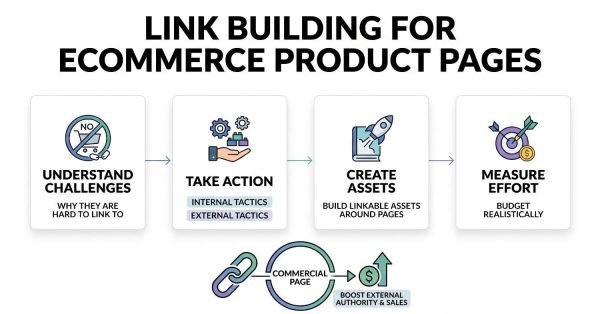
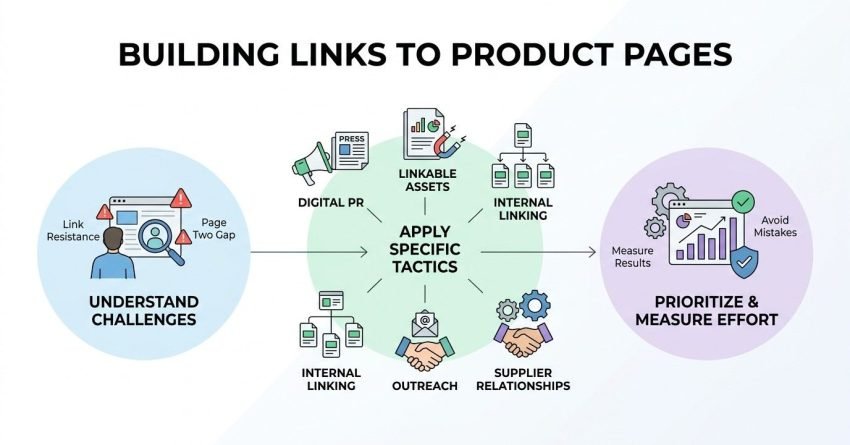
This guide covers why product pages resist links in the first place, the specific tactics that work digital PR, linkable assets, internal linking, outreach, and supplier relationships how to prioritize and measure the effort, and the mistakes that get commercial links penalized or wasted. We’ll move from foundations to execution to measurement.
Why Product Pages Are Harder to Link Than Blog Content
Product pages are commercial destinations that describe a specific item for sale rather than educate a reader, and that single distinction is why they attract far fewer natural backlinks than blog content. Nobody links to a product page the way they link to a study or a guide there’s no insight to cite, no data to quote, nothing to reference in someone else’s article.
I see this pattern on almost every ecommerce site I audit. The blog ranks. The product pages don’t. Editorial sites avoid linking to pages that look like they’re asking for a sale, because it reads as an endorsement they didn’t intend to make.
Commercial Intent vs. Editorial Linkability
Editorial linkability is the quality that makes a page worth referencing on its own merit, independent of any transaction it might lead to. A product page fails this test by design its entire structure points toward “buy now,” not “learn this.”
That’s not a flaw to fix. It’s a structural reality that shapes everything else in this guide, starting with linkable asset strategy.
The Thin-Content Perception Problem
Thin-content perception happens when a page’s word count and structural depth signal to both search engines and human linkers that there’s nothing substantial to reference. Most product pages run 100-300 words of specs and description.
A journalist or blogger scanning that page for a citation-worthy fact won’t find one. This is the core reason buying guides exist as a workaround, which I get into further down.
How Link Building for Product Pages Differs From Content Link Building
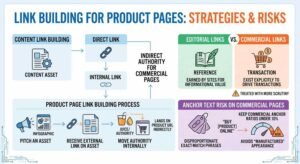
Link building for product pages requires routing authority toward commercial URLs indirectly, since direct outreach for a sales page rarely succeeds the way it does for educational content. The tactics aren’t different in kind, but the application shifts almost entirely.
Content link builders pitch an asset and get a direct link to that asset. Product page link builders pitch an asset and then move the authority internally, because the external link rarely lands on the product URL itself.
Editorial Links vs. Commercial Links
Editorial links are earned by sites that reference your content for its informational value, while commercial links exist explicitly to drive a transaction and are treated with more scrutiny by search engines. Google’s own guidance on link schemes flags paid or manipulative commercial links as a violation, and Google Search Central’s spam policies treat unnatural commercial linking as a ranking risk.
This distinction is why so much product-page link building actually happens one step removed from the product itself.
Anchor Text Risk on Commercial Pages
Anchor text risk is the exposure created when a disproportionate share of a page’s inbound anchors use exact-match commercial phrases like “buy [product] online.” Google’s algorithms have targeted this pattern specifically since the original Penguin update.
I keep commercial anchor ratios under 10% of total inbound anchors for any product page I work on. Anything higher starts to look manufactured rather than earned.
Digital PR Strategies for Product Page Links
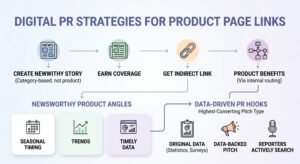
Digital PR for product pages works by creating a newsworthy story around a product category rather than the product listing itself, then earning coverage that links to a supporting asset or, less often, the page directly. Journalists don’t cover products. They cover trends, data, and angles.
I’ve placed dozens of these campaigns, and the pattern holds: the story gets the link, and the product benefits through internal routing.
Newsworthy Product Angles
A newsworthy angle reframes a product’s core feature as a trend, controversy, or timely data point that a journalist would cover independent of any brand relationship. Seasonal timing, price shifts, and category-wide shortages all work as hooks.
Sustainability claims and cost comparisons perform especially well right now, according to Cision’s 2024 State of the Media report, which found journalists increasingly prioritize data-backed pitches over product announcements.
Data-Driven PR Hooks
A data-driven PR hook is an original statistic, survey result, or proprietary dataset that gives a journalist something concrete to cite. This is the single highest-converting pitch type in my experience running outreach campaigns.
HARO and journalist outreach works especially well paired with this kind of hook, since reporters actively search for sourced data on tight deadlines.
Linkable Asset Creation to Support Product Pages
A linkable asset is a piece of content built specifically to attract backlinks on its own editorial merit, then structured to pass that authority internally toward a product page. This is the workaround for the thin-content problem covered earlier.
The asset does the attracting. The internal link structure does the routing. Both pieces have to exist together or the strategy breaks down halfway through.
Buying Guides as Link Magnets
A buying guide is a comprehensive resource that helps readers evaluate a product category, and it earns links the way a product page never will because it teaches rather than sells. I’ve seen buying guides pull in ten times the referring domains of the product pages they support.
The guide links to specific products contextually, passing a portion of its earned authority downstream. That mechanism only works with deliberate internal linking architecture, covered in detail later in this guide.
Comparison and “Best Of” Assets
A comparison asset evaluates multiple products against shared criteria, giving readers and linkers a reason to reference it that a single product listing can’t provide. “Best of” formats consistently rank for high-volume commercial-investigation queries.
These assets work particularly well when built around genuine testing or original data rather than aggregated specs pulled from manufacturer sites.
Internal Linking Strategies That Pass Authority to Product Pages
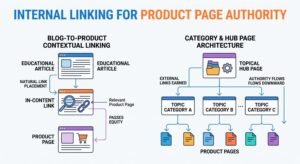
Internal linking architecture is the deliberate structuring of links from high-authority pages on a site toward product pages that need ranking support. This is where the authority earned by blog content and linkable assets actually reaches the commercial page.
Most sites get this backwards. They build great content and then forget to point it anywhere useful.
Blog-to-Product Contextual Linking
Blog-to-product contextual linking places a natural, in-content link from an educational article to a relevant product page at the exact moment a reader would want to see it. This works because the link sits inside genuine explanatory content rather than a sidebar widget.
I’ve moved product pages from page three to page one purely by adding three or four contextual blog links, with zero new external backlinks involved.
Category and Hub Page Architecture
Category and hub page architecture organizes product pages beneath topical hub pages so that authority flows downward through a logical site structure. A category page that itself earns external links passes meaningful equity to every product page linked beneath it.
This is a foundational structural decision that shapes how effectively every other tactic in this guide performs.
Guest Posting and Contributor Links for Product Pages
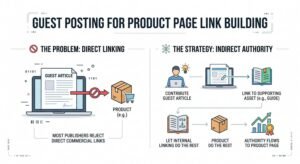
Guest posting for product page link building means contributing an article to another site and earning a contextual link, though that link almost always points to a supporting asset rather than the product page itself. Most publishers reject direct commercial links in guest content outright.
I’ve had guest post pitches rejected specifically because the draft linked to a product URL instead of an educational one.
Where Guest Posts Can (and Can’t) Point to Products
A guest post can point to a product page only when the publication’s editorial guidelines explicitly allow commercial links, which is rare among quality sites. Most publishers require links to point to non-commercial resources.
The workaround mirrors the linkable asset strategy: link the guest post to a guide, then let internal linking do the rest.
Influencer and Affiliate Outreach for Product Backlinks
Influencer and affiliate outreach recruits third parties to create content reviewing or featuring a product, generating both a backlink and referral traffic in a single placement. Unlike guest posts, these links often do point directly at the product page, since the entire purpose of the content is the review itself.
This is one of the few tactics where a direct commercial link is both expected and acceptable.
Micro-Influencer Product Reviews
Micro-influencer product reviews come from creators with smaller, highly engaged audiences who typically link directly to the product being reviewed. These links carry real relevance signals because the surrounding content is genuinely about the product.
Affiliate program structures frequently formalize this relationship at scale, which I cover next.
Affiliate Program Link Structures
An affiliate program link structure sets up trackable, often nofollowed links that affiliates use to drive traffic and earn commission on resulting sales. Google’s guidance treats these as paid links by nature, meaning they typically carry no direct ranking value even though they drive qualified traffic.
The traffic and conversion signals still matter for overall page performance, even without passing link equity.
Supplier, Manufacturer, and Distributor Link Opportunities
Supplier and manufacturer link opportunities come from B2B relationships where a company you source from, sell to, or partner with links to your product pages as part of normal business documentation. These links are often the easiest to earn because the relationship already exists.
I ask every client about their supplier list before starting outreach, because half the link opportunities are sitting in an existing vendor relationship.
Leveraging B2B Relationships for Backlinks
Leveraging B2B relationships means formally requesting that manufacturers, distributors, or business partners list your product pages on their “where to buy” or partner directory pages. Manufacturers frequently maintain retailer directories that link out to exactly this kind of page.
This tactic converts an existing business relationship into a link asset with almost no additional outreach cost.
Resource Page and Directory Link Building for Products
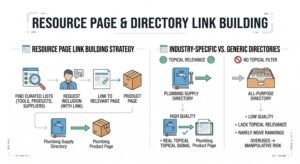
Resource page link building involves finding curated lists of tools, products, or suppliers in a given industry and requesting inclusion with a link to the relevant page. Quality varies enormously across this category.
Industry-specific resource pages carry real topical relevance. Generic business directories mostly don’t.
Industry-Specific Directories vs. Generic Ones
Industry-specific directories are curated by niche publications or associations and carry topical relevance that generic, all-purpose directories lack entirely. A plumbing supply directory linking to a plumbing product page passes meaningful topical signal.
Generic directories with no topical filter rarely move rankings and can occasionally look manipulative if overused.
Unlinked Brand Mention Reclamation for Product Pages
Unlinked mention reclamation finds instances where a site has already named your brand or product without linking to it, then requests that the mention be converted into a link. This is consistently the highest-conversion outreach tactic I run, because the relationship groundwork is already done.
The site chose to mention the product voluntarily. Converting that into a link is a small ask compared to cold outreach.
Finding and Converting Unlinked Mentions
Finding unlinked mentions typically involves monitoring tools that alert you whenever your brand or product name appears online without an accompanying hyperlink. A simple, polite email asking the site to add the link converts a meaningful share of these mentions.
Response rates on this tactic regularly beat cold outreach by a wide margin in my own campaigns.
HARO and Journalist Outreach for Product Coverage
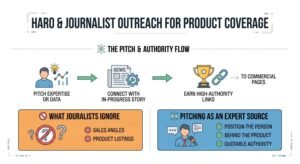
Journalist outreach for product coverage means pitching your product or its underlying data as a source for a reporter’s in-progress story, most commonly through query platforms that connect journalists with expert sources. This channel produces some of the highest-authority links available to commercial pages.
The pitch has to lead with expertise or data, never with a sales angle, or journalists ignore it immediately.
Pitching Products as Expert Sources
Pitching a product as an expert source means positioning the person behind the product, not the listing itself, as the quotable authority a journalist needs. The resulting link usually points to a bio page, guide, or homepage rather than the product URL directly.
This is another case where the product page benefits through internal routing rather than a direct external link.
Content Marketing Assets That Naturally Attract Product Links
Content marketing assets built around original data or interactive utility attract links on pure editorial merit, independent of any commercial angle. These sit one level above buying guides in link-earning potential because they’re genuinely novel rather than curatorial.
I prioritize these for clients with the budget to invest in research, since the payoff compounds over years rather than months.
Original Research and Surveys
Original research and surveys generate proprietary statistics that other publishers cite and link to as their source, creating a durable stream of inbound links over time. A single well-promoted survey can out-earn years of manual outreach.
Original data of this kind consistently ranks among the most-cited asset types across content marketing studies.
Interactive Tools and Calculators
Interactive tools and calculators give visitors a reason to bookmark, share, and link to a page because it solves a specific, recurring problem rather than just describing one. Cost calculators and sizing tools perform especially well in ecommerce contexts.
These assets take real development investment, which is why they’re less common than blog-based linkable assets.
Anchor Text Strategy and Risk Management for Commercial Pages
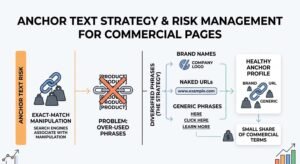
Anchor text strategy for commercial pages means deliberately diversifying the phrasing used in inbound links to avoid the exact-match pattern that search engines associate with manipulation. This connects directly back to the anchor text risk covered earlier in this guide.
A healthy commercial page’s anchor profile looks messy on purpose: brand names, naked URLs, and generic phrases mixed with only a small share of commercial terms.
Diversifying Anchor Text Safely
Diversifying anchor text safely means capping exact-match commercial anchors at a small minority share of total inbound links while allowing branded and generic anchors to dominate the profile. I aim for branded anchors making up the largest single category, with commercial phrasing well under 10%.
This ratio has held up as a safe benchmark across every product-page campaign I’ve run since Penguin.
How to Prioritize Which Product Pages Get Link Building Investment
Prioritizing product pages for link investment means ranking pages by revenue potential and current ranking gap rather than treating every product URL equally. Not every product deserves the same outreach budget.
I build this prioritization before touching a single outreach email, because it changes which tactics even make sense to run.
Revenue-Based Prioritization Framework
A revenue-based prioritization framework scores product pages by margin, search volume, and current ranking position to identify where link investment produces the clearest return. Pages ranking positions 4 through 15 for commercially valuable terms typically offer the best return on link building effort.
Page-one pages rarely need the push, and page-five-plus pages often need content fixes before links help at all.
Measuring the Impact of Links on Product Page Rankings and Sales
Measuring link impact on product pages means tracking ranking position, organic traffic, and conversion rate together rather than judging link building by referring-domain count alone. A link building campaign that moves rankings but not revenue hasn’t actually succeeded.
I report on all three metrics together for every client, because isolating just one tells an incomplete story.
Tracking Rankings, Traffic, and Conversions
Tracking rankings, traffic, and conversions together requires connecting rank-tracking data with Google Analytics ecommerce reporting to see whether ranking improvements actually convert into revenue. Google Search Console’s performance reports provide the ranking and click data needed as the baseline layer.
Without this connected view, it’s easy to celebrate a ranking jump that never produces a single additional sale.
Attribution Challenges in Link Building ROI
Attribution challenges arise because a single purchase often follows multiple touchpoints, making it difficult to credit one link building campaign for a specific sale. Multi-touch attribution models help but rarely produce a perfectly clean number.
I set expectations with clients upfront that link building ROI is a directional signal, not a precise formula.
Common Mistakes That Get Product Page Links Penalized or Wasted
Common product-page link building mistakes include buying links at scale, over-optimizing anchor text, and targeting low-quality directories that carry no topical relevance. Any one of these can waste a budget or trigger a manual action.
I’ve inherited cleanup projects for all three of these mistakes within the past year alone.
Paid Link Red Flags on Commercial Pages
Paid link red flags include sudden spikes in exact-match commercial anchors, links from clearly unrelated niches, and patterns matching known link-selling networks. Google’s spam policies explicitly name paid links as a violation when they’re intended to manipulate rankings.
A site that suddenly gains fifty links from unrelated foreign-language domains in a month is showing a textbook red flag.
Building a Sustainable Link Building Timeline for Product Pages
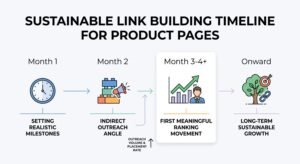
A sustainable link building timeline for product pages sets realistic monthly milestones across outreach volume, placement rate, and ranking movement rather than promising fast results. Product page link building moves slower than content link building because the outreach angle is inherently indirect.
I tell every client the same thing at kickoff: expect the first meaningful ranking movement around month three to four, not month one.
What Realistic Progress Looks Like Month by Month
Realistic month-by-month progress starts with asset creation and outreach list building in months one and two, first placements landing in months two and three, and measurable ranking movement typically appearing by months four through six. This timeline holds fairly consistently across the ecommerce campaigns I’ve managed.
Campaigns promising page-one rankings within thirty days are making a claim the mechanics of link building simply can’t support.
Conclusion
Product page link building works through indirect routes: digital PR, linkable assets, internal architecture, and outreach- because direct commercial links stay rare and risky.
Every tactic here feeds a broader authority-building strategy that strengthens the whole site over time, not just one page.
We build these systems for clients every day, and White Label SEO Service can map out a realistic plan for your product pages.
Frequently Asked Questions
Can you build links directly to a product page?
Yes, though direct links are less common than links routed through supporting content. Affiliate reviews and manufacturer directories often link straight to product URLs.
How long does it take to rank a product page with link building?
Most campaigns show measurable ranking movement between four and six months. Faster results usually signal risky, unsustainable tactics.
Why don’t bloggers link to product pages?
Bloggers avoid linking to pages that look purely transactional because it reads as an unearned endorsement. They prefer citing educational content instead.
What anchor text is safe for product page links?
Branded and generic anchors should dominate the profile, with exact-match commercial phrases kept under roughly 10% of total links. This mirrors safe practices since the Penguin update.
Do internal links help product pages rank?
Yes, internal links from high-authority blog and category pages pass meaningful authority to product pages. This is often faster to execute than external outreach.
Are affiliate links good for SEO?
Affiliate links are typically nofollow and carry no direct ranking value, but the referral traffic and conversions still matter. They shouldn’t be counted as link building for rankings.
What’s the biggest mistake in product page link building?
Buying links at scale or over-optimizing commercial anchor text creates the highest penalty risk. Both patterns closely match known manipulation signals Google actively targets.