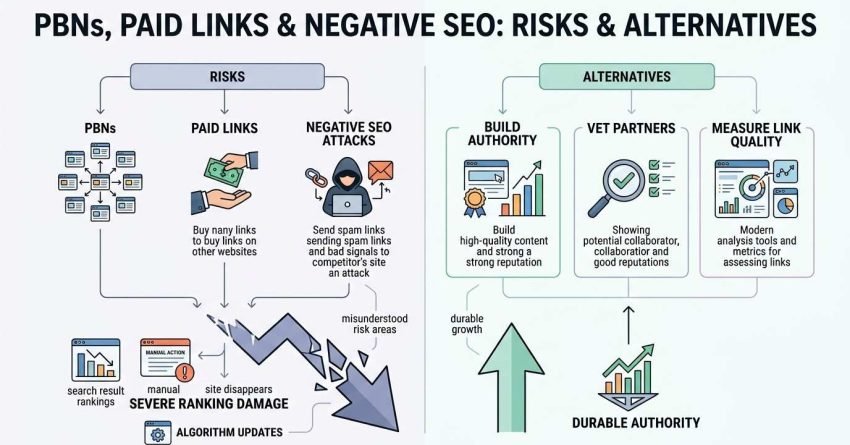
Private blog networks, paid links, and negative SEO attacks represent three of the most misunderstood risk areas in modern search optimization, each carrying the potential to cause severe, sometimes irreversible ranking damage. I’ve watched business owners lose years of organic growth in a single algorithm update because someone convinced them a shortcut would work. Understanding what these tactics actually are, and why they backfire, is the first step toward protecting your site.
Search engines have spent over a decade refining systems specifically built to catch manipulative link schemes. We’ve seen the consequences firsthand: recovery from a manual action can take months, and some sites never fully regain their previous rankings.
This guide walks through what PBNs and paid links actually are and why they’re risky, how negative SEO attacks work and how to defend against them, and the white hat alternatives that build durable authority instead. We’ll also cover how to vet a legitimate link partner and measure link quality the right way.
What Are Private Blog Networks (PBNs)?
A private blog network is a group of websites built or acquired solely to host links pointing to a single “money site” in order to manipulate search rankings. I think of PBNs as fake ecosystems; they mimic real websites but exist purely to pass artificial authority.
These networks often reuse expired domains that once had genuine backlink profiles, hoping to inherit some of that old authority. The content on PBN sites is usually thin, generic, or spun from other articles just to justify the link’s existence.
How PBNs Are Built and Detected
Most PBNs share hosting IPs, WHOIS patterns, template designs, or interlinking structures that create a detectable footprint. Google’s algorithms and manual reviewers actively hunt for these patterns across large-scale link graphs.
I’ve reviewed sites where a single shared Google Analytics ID across a dozen “unrelated” blogs gave away the entire network in minutes. Once discovered, every site in that network typically gets devalued or penalized together, not just the target site benefiting from it.
What Counts as a Paid Link Under Google’s Guidelines?
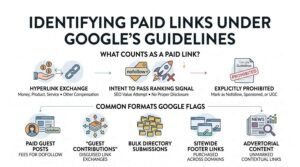
A paid link is any hyperlink exchanged for money, product, service, or other compensation with the intent of passing ranking signal, and Google’s Webmaster Guidelines explicitly prohibit this without proper disclosure. The key issue isn’t payment itself; sponsorships and advertising are normal business. It’s the attempt to pass SEO value without marking the link as nofollow, sponsored, or ugc.
We see this most often in guest post arrangements where a fee is paid specifically for a dofollow placement rather than genuine editorial value.
Common Paid Link Formats Google Flags
Link exchanges disguised as “guest contributions,” bulk directory submissions, and sitewide footer links purchased across multiple domains all fall under this category. Advertorial content that includes unmarked contextual links is another format search engines routinely catch through pattern analysis.
Why Businesses Turn to PBNs and Paid Links
Businesses turn to PBNs and paid links because organic link earning is slow, unpredictable, and requires sustained content and outreach investment that many teams aren’t prepared for. I understand the appeal: a paid placement can produce a backlink in days, while digital PR might take months to land coverage.
The pressure to show fast ranking movement, especially for agencies reporting to clients, pushes some toward shortcuts that promise quick authority signals. That short-term thinking is exactly what creates long-term exposure.
The Real Risks of Using PBNs
The primary risk of using a PBN is a manual action penalty from Google that can deindex or severely suppress rankings for the site being promoted, along with every domain in the network. I’ve seen this play out repeatedly: one flagged network takes down link equity across dozens of client sites simultaneously.
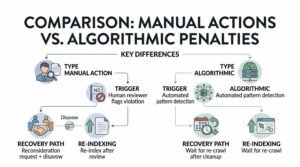
Recovery isn’t quick either. Once flagged, a site typically needs a full disavow of the toxic links, a reconsideration request, and months of clean signal-building before trust rebuilds.
Manual Actions vs. Algorithmic Penalties
| Type | Trigger | Detection Method | Recovery Path |
| Manual Action | Human reviewer flags violation | Search Quality team review | Reconsideration request + disavow |
| Algorithmic | Automated pattern detection | Spam-fighting systems (e.g., SpamBrain) | Wait for re-crawl after cleanup |
Manual actions come with a notice inside Google Search Console, which at least tells you exactly what triggered it. Algorithmic suppression is quieter:r rankings just decline gradually with no explicit warning, which makes diagnosis far harder.
The Real Risks of Paid Link Schemes
Paid link schemes risk triggering algorithmic devaluation of the purchased links or a manual action if the pattern is flagged, effectively wasting the investment while creating a lasting spam signal tied to the domain. The frustrating part is that even after the scheme is abandoned, historical toxic links can linger in the profile for years unless actively disavowed.
Beyond the ranking risk, paid link networks tend to disappear or get sold, meaning the links you paid for often vanish anyway, leaving nothing but the risk exposure behind.
How Google Detects Manipulative Link Patterns
Google detects manipulative link patterns primarily through machine learning systems that analyze link velocity, anchor text distribution, referring domain quality, and network-level relationships between sites. Google’s own documentation on link spam confirms that both algorithmic systems and human reviewers actively work to neutralize these signals rather than simply ignoring them.
Link Spam Update and Spam Detection Systems
Google’s SpamBrain system was specifically built to identify link spam at scale, including sites that buy or create links for the sole purpose of manipulating rankings. Sudden spikes in referring domains, unnatural anchor text repetition, and links from clearly unrelated niches are the most common triggers flagged by these systems.
I always tell clients that a natural link profile grows unevenly and organically; it never shows the clean, repeatable pattern that manipulative schemes tend to produce.
What Is Negative SEO?
Negative SEO is a set of malicious tactics used by competitors or bad actors to intentionally damage a website’s search rankings, often by building spammy links, scraping content, or triggering technical penalties. This isn’t theoretical; I’ve worked with clients who noticed sudden ranking drops traced directly to thousands of spam links pointing at their domain overnight.
Unlike a self-inflicted PBN penalty, negative SEO is done TO you, which makes proactive monitoring essential rather than optional.
Common Negative SEO Attack Methods
Attackers frequently build large volumes of low-quality or spam backlinks pointing at a competitor’s site, hoping to trigger an algorithmic link-spam flag. Content scraping, fake negative reviews, and even hacking attempts to inject malicious code are additional tactics used to damage trust and rankings simultaneously.
How to Identify a Negative SEO Attack
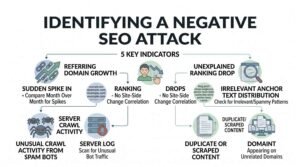
A negative SEO attack is usually identified through a sudden, unexplained spike in referring domains combined with a drop in rankings that has no correlation to any site-side change. I check Google Search Console’s Links report first, since a jump from dozens to thousands of new referring domains in a short window is rarely organic.
- Compare referring domain growth month over month for sudden spikes
- Check anchor text distribution for irrelevant or spammy keyword patterns
- Review server logs for unusual crawl activity from spam bots
- Cross-reference ranking drops against Google’s confirmed algorithm update dates
- Scan for duplicate or scraped content appearing on unrelated domains
How to Protect Your Site from Negative SEO
Protecting a site from negative SEO starts with regular backlink monitoring and a documented disavow process so toxic links never accumulate unnoticed. We treat this as an ongoing maintenance task, not a one-time fix, because attacks can happen at any point in a site’s lifecycle.
- Set up automated alerts for new referring domains using a backlink monitoring tool.
- Review the disavow file quarterly, even without a suspected attack
- Secure your CMS and hosting account against unauthorized access
- Monitor branded search results for scraped or duplicated content
- Keep a clean record of your own legitimate link-building activity for reference
Disavow Tool Best Practices
Google’s Disavow Tool should only be used for links you’re confident are manipulative or spammy, since disavowing legitimate links can actually hurt a site’s authority. I build disavow files in batches, grouped by domain, and I document the reasoning behind each entry in case a future audit needs the context.
Recovering From a Link-Related Penalty
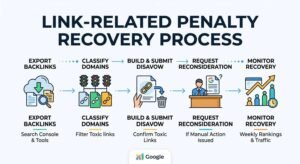
Recovering from a link-related penalty requires identifying every toxic or manipulative link, disavowing them formally, and in the case of a manual action, submitting a reconsideration request explaining the cleanup. I’ve found that recovery timelines vary widely, ranging from a few weeks for algorithmic issues to several months for manual actions requiring Google review.
- Export the full backlink profile using Search Console and a third-party tool.
- Classify each referring domain as safe, questionable, or toxic
- Build and submit a disavow file for confirmed toxic links
- Submit a reconsideration request if a manual action notice was issued
- Monitor rankings and traffic weekly for signs of recovery
White Hat Alternatives to PBNs and Paid Links
White hat alternatives to PBNs and paid links include earned media coverage, genuine guest contributions, and content designed specifically to attract natural citations from other sites. These methods take longer to produce results, but the authority they build tends to compound rather than evaporate the moment a network gets caught.
| Method | Time to Results | Risk Level | Durability |
| Digital PR | 2-6 months | Very Low | High |
| Guest Posting (editorial) | 1-3 months | Low | High |
| Content-driven link earning | 3-9 months | Very Low | Very High |
| Broken link building | 1-2 months | Low | Medium |
Digital PR and Earned Media
Digital PR involves creating newsworthy stories, data studies, or expert commentary that journalists and publishers want to cite naturally in their own coverage. I’ve seen a single well-timed data study earn more authoritative links in a month than a year of manual outreach ever could.
Guest Posting Done Correctly
Legitimate guest posting means contributing genuinely useful content to a relevant publication because the editorial team wants it, not because a link was purchased. The distinction matters enormously to Google’s systems, which increasingly evaluate whether the linking content adds real value to that publication’s audience.
Content-Driven Link Earning Strategies
Content-driven link earning relies on creating resources genuinely useful enough that other sites choose to reference them without any outreach or payment involved. Original research, in-depth guides, and free tools tend to perform best here because they give other publishers a concrete reason to cite the source.
I’ve watched a well-designed calculator tool earn passive links for years after publication, something no paid placement could ever replicate.
How to Vet a Legitimate Link Building Partner
A legitimate link building partner should be able to show real editorial relationships, transparent reporting on where links are placed, and a clear refusal to guarantee specific rankings. Any provider promising a fixed number of dofollow links per month at a flat low price is almost certainly running some version of a PBN or paid scheme.
I always ask prospective partners for sample placements and check whether those sites carry genuine organic traffic, not just an inflated domain rating metric.
Measuring Link Quality: Metrics That Actually Matter
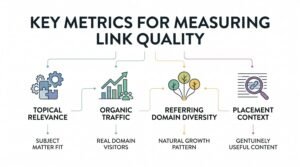
Link quality is measured primarily through relevance to your niche, the referring domain’s organic traffic, and the naturalness of the placement context, not through a single third-party authority score. I rely on relevance and traffic data far more than domain rating alone, since a high score with zero real visitors is often a sign of an artificial network.
| Metric | What It Reveals |
| Topical Relevance | Whether the link fits the site’s actual subject matter |
| Organic Traffic | Confirms the domain has real visitors, not just inflated metrics |
| Referring Domain Diversity | Signals a healthy, natural growth pattern |
| Placement Context | Whether the link sits within genuinely useful content |
Building a Sustainable, Long-Term Link Profile
A sustainable link profile grows gradually across diverse, relevant domains through a mix of digital PR, content promotion, and genuine relationship building rather than any single tactic. I always tell clients that the sites still ranking strongly five years from now are the ones that never needed a disavow file in the first place.
Patience here isn’t a weakness; it’s the actual strategy, because manipulative shortcuts eventually get caught while earned authority keeps compounding.
Conclusion
PBNs, paid links, and negative SEO attacks all share one trait: manufactured signals that search engines are built to detect. Understanding these risks protects the authority you’ve already earned.
Sustainable growth comes from earned links, technical health, and consistent content the strategies covered throughout this guide.
We help businesses build link profiles that last. Reach out to White Label SEO Service to start building sustainable authority today.
Frequently Asked Questions
Can a PBN link ever be worth the risk?
No, a PBN link is never worth the risk because the potential downside, a manual action or network-wide penalty, far outweighs any short-term ranking gain. The damage often extends beyond the targeted site to every domain in the network.
How long does Google take to detect a paid link scheme?
Detection timing varies, but algorithmic systems can flag patterns within weeks, while manual reviews may take months. Some schemes go undetected for years before a targeted investigation surfaces them.
Is guest posting always considered a paid link violation?
No, guest posting only violates guidelines when compensation is exchanged specifically for a dofollow link without disclosure. Genuine editorial contributions accepted on merit remain fully compliant.
What is the first sign of a negative SEO attack?
The first sign is typically a sudden spike in low-quality referring domains combined with an unexplained ranking drop. Checking Google Search Console’s Links report usually confirms the pattern quickly.
Does disavowing links guarantee recovery from a penalty?
No, disavowing links doesn’t guarantee recovery, especially for manual actions requiring a formal reconsideration request. It removes the toxic signal, but Google still reviews the overall cleanup before restoring trust.
Can negative SEO actually work against a competitor?
Negative SEO can cause temporary damage, but Google’s spam detection systems are increasingly effective at recognizing and discounting unnatural attack patterns. Most well-monitored sites recover without lasting harm.
How often should I audit my backlink profile?
A quarterly backlink audit is generally sufficient for most sites, though larger or more competitive domains benefit from monthly reviews. Regular monitoring catches both self-inflicted risks and external attacks early.