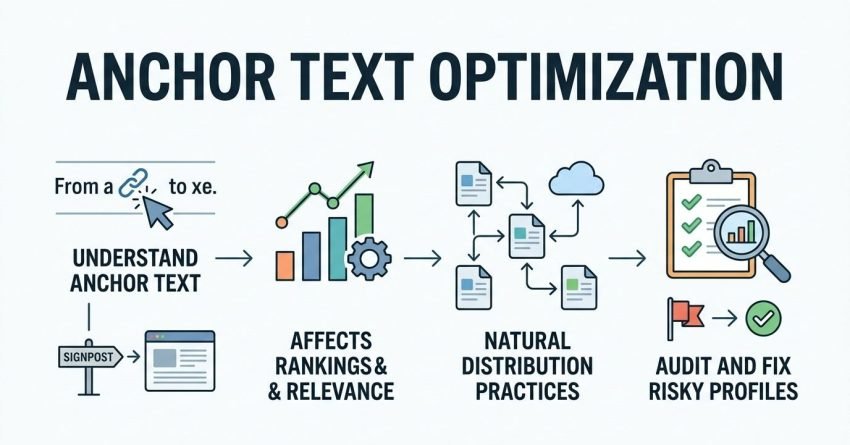
Anchor text is the clickable, visible words in a hyperlink that tell both users and search engines what the destination page is about. I think of it as a signpost: it sits inside a sentence, but it carries weight far beyond that sentence, shaping how Google interprets the relevance of the page it points to. Getting this wrong is one of the most common ways sites accidentally trigger algorithmic scrutiny.
Anchor text distribution affects rankings, relevance signals, and penalty risk in ways most site owners never audit. We see this gap constantly in client accounts we inherit.
This guide covers what anchor text is and how search engines read it, the main anchor types and how to distribute them safely, the internal and external linking practices that keep a profile natural, and how to audit and fix an anchor profile that’s drifted into risky territory.
What Is Anchor Text and Why Does It Matter for SEO?
Anchor text is the visible, clickable text of a hyperlink, and search engines use it as a relevance signal to understand what the linked page is about. I look at it as one of the oldest and still most reliable context clues in the entire SEO toolkit.
Search engines built much of their early relevance models around this signal, and it still carries meaning today even though its role has changed shape.
How Search Engines Use Anchor Text to Understand Context
Search engine crawlers read the words inside a link and associate them with the destination page’s topic, building an early relevance map before they even fully parse that page’s content. This is why anchor text has historically been such a strong ranking signal; it’s essentially a third party (the linking page) vouching for what the destination page covers.
I’ve watched this play out on sites where a poorly worded internal link actually confused how a page got categorized in search results. The words matter.
Anchor Text vs. Alt Text vs. Meta Text
Anchor text, alt text, and meta text serve three distinct purposes: anchor text describes a link’s destination, alt text describes an image for accessibility and image search, and meta text (title tags and descriptions) summarizes a page for search result listings. People mix these up constantly.
Each one plays into on-page optimization differently, but they’re not interchangeable, and treating them the same way is a mistake I see even in otherwise well-optimized sites.
The Main Types of Anchor Text
Every anchor falls into one of six categories, and knowing which is which is the first step to building a distribution strategy that won’t get flagged. This table shows what each type looks like in practice.
| Anchor Type | Example | Typical Use Case |
| Exact Match | “anchor text optimization” | Rarely, for highest-value target pages only |
| Partial Match | “optimizing anchor text for SEO” | Frequently, for natural variation |
| Branded | “White Label SEO Service” | Common in backlinks and citations |
| Naked URL | “example.com/page” | Common in press mentions, references |
| Generic | “click here,” “this page” | Common but low SEO value |
| Image-Based | Alt text acting as anchor | Common for visual content links |
Exact Match Anchors
Exact match anchor text uses the precise keyword phrase a page is trying to rank for, and it carries the strongest topical signal but also the highest penalty risk when overused. I treat this anchor type like a scarce resource; spend it carefully.
A backlink profile that leans too heavily on exact match anchors is one of the clearest fingerprints of manipulative link building, and Google’s algorithms are tuned specifically to catch this pattern.
Partial Match Anchors
Partial match anchor text includes a variation of the target keyword rather than the exact phrase, giving search engines relevance signals without the rigid repetition that trips spam filters. This is the anchor type I lean on most for external link building.
It reads naturally to human readers too, which matters just as much as the algorithmic side.
Branded Anchors
Branded anchor text uses the company or website’s name instead of a keyword, and it’s the safest, most natural-looking anchor type in any healthy backlink profile. Most authoritative sites earn branded anchors organically, just by being mentioned.
A healthy link profile is usually dominated by this type, not by keyword-rich variations.
Naked URL Anchors
A naked URL anchor is simply the raw web address used as the clickable text, and it appears constantly in citations, press coverage, and forum mentions. These occur naturally and don’t need engineering.
Generic Anchors
Generic anchor text uses non-descriptive phrases like “click here” or “read more” that give search engines no topical information about the destination page. These still have a place in a natural-looking profile, oddly enough, because real websites use them all the time.
Image-Based Anchors
When an image is used as a hyperlink, its alt text functions as the anchor text search engines read for context. This is often overlooked, but it deserves the same strategic thought as text anchors.
How Anchor Text Impacts Search Rankings
Anchor text impacts rankings by signaling topical relevance between the linking page and the destination page, though its weight has been recalibrated significantly since Google’s algorithm updates targeted manipulation. I’ve seen this shift firsthand across a decade of client campaigns.
Relevance Signals and Topical Association
Search engines use anchor text alongside surrounding page content to confirm what a destination page is actually about, cross-referencing it against the page’s own on-page signals. A mismatch between anchor text and destination content damages trust signals for both pages involved.
Anchor Text as a Ranking Factor Post-Penguin
Google’s Penguin algorithm update, first rolled out in 2012, specifically targeted manipulative anchor text patterns and devalued links built purely for keyword ranking purposes. This single update reshaped how the entire SEO industry approaches link building.
Anchor text still matters, but the era of stuffing exact match keywords into every backlink ended with that update, and any strategy still built that way is operating a decade out of date.
The Ideal Anchor Text Ratio (Distribution Strategy)
A natural anchor text profile typically distributes across branded (40-60%), naked URL and generic (20-30%), partial match (10-20%), and exact match (under 5-10%) anchors. I use this range as a starting framework, not a rigid formula, because every niche behaves a little differently.
Recommended Anchor Text Percentages by Type
This table breaks down a defensible distribution range based on patterns observed across healthy, non-penalized backlink profiles.
| Anchor Type | Recommended Range |
| Branded | 40–60% |
| Naked URL / Generic | 20–30% |
| Partial Match | 10–20% |
| Exact Match | 5–10% |
How Anchor Ratios Shift by Site Age and Authority
Newer, lower-authority sites should lean even further toward branded and generic anchors, since a young domain with a keyword-heavy anchor profile is one of the strongest spam signals algorithms watch for. As domain authority grows, a slightly higher share of partial match anchors becomes safer to sustain.
Anchor Text Best Practices for Internal Linking
Internal linking anchor text should describe the destination page’s actual topic using natural, varied phrasing pulled from the surrounding sentence rather than forced keyword repetition. This is where site owners actually have full control, unlike backlinks that depend on other websites.
I always tell clients that internal linking is the lowest-risk, highest-control lever they have, since every anchor choice is entirely within their own hands.
Anchor Text Best Practices for External & Backlink Building
External backlink anchor text should prioritize branded and natural-language variations over exact match keywords, since site owners have far less control over how third-party sites choose to link to them. When you can influence the anchor, and you should, aim for phrasing that a real editor would naturally write.
Guest posts and outreach links deserve extra caution here, because these are the links most closely scrutinized for manipulation patterns.
Over-Optimization: How Anchor Text Triggers Penalties
Anchor text over-optimization happens when a disproportionate share of a site’s backlinks use exact match keyword anchors, creating a pattern that looks manufactured rather than earned. This is the single fastest way I’ve seen sites lose rankings overnight.
Google Penguin and Anchor Text Spam Signals
Google’s algorithm specifically analyzes anchor text distribution as a spam signal, flagging profiles where exact match anchors appear far more frequently than would occur through natural link earning. A Moz industry study found that sites recovering from Penguin penalties typically needed to disavow or dilute over 60% of their exact match anchor links.
Warning Signs of an Unnatural Anchor Profile
A sudden spike in exact match anchors, anchor text that doesn’t match the linking page’s topic, and dozens of links using identical phrasing are the clearest red flags of an unnatural profile. I run every new client account through this checklist before touching anything else.
How to Audit Your Existing Anchor Text Profile
An anchor text audit starts by exporting your full backlink profile, then categorizing every anchor into the six core types to calculate your current distribution percentages. This process usually takes an afternoon for a mid-sized site and reveals problems most owners never knew existed.
- Export your complete backlink list from a link analysis tool.
- Categorize each anchor into exact match, partial match, branded, naked URL, generic, or image-based.
- Calculate the percentage each category represents of the total.
- Compare the results against the healthy distribution ranges.
- Flag any linking domain using suspiciously repetitive exact match phrasing.
- Prioritize disavow or outreach removal for the highest-risk links.
Tools Used to Analyze and Track Anchor Text
Anchor text analysis relies on backlink data pulled from specialized SEO platforms, since this information isn’t available through on-page inspection alone. Ahrefs, Semrush, and Google Search Console are the three most commonly used sources for this work.
Google Search Console shows which queries and pages Google associates with your site, while third-party tools like Ahrefs break down full anchor text distribution across your entire link profile.
Anchor Text Optimization for E-Commerce and Local SEO
E-commerce and local SEO sites face unique anchor text pressure because product names, category terms, and city-based keywords are tempting exact match targets that carry elevated spam risk. I’ve seen local service sites get hit especially hard here, since their keyword set is naturally narrow.
Blending city and service terms into natural, varied phrasing protects these sites while still building the topical signals they need.
Anchor Text and Its Role in Topical Authority Building
Anchor text contributes to topical authority by reinforcing the semantic relationships between clustered content, helping search engines understand how a site’s pages connect around a core subject. Every internal link is a small vote for how your content map fits together.
A site with strong topical authority typically shows consistent, varied anchor patterns pointing between related pages, rather than isolated pages linked in only one direction.
Common Anchor Text Mistakes to Avoid
The most common anchor text mistake is over-reliance on exact match keywords across backlinks, followed closely by generic anchors used in situations that call for descriptive phrasing. I see both errors constantly, often on the same site.
Ignoring internal linking entirely, reusing the same anchor for multiple different destination pages, and never auditing anchor distribution round out the most frequent issues.
How Anchor Text Strategy Fits Into a Broader SEO Timeline
Anchor text optimization is one component within a broader SEO timeline that includes technical foundations, content development, and ongoing authority building. It rarely produces isolated ranking movement on its own; it works alongside the rest of a site’s optimization efforts.
Site owners planning their SEO investment should expect anchor text refinement to be a continuous, incremental process rather than a one-time fix.
Conclusion
Anchor text ties together relevance signals, ranking factors, and link profile health across a site’s entire SEO foundation. We see anchor strategy as one piece of a larger, sustainable growth plan built on technical health and authority. Let White Label SEO Service audit your anchor profile and build a distribution strategy that protects your rankings long-term.
Frequently Asked Questions
What is the ideal anchor text ratio for SEO?
A healthy anchor text ratio leans heavily toward branded anchors (40-60%), with naked URLs and generic anchors filling another 20-30%. Exact match anchors should stay under 10% to avoid triggering spam signals.
Can too much exact match anchor text hurt my rankings?
Yes, an over-reliance on exact match anchor text is one of the clearest signals of manipulative link building. Google’s Penguin algorithm specifically targets this pattern and can suppress rankings as a result.
What’s the difference between anchor text and internal linking?
Anchor text is the clickable words within any link, while internal linking refers to the practice of connecting pages within the same site. Internal links use anchor text, but anchor text also applies to external backlinks.
How often should I audit my anchor text profile?
Most sites benefit from an anchor text audit every quarter, especially during active link building campaigns. Sites with larger backlink profiles or recent ranking drops should audit more frequently.
Does anchor text still matter after Google’s algorithm updates?
Yes, anchor text still matters, but its role shifted after Penguin toward rewarding natural variation over exact match repetition. Relevance and diversity now carry more weight than raw keyword matching.
What anchor text should I use for guest posts and backlinks?
Branded and partial match anchors are the safest choices for guest posts and outreach backlinks. Exact match anchors in these contexts carry elevated risk since they look deliberately engineered.
How do I fix an over-optimized anchor text profile?
Fixing an over-optimized profile starts with auditing your current distribution, then disavowing or diluting excessive exact match links. Building new links with branded and natural-language anchors gradually rebalances the ratio.