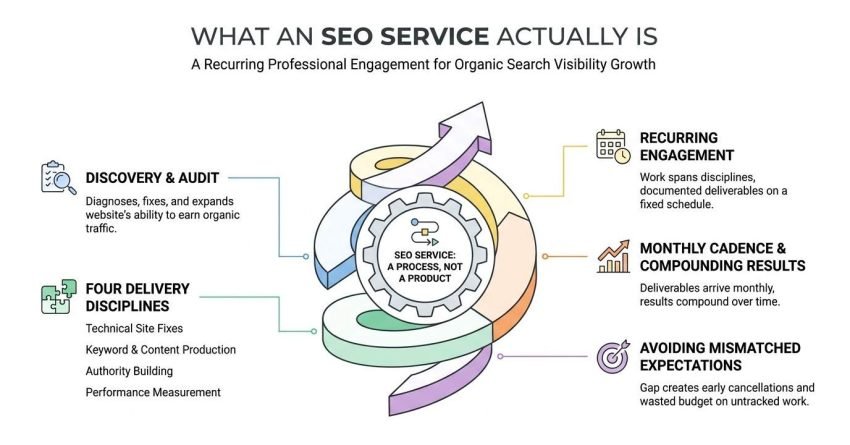
An SEO service is a recurring professional engagement that combines technical site fixes, keyword and content production, authority building, and performance measurement to grow a website’s organic search visibility over time. Deliverables arrive on a monthly cadence, and results compound rather than appear immediately.
Most buyers sign SEO contracts without knowing what lands in their inbox each month. That gap creates mismatched expectations, early cancellations, and wasted budget on work nobody tracked.
I wrote this guide to close that gap completely. It covers what an SEO service actually is, the discovery and audit work that opens an engagement, the four delivery disciplines of technical, on-page, content, and links, how local and analytics work fit in, what each month realistically produces across a first year, how pricing and team structure shape scope, and how to read a proposal before you sign it.
What an SEO Service Actually Is
An SEO service is a recurring professional engagement in which a specialist team diagnoses, fixes, and expands a website’s ability to earn organic search traffic. The work spans four disciplines and produces documented deliverables on a fixed schedule.
I find the confusion usually starts with a category error. People buy SEO expecting a product, then receive a process.
The distinction matters for how you judge value. A product is finished. A process is measured by whether the right work happened in the right order.
The Four Working Parts of Any SEO Engagement
Every legitimate SEO service breaks into four working parts, regardless of agency size or industry. Technical SEO makes pages accessible and fast. On-page SEO makes each page clearly about something. Content creates the pages worth ranking. Authority building earns the external signals that decide competitive positions.
Strip any one of those out and the engine misfires. I have audited plenty of accounts where three years of content sat behind a broken indexation setup, earning nothing.
The four parts do not receive equal weight every month. Technical dominates early, content dominates the middle, and authority work compounds across the whole term.
Deliverables vs Outcomes: Why the Difference Matters
Deliverables are the artifacts a team produces, such as audits, briefs, published pages, fixed templates, and earned links. Outcomes are what those artifacts eventually cause, such as rankings, sessions, leads, and revenue.
I hold agencies accountable to deliverables monthly and to outcomes quarterly. That split protects both sides from arguing about traffic in month two, when no meaningful signal exists yet.
A scope of work that promises outcomes without listing deliverables is unmeasurable. A scope that lists deliverables without tying them to outcomes is busywork.
Discovery, Audit, and Baseline Setting (Month 1)
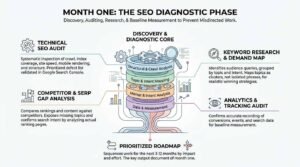
Month one of an SEO service is spent on discovery, technical auditing, keyword research, competitor analysis, and baseline measurement, with few or no public-facing changes shipped. This month exists to prevent expensive work from being aimed at the wrong targets.
I treat this as the diagnostic phase. You cannot prescribe until you have measured, and most sites carry problems nobody flagged internally.
The deliverables from this month are documents rather than page changes. That feels slow to clients expecting instant activity, which is exactly why the sequence needs explaining up front.
Here is what a properly scoped first month produces, in order:
- Technical SEO audit covering crawl, index coverage, site speed, mobile rendering, and structural issues
- Keyword research and demand map grouping search terms into topics and intent stages
- Competitor and SERP gap analysis identifying who ranks, why, and where openings exist
- Analytics and tracking audit confirming that conversions, events, and search data are recorded correctly
- Prioritized roadmap sequencing the next three to twelve months of work by impact and effort
The Technical SEO Audit
A technical SEO audit is a systematic inspection of how search engines crawl, render, and index a website, producing a prioritized list of defects with severity ratings. It is the single most valuable document produced in month one.
I run these against a crawler, then validate everything in Google Search Console before writing a single recommendation. Crawler output alone produces false positives that waste developer hours.
The audit should separate critical blockers from cosmetic warnings. A site with 40 flagged issues where three actually suppress traffic needs those three named clearly.
Keyword Research and Search Demand Mapping
Keyword research is the process of identifying the queries a target audience uses, grouping them by topic and intent, and estimating the traffic and difficulty attached to each. Modern keyword research maps topics rather than isolated phrases.
I build these as clusters, because a single page can rank for dozens of related queries. Chasing one keyword per page produces thin, fragmented sites.
The output should tell you which topics you can realistically win this year and which need eighteen months of authority first. That honesty shapes the entire content calendar.
Competitor and SERP Gap Analysis
Competitor gap analysis compares your site’s ranking keywords and content coverage against the sites currently occupying the top positions, exposing topics where competitors earn traffic and you have nothing published. It converts a vague sense of being behind into a specific list.
I read the actual ranking pages, not just the export. The export tells you what ranks, and the page tells you why.
SERP analysis also confirms intent. A commercial term dominated by comparison articles will not be won with a product page, no matter how well optimized.
Technical SEO Deliverables
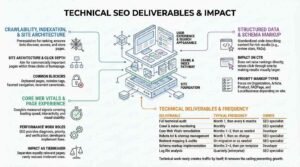
Technical SEO deliverables are the fixes and configurations that make a site crawlable, indexable, fast, and correctly interpreted by search engines. These deliverables front-load into the first three months, then shift to monitoring and maintenance.
Technical work rarely creates traffic by itself. It removes the ceiling that prevents everything else from working.
I have watched sites gain 30 to 60 percent organic traffic from technical fixes alone, purely because indexation was broken. That is recovery, not growth, and the distinction matters when setting expectations.
This table shows the technical deliverables a competent service produces and how often each recurs:
| Deliverable | Typical Frequency | Owner |
| Full technical audit | Month 1, then every 6 months | SEO specialist |
| Crawl and index monitoring | Monthly | SEO specialist |
| Core Web Vitals remediation | Months 1–3, then as needed | Developer |
| Robots.txt and sitemap management | Month 1, then on change | SEO specialist |
| Redirect mapping and audits | On migration or as needed | SEO specialist |
| Schema markup implementation | Months 2–4, then per template | Developer |
| Log file analysis | Quarterly (enterprise) | SEO specialist |
Crawlability, Indexation, and Site Architecture
Crawlability is a site’s ability to let search engine bots discover and access its pages, while indexation is whether those pages are stored and eligible to rank. Both are prerequisites, not optimizations.
Site architecture decides how link equity flows and how easily crawlers reach deep pages. I aim for every commercially important page sitting within three clicks of the homepage.
Common blockers include orphaned pages, noindex tags left on staging templates, faceted navigation generating millions of URLs, and canonical tags pointing at the wrong version. Each one is invisible in a browser and fatal in a crawl.
Core Web Vitals and Page Experience
Core Web Vitals are Google’s measured page experience signals covering loading speed, interactivity, and visual stability, currently defined as Largest Contentful Paint, Interaction to Next Paint, and Cumulative Layout Shift. Google confirms these form part of its page experience signals.
The performance work is usually developer work, not SEO work. The SEO deliverable is the diagnosis, the priority order, and the verification that fixes landed.
I treat Core Web Vitals as a tiebreaker rather than a lever. It separates two equally relevant pages, and it rarely rescues an irrelevant one.
Structured Data and Schema Markup
Structured data is standardized code that describes a page’s content to search engines in machine-readable form, enabling rich results such as review stars, FAQs, breadcrumbs, and product details. Google documents supported types in its structured data gallery.
Schema markup does not directly raise rankings. It raises click-through rate by making a result visually larger and more informative in the SERP.
I prioritize Organization, Article, Product, FAQPage, and LocalBusiness markup depending on the site type. Beyond those, returns drop off quickly.
On-Page SEO Deliverables
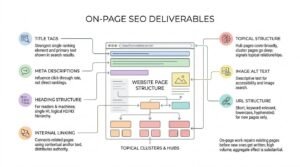
On-page SEO deliverables are the per-page optimizations that clarify what a page is about, covering titles, headings, metadata, internal links, and content structure. These are the fastest-shipping deliverables in any SEO service.
On-page work is where existing pages get repaired before new ones get written. I always harvest that low-hanging fruit first, because a page already indexed and ranking at position 12 needs less effort than a page that does not exist.
The volume is high, and the individual impact is modest. Across a few hundred pages, the aggregate effect is substantial.
| Element | Deliverable | Cadence |
| Title tag | Rewritten with primary query, under 60 characters | Batched monthly |
| Meta description | Rewritten for click-through, 150–160 characters | Batched monthly |
| H1 and heading structure | Single H1, logical H2/H3 hierarchy | Per page edit |
| Image alt text | Descriptive text for accessibility and image search | Per page edit |
| URL structure | Short, keyword-relevant, lowercase, hyphenated | On new pages only |
| Internal links | Contextual links from relevant existing pages | Monthly pass |
Title Tags, Meta Descriptions, and Heading Structure
Title tags are the strongest single on-page ranking element and the primary text shown in search results, which makes them both a ranking and a click-through lever. I rewrite these in batches, prioritized by impressions rather than by page importance.
Meta descriptions do not influence rankings directly. They influence whether anyone clicks, and click-through rate influences everything downstream.
Heading structure exists for readers and for machines equally. One H1 stating the page subject, then H2s covering distinct sections, then H3s only where a section genuinely subdivides.
Internal Linking and Topical Structure
Internal linking is the practice of connecting related pages within a site using contextual anchor text, distributing authority and signaling topical relationships to search engines. It is the most underused deliverable in most SEO services.
I run a dedicated internal linking pass monthly, because every new page published changes the optimal link graph. New pages need inbound links from existing authority, and existing pages benefit from pointing at fresh depth.
Topical structure sits underneath this. Hub pages cover a subject broadly, cluster pages go deep on components, and the links between them tell search engines which page owns which query.
Content Deliverables and Editorial Production
Content deliverables are the researched, written, optimized, and published pages that give a site something to rank with, produced on a fixed monthly volume agreed in the scope of work. Content is where most of an SEO budget goes after month three.
The volume varies enormously by budget and competition. I typically see two to four substantial pieces monthly on a mid-market retainer, and ten or more on aggressive growth programs.
What matters more than volume is whether each piece targets validated demand and fits the topical map. Publishing eight unaimed articles beats publishing zero, and it loses to publishing three aimed ones.
A complete content deliverable moves through this production sequence:
- Topic selection from the keyword and demand map built in month one
- SERP and competitor analysis for the target query, establishing required depth and format
- Content brief specifying headings, entities, questions to answer, word count, and internal link targets
- Drafting by a writer with subject familiarity
- SEO and editorial review checking accuracy, structure, and optimization
- Publishing and internal linking into the existing site structure
- Performance monitoring at 30, 60, and 90 days
Content Briefs and Semantic Outlines
A content brief is a structured specification that tells a writer exactly what a page must cover, including target query, required subtopics, entities to mention, competitor benchmarks, and internal link targets. The brief is a deliverable in its own right, and I expect to see it.
Briefs are where the SEO strategy actually enters the content. Without one, a writer produces something readable that ranks for nothing.
Semantic outlines extend the brief by mapping the relationships between concepts on the page. This is what separates content that covers a topic from content that merely mentions it.
Pillar and Cluster Content Production
Pillar pages are broad, authoritative hub pages covering an entire topic at an orientation depth, while cluster pages go deep on individual subtopics and link back to the pillar. This architecture concentrates topical authority instead of scattering it.
I build the pillar first, then produce clusters against the gaps it deliberately leaves open. Each cluster strengthens the pillar’s claim on the head term.
The model also solves an internal linking problem automatically. Every new cluster has an obvious home, and the pillar gains a fresh inbound link each time.
Content Refreshes and Decay Recovery
Content decay is the gradual loss of rankings and traffic that published pages suffer as competitors update, search intent shifts, and information ages. Refreshing existing pages usually delivers faster returns than publishing new ones.
I audit for decay quarterly, pulling any page that lost more than 20 percent of its clicks year over year. Those pages already have authority and index history, so recovery is cheap.
A refresh deliverable includes updated data, expanded sections, new internal links, and a revised publish date. It is a distinct line item, not something absorbed silently into the content quota.
Link Building and Digital PR Deliverables
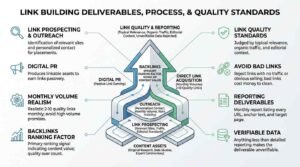
Link building deliverables are the earned external links a service acquires each month, along with the prospecting, outreach, and content assets that produce them. Link acquisition is the slowest and most expensive deliverable in an SEO service.
Realistic monthly volumes sit between two and ten quality links for most mid-market programs, depending on budget and niche difficulty. Anyone promising fifty links a month is selling volume from sources that carry no weight.
Backlinks remain a primary ranking factor, and Google’s own documentation still frames links as a signal of content value. The bar is quality, not count.
Link Prospecting and Outreach
Link prospecting is the identification of relevant sites that could plausibly link to your content, filtered by topical relevance, traffic, and editorial standards. Outreach is the personalized contact process that converts prospects into placements.
I want to see the prospect list and the outreach volume in the monthly report. A campaign contacting 200 sites to earn four links is normal, and hiding the ratio hides the effort.
Digital PR sits alongside this, producing linkable assets such as original research, data studies, and expert commentary. These earn links passively rather than through direct asking.
Link Quality Standards and Reporting
Link quality is judged by topical relevance, the linking site’s own organic traffic, editorial context, and whether the link would exist if search engines did not. Domain authority scores are directional, not decisive.
I reject links from sites with no organic traffic, no editorial standards, or obvious link-selling patterns. A bad link is worse than no link, because cleaning it up costs money later.
The monthly report should list every link acquired with the URL, anchor text, and target page. Anything less makes the deliverable unverifiable.
Local SEO Deliverables (When Location Matters)
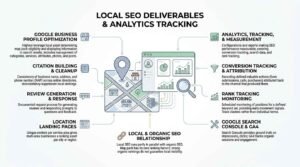
Local SEO deliverables are the optimizations that make a business visible in map packs and location-based searches, covering Google Business Profile management, citation consistency, review generation, and location landing pages. These deliverables apply to businesses serving defined geographic areas.
Local SEO runs partly in parallel with organic SEO and partly separately. The map pack has its own ranking factors, and strong organic rankings do not guarantee local visibility.
I scope local work as an add-on line item rather than assuming it. A national SaaS company needs none of it, and a multi-location dental group needs most of the budget spent there.
Local deliverables typically include:
- Google Business Profile optimization covering categories, services, attributes, photos, and posts
- Citation building and cleanup across directory listings with consistent name, address, and phone data
- Review generation and response through a documented request process
- Location landing pages with unique content per service area
- Local link acquisition from chambers, sponsorships, and regional publications
Google Business Profile Management
A Google Business Profile is the free business listing that determines map pack eligibility and displays business information directly in search results. It is the highest-leverage local asset a business owns.
Active management means weekly posts, prompt question responses, updated hours, and fresh photos. Google rewards recency signals here more visibly than on a website.
I treat category selection as the single most consequential setting. The primary category drives which queries the profile is eligible for, and changing it shifts visibility within days.
Citations, NAP Consistency, and Local Landing Pages
Citations are online mentions of a business’s name, address, and phone number across directories, and NAP consistency means those details match exactly everywhere they appear. Inconsistency creates ambiguity that suppresses local rankings.
The cleanup is tedious and finite. Once corrected, citations need only periodic auditing rather than ongoing production.
Location landing pages give multi-area businesses a ranking asset per city or region. Each needs genuinely distinct content, because duplicated pages with swapped city names rank for nothing.
Analytics, Tracking, and Measurement Setup
Analytics deliverables are the configurations, dashboards, and reports that make SEO performance measurable, covering conversion tracking, search data monitoring, and rank tracking. Measurement setup happens in month one and is verified continuously afterward.
Untracked SEO is unaccountable SEO. I have inherited accounts running for two years with broken conversion tracking, where nobody could prove whether the investment returned anything.
The setup work is small, and the consequence of skipping it is total. Every ROI conversation for the next twelve months depends on it.
| What Gets Measured | Primary Tool | Reporting Cadence |
| Organic sessions and engagement | Google Analytics 4 | Monthly |
| Impressions, clicks, and average position | Google Search Console | Monthly |
| Keyword rankings by cluster | Rank tracking platform | Weekly or monthly |
| Conversions and assisted conversions | GA4 plus CRM | Monthly |
| Index coverage and technical errors | Google Search Console | Monthly |
| Backlink acquisition | Link index tool | Monthly |
Conversion Tracking and Attribution
Conversion tracking is the recording of defined valuable actions such as form submissions, calls, purchases, and signups, attributed back to the channel that produced them. Without it, SEO reporting stops at traffic.
I insist on offline conversion import where sales close by phone or over weeks. Organic frequently sources leads that convert months later, and last-click reporting buries that contribution entirely.
Attribution will never be perfect. It only needs to be consistent enough to compare periods and channels honestly.
Rank Tracking and Search Console Monitoring
Rank tracking is the scheduled monitoring of a site’s positions for a defined keyword set, providing early movement signals before traffic changes appear. Search Console provides the ground truth on impressions, clicks, and query-level performance.
I use rankings as a leading indicator and Search Console as the record. Ranking tools sample, and Search Console reports what Google actually served.
Track clusters rather than individual terms. A page moving from position 14 to position 7 across forty related queries matters more than one keyword hitting position one.
Month-by-Month SEO Deliverables Timeline
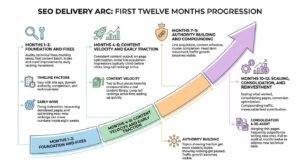
An SEO service follows a predictable delivery arc across the first twelve months: audits and fixes in months one to three, content velocity in months four to six, authority compounding in months seven to nine, and scaling in months ten to twelve. Meaningful traffic movement typically begins between months four and six.
Timelines vary with site age, domain authority, competition, and how much technical debt exists at the start. An established site with clean technicals moves faster than a new domain in a competitive niche.
This table shows the standard first-year delivery arc:
| Period | Primary Deliverables | Expected Signal |
| Months 1–3 | Audits, technical fixes, tracking setup, first content batch | Index and crawl improvements, early ranking movement |
| Months 4–6 | Content velocity, on-page rollout, initial link acquisition | Impressions rising, long-tail rankings landing |
| Months 7–9 | Authority building, content refreshes, cluster completion | Head term movement, traffic growth becoming visible |
| Months 10–12 | Scaling winners, consolidating, conversion optimization | Compounding traffic, measurable lead contribution |
Months 1–3: Foundation and Fixes
Months one to three deliver the audit, the technical remediation, the tracking setup, the content roadmap, and the first batch of published or optimized pages. This period produces the most work and the least visible traffic.
I set expectations hard here, because month-three cancellations are the most common and the most wasteful. The account is loaded with work that has not had time to register.
Early wins do exist. Fixing indexation, recovering deindexed pages, and optimizing existing near-miss rankings can move numbers inside eight weeks.
Months 4–6: Content Velocity and Early Traction
Months four to six shift the balance from fixing to publishing, with consistent content output, on-page optimization rolling across existing pages, and the first meaningful link acquisition. Impressions typically climb before clicks do.
This is where the roadmap built in month one gets executed at pace. Two to four pieces monthly compound into a real content library by month six.
Long-tail rankings arrive first. Those queries have low volume individually and add up quickly across a growing page count.
Months 7–9: Authority Building and Compounding
Months seven to nine emphasize link acquisition, content refreshes, and cluster completion around the topics showing early traction. Head terms start moving because the supporting cluster now exists.
I reallocate budget here based on evidence. Topics showing traction get more clusters, and topics showing nothing get paused rather than pursued out of stubbornness.
Traffic growth becomes visible in this window for most accounts. The earlier work stops feeling theoretical.
Months 10–12: Scaling, Consolidation, and Reinvestment
Months ten to twelve focus on scaling what worked, consolidating underperforming pages, deepening conversion rate optimization, and setting the roadmap for year two. The compounding effect becomes measurable in leads rather than sessions.
Consolidation matters as much as production by this stage. Merging thin overlapping pages into single stronger ones frequently outperforms writing new ones.
I run a full re-audit at month twelve. Twelve months of publishing and development changes create new technical debt, and the cycle restarts on better foundations.
Reporting Cadence and What a Good Report Contains
An SEO report is a scheduled document that states what was delivered, what changed in performance, what was learned, and what happens next. Monthly reporting is standard, with quarterly strategic reviews layered on top.
Bad reports dump dashboard screenshots and call it accountability. A good report is readable by someone who does not do SEO for a living.
I judge agencies on this document more than any other artifact. It reveals whether they know what they did and why.
A complete monthly report contains these sections in order:
- Deliverables completed listing every item shipped with links to proof
- Performance summary covering sessions, impressions, clicks, and conversions against the prior period
- Ranking movement by keyword cluster rather than isolated terms
- Links acquired with URL, anchor text, and target page
- Insights and analysis explaining what the numbers mean
- Next month’s plan with named deliverables and owners
- Blockers flagging anything waiting on client action
Monthly Report Structure
Monthly reports document activity and short-term signal, not strategic direction. They answer whether the agreed work happened and whether early indicators are moving.
I keep these under six pages. Length signals effort to nobody and buries the two numbers that matter.
Comparisons should be month over month and year over year simultaneously. Seasonal businesses look catastrophic on month-over-month alone.
Leading vs Lagging Indicators
Leading indicators are early signals that predict future results, such as impressions, average position, indexed pages, and links acquired. Lagging indicators are outcomes, such as organic sessions, conversions, and revenue.
Early in an engagement, judge leading indicators only. Impressions rising with clicks flat means pages are being seen and not yet clicked, which is progress.
By month six, lagging indicators should be moving. If leading indicators climbed for six months and lagging indicators did not, something in targeting or conversion is broken.
SEO Pricing Models and What Each Buys You
SEO services are priced through monthly retainers, fixed-scope projects, hourly consulting, or performance-based arrangements, with monthly retainers being the dominant model for ongoing work. Pricing correlates directly with deliverable volume, not with promised outcomes.
Typical US retainers range from roughly $1,500 to $10,000 per month for small and mid-market businesses, with enterprise programs running considerably higher. Below $1,000 monthly, the hours available cannot cover technical, content, and links simultaneously.
I always ask what the retainer buys in hours or units. A price without a deliverable count is a number with no meaning attached.
| Model | Typical Range | Best For |
| Monthly retainer | $1,500–$10,000/month | Ongoing growth programs needing all four disciplines |
| Fixed-scope project | $3,000–$25,000 one-time | Audits, migrations, one-off technical overhauls |
| Hourly consulting | $100–$300/hour | In-house teams needing direction, not execution |
| Performance-based | Variable | Rarely advisable; incentivizes short-term tactics |
Monthly Retainer, Project, and Hourly Models
Monthly retainers buy a recurring allocation of hours across strategy, technical work, content, and links, delivered on a fixed cadence. This model suits SEO because the work is cumulative and never genuinely finished.
Project pricing suits bounded work with a clear endpoint, such as a technical audit, a site migration, or a one-time content overhaul. The deliverable is defined, and the engagement closes.
Hourly consulting suits teams with internal execution capacity that need direction rather than hands. I use this where a client has developers and writers already and lacks strategy.
What Budget Tiers Realistically Deliver
At $1,500 to $3,000 monthly, expect technical maintenance, two to three content pieces, on-page optimization, and minimal link acquisition. This tier works for local businesses and low-competition niches.
At $3,000 to $7,000 monthly, expect the full four disciplines running simultaneously, four to eight content pieces, active link building, and monthly strategic input. This is the standard mid-market tier.
Above $7,000 monthly, expect dedicated team members, higher content velocity, digital PR, and enterprise-grade technical work including log file analysis and migration support.
Roles, Team Structure, and Who Does the Work
An SEO service is delivered by a team combining strategy, technical, content, and outreach roles, whether that team sits in an agency, in-house, or in a white-label arrangement. Understanding who does what tells you where a scope of work is thin.
Solo practitioners cover all four disciplines at lower volume. That works fine for smaller sites and breaks down at scale.
I ask who specifically executes each deliverable before signing anything. Vague answers about “our team” usually mean subcontracted work with no accountability chain.
| Role | Responsibility |
| SEO strategist | Roadmap, priorities, reporting, client direction |
| Technical SEO specialist | Audits, crawl analysis, developer specs, schema |
| Content strategist | Keyword mapping, briefs, editorial calendar |
| Writer or editor | Drafting, revision, subject accuracy |
| Outreach specialist | Prospecting, pitching, link acquisition |
| Developer | Implementing technical fixes and templates |
| Analyst | Tracking setup, dashboards, attribution |
The Core SEO Delivery Team
The core delivery team pairs a strategist who sets direction with specialists who execute technical, content, and outreach work. On mid-market accounts, one person frequently covers two roles.
I want a named point of contact who understands the account, not a rotating account manager relaying messages. Continuity is worth more than org chart depth.
Developer access is the most common bottleneck. Technical recommendations sit unimplemented for months when nobody owns the ticket.
In-House, Agency, and White Label Models
In-house SEO gives you full control and deep product knowledge, at the cost of hiring and retaining specialists across four disciplines. Most businesses cannot justify four salaries for one channel.
Agency SEO buys specialist breadth and tooling immediately, at the cost of divided attention across a client roster. The trade is speed for exclusivity.
White label SEO is a delivery model where an agency or consultant outsources execution to a specialist provider who works under the reseller’s brand, giving the reseller full-service capability without hiring. Marketing agencies use this to add search delivery to an existing client base.
What Clients Are Responsible For
Clients are responsible for providing access, approving deliverables, implementing changes on locked systems, supplying subject expertise, and making timely decisions. Client-side delay is the most common cause of underperforming SEO engagements.
I have seen roadmaps slip a full quarter because a single developer ticket sat unassigned. The agency reported it monthly, and it stayed open regardless.
Naming these responsibilities in the scope of work protects both parties. Ambiguity here becomes blame later.
Client responsibilities typically cover:
- Access provision to CMS, analytics, Search Console, hosting, and DNS
- Approval turnaround on content and technical recommendations within an agreed window
- Development resource for implementing fixes when the agency lacks site access
- Subject matter input for content requiring internal expertise
- Business context including seasonality, product changes, and sales feedback
Access, Approvals, and Implementation
Access delays kill month one. I ask for CMS, analytics, Search Console, and hosting credentials before the engagement starts, because gathering them afterward routinely takes three weeks.
Approval bottlenecks compound. Content sitting in review for a month pushes every downstream deliverable back and shortens the runway for results.
Implementation ownership needs to be decided explicitly. Either the agency ships changes directly, or the client’s developer does, and half-arrangements produce work that never goes live.
The Cost of Client-Side Delays
Every week of delay costs more than a week of results, because SEO compounds. A page published in month four accumulates authority that a page published in month seven has not started earning.
I quantify this in reporting. Flagging blocked deliverables monthly makes the cost visible rather than absorbing it silently.
Agencies rarely push hard on this, and clients rarely see the compounding cost. Both sides lose from that quiet.
What Is Not Included in a Standard SEO Service
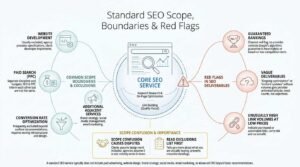
A standard SEO service does not typically include paid advertising management, website design and development, brand strategy, social media management, email marketing, or conversion rate optimization beyond basic recommendations. These are adjacent services with separate scopes and budgets.
Scope confusion causes more disputes than performance does. Clients assume design work is included, agencies assume it is not, and nobody wrote it down.
I read the exclusions list before the inclusions list. It tells you more about what you are actually buying.
Common Scope Boundaries
Website development is usually excluded, with the agency providing specifications and the client’s developer implementing them. Some agencies bundle limited development hours, and most do not.
Paid search sits in a separate discipline with separate budgets. SEO and PPC inform each other, and they are not the same deliverable.
Conversion rate optimization is frequently excluded beyond surface recommendations. Full CRO involves testing infrastructure and design resources well outside a standard SEO retainer.
Red Flags in SEO Deliverable Lists
Guaranteed rankings are the clearest red flag, because no provider controls Google’s algorithm. Any guarantee of position one for a competitive term is either meaningless or based on a term nobody searches.
Vague deliverables such as “ongoing optimization” or “content updates” without volumes attached give the provider unlimited latitude. I want counts, not adjectives.
Unusually high link volumes at low prices indicate purchased or automated links. Those carry risk and no benefit.
How to Evaluate an SEO Proposal or Scope of Work
An SEO proposal should be evaluated on deliverable specificity, timeline realism, measurement methodology, team transparency, and contract terms. The proposal document itself is the best available sample of how a provider thinks.
Compare proposals on deliverables, not on price. Two retainers at the same monthly figure frequently buy wildly different amounts of work.
I look for a proposal that admits uncertainty. Anyone certain about timelines and outcomes before auditing the site is guessing confidently.
Run every proposal through this checklist:
- Are deliverables listed with quantities rather than described as ongoing activity?
- Is a timeline stated with expected signals by month rather than a results promise?
- Is measurement defined, including which metrics matter and how they are tracked?
- Is the team named with clear ownership per discipline?
- Are exclusions stated so scope boundaries are explicit?
- Are contract terms fair on notice period, data ownership, and exit?
Questions to Ask Before Signing
Ask what happens in month one and what specifically arrives at the end of it. A provider who cannot describe their first thirty days has no process.
Ask how they will measure success and what they will do if month six shows nothing. The answer reveals whether they have a diagnostic loop or just a production line.
Ask to see an anonymized monthly report from a live account. Sales decks are polished, and reports are honest.
Contract Terms, Exit Clauses, and Data Ownership
SEO contracts commonly run six to twelve months, reflecting the time required for compounding work to show results. Anything shorter incentivizes tactics over strategy.
Data ownership needs to be stated explicitly. You should retain access to analytics properties, Search Console, content, and any accounts created on your behalf when the engagement ends.
Exit clauses should cover notice period, handover deliverables, and what happens to in-progress work. I want a documented handover, not a lockout.
Conclusion
You now know what an SEO service delivers across technical, on-page, content, and authority work, how those deliverables sequence month by month, and what pricing, teams, and scope boundaries genuinely look like.
Every discipline covered here goes deeper on its own, and each dimension deserves the fuller treatment its dedicated resource provides.
White Label SEO Service helps agencies and businesses deliver all of it under their own brand. Talk to White Label SEO Service about scoping your first ninety days.
Frequently Asked Questions
How long does it take to see results from an SEO service?
Most sites see early ranking movement within three months and meaningful traffic growth between months four and six. Competitive niches and new domains take longer.
How many deliverables should I expect each month?
A mid-market retainer typically delivers two to eight content pieces, a technical maintenance pass, an internal linking review, two to ten links, and a monthly report.
Is link building always part of an SEO service?
No, link building is frequently a separate line item or excluded entirely at lower budget tiers. Confirm it explicitly in the scope of work before signing.
What happens in month one of an SEO engagement?
Month one delivers a technical audit, keyword research, competitor analysis, tracking setup, and a prioritized roadmap. Few public-facing changes ship during this period.
Do I still need SEO deliverables after rankings improve?
Yes, because competitors publish, algorithms update, and content decays. Maintenance retainers protect earned positions and typically cost less than growth retainers.
Can I get an SEO service without content writing included?
Yes, many providers offer strategy, briefs, and technical work while your team writes. This reduces cost and shifts production capacity onto you.
What should an SEO service cost per month?
US retainers typically run $1,500 to $10,000 monthly depending on competition and scope. Below $1,000, hours cannot cover all four disciplines properly.