SEO is one of the highest-leverage investments a business can make, but it’s also one of the easiest to get burned on. Unethical SEO services promise fast rankings using tactics that violate search engine guidelines, and the fallout de-indexing, manual penalties, years of lost traffic often lands on the business owner, not the agency that caused it.
I’ve seen too many companies inherit a mess from a “growth hacker” who guaranteed page-one rankings in 30 days. The damage takes months or years to undo, and it costs far more than the original contract ever did.
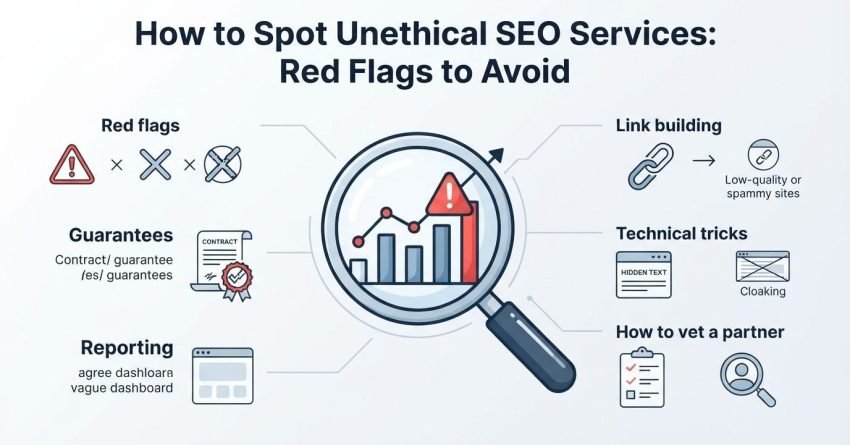
This guide covers what actually separates ethical from unethical SEO, the specific red flags around guarantees, reporting, and link building, the technical tricks bad agencies hide behind, and how to vet a partner or exit a bad one before more damage is done.
What Makes an SEO Service “Unethical” vs. Just Aggressive
Unethical SEO refers to any optimization tactic that violates a search engine’s published guidelines in order to manipulate rankings artificially. The distinction matters because “aggressive” SEO can still be fully compliant; it just moves fast within the rules, while unethical SEO breaks them outright.
I think of it on a spectrum. White hat SEO follows Google’s Search Essentials guidelines and builds rankings through genuine value: useful content, clean technical structure, and links earned through relationships or reputation. Black hat SEO does the opposite; it manipulates the algorithm directly through things like link buying, cloaking, or content automation designed to deceive rather than inform.
Gray hat SEO sits in the murky middle. It’s not explicitly banned, but it pushes boundaries in ways that carry real risk. Understanding where a tactic falls on this spectrum is the first step before evaluating any agency’s methods.
Black Hat vs. Gray Hat vs. White Hat SEO
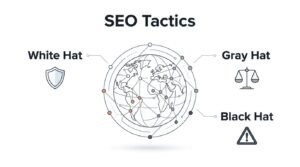
Black hat SEO directly violates search engine guidelines to manipulate rankings, while white hat SEO builds rankings through legitimate, guideline-compliant methods. Gray hat tactics exploit loopholes that aren’t explicitly banned but often draw penalties once search engines catch up to them.
| Category | Example Tactics | Risk Level |
| White Hat | Quality content, natural backlinks, technical optimization | Low |
| Gray Hat | Aggressive guest posting, expired domain reuse, thin affiliate content | Medium |
| Black Hat | PBNs, cloaking, keyword stuffing, negative SEO | High |
Guaranteed #1 Rankings – Why This Promise Is a Red Flag
No legitimate SEO provider can guarantee a #1 ranking, because Google’s algorithm weighs hundreds of variable, constantly changing factors no outside agency controls. Any contract or sales pitch promising a specific rank position by a specific date is a strong signal the agency either doesn’t understand search mechanics or is planning to use manipulative shortcuts to force a short-term result.
I’ve watched agencies guarantee “page one in 60 days” and hit it using PBNs, only to see the client’s entire domain de-indexed three months later. The guarantee wasn’t a lie exactly; it just omitted the part where the ranking wasn’t sustainable.
Ranking position depends on competitor behavior, algorithm updates, and search intent shifts, none of which any single agency controls. A trustworthy provider talks in terms of traffic growth, visibility trends, and ranking improvements over a realistic timeline, not a locked-in number one spot.
Vague or Secretive Reporting Practices
An unethical SEO provider often withholds specific details about what work was actually performed, hiding behind vague monthly summaries instead of verifiable data. This lack of transparency isn’t accidental; it’s frequently a way to disguise low-effort work or tactics the client wouldn’t approve of if they saw them clearly.
I always tell clients: if your SEO report can’t answer “what exactly did you do this month, and what changed because of it,” something is being hidden. Reporting should tie every action back to a measurable outcome in rankings, traffic, or conversions.
Reports built around dashboard screenshots with no context, unexplained “optimization” line items, or refusal to share login access to analytics platforms are all consistent patterns among providers cutting corners.
What Transparent SEO Reporting Should Include
Transparent SEO reporting includes direct access to source data, a clear breakdown of completed work, and outcome metrics tied to business goals rather than vanity numbers.
- Full access to Google Search Console and Google Analytics under the client’s own account
- An itemized list of specific pages, keywords, or technical fixes worked on
- Ranking movement data compared against a defined baseline
- Organic traffic and conversion trends over time
- A summary connecting SEO activity to business outcomes like leads or revenue
Link Schemes and Paid Link Networks
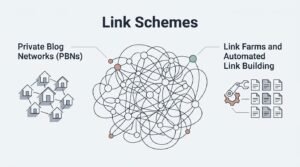
A link scheme is any pattern of link building designed primarily to manipulate a site’s ranking rather than to genuinely reference useful content, and it remains one of the most common tactics used by unethical SEO providers. Google’s own guidelines explicitly name buying or selling links that pass ranking credit as a violation subject to manual action.
I run into this constantly during audits of a site with thousands of backlinks from unrelated foreign directories, casino sites, or spun blog networks that have nothing to do with the client’s industry. It’s often the fastest tactic to spot because the link profile looks nothing like organic growth.
An Ahrefs study of link building trends found that pages in the top 10 search results have significantly more referring domains than lower-ranked pages, which is exactly why bad actors try to shortcut the process by buying links in bulk instead of earning them.
Private Blog Networks (PBNs)
A private blog network is a group of websites, often built on expired domains with pre-existing authority, that a single entity secretly owns and uses purely to build links to a client’s main site. Search engines actively hunt for PBN footprints, shared hosting IPs, matching WHOIS data, thin content, and penalize the linked sites once discovered.
Link Farms and Automated Link Building
A link farm is a network of low-quality, often auto-generated websites that exist solely to host outbound links for paying clients, with no genuine editorial content of their own. Automated link building software that mass-submits a URL to hundreds of directories in a single day produces the exact unnatural pattern search engines are trained to detect.
Keyword Stuffing and Doorway Pages
Keyword stuffing is the practice of overloading a page’s content, meta tags, or alt text with a target keyword far beyond what reads naturally, in an attempt to manipulate relevance signals. It’s one of the oldest black hat tactics and one of the easiest for modern algorithms to detect and penalize.
Doorway pages take this further; they’re built purely to rank for a narrow keyword variation and funnel all traffic to one destination page, offering the visitor no unique value of their own. I still see agencies build dozens of near-identical location pages (“plumber in [city]”) stuffed with the city name repeated unnaturally throughout the copy.
Google’s guidelines treat both practices as manipulative because they prioritize algorithm manipulation over the actual person reading the page.
Duplicate or Spun Content Practices
Content spinning is the automated process of rewriting existing text, swapping words for synonyms via software to create what looks like “unique” content across multiple pages without any original research or insight. The resulting text often reads awkwardly and provides no genuine value to a reader because it was never written by someone with actual subject expertise.
I’ve pulled up spun content in audits where entire paragraphs made grammatical sense on the surface but contained factual nonsense, because the synonym-swapping software didn’t understand context. Search engines increasingly use natural language processing to detect this exact pattern.
Duplicate content across a client’s own location or service pages, published just to capture more search real estate, creates a different but related problem: cannibalization, where pages compete against each other instead of ranking well individually.
Cloaking and Hidden Text Techniques
Cloaking is the practice of showing search engine crawlers different content than what a human visitor actually sees, in order to manipulate rankings while presenting a different experience to real users. This directly violates search engine guidelines because it deceives both the algorithm and the person searching.
Hidden text is a simpler version of the same idea: white text on a white background, text hidden behind an image, or font sizes set to zero, all stuffed with keywords a visitor never sees. I’ve found this hiding in old WordPress themes where an agency edited the CSS just enough to bury a paragraph of keyword-stuffed text off-screen.
Both tactics are explicitly flagged in manual review processes, and sites caught using them typically face a significant ranking or indexing penalty once discovered.
Unrealistic Timelines and Overnight Ranking Promises
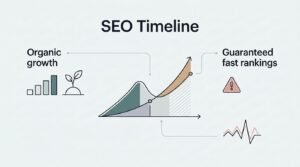
SEO typically takes four to twelve months to produce meaningful, sustainable ranking movement, which makes any promise of overnight or 30-day top rankings a near-certain sign of manipulative tactics. Organic growth is gradual because search engines need time to crawl, index, evaluate, and build trust signals around new or improved content.
A study by Ahrefs analyzing two million keywords found that only 5.7% of newly published pages reach the top 10 search results within a year, and most of those pages had strong existing domain authority behind them already.
I explain this to every new client the same way: the timeline isn’t a sales tactic; it’s how the algorithm actually works. Any provider promising results dramatically faster than this is either using paid links and cloaking to force a temporary spike, or simply doesn’t understand how ranking signals accumulate over time.
Fast movement is possible in low-competition niches or with an already-authoritative domain, but as a blanket promise across any industry, “guaranteed fast rankings” almost always signals a shortcut being taken somewhere in the process.
Lack of Technical SEO Transparency (Access & Ownership Issues)
An unethical SEO provider frequently insists on creating and owning all of your core accounts Search Console, Google Analytics, domain registration rather than working within accounts you control. This isn’t a technical convenience; it’s a control mechanism that makes it difficult or impossible to leave the relationship without losing your historical data and rankings.
I’ve helped clients recover access to their own Google Business Profile after an agency refused to transfer ownership during a contract dispute. The business had built years of reviews and local visibility, all held hostage by a login the client never controlled.
Legitimate agencies work as guests or managers within client-owned accounts, never as the sole owner. If a provider resists giving you admin-level access to your own data, that resistance is the red flag itself.
Who Should Own Your Website’s Accounts
The business owner should hold primary administrative ownership of every core account domain registrar, hosting, Google Search Console, Google Analytics, and Google Business Profile with the SEO agency added only as a manager or user.
- Domain registrar account (registered under the business’s name and email)
- Hosting account and CMS admin access
- Google Search Console (owner-level access)
- Google Analytics (admin-level access)
- Google Business Profile (primary owner)
One-Size-Fits-All Strategies and Templated Audits
A templated SEO strategy applies the same checklist, keyword targets, and content plan across every client regardless of industry, competitive landscape, or business goals. This approach ignores the fact that a local service business and an e-commerce brand face entirely different ranking challenges and require different strategic priorities.
I can usually spot a templated audit within the first few pages: generic recommendations like “add more content” or “improve page speed” with no specifics tied to the client’s actual competitors or search landscape. A genuine audit references the client’s specific keyword gaps, technical issues found on their exact site, and named competitors currently outranking them.
Agencies running dozens of clients through identical playbooks are optimizing for their own efficiency, not the client’s actual competitive position in search results.
Negative SEO Tactics Used Against Competitors
Negative SEO refers to a set of malicious tactics used to deliberately damage a competitor’s search rankings, rather than improve one’s own. Common methods include building thousands of spammy backlinks toward a competitor’s site to trigger a manual penalty, or scraping and republishing a competitor’s content to create duplicate content issues.
I flag this as a red flag on both sides: an agency willing to suggest negative SEO against a competitor is also an agency willing to expose your own site to the same tactics from someone else, or worse, from Google’s spam detection systems reacting to the scheme. Google’s Search Central documentation explicitly outlines these link spam patterns as policy violations regardless of who initiates them.
Any agency proposing to “handle the competition” through link-based sabotage rather than through better content and technical execution is operating well outside ethical practice.
Ignoring Google’s Webmaster Guidelines and Algorithm Updates
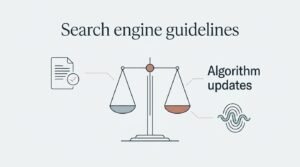
Search engine guidelines, published directly by Google, define exactly which SEO practices are acceptable and which trigger manual or algorithmic penalties. An agency that either doesn’t reference these guidelines or actively works around them is building your visibility on a foundation that can collapse with the next core algorithm update.
I’ve watched entire client portfolios lose 40-60% of organic traffic overnight following updates specifically designed to catch manipulative link patterns or thin content. Agencies who stayed within guidelines barely noticed the update; the ones cutting corners saw their client base evaporate.
A provider who can’t clearly explain how their tactics align with current published guidelines, or who dismisses algorithm updates as “just Google being difficult,” is signaling a fundamental misunderstanding of how sustainable rankings actually work.
Pricing Red Flags – Too Cheap or Suspiciously High
SEO pricing that sits far below market rate almost always indicates automated, templated, or outsourced low-quality work, while pricing far above market rate with no clear scope breakdown often signals padding rather than added value. Both extremes deserve scrutiny, but for different reasons.
| Price Range (Monthly) | Likely Scope | Red Flag Risk |
| Under $500 | Automated tools, templated reports, minimal human oversight | High |
| $500–$1,500 | Small business focus, limited content/link output | Medium-Low |
| $1,500–$5,000 | Full-service strategy, content, technical, and link building | Low |
| $5,000+ | Enterprise scope or unclear justification | Depends on scope clarity |
A genuine SEO engagement requires real human hours of research, content creation, technical audits, outreach, and those hours cost money. When a provider quotes $200 a month for “complete SEO management,” the math simply doesn’t support real work being done; something is being automated, outsourced cheaply, or skipped entirely.
On the other end, a $10,000-a-month retainer with no itemized breakdown of deliverables is just as concerning, because it makes it impossible to evaluate whether the spend matches the actual work performed.
No Case Studies, References, or Verifiable Track Record
A legitimate SEO agency should be able to produce specific, verifiable examples of past client results, including measurable before-and-after data on traffic, rankings, or conversions. The absence of any documented track record, or reluctance to provide client references, often means the agency has little successful history to show.
I always ask for at least two references I can contact directly, plus a walkthrough of the actual strategy behind a documented case study, not just a screenshot of a traffic graph trending upward with no context. Traffic can spike for dozens of reasons unrelated to SEO skill.
Agencies confident in their work are typically eager to share specifics, because verifiable results are their strongest sales argument. Reluctance to provide this data is itself informative.
How to Vet and Choose an Ethical SEO Partner
Vetting an ethical SEO partner means verifying their reporting transparency, checking references, reviewing their link building philosophy, and confirming they follow published search engine guidelines before signing any contract. This process takes time upfront but prevents months or years of remediation later.
I recommend treating this like hiring a key employee, not a vendor. Ask direct questions, request documentation, and pay close attention to how they explain their methodology; vague or defensive answers are as telling as the answers themselves.
Key Questions to Ask Before Hiring an SEO Agency
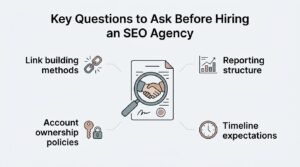
Before hiring an SEO agency, ask specific questions about their link building methods, reporting structure, account ownership policies, and realistic timeline expectations to confirm they operate ethically.
- Will our business retain full ownership of all accounts and data?
- Can you walk me through exactly how you build backlinks?
- What reporting will I receive, and can I access raw data directly?
- Can you provide two references I can contact directly?
- What is your realistic timeline for measurable ranking improvement?
- How do you stay current with algorithm updates and guideline changes?
What to Do If You’re Already Working With an Unethical SEO Provider
If you suspect your current SEO provider is using unethical tactics, the first step is requesting full access to your Search Console, Analytics, and backlink profile to audit exactly what’s been done to your site. Acting quickly limits further damage and preserves evidence you may need for recovery.
- Request immediate admin access to all accounts tied to your domain
- Export your full backlink profile using a tool like Ahrefs or Semrush
- Check Search Console for manual action notices or unusual indexing drops
- Disavow toxic or spammy backlinks identified in the audit
- Document all findings before terminating the contract
- Bring in an independent auditor to assess technical and content damage
I’ve walked several clients through exactly this process, and the businesses that acted fastest after noticing red flags recovered in months rather than years. The longer a manipulative pattern runs, the more entrenched the damage becomes in the site’s link and content profile.
Conclusion
Unethical SEO hides behind guarantees, secrecy, and shortcuts, from PBNs to cloaking to templated audits with no real strategy behind them.
Sustainable rankings come from transparency, technical accuracy, and guideline-compliant execution, not manipulation that collapses under the next algorithm update.
We help businesses build SEO the right way. White Label SEO Service brings transparent reporting and proven, penalty-free strategy to every partnership.
Frequently Asked Questions
What is considered “black hat” SEO?
Black hat SEO refers to any tactic that directly violates search engine guidelines to manipulate rankings. Common examples include cloaking, keyword stuffing, PBNs, and paid link schemes.
Can unethical SEO practices get my website penalized by Google?
Yes, unethical SEO practices can trigger both manual actions and algorithmic penalties from Google. Penalties can result in significant ranking drops or complete de-indexing of affected pages.
How long does it take to recover from a Google penalty caused by bad SEO?
Recovery timelines vary widely, typically ranging from several months to over a year. The severity depends on the penalty type, how quickly toxic links are disavowed, and how thoroughly the issues are fixed.
Is it normal for SEO agencies to guarantee rankings?
No, guaranteeing specific rankings is not normal or realistic among reputable agencies. Search engines weigh hundreds of variable factors no single agency can fully control.
How much should ethical SEO services cost?
Ethical, full-service SEO typically costs between $1,500 and $5,000 per month for most small to mid-sized businesses. Pricing far below this range usually signals automated or low-quality work.
What’s the difference between white hat and black hat link building?
White hat link building earns links through relationships, quality content, and outreach. Black hat link building buys, farms, or artificially manufactures links purely to manipulate rankings.
How do I know if my current SEO agency is using risky tactics?
Request full access to your backlink profile and Search Console data, then check for unnatural link patterns or manual action warnings. Vague reporting and refusal to share raw data are also strong warning signs.