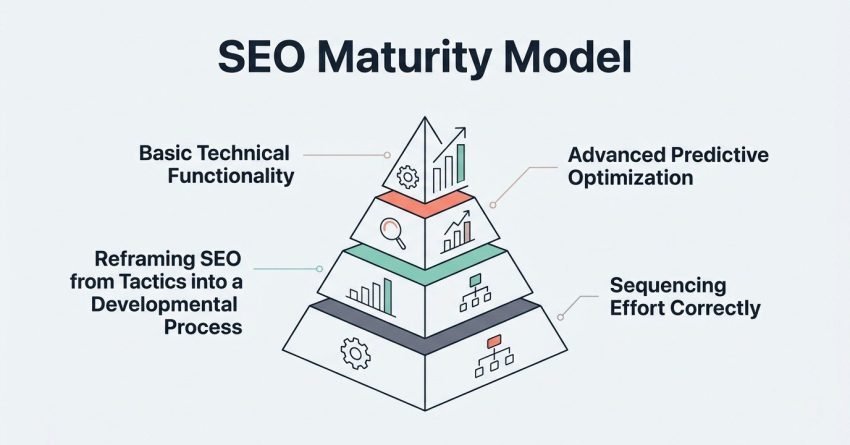
An SEO maturity model is a framework that maps a website’s organic search capability across five progressive stages, from basic technical readiness to predictive, data-driven growth. We built this model because most businesses judge SEO success by rankings alone, when the real predictor of long-term ROI is how mature their underlying organic system actually is. A site stuck on broken technical foundations cannot benefit from great content, and great content cannot compound without the authority signals that come later.
Skipping stages is why so many SEO investments underperform expectations. Understanding your actual stage prevents wasted budget and misaligned timelines.
This guide covers what the SEO maturity model is and how its stages connect, a full breakdown of each of the five stages from technical foundations through predictive optimization, how to assess where your website currently stands, and what realistic timelines, budgets, and reporting look like at each level.
What Is an SEO Maturity Model?
An SEO maturity model is a structured framework that classifies a website’s organic search capability into distinct stages, ranging from basic technical functionality to advanced, predictive optimization. I use this framework with clients because it reframes SEO from a list of tactics into a developmental process, similar to how software teams measure engineering maturity.
Most SEO advice treats every website as if it needs the same tactics at the same time. A site with broken indexation does not need a link building campaign; it needs its crawlability fixed first. The maturity model exists to sequence effort correctly.
Why SEO Maturity Matters for Long-Term ROI
SEO maturity matters for long-term ROI because it determines whether investment in content or links can actually compound into ranking gains. Money spent on advanced tactics before foundational issues are resolved typically produces little measurable return. I have seen agencies pitch authority-building campaigns to sites that Google could not even fully crawl.
Matching investment to maturity stage protects budget and sets realistic expectations from day one.
How the Five Stages of SEO Maturity Work Together
The five SEO maturity stages work together as a progressive, largely sequential system where each stage builds the capability the next stage depends on. Foundational technical health enables content to get indexed and ranked, structured content enables topical authority, and authority enables the trust signals that support predictive, AI-era optimization.
Progression is not always linear in practice. A business can be technically mature but content-immature, or vice versa, which is why maturity gets assessed per dimension rather than as a single score.
The compounding effect is what makes this model useful for planning. Each stage’s gains make the next stage’s effort more efficient, which is also why rushing ahead of your true stage tends to waste budget rather than accelerate growth.
Signals That Indicate Which Stage You’re In
The clearest signal of your current SEO maturity stage is where your growth bottleneck sits, not how much content or links you have accumulated. A site with strong content but flat rankings for months often has an authority gap, not a content gap. A site with neither traffic nor indexed pages almost always has a technical gap.
Reviewing Google Search Console coverage reports alongside ranking distribution reveals the bottleneck quickly.
Stage 1 – Foundational SEO (Technical & Crawlability Basics)
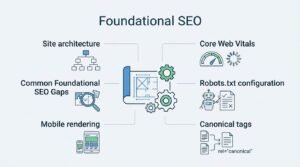
Foundational SEO is the first maturity stage, focused entirely on ensuring search engines can crawl, render, and index a website correctly. Foundational SEO is a technical SEO discipline that establishes crawlability, indexation, and site architecture as prerequisites before any content or authority work can produce results. Without this stage complete, nothing built afterward performs reliably.
Site architecture at this stage means a logical URL structure, a clean XML sitemap, and internal linking that lets search engines discover every important page within a few clicks. Core Web Vitals also live here, since Google’s own documentation ties page experience signals directly to ranking eligibility.
Robots.txt configuration, canonical tags, and mobile rendering round out the checklist. A site that fails any of these basics is not ready for the content or authority stages, no matter how much budget gets poured into them.
Common Foundational SEO Gaps in Early-Stage Websites
The most common foundational SEO gap in early-stage websites is unresolved indexation issues, where pages exist but never get crawled or added to Google’s index. Duplicate content from unclear canonicalization causes this frequently. Slow page speed on mobile devices is the second most common gap I encounter.
Stage 2 – Structured SEO (On-Page & Content Fundamentals)
Structured SEO is the second maturity stage, where a website organizes its content around clear keyword mapping, consistent on-page optimization, and logical topic structure. This is where title tags, header hierarchy, meta descriptions, and internal linking patterns start reflecting actual search demand rather than guesswork.
Keyword mapping at this stage means assigning one primary topic per page and avoiding overlap between pages that compete for the same query. On-page optimization means title tags and headers that match search intent, not just inserting keywords.
Content structure becomes measurable here too. Pages need clear H1-H2-H3 hierarchies, scannable formatting, and internal links that connect related pages into a coherent site structure rather than isolated posts.
How Content Quality Signals Structured Maturity
Content quality signals structured maturity when pages consistently answer the specific query they target within the first few sentences, rather than burying the answer under generic introductions. Structured-stage sites also show consistent formatting patterns across pages, which indicates a repeatable content process rather than one-off writing.
Stage 3 – Strategic SEO (Topical Authority & Search Intent)
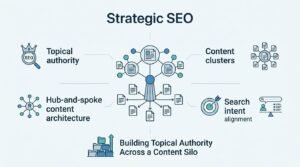
Strategic SEO is the third maturity stage, defined by building topical authority through interconnected content clusters that comprehensively address a subject area rather than isolated keywords. At this stage, individual pages stop competing for attention and start reinforcing each other through a hub-and-spoke content architecture.
Search intent alignment becomes the primary skill here. A page ranking for “best CRM software” needs a comparison format, while a page ranking for “what is a CRM” needs a definition-first structure. Matching format to intent is what separates strategic maturity from structured maturity.
Topical authority itself gets measured by coverage breadth and depth across a content silo, not by any single page’s word count. Comprehensive coverage of a topic domain signals expertise to search engines in a way that scattered content never can.
Building Topical Authority Across a Content Silo
Building topical authority across a content silo means publishing a pillar page that orients readers across a full topic, supported by cluster pages that go deep into each subtopic the pillar introduces. This is the exact architecture this page itself follows for the topic of SEO maturity.
Stage 4 – Authoritative SEO (Link Building & Domain Trust)
Authoritative SEO is the fourth maturity stage, centered on earning backlinks and trust signals that establish a website’s credibility within its industry. Domain authority at this stage functions less like a single tactic and more like accumulated proof, built through digital PR, expert contributions, and content that earns citations naturally.
E-E-A-T, Google’s framework for experience, expertise, authoritativeness, and trust, becomes directly relevant here. Author credentials, transparent sourcing, and cited data all feed into how search engines assess whether a domain deserves ranking trust for competitive queries.
An Ahrefs study of 1 billion pages found that 90.63% of pages get zero traffic from Google, largely due to a lack of backlinks, which underscores how much this stage separates sites that rank from sites that merely publish.
How Link Acquisition Changes at This Stage
Link acquisition changes at this stage from opportunistic outreach to a deliberate program tied to genuinely link-worthy assets, such as original research, data studies, or tools. Businesses at earlier maturity stages chase any backlink; authoritative-stage businesses build things worth linking to naturally.
Stage 5 – Predictive SEO (Data-Driven & AI-Optimized Growth)
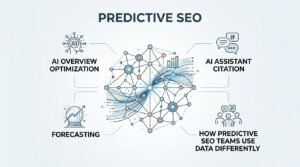
Predictive SEO is the fifth and most advanced maturity stage, where organic strategy is driven by forecasting models, AI Overview optimization, and performance data rather than reactive tactics. Businesses at this stage treat search visibility as a measurable system they can model, not a black box they hope performs.
AI Overview and AI assistant citation have become a real ranking surface. Content at this stage is structured specifically to survive extraction into AI-generated answers, with self-contained claims and clearly sourced statistics.
Forecasting at this stage uses historical ranking and traffic data to predict the impact of new content or link investments before they happen, turning SEO from a cost center into a modeled growth channel with projectable returns.
How Predictive SEO Teams Use Data Differently
Predictive SEO teams use data differently by building forecasting models that connect ranking position changes to projected traffic and revenue, rather than reporting rankings as a standalone metric. This requires integrating Google Search Console, Google Analytics, and often custom data pipelines.
How to Assess Your Current SEO Maturity Stage
Assessing your current SEO maturity stage requires auditing four areas independently: technical health, on-page structure, topical coverage, and link authority, since a business can be mature in one area and immature in another. A single overall score hides the real bottleneck.
A self-audit framework starts with Google Search Console’s coverage and performance reports, cross-referenced against a content inventory that maps existing pages to topic clusters. Backlink profile analysis through a tool like Ahrefs or Semrush completes the picture.
The most common misjudgment I see is businesses assuming they are content-mature because they publish frequently, when their content lacks the topical structure that Stage 3 requires. Volume without structure does not equal maturity.
Key Metrics That Reveal Your True Maturity Level
Key metrics that reveal true maturity level include indexation rate from Google Search Console, keyword ranking distribution across page one versus page three, referring domain growth rate, and organic traffic per published page. Low traffic per page despite high publishing volume usually points to a structural or intent-matching problem.
Realistic SEO Timelines at Each Maturity Stage
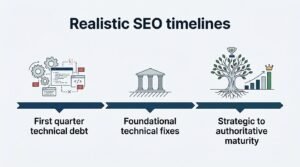
Realistic SEO timelines vary significantly by maturity stage, with foundational technical fixes often showing indexation improvements within four to eight weeks, while moving from strategic to authoritative maturity can take six to twelve months depending on competition. There is no universal timeline that applies across every business and industry.
Ahrefs’ analysis of two million keywords found that only 5.7% of pages reach the top 10 within a year, which reflects how much competitive density affects timeline expectations regardless of maturity stage.
Businesses starting at Stage 1 with significant technical debt should expect the first quarter to show minimal traffic movement, since foundational fixes precede any content or authority gains showing up in rankings.
Why SEO Timelines Vary by Industry and Competition
SEO timelines vary by industry and competition because keyword difficulty, incumbent domain authority, and search volume differ dramatically between niches. A local service business often reaches page one faster than a national SaaS brand competing against established enterprise domains.
Common Mistakes That Stall SEO Maturity Progression
The most common mistake that stalls SEO maturity progression is investing in link building or content volume before resolving foundational technical issues, which wastes budget on tactics the site cannot yet benefit from. I see this constantly with businesses eager to skip ahead to visible results.
Another frequent stall point is treating content production as a volume game rather than a topical coverage game, which keeps businesses stuck at Stage 2 indefinitely regardless of how many articles they publish.
How Budget and Resourcing Shift Across Maturity Stages
Budget and resourcing needs shift substantially across SEO maturity stages, with early stages requiring heavier technical and development resources while later stages require more content strategy and outreach investment. Stage 1 often needs a developer more than a writer.
By Stage 4 and Stage 5, budget typically shifts toward digital PR, data analysis, and specialized reporting tools, since the tactics that move the needle change as technical debt gets resolved.
The Role of Analytics and Reporting in SEO Maturity
Analytics and reporting play a different role at each SEO maturity stage, shifting from basic crawl error monitoring in early stages to predictive forecasting models in advanced stages. Google Search Console and Google Analytics 4 remain the core tools throughout, but what gets measured changes.
Early-stage reporting focuses on indexation and crawl errors. Mid-stage reporting tracks keyword rankings and content performance. Late-stage reporting connects organic traffic directly to revenue and pipeline data.
When to Bring In an SEO Agency vs. Build In-House
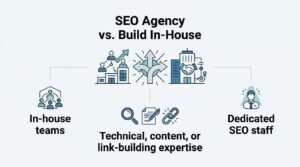
Bringing in an SEO agency typically makes sense when a business lacks the technical, content, or link-building expertise needed to progress past its current maturity stage within a reasonable timeframe. In-house teams often work well for content-stage execution but struggle with the technical and authority-building specialization required at later stages.
Businesses without dedicated SEO staff frequently benefit from agency support starting at the foundational stage, since technical errors compound quickly and are costly to unwind later.
Conclusion
The SEO maturity model connects technical foundations, content structure, topical authority, and domain trust into one progressive system. Predictive, data-driven optimization sits at the top, but every stage below it makes the next one possible.
We help businesses identify exactly where they stand and build the roadmap to move forward. Talk to White Label SEO Service about assessing your organic maturity stage today.
Frequently Asked Questions
What is the SEO maturity model?
The SEO maturity model is a framework that classifies organic search capability into five progressive stages, from technical foundations to predictive optimization. It helps businesses match SEO investment to their actual readiness level.
How long does it take to move between SEO maturity stages?
Moving between SEO maturity stages typically takes three to twelve months depending on the stage and competition level. Technical fixes move fastest, while building authority and topical depth takes considerably longer.
What is the difference between technical SEO and strategic SEO maturity?
Technical SEO maturity concerns crawlability, indexation, and site health, while strategic SEO maturity concerns topical authority and search intent alignment. Technical maturity is a prerequisite for strategic maturity to produce results.
How do I know what SEO maturity stage my website is in?
You can determine your SEO maturity stage by auditing technical health, content structure, topical coverage, and backlink authority separately. Your growth bottleneck usually reveals your true current stage.
Does every business need to reach Stage 5 (Predictive SEO)?
Not every business needs to reach Stage 5, since predictive SEO requires significant data infrastructure and competitive pressure to justify the investment. Many businesses achieve strong ROI stopping at Stage 3 or 4.
What causes businesses to get stuck at an early SEO maturity stage?
Businesses get stuck at early SEO maturity stages primarily by investing in advanced tactics like link building before fixing foundational technical issues. Unresolved indexation problems are the most common cause.
How does an SEO agency help accelerate maturity progression?
An SEO agency accelerates maturity progression by diagnosing the true bottleneck stage and applying specialized technical, content, or authority-building expertise. This avoids wasted budget on premature tactics.