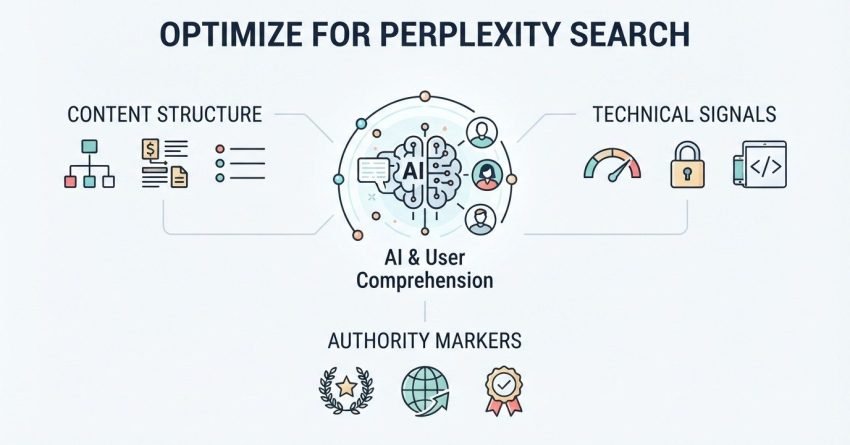
Perplexity search optimization is the process of structuring content, technical signals, and authority markers so Perplexity’s AI can find, understand, and cite a page as a source in its answers. I’ve watched this shift from a niche curiosity to a real traffic channel over the past year, and it works on different mechanics than the ranking systems most of us grew up on.
Businesses that ignore this channel now will spend 2026 playing catch-up on citations they could’ve earned today. Every week without a strategy here is a week competitors get cited instead of you.
This guide covers how Perplexity actually retrieves and ranks content, the technical and on-page foundations that make a page citable, how authority and backlinks factor into AI search, and what a realistic timeline looks like. I’ll also flag the mistakes that quietly kill visibility.
What Is Perplexity Search and How Does It Work
Perplexity is an AI-powered answer engine that retrieves information from live web sources and generates a synthesized, cited response instead of a list of links. I think of it less as a search engine and more as a research assistant that shows its work. It reads multiple pages, pulls the most relevant facts, and stitches them into an answer with source attribution.
That citation behavior is the whole game here. Ranking number one doesn’t matter if Perplexity never quotes your page in its answer.
How Perplexity Differs From Traditional Search Engines
Traditional search hands the user ten blue links and lets them do the reading. Perplexity does the reading for them and delivers a synthesized answer with sources attached.
This means the unit of competition changes. You’re not competing for a click on a headline anymore; you’re competing to be the sentence that gets quoted.
How Perplexity Sources and Cites Answers
Perplexity selects sentences, not pages, and it favors content that answers a question in a self-contained, verifiable way. A vague or hedged sentence rarely survives extraction intact.
I’ve found that pages built around clear, entity-first definitions get pulled into answers far more consistently than pages that bury the point under three paragraphs of scene-setting.
Why Perplexity Optimization Matters for Businesses in 2025
Perplexity’s user base has grown fast enough that ignoring it now means losing a distribution channel your competitors are already claiming. Being cited puts your brand name directly inside an AI-generated answer, often with zero competing links on the page.
That’s a different kind of visibility than a search results page. There’s no scrolling past nine other results; if you’re cited, you’re the answer, or one of a handful shown alongside it.
I treat this the same way I treated featured snippets years ago: an early-mover advantage that compounds the longer competitors wait.
How Perplexity’s AI Models Retrieve and Rank Content
Perplexity retrieves content in real time from the live web and combines it with a language model that synthesizes the retrieved material into a direct answer. This retrieval step happens at query time, not from a static, pre-built index the way classic search engines work.
That real-time behavior changes what “ranking” even means here.
Retrieval-Augmented Generation (RAG) Explained
Retrieval-Augmented Generation is the architecture behind Perplexity’s answers, and it works by fetching relevant documents first, then generating a response grounded in what was fetched. The model doesn’t rely purely on what it memorized during training.
This is why fresh, well-structured pages can outperform older, more “authoritative” pages that haven’t been updated. Retrieval-augmented generation rewards recency and clarity over pure domain age.
Real-Time Web Crawling vs. Index-Based Search
Google crawls, indexes, and stores pages ahead of time, then serves from that stored index at query time. Perplexity leans more heavily on live retrieval, which means a page published this morning has a real shot at being cited this afternoon.
That’s a genuinely different opportunity window than classic SEO ever offered.
Content Formatting That Perplexity Prefers
Perplexity favors content written in an answer-first structure, where the core response appears in the opening sentence and supporting context follows. I write every section this way now, regardless of the destination platform, because it works everywhere extraction matters.
Structure isn’t decoration here. It’s the mechanism that determines whether your content survives being lifted out of context.
Answer-First Structure and Extractable Sentences
Every extractable sentence needs to name its own subject and stand completely alone. A sentence that leans on “it” or “this” to carry meaning from the sentence before rarely gets quoted cleanly.
I check every key claim in my content against this test: does it still make sense if someone reads only this one sentence?
Using Lists, Tables, and Data for Citation
Numbered steps, comparison tables, and clearly labeled data points give Perplexity a defined shape to extract. A wall of unstructured prose forces the model to guess where the answer actually lives.
I lead every table and list with one sentence stating exactly what it shows, since an extracted table without that context loses its meaning entirely.
Technical SEO Requirements for Perplexity Visibility
Perplexity can only cite content it can access, so crawlability, fast load times, and clean structured data remain non-negotiable technical foundations. None of the AI-search hype changes the fact that a blocked or broken page simply won’t appear.
I still run the same technical audits I always have, just with an added lens for how an AI crawler parses the page.
Crawlability and Indexability Basics
A page has to be reachable, unblocked in robots.txt, and free of accidental noindex tags before any content strategy matters. I’ve seen strong content sit invisible for months because of one stray meta tag.
Site Speed and Structured Data Considerations
Slow-loading pages get skipped by crawlers with limited patience, and structured data helps disambiguate what a page is actually about. Schema markup gives both traditional and AI crawlers a machine-readable shortcut to your content’s meaning.
E-E-A-T Signals and Source Credibility in Perplexity
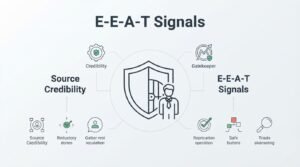
Perplexity weighs source credibility heavily, favoring pages that demonstrate real experience, expertise, authority, and trust over generic or unattributed content. This isn’t new; Google has pushed E-E-A-T for years, but AI answer engines apply it with even less tolerance for thin content.
An unnamed author, no citations, and no clear expertise markers make a page an easy skip for an AI system trying to avoid citing something unreliable.
I make sure every claim on a page can be traced to a credible source, because **E-E-A-T signals**now function as a gatekeeper for AI citation, not just a ranking nudge.
How to Structure Content for AI Citation and Extraction
Structuring content for AI citation means writing self-contained, entity-first sentences organized under headings that directly answer a likely query. I plan the heading itself as the question a user might ask, then answer it in the very first line beneath it.
This section-by-section discipline is what separates content AI systems quote from content they skip past.
Definitions matter more here than almost anywhere else. Every major entity I introduce gets one sentence in the form “[Entity] is a [type] that [attribute],” placed right where the entity first appears substantively, not tucked into a glossary at the bottom.
I also match every heading to one specific extractable shape: a definition paragraph for “what is” queries, a table for comparisons, a numbered list for processes. Mixing shapes under one heading dilutes the extraction target.
Keyword and Query Research for Perplexity Search
Perplexity users often phrase queries as full questions rather than short keyword fragments, so research needs to shift toward conversational, intent-rich phrasing. I pull these directly from real user language rather than forcing short-tail keywords into unnatural sentences.
Tools built for traditional keyword research still help, but I weight question-based variants and comparison phrasing much higher than I used to.
On-Page Optimization Tactics for Perplexity
Clear headings, descriptive subheadings, and a logical content hierarchy help Perplexity’s retrieval system understand exactly what each section covers. I treat every H2 and H3 as a mini-answer engine of its own, not just a visual break in the page.
Internal consistency in terminology matters too; switching between synonyms for the same concept across a page can confuse retrieval systems that are matching on precise phrasing.
The Role of Backlinks and Authority in Perplexity Rankings
Backlinks still function as a trust signal in Perplexity’s source evaluation, even though the platform weighs real-time relevance more heavily than a static link profile. A page with strong topical authority and a healthy link profile tends to get pulled into answers more consistently than an unlinked, isolated page.
I don’t chase links for their own sake anymore, but I do make sure genuinely valuable content earns natural citations from other sites, because that pattern signals credibility to both traditional and AI search systems.
Perplexity Pages, Perplexity Spaces, and Brand Visibility
Perplexity’s own Pages and Spaces features let users and brands publish structured content directly inside the platform, creating an additional visibility channel beyond traditional web citation. I keep an eye on these features because they represent a direct-publishing opportunity that didn’t exist in classic search.
Brands showing up inside Perplexity’s native content tools get a visibility layer that a normal web page competing for citation doesn’t have access to.
Measuring and Tracking Perplexity Search Performance
Tracking Perplexity visibility requires checking referral traffic in analytics tools and manually testing target queries to see whether your pages get cited. There’s no dedicated “Perplexity Search Console” yet, so I rely on server log analysis and direct query testing to fill that gap.
Referral traffic from perplexity.ai showing up in Google Analytics is usually the first concrete signal that citations are converting into visits.
Common Perplexity Optimization Mistakes to Avoid
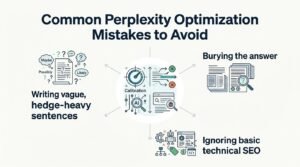
Writing vague, hedge-heavy sentences is the most common mistake I see, because Perplexity’s extraction system skips over content that never commits to a clear, standalone answer. Burying the answer under three paragraphs of introduction before getting to the point is a close second.
Ignoring basic technical SEO because “this is an AI thing now” is another one; crawlability and speed still gate everything else.
Perplexity Search vs. Google SEO vs. Other AI Search Engines
Perplexity, Google, and other AI search tools like ChatGPT search all reward clear, well-structured, authoritative content, but they differ in how heavily they weigh real-time retrieval versus static indexing. Google still leans on its enormous pre-built index; Perplexity leans harder on live retrieval at query time.
| Platform | Primary Mechanism | Citation Behavior |
| Google Search | Static index, PageRank-influenced | Ranks links, sometimes shows AI Overview |
| Perplexity | Real-time retrieval + RAG | Synthesizes answer, cites sources inline |
| ChatGPT Search | Hybrid retrieval + model knowledge | Cites sources selectively within answer |
Optimizing for one of these systems overlaps heavily with optimizing for the others, since all three reward the same underlying clarity and structure.
Perplexity Optimization Timeline: What to Expect
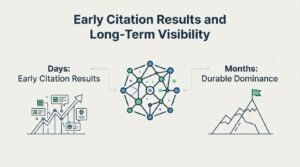
Early citation results can appear within days of publishing a well-structured page, since Perplexity’s real-time retrieval doesn’t wait for a traditional indexing cycle. Consistent, repeatable visibility across many queries typically takes a few months of sustained content and authority work.
I set realistic expectations with clients here: fast initial signals, but durable dominance still takes the same sustained effort classic SEO always required.
Conclusion
Perplexity search rewards clear structure, credible sourcing, and content built to survive extraction. We’ve walked through the technical, content, and authority pillars that make citation possible.
This space will keep evolving alongside AI search adoption, and the sites investing in structure now will hold the advantage later.
We help businesses build that foundation. Partner with White Label SEO Service to turn AI search visibility into real, measurable growth.
Frequently Asked Questions
What is Perplexity search optimization?
Perplexity search optimization is structuring content and technical signals so Perplexity’s AI can find, understand, and cite a page. It focuses on clarity, credibility, and extractable answers rather than traditional keyword ranking.
How is optimizing for Perplexity different from traditional SEO?
Perplexity rewards real-time retrieval and citation-worthy sentences over static ranking signals. Traditional SEO still matters, but answer-first structure and source credibility carry more weight here.
Does Perplexity use Google’s index?
No, Perplexity primarily uses its own real-time retrieval system rather than relying on Google’s index. It fetches live web content at query time to generate its answers.
How long does it take to get cited in Perplexity?
Initial citations can appear within days of publishing well-structured, crawlable content. Consistent visibility across many queries usually takes a few months of sustained effort.
Can small businesses get cited in Perplexity search?
Yes, small businesses can get cited if their content is clear, credible, and well-structured. Perplexity prioritizes content quality and extractability over domain size or age.
Does Perplexity optimization require backlinks?
Backlinks aren’t strictly required, but they strengthen the authority signals Perplexity uses to evaluate sources. Strong topical content paired with natural citations performs best.
How do I track my visibility in Perplexity search?
Track referral traffic from perplexity.ai in your analytics platform and manually test target queries. There’s no dedicated Perplexity Search Console yet, so manual monitoring fills the gap.