Thin, duplicate, and scaled content penalties happen when Google determines a significant portion of a site’s pages offer little unique value to searchers, whether through low-effort pages, repeated text, or mass-produced content at scale. I have watched this hit sites that looked “fine” on the surface but were quietly bleeding rankings for months. These penalties do not usually arrive as a single dramatic drop. They creep in through a core update or a helpful content signal, and by the time most site owners notice, dozens or hundreds of pages are already affected.
Ignoring this problem gets more expensive every month it sits untreated. Recovery gets harder, not easier, the longer thin or duplicate content stays live on a domain.
This guide covers how Google defines and detects these content problems, the diagnostic process using Search Console and content audits, the specific fixes for thin, duplicate, and scaled content issues, and what a realistic recovery timeline actually looks like once cleanup is underway.
What Google Considers Thin, Duplicate, or Scaled Content
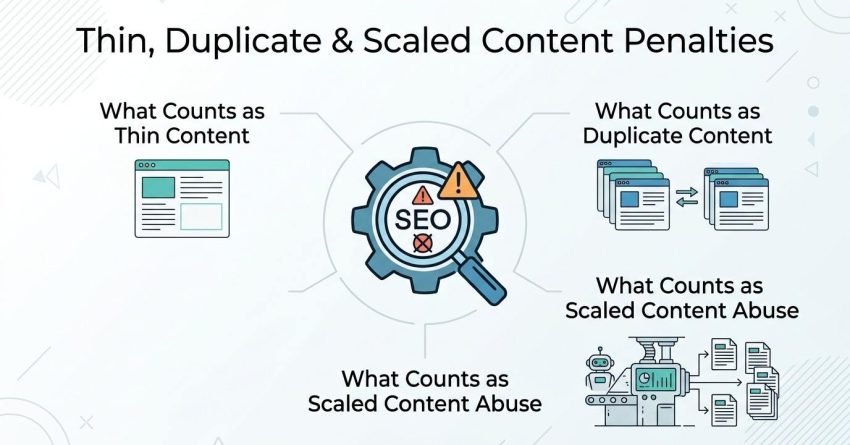
Thin content is any page that provides minimal original value to a user, while duplicate content is text that matches or closely mirrors content elsewhere, and scaled content abuse refers to mass-produced pages created primarily to manipulate rankings rather than help users. These three categories overlap constantly in real audits. A single page can be thin, partially duplicated from a template, and part of a scaled publishing pattern all at once.
I separate them because Google’s systems treat them slightly differently, and the fix for one is not always the fix for another.
What Counts as Thin Content
Thin content includes doorway pages, auto-generated text with no added insight, affiliate pages that just repeat manufacturer descriptions, and pages built around a single keyword variation with barely any substance. Google’s spam policies explicitly call out “content generated primarily to rank rather than to help users” as a core violation.
The common thread is low reader value, not word count. A 200-word page that fully answers a narrow question is not automatically thin.
What Counts as Duplicate Content
Duplicate content shows up internally through faceted navigation, printer-friendly URLs, and boilerplate product descriptions repeated across dozens of listings. It shows up externally through syndication, scraped content, or content licensed to multiple domains.
Google does not usually penalize duplicate content directly. It filters and consolidates duplicate URLs into a single indexed version, which quietly costs a site its own visibility.
What Counts as Scaled Content Abuse
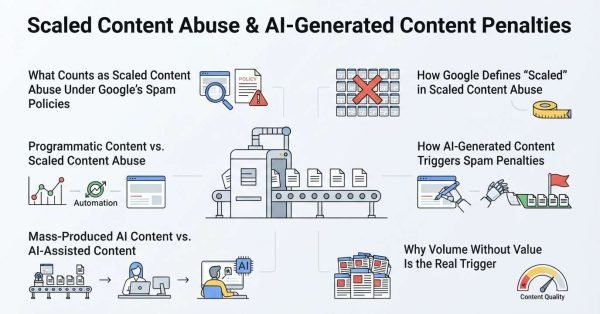
Scaled content abuse describes the practice of generating large volumes of pages, often through AI or automated templates, with the primary purpose of manipulating search rankings rather than serving genuine user need. Google added this specifically as an update to its spam policies in March 2024, closing a gap that automated content had been exploiting for years.
Programmatic content is not automatically abuse. The distinction sits entirely in whether the output adds unique value at scale or just repeats a template with swapped variables.
How the Helpful Content System and Core Updates Target This Content
The helpful content system evaluates content site-wide rather than page-by-page, meaning a critical mass of thin or unhelpful pages can suppress rankings even for a site’s genuinely strong content. This is the part that surprises most site owners the most. A useful blog post can lose rankings simply because it sits on a domain weighed down by hundreds of thin category pages.
Core updates work differently. They reassess relevance and quality signals broadly, and a site heavy on duplicate or scaled content often sees a correlated ranking drop during these rollouts, even without an explicit manual penalty being issued.

Site-Wide vs. Page-Level Penalties
A site-wide suppression affects the whole domain’s visibility, while a page-level issue only suppresses specific URLs or templates. Google has confirmed that helpful content signals apply sitewide, meaning individual page quality is evaluated in the context of the entire site’s content pattern.
I check both angles in every audit, because treating a site-wide problem as a page-level fix wastes weeks of effort.
Algorithmic vs. Manual Actions
Algorithmic suppression happens automatically through ranking systems with no notification, while a manual action is a direct penalty applied by a Google reviewer and shown in Search Console under the Manual Actions report. Manual actions for thin content or scaled content abuse require a reconsideration request after cleanup.
Most thin and duplicate content issues I encounter are algorithmic, not manual. That distinction changes the entire recovery path.
Warning Signs You Have a Thin or Duplicate Content Problem
The clearest warning sign is a broad, gradual decline in organic traffic across many pages at once rather than a single page losing rankings, often coinciding with a known core update or helpful content update rollout date. I look at this pattern first because it separates a content quality problem from a technical or backlink issue.
Isolated ranking drops on one or two pages point toward competition or relevance mismatches. Widespread, correlated drops point toward a systemic content quality problem.
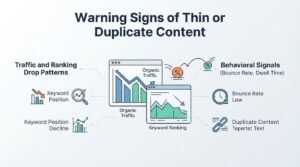
Traffic and Ranking Drop Patterns
A site hit by a thin or scaled content issue typically shows traffic decline across an entire content category or template type, not just random pages. An Ahrefs study tracking helpful content update impacts found that sites lost an average of 50% organic traffic within weeks of being flagged.
Cross-referencing the drop date against Google’s confirmed update rollout calendar is the fastest way to confirm the cause.
Behavioral Signals (Bounce Rate, Dwell Time)
Elevated bounce rates and short session durations on affected pages often precede or accompany ranking drops, since these behavioral patterns reflect the same low-value experience Google’s systems are trying to detect. These metrics will not confirm causation alone, but they corroborate a content quality diagnosis when paired with ranking data.
How to Diagnose Thin Content Using Google Search Console
Google Search Console’s Page Indexing report and Performance report together reveal which pages Google considers low-value, either through explicit exclusion reasons or through declining impressions despite stable rankings. This is where I start every audit, because it is free, first-party data straight from Google’s own crawlers.
Reading the Performance Report for Impact
The Performance report shows impressions and clicks trending down for specific URL groups, and filtering by page path or query pattern isolates whether the decline is template-wide or isolated. A sitewide decline visible here supports a content quality diagnosis over a technical one.
Using the Page Indexing Report for Exclusions
The “Crawled – currently not indexed” and “Discovered – currently not indexed” labels in the Page Indexing report are Google’s clearest signal that it has assessed a page as too thin or too similar to other content to justify indexing. A high volume of pages under these labels almost always maps directly to a thin or duplicate content problem.
How to Diagnose Duplicate Content Issues
Duplicate content diagnosis requires comparing page content directly, either through a crawling tool that flags near-identical text or through manual review of templated sections like product descriptions and category boilerplate. Screaming Frog, Sitebulb, and similar crawlers include built-in near-duplicate content detection that flags similarity percentages between URLs.
Internal Duplication (Templates, Boilerplate, Faceted Navigation)
Faceted navigation on ecommerce sites generates enormous numbers of near-identical URLs through filter and sort parameters, and this is one of the most common sources of internal duplication I find in audits. Boilerplate text repeated across service area pages or location pages creates the same problem at a smaller scale.
External/Syndicated Duplication
Content syndicated to partner sites or scraped without permission creates duplication that Google has to resolve by choosing a canonical version, and that chosen version is not always the original source. Monitoring for unauthorized republishing protects the original page’s ranking equity.
How to Identify Scaled Content Abuse (AI & Programmatic Content)
Scaled content abuse is identified by a pattern of many pages built from the same template with minimal unique substance per page, often published in unusually large batches over a short period. Publishing velocity is one of the strongest signals here. A site that suddenly adds thousands of pages in a matter of weeks draws scrutiny regardless of the content source.
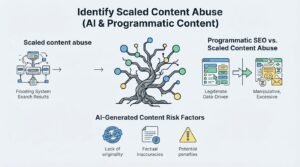
Programmatic SEO vs. Scaled Content Abuse
Programmatic SEO becomes abuse specifically when the output fails to add meaningful unique value per page, relying instead on variable substitution inside a fixed template. Legitimate programmatic pages, like real-time inventory listings with genuinely distinct data, are treated differently from templated pages with swapped city names and no additional substance.
AI-Generated Content Risk Factors
Google has stated it does not penalize AI-generated content specifically, but content produced primarily to manipulate rankings, AI or otherwise, falls under the scaled content abuse policy. The risk factor is publishing volume combined with low editorial oversight, not the generation method itself.
Content Audit Framework: Categorizing Pages by Performance
A content audit sorts every indexed page into one of four buckets: keep, improve, consolidate, or remove, based on traffic, backlinks, conversion value, and content uniqueness. I pull this data from Google Analytics, Search Console, and a crawl export into a single spreadsheet before making any decisions.
Keep, Improve, Consolidate, or Remove Criteria
Pages with steady traffic and unique value get kept as-is; pages with potential but weak execution get improved; pages covering overlapping topics get consolidated into one stronger page; and pages with no traffic, no backlinks, and no unique value get removed. This framework prevents the common mistake of deleting pages that quietly hold backlink equity.
Using Analytics Data to Score Pages
Assigning a simple numeric score based on twelve-month organic sessions, referring domains, and conversion events turns a subjective audit into a repeatable, prioritized action list. Pages scoring at the bottom across all three metrics are the safest candidates for removal or consolidation.
How to Fix Thin Content (Improve or Consolidate)
Fixing thin content means either substantially expanding a page’s unique value and depth or merging it with a stronger, related page and redirecting the old URL. The decision between these two paths depends entirely on whether the topic deserves its own page or was artificially split to target keyword variations.
Content Expansion vs. Merging Pages
Expansion works when a topic has genuine standalone search demand and room for original insight, examples, or data. Merging works when several thin pages target overlapping queries that a single comprehensive page could satisfy better.
Adding E-E-A-T Signals
Author bylines, credentials, original data, and clear sourcing all strengthen a page’s experience and expertise signals, which directly counter the “low value” characteristics that trigger thin content classification. A page rewritten with genuine first-hand insight reads differently to both users and Google’s quality systems than a generic rewrite.
How to Fix Duplicate Content (Canonicalization & Redirects)
Duplicate content gets resolved through canonical tags when the duplicate URLs need to stay accessible, or through 301 redirects when the duplicate page should be permanently retired in favor of one consolidated URL. Choosing the wrong method between these two is one of the most common technical SEO mistakes I see during recovery work.
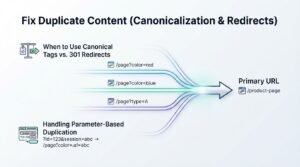
When to Use Canonical Tags vs. 301 Redirects
Canonical tags suit situations where duplicate URLs serve a functional purpose, like sort parameters a user might still visit directly, while 301 redirects suit situations where the duplicate page has no reason to exist independently anymore. Redirects pass more consolidated ranking signal than canonicals in most real-world cases.
Handling Parameter-Based Duplication
URL parameters from filtering, sorting, and session tracking create massive duplication at scale on larger sites, and configuring parameter handling alongside canonical tags prevents this from recurring after cleanup. Google Search Console’s URL Parameters tool has been deprecated, making canonical tags and robots.txt rules the primary control mechanisms now.
When and How to Deindex or Remove Low-Value Pages
Removing a low-value page from Google’s index requires either a noindex tag for pages that should stay live for users, complete deletion with a 404 or 410 status for pages with no ongoing purpose, or a 301 redirect when a closely related page can absorb the value. The right choice depends on whether the page still serves any functional or legal purpose on the site.
Noindex vs. Deletion vs. Redirect Decision Path
A page kept for internal navigation or compliance reasons but with no search value gets noindexed. A page with zero remaining purpose gets deleted outright. A page covering a topic another page already covers better gets redirected.
Using the URL Removal Tool for Emergency Cases
Google Search Console’s URL Removal tool temporarily hides a URL from search results within hours, which is useful for urgent situations but does not replace the permanent fix of noindexing, redirecting, or deleting the underlying page. It buys time, nothing more.
Recovery Timeline: What to Expect After Cleanup
Recovery from algorithmic thin or duplicate content suppression typically takes one to four months after cleanup, since Google’s systems need to recrawl, reassess, and refresh their quality signals for the affected pages during a subsequent core update or refresh cycle. This timeline frustrates a lot of site owners who expect immediate results after fixing the underlying problem.

Algorithmic Recovery Windows
Recovery from helpful content and core update suppressions is generally tied to the next major update rollout rather than happening continuously, since Google has confirmed these systems reassess sites periodically rather than in true real time. Cleanup completed between update cycles may sit unrewarded until the next rollout.
Manual Action Reconsideration Requests
A manual action for thin or scaled content requires submitting a reconsideration request through Search Console after cleanup, and Google’s own guidance states most requests are reviewed within a few weeks, though complex sites can take longer. The request should document exactly what was changed and why, page by page where feasible.
Preventing Future Thin, Duplicate & Scaled Content Penalties
Preventing future penalties requires publishing standards that set a minimum quality bar before content goes live, combined with regular audits that catch thin or duplicate patterns before they accumulate at scale. Waiting for another update to reveal a problem is far more costly than catching it during the editorial process.
Content Governance and Publishing Standards
A documented content brief process, mandatory originality checks, and a minimum threshold for unique value per page all reduce the chance of accidentally scaling thin content across a growing site. This matters most for sites publishing at high volume, like ecommerce catalogs or local service area pages.
Auditing Cadence and Monitoring Tools
Quarterly content audits using Search Console indexing data, combined with ongoing rank tracking, catch quality drift before it becomes a sitewide pattern. Sites growing quickly benefit from monthly checks rather than quarterly ones during periods of rapid content expansion.
Conclusion
Thin, duplicate, and scaled content penalties stem from the same root cause: pages that fail to deliver unique value at the volume Google now expects. Diagnosing the pattern early, through Search Console data and structured audits, determines how fast recovery happens.
Sustainable content growth depends on treating every new page as an investment in site-wide quality, not just an isolated ranking opportunity worth chasing alone.
We help businesses diagnose, clean up, and rebuild content quality signals that stick. Talk to White Label SEO Service about auditing your site today.
Frequently Asked Questions
How long does it take to recover from a thin content penalty?
Recovery typically takes one to four months after cleanup is complete. The exact timeline depends on Google’s update cycles and how thoroughly the underlying content issues were addressed.
Does Google penalize AI-generated content specifically?
No, Google does not penalize content simply because it was AI-generated. It penalizes content, AI or human-written, that was produced primarily to manipulate search rankings rather than help users.
What is the difference between thin content and duplicate content?
Thin content lacks sufficient depth or original value on its own. Duplicate content matches or closely mirrors text found elsewhere, whether on the same site or externally.
Can duplicate content get my whole site penalized?
Duplicate content itself rarely triggers a sitewide penalty directly. Google typically filters duplicates from its index, but excessive duplication can contribute to broader helpful content suppression.
How many thin pages does it take to trigger a helpful content issue?
There is no fixed number, since Google evaluates the overall proportion and pattern of low-value content across a site. A smaller site with many thin pages proportionally is at higher risk than a large site with the same raw count.
Should I delete or redirect thin content pages?
Redirect pages that overlap with stronger existing content, and delete pages with no traffic, backlinks, or consolidation opportunity. The choice depends on whether another page can genuinely absorb the removed page’s value.
Can I recover from a manual action for scaled content abuse?
Yes, recovery requires removing or substantially fixing the offending content and submitting a reconsideration request through Google Search Console. Most requests are reviewed within a few weeks, though complex cases take longer.